
Before Fusion Became a Formula
Weather Report did not begin as the sleek electric band most listeners associate with Heavy Weather, “Birdland” and Jaco Pastorius. When Joe Zawinul, Wayne Shorter and Miroslav Vitouš formed the group around 1970, their original idea was considerably more open and difficult to categorize. They were emerging from a period in which jazz itself seemed to be breaking apart and rebuilding its vocabulary. Electric instruments were becoming increasingly important, rock had changed expectations about volume and rhythm, free jazz had challenged conventional structure, and Miles Davis was creating studio recordings in which composition, improvisation and production could no longer be separated easily. Zawinul and Shorter had participated directly in that transformation, appearing on both In a Silent Way and Bitches Brew. Weather Report grew from the possibilities those sessions exposed, but it was never intended simply as another Miles Davis offshoot. Zawinul and Shorter wanted a band capable of developing its own musical logic.
The most useful phrase associated with the early Weather Report came from Zawinul himself: “We always solo and we never solo.” The paradox described an ensemble in which the traditional hierarchy between soloist and accompaniment could disappear. Instead of stating a theme, moving through individual solos and returning to the theme, the musicians could improvise collectively, with foreground and background changing constantly. Bass might momentarily become melodic. Percussion might redirect the entire group. Shorter’s soprano could emerge from a texture rather than stand above it. Zawinul could provide atmosphere instead of conventional chordal accompaniment. The band’s official history describes this first phase as an attempt to create more impressionistic and individualistic music, while its debut deliberately stretched conventional ideas about rhythm and harmony.
That philosophy matters because without it the later Weather Report can seem like a completely different band. It was not. The group gradually replaced collective freedom with increasingly sophisticated composition and groove, but its obsession with sound, interaction and ensemble identity remained.
Zawinul and Shorter Before Weather Report
The partnership between Zawinul and Shorter had roots extending well before the fusion era. They first encountered one another in Maynard Ferguson’s big band in 1959, then followed very different paths through the 1960s. Zawinul became an important member of Cannonball Adderley’s group and developed a reputation not only as a pianist but as a composer capable of writing memorable music without sacrificing harmonic sophistication. Shorter moved through Art Blakey’s Jazz Messengers before joining Miles Davis’s celebrated second quintet in 1964, where his compositions became essential to one of the most influential small groups in modern jazz.
By the end of the decade both musicians had reached a point where conventional acoustic jazz could no longer contain everything they were interested in doing. Zawinul was increasingly fascinated by electronic keyboards and new approaches to texture. Shorter had already demonstrated through his Blue Note albums that composition could be mysterious, asymmetrical and emotionally ambiguous without abandoning jazz improvisation.
Miles Davis provided the environment in which these instincts could encounter electricity on a larger scale.
But Weather Report was where Zawinul and Shorter could pursue them over years rather than sessions.
Miroslav Vitouš: The Third Founder
The original Weather Report story is often reduced to Zawinul and Shorter, with the bassist treated almost as an early member who happened to leave before the band’s most famous period. That dramatically understates Miroslav Vitouš.
The Czech-born bassist was a genuine founding partner. Classically trained and already experienced with musicians including Chick Corea, Stan Getz and Herbie Mann, Vitouš possessed the technical freedom required for Weather Report’s original conception. The bass did not need to remain at the bottom of the ensemble establishing roots and conventional time. Vitouš could move melodically, respond to Shorter and participate directly in collective improvisation. The band’s official history identifies him alongside Zawinul and Shorter in the formation of the group.
This early role explains why the transition that eventually pushed Vitouš out was so significant.
Weather Report did not simply change bass players.
It changed its idea of what the bass was supposed to do.
That transformation would eventually open the door first to Alphonso Johnson and then to Jaco Pastorius, but its origins can already be heard several years earlier.
The First Weather Report
Released in May 1971, the self-titled Weather Report sounds strikingly different from the group’s later commercial peak. Acoustic and electric instruments coexist without the production becoming dominated by synthesizers. Rhythm is fluid. Pieces can behave more like environments than conventional tunes. Shorter plays soprano saxophone throughout, while Vitouš often refuses the expected supporting role of a bassist.
The album’s opening, “Milky Way,” immediately announces that this will not be a standard fusion record driven by guitar riffs and backbeats. Zawinul and Shorter are concerned with atmosphere and sonic interaction. Elsewhere, compositions including “Orange Lady,” “Seventh Arrow,” “Tears” and “Eurydice” reveal how differently the three principal composers approached the same ensemble. The record is unified less by one compositional style than by the musicians’ willingness to allow each piece to determine its own structure.
This is an important correction to the way fusion is sometimes remembered. The genre did not begin simply when jazz musicians added electric instruments and rock rhythms. Early fusion included a much broader field of experiments. Weather Report’s first album belongs to the branch in which timbre and collective improvisation could be as important as amplified power.
There is electricity.
But there is remarkably little interest in sounding like a rock band.
The Rhythm Section Was Always Changing
One feature of Weather Report appeared almost immediately and would continue throughout the group’s history: instability in the rhythm section. Zawinul and Shorter remained the permanent axis, while bassists, drummers and percussionists changed repeatedly.
The debut included Alphonse Mouzon on drums and Airto Moreira among the percussionists. For the band’s first major touring period, Brazilian percussionist Dom Um Romão became an important member, while Eric Gravatt took over the drum chair. The resulting ensemble developed an extraordinarily forceful version of the band’s early collective approach.
This constant movement of personnel could have destroyed a less clearly conceived group. Instead, it became part of Weather Report’s evolution. Each rhythm section altered what Zawinul and Shorter could write.
The band did not replace musicians and continue unchanged.
It absorbed them.
Live in Tokyo: Weather Report Without a Safety Net
One of the best documents of the original conception is Live in Tokyo, recorded on January 13, 1972 during the group’s first Japanese tour. The performances are expansive, volatile and often far removed from the polished studio precision that would characterize later Weather Report. The original Japanese double album captured lengthy medleys and collective improvisations, with Gravatt and Dom Um Romão giving the group an enormous rhythmic range.
Here Zawinul’s statement about everyone soloing becomes audible rather than theoretical. There are moments when it is difficult to identify who is accompanying whom because the functions keep shifting. Shorter can disappear into the ensemble and return. Vitouš can challenge rather than support the harmonic direction. Percussion can become structural rather than decorative.
This early Weather Report was not interested in providing a predictable sequence of featured improvisers.
The ensemble itself was the improviser.
The Japanese concerts also demonstrated that highly exploratory electric jazz could attract an enthusiastic audience. Zawinul later recalled being surprised by the reception the group received in Japan, where audiences greeted the relatively new band with extraordinary attention.
The experience reinforced the idea that Weather Report could build an identity without simplifying its music.
At least for the moment.
I Sing the Body Electric
The second studio release, I Sing the Body Electric, appeared in 1972 and captured the band at an interesting transitional point. The first side consisted of new studio recordings, while the second used edited material from the Tokyo concert. It also marked the first Weather Report album to feature Dom Um Romão and Eric Gravatt as members.
The studio material expanded the palette considerably. Zawinul’s ARP 2600 synthesizer began appearing, an instrument that would eventually become fundamental to Weather Report’s identity. Guest musicians expanded the ensemble further, including Ralph Towner on twelve-string guitar and additional winds and voices.
This matters because Zawinul’s eventual dominance of synthesizer technology is sometimes viewed mainly through later albums. In reality, his experimentation with electronic sound was already becoming central while Weather Report remained highly improvisational.
He did not simply replace acoustic piano with synthesizer.
He began treating electronics as orchestration.
A synthesizer could create an environment around Shorter’s saxophone, imitate no conventional instrument at all or alter the apparent size of the ensemble.
That approach would become one of Weather Report’s most influential contributions to electric jazz.
Wayne Shorter’s Different Kind of Leadership
As Zawinul’s sonic personality became increasingly obvious, Wayne Shorter occupied a fascinating role. He was one of the most celebrated saxophonists and composers of his generation, yet Weather Report did not behave like a Wayne Shorter group.
Shorter often seemed comfortable allowing the band to move around him.
This restraint would become even more striking during the Jaco Pastorius years, when Zawinul and Jaco could dominate the sonic foreground. But Shorter’s refusal to compete constantly for attention should not be mistaken for absence. His compositions and his ability to enter an arrangement at precisely the right moment were essential to Weather Report’s character.
A conventional fusion band might build toward the saxophone solo.
Weather Report could allow the saxophone to appear almost as a dramatic event inside an already moving landscape.
Shorter understood the power of not playing.
That made his entrances matter.
The Problem With Total Freedom
The early collective philosophy was creatively fertile, but it contained a problem. If everyone could participate freely in shaping the music, how could Weather Report develop stronger rhythmic identities and more memorable compositions without restricting that freedom?
Zawinul increasingly wanted groove.
This did not mean abandoning improvisation. It meant establishing rhythmic foundations powerful enough to sustain longer structures. Funk had become impossible for jazz musicians to ignore, and Zawinul understood that repeated rhythm could generate possibilities rather than merely limit them.
That vision began to conflict with Vitouš’s conception of the bass.
Vitouš excelled at free, melodic interaction. Zawinul increasingly wanted bass figures capable of anchoring repeated grooves.
The disagreement was aesthetic before it became personnel-related.
And the decisive turning point arrived with Sweetnighter.
Sweetnighter: The Pivot
Released in 1973, Sweetnighter may be the most important transitional album in Weather Report’s history. The band’s own discography describes it explicitly as the moment when Weather Report began moving from an open improvisational style toward a more compositionally structured approach, with funk rhythms and electric bass becoming increasingly prominent. It was also the final Weather Report album on which Vitouš remained the principal bassist.
The change becomes obvious on “Boogie Woogie Waltz.”
The piece is long, but its length no longer comes primarily from free collective exploration. A repeating rhythmic conception creates the foundation. Musicians can improvise, but the groove remains a gravitational center.
“125th Street Congress” pushes the transformation even further. Its rhythmic emphasis would later make it attractive to DJs and hip-hop producers, an afterlife that reveals just how far Weather Report had moved from the atmospheric abstraction of the debut. The band’s official history specifically notes that the funk-oriented tracks from Sweetnighter would later attract sampling culture.
The crucial development was not simply that Weather Report had become funkier.
The relationship between freedom and repetition had changed.
When the Bass Became the Argument
To achieve the heavier rhythmic conception Zawinul wanted, Weather Report used additional electric bassists on parts of Sweetnighter. This was more than a production choice. It exposed the growing disagreement over the band’s future. Contemporary histories of the album note that outside funk bass was brought in for tracks where Zawinul wanted a stronger groove, foreshadowing Vitouš’s departure.
The irony is that Vitouš had been ideal for the original Weather Report.
The band changed around him.
His departure therefore should not be interpreted simply as replacing an inadequate bassist with a better one. Weather Report needed a different function from the instrument.
This distinction becomes crucial when discussing Jaco Pastorius later. Jaco did not simply arrive as a virtuoso who revolutionized the band from nowhere. Weather Report had been redefining the role of electric bass for several years before he entered.
The road toward Jaco begins with Sweetnighter.
But it passes through someone else first.
Alphonso Johnson
For Mysterious Traveller in 1974, Alphonso Johnson emerged as the bassist capable of carrying Weather Report into its next phase. His electric bass could provide the stronger rhythmic foundation Zawinul increasingly wanted while retaining enough flexibility for the band’s jazz vocabulary. The album also found Zawinul expanding his synthesizer language, with the ARP becoming increasingly important to the group’s orchestral identity.
Mysterious Traveller is where the Weather Report recognized by many later listeners begins to come clearly into focus.
The music remains adventurous.
But the structures are stronger.
The grooves are deeper.
The electronics are more integrated.
And the compositions increasingly possess identities that survive beyond the improvisation surrounding them.
Tracks such as “Nubian Sundance,” “Cucumber Slumber,” “Mysterious Traveller” and “Scarlet Woman” demonstrate a band learning how to preserve exploration while giving listeners more rhythmic and melodic anchors.
Weather Report was becoming more accessible.
It was not becoming simpler.
Toward Black Market
By Tale Spinnin’ in 1975, the transformation was well underway. Zawinul’s keyboards had become increasingly orchestral, Shorter’s saxophone operated inside more carefully defined compositions, and Alphonso Johnson gave the music an electric foundation very different from Vitouš’s early acoustic freedom. The group had traveled an enormous distance in only four years. Its official discography runs directly from the exploratory 1971 debut through Sweetnighter, Mysterious Traveller and Tale Spinnin’ before reaching Black Market in 1976.
And then the personnel changed again.
During the making of Black Market, a young bassist entered Weather Report who would become so closely associated with the band that he would eventually distort popular memory of everything that came before him.
Jaco Pastorius did not create Weather Report.
He joined a great band that had already spent five years reinventing itself.
But once he arrived, the possibilities changed again.
The electric bass could now provide groove, melody, harmony, harmonics and an almost vocal lead presence inside the same arrangement. Zawinul immediately recognized that this was not merely another rhythm-section replacement.
Weather Report was approaching the lineup that would make it internationally famous.
And Black Market would become the bridge.
Buy Amazon
Jaco Pastorius Arrives
By the time Jaco Pastorius entered Weather Report, the band had already spent five years changing the definition of its own music. The open collective improvisation of the 1971 debut had gradually given way to stronger compositions, funk-derived rhythm, increasingly sophisticated synthesizer orchestration and a more prominent role for electric bass. Miroslav Vitouš had been essential to the original conception, and Alphonso Johnson had helped carry the group toward the muscular sound of Mysterious Traveller and Tale Spinnin’. Jaco therefore did not arrive to solve a band that lacked direction. He arrived at precisely the moment when Joe Zawinul’s evolving conception demanded a bassist capable of doing several apparently contradictory things at once: anchor a groove, improvise like a jazz musician, provide melodic counterpoint, create unusual timbres and occupy enough sonic territory to function almost as another lead instrument.
Pastorius believed he was that musician. His confidence was already legendary. The often-repeated story of his introduction to Zawinul captures something essential about his personality: he approached one of the most respected keyboardists in jazz with the conviction that he was the greatest bass player in the world. Whether heard as arrogance or extraordinary self-knowledge, the claim was consistent with the musician who would soon appear on Weather Report records. Jaco did not play electric bass as though apologizing for its traditional supporting role. He heard the fretless instrument as an independent voice, capable of singing, producing artificial harmonics, creating chords and moving across the ensemble with the freedom of a horn.
Weather Report was ready for that idea.
Black Market: The Bridge
Black Market, released in 1976, documents the transition. Alphonso Johnson remained important to the album, but Jaco appeared on two pieces, including Zawinul’s “Cannon Ball” and his own composition “Barbary Coast.” The result allows listeners to hear Weather Report changing bass identities almost in real time.
“Cannon Ball,” dedicated to Zawinul’s former employer Cannonball Adderley, demonstrates immediately why Jaco’s tone mattered. The fretless bass does not simply provide low-frequency foundation. It has a vocal quality. Notes slide and bloom, interacting with Zawinul’s keyboards in a register that makes the bass unusually visible without destroying the groove.
“Barbary Coast” goes further because Jaco arrives not only as instrumentalist but as composer. Its bass figure establishes the track’s identity from the beginning, but the piece is not merely a bass showcase. The groove creates a framework into which the entire band can enter.
That distinction would become important throughout Jaco’s Weather Report years.
His virtuosity attracted attention.
His best contribution was compositional.
Why Jaco Changed the Ensemble
Much of the mythology surrounding Jaco focuses on technique: fretless intonation, harmonics, speed, chords and the singing quality of his tone. All of those innovations matter, but Weather Report benefited from something broader.
Jaco understood arrangement.
A bassist who constantly demonstrates virtuosity can destroy a band by occupying too much space. Jaco certainly had moments of excess, particularly as his stage persona grew, but on the great Weather Report recordings he frequently understood how to make an unusual bass sound serve a composition.
His instrument could become a melodic partner for Shorter.
It could reinforce Zawinul’s synthesizer bass ideas.
It could establish a funk groove.
It could disappear beneath the arrangement and then suddenly emerge.
This flexibility gave Zawinul new compositional possibilities. Weather Report no longer had to choose between a bass that anchored the rhythm and one that interacted freely.
Jaco could do both.
Sometimes within the same phrase.
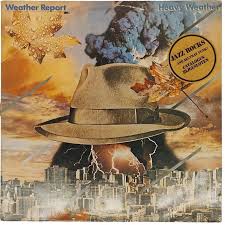
Heavy Weather
The transformation reached its most famous expression with Heavy Weather in 1977. By this point, Jaco was fully integrated into the band, and the album featured a changing percussion and drum lineup that included Alex Acuña and Manolo Badrena alongside the core of Zawinul, Shorter and Pastorius.
The album became Weather Report’s commercial breakthrough and remains one of the most widely recognized records in jazz fusion. But its success can obscure how strange the achievement actually was. This was still instrumental music created by musicians with deep jazz backgrounds. There was no conventional pop singer at the center, no attempt to simplify the group into a rock-band format, and no abandonment of improvisation.
What changed was the band’s ability to make complexity memorable.
That is a different accomplishment from making complexity disappear.
“Birdland”
Nothing demonstrates this better than “Birdland.”
Zawinul’s composition became Weather Report’s signature piece and eventually one of the most recognizable instrumental themes associated with jazz fusion. The title referred to the famous New York jazz club named after Charlie Parker, connecting the music’s contemporary electric sound to the jazz world from which Zawinul had emerged.
The brilliance of “Birdland” lies partly in its accessibility. The opening synthesizer figure is immediately identifiable. The melody can be remembered after a single hearing. The groove is strong enough to communicate physically even to listeners with little interest in harmonic analysis.
Yet the arrangement contains enormous sophistication.
Different keyboard colors enter and leave.
Bass functions change.
Shorter’s saxophone is integrated into the ensemble rather than simply placed above it for a conventional solo.
Percussion adds movement without clutter.
Themes appear in layers.
“Birdland” became popular because the musicians discovered how to concentrate their complexity into musical gestures listeners could retain.
The record does not ask the audience to admire difficulty.
It invites them inside.
The Importance of Joe Zawinul
Jaco’s arrival can easily dominate the narrative of Heavy Weather, but the album confirms that Joe Zawinul had become Weather Report’s principal sonic architect. His synthesizer work had progressed dramatically since the tentative electronic textures of the early records.
By 1977, Zawinul was effectively orchestrating through keyboards.
He could create bass-like sounds, sustained harmonic environments, sharp rhythmic figures and colors that had no obvious acoustic equivalent. Rather than treating the synthesizer as an electric piano with more settings, he explored its ability to expand the apparent size and identity of the band.
This became one of Weather Report’s most influential innovations.
Later keyboardists in jazz, funk, electronic music and popular production would increasingly think of synthesizers not simply as instruments but as sound-design environments.
Zawinul was doing this while retaining an improviser’s instincts.
Technology served composition.
The machine did not replace interaction.
Wayne Shorter in the Age of Synthesizers
Shorter’s position became even more unusual as Weather Report grew sonically larger. A less confident saxophonist might have responded by playing more aggressively to compete with the keyboards and Jaco’s increasingly prominent bass.
Shorter often did the opposite.
His appearances could be brief, carefully placed and extraordinarily effective. He understood that the saxophone did not need to dominate every piece simply because one of jazz’s greatest saxophonists was standing onstage.
This restraint is part of Weather Report’s mature identity.
Shorter could enter after an extended electronic passage and immediately humanize the texture. His soprano or tenor did not have to demonstrate technical superiority over the arrangement.
A few notes could change its temperature.
In a band increasingly famous for virtuosity, Shorter became the master of omission.
“A Remark You Made”
Zawinul’s “A Remark You Made” provides perhaps the clearest example of this balance. The composition was written with Jaco’s singing fretless tone in mind, and the bass becomes almost another melodic instrument.
The piece demonstrates why reducing Weather Report to “fast fusion” is so misleading. There is patience here. Long tones matter. Harmony unfolds gradually. Jaco’s bass can occupy emotional territory usually assigned to a horn or voice.
Shorter’s tenor responds with similar restraint.
Zawinul provides the harmonic environment.
The result is not a contest between virtuosos.
It is an ensemble listening carefully to timbre.
That sensitivity had existed in Weather Report from the beginning.
The instruments had changed.
The principle had not.
“Teen Town”
Then comes the opposite side of Jaco’s personality.
“Teen Town,” his composition on Heavy Weather, turns electric bass into both rhythmic engine and principal melodic voice. The famous bass line is not merely accompaniment to the tune.
It largely is the tune.
The track demonstrates how radically Jaco could reinterpret the instrument’s role while still functioning inside an ensemble. His lines possess extraordinary articulation and rhythmic precision, but the musical impact comes from the fact that they organize the composition.
This distinction matters because generations of bassists would later imitate Jaco’s technique.
Harmonics could be copied.
Fretless tone could be copied.
Fast passages could be practiced.
More difficult to reproduce was his ability to make a bass-centered idea function as a compelling piece of music.
Technique became influential.
Composition made the technique meaningful.
“Havona”
The album closes with Jaco’s “Havona,” another demonstration that his significance inside Weather Report extended beyond instrumental virtuosity. The composition provides a sophisticated harmonic environment while allowing the bassist enormous expressive freedom.
Here the relationship between jazz tradition and fusion becomes especially clear. Beneath the electric sound, the musicians are still engaged with harmonic movement, improvisational development and interaction.
Fusion did not eliminate jazz.
At its best, it changed the conditions under which jazz improvisation could occur.
Heavy Weather became successful partly because Weather Report learned how to make those conditions emotionally immediate.
Commercial Success Without Becoming a Pop Band
The popularity of Heavy Weather created a new situation. Weather Report had become one of the few jazz-derived instrumental groups capable of reaching a genuinely broad audience.
That success brought opportunities and dangers.
Larger venues meant greater visibility.
Jaco’s charisma gave the group a recognizable stage personality.
“Birdland” reached listeners who might never have purchased an experimental jazz album.
But increased popularity also encouraged a simplified narrative: Weather Report as a virtuoso fusion supergroup centered on Zawinul and Jaco.
The reality remained more complicated.
Shorter was still essential.
The rhythm section continued changing.
And Zawinul was still searching for new ways to organize the band.
Weather Report had no interest in making Heavy Weather repeatedly.
Mr. Gone
The next studio album, Mr. Gone, appeared in 1978 and became one of the most controversial records in the group’s catalog. Zawinul pushed studio production and synthesizers further, and the album’s treatment of drums became a major point of debate.
The infamous one-star review in DownBeat has become part of Weather Report mythology. The criticism reflected broader anxieties surrounding fusion: had electronic production become too dominant? Was studio construction replacing genuine jazz interaction? Had commercial success pulled Weather Report away from improvisation?
Whatever one thinks of the album, Mr. Gone is important because it exposes the contradictions of late-1970s fusion.
Technology was expanding what musicians could create.
It was also forcing jazz criticism to reconsider what counted as performance.
Weather Report existed directly inside that argument.
Peter Erskine
One solution to the band’s rhythmic future arrived through Peter Erskine, who joined Weather Report during this period and would become one of its most important drummers.
Erskine offered a particularly useful combination. He could play with the power required for large concert venues, but his jazz instincts allowed him to respond dynamically rather than simply reinforce a fixed groove.
The chemistry between Erskine and Jaco became especially important.
Jaco could move aggressively around the beat because Erskine provided enough structural clarity to keep the music grounded. Erskine, meanwhile, could respond to Jaco’s rhythmic provocations without turning every passage into competition.
Weather Report had found another rhythm section capable of changing its identity.
8:30
The live album 8:30, released in 1979, captured Weather Report at extraordinary stage power. By this point, Jaco had become a major attraction in his own right, and the group could move between tightly organized compositions and extended performance energy.
The live setting also reveals how much Weather Report had changed since Tokyo in 1972.
The early band could dissolve into collective improvisation.
The late-1970s band often worked from much stronger compositional identities.
But neither approach was inherently less adventurous.
The location of the adventure had changed.
In 1972, uncertainty often concerned where the piece itself might go.
By 1979, uncertainty could occur inside highly defined compositions through interaction, dynamics, solos and rhythmic variation.
The frame had become stronger.
The musicians remained free inside it.
Night Passage
With Night Passage in 1980, Weather Report responded to some of the studio density of Mr. Gone by emphasizing more direct ensemble performance. The record includes Zawinul’s title composition, Shorter’s writing and Jaco’s extraordinary “Three Views of a Secret,” one of his most enduring compositions.
“Three Views of a Secret” again demonstrates why Jaco’s compositional legacy matters as much as his bass playing. The piece is lyrical without becoming sentimental, harmonically rich without turning academic and spacious enough for the ensemble to shape its emotional trajectory.
Weather Report at this point contained three remarkable composers.
Zawinul.
Shorter.
Pastorius.
That abundance was one of the band’s greatest strengths.
It also made long-term balance increasingly difficult.
Weather Report Again
The group released another self-titled album in 1982, more than a decade after its debut. The identical title unintentionally invites comparison.
The first Weather Report had been built around collective improvisation and an almost anti-hierarchical conception of ensemble roles.
The second came from a band that had passed through funk, synthesizer orchestration, international success and the emergence of one of the most influential electric bassists in history.
Yet there remained continuity.
Both albums were interested in sound.
Both resisted conventional jazz instrumentation.
Both treated composition as something flexible enough to be transformed by the musicians.
Weather Report had not abandoned its original identity.
It had spent eleven years arguing with it.
Jaco Leaves
By the early 1980s, however, Jaco’s relationship with Weather Report was reaching its end. His ambitions were expanding, his solo career had developed, and the personal difficulties that would later become inseparable from his tragic biography were increasingly affecting his professional life.
His departure closed the band’s most famous chapter.
But it did not close Weather Report.
This distinction matters because popular histories sometimes treat everything after Jaco as an epilogue. Zawinul and Shorter did not.
They rebuilt again.
Just as they had after Vitouš.
Just as they had after Alphonso Johnson.
The next incarnation would bring Victor Bailey, Omar Hakim and José Rossy, giving Weather Report a younger and different rhythmic identity.
The challenge was enormous.
How does a band replace someone considered irreplaceable without becoming a tribute to its own past?
Weather Report’s answer was characteristically unsentimental:
Change the band again.
Weather Report After Jaco
The departure of Jaco Pastorius could easily have ended Weather Report. By the early 1980s, Jaco had become so closely identified with the band that many listeners regarded his fretless bass as an essential component of its sound. His stage presence had also given Weather Report something it had never possessed in quite the same way before: a charismatic performer whose physical energy could communicate immediately in large venues. Yet ending the story with Jaco would misunderstand the principle that had governed Weather Report since 1971. The rhythm section had always changed. Miroslav Vitouš, Alphonso Johnson and Pastorius represented different solutions to different versions of the band, while Joe Zawinul and Wayne Shorter remained the central partnership. When Jaco left, they did what they had repeatedly done before. They rebuilt the ensemble around musicians capable of creating another identity.
The new lineup introduced bassist Victor Bailey, drummer Omar Hakim and percussionist José Rossy. None was asked simply to imitate the musicians who had preceded him. Bailey faced the most impossible comparison, because following Pastorius on electric bass meant entering a position whose previous occupant had transformed the instrument. His response was intelligent: he retained the technical sophistication required by Weather Report while developing a rounder, more grounded electric sound. Hakim brought remarkable precision and power, while Rossy helped preserve the layered percussion that had remained fundamental to Weather Report from its earliest years. The result was not the Jaco band without Jaco. It was another Weather Report.
Procession: Rebuilding the Rhythm Section
Procession, released in 1983, introduced this new configuration and immediately demonstrated that Weather Report intended to move forward rather than reproduce Heavy Weather. The album retains Zawinul’s increasingly sophisticated electronic orchestration, but the new rhythm section gives the music a different physical character. Bailey’s bass is less likely to demand the foreground than Jaco’s, allowing the low end to function differently inside Zawinul’s expanding keyboard textures. Hakim can move between tightly articulated funk, jazz flexibility and the precision increasingly demanded by 1980s production.
The title track is particularly revealing because it builds through accumulation. Weather Report had always understood that percussion could organize form, but by this stage Zawinul could combine live rhythm with electronic color in increasingly elaborate ways. The band sounds larger than the number of musicians actually present.
This had been one of his ambitions from the beginning.
Synthesizers were becoming an orchestra.
The difference was that by the early 1980s, the technology was finally catching up with his imagination.
Victor Bailey and the Problem of Following Jaco
Bailey deserves more recognition in Weather Report’s history precisely because his position was so difficult. Any bassist following Jaco Pastorius would inevitably be judged by comparison, and imitation would have guaranteed failure.
Bailey instead brought his own strengths: a deep groove, technical clarity and an ability to operate inside increasingly dense arrangements without constantly forcing the bass into the lead.
This changed the balance of Weather Report.
During the Jaco years, listeners could sometimes hear the band as a triangle of dominant personalities: Zawinul, Shorter and Pastorius. With Bailey, the center shifted more decisively toward Zawinul’s compositional and electronic conception.
That was not necessarily a decline.
It was another redistribution of responsibility.
Weather Report had always been shaped partly by what its bassist made possible. Vitouš encouraged collective freedom. Alphonso Johnson helped establish stronger electric grooves. Jaco expanded the bass into melodic and compositional territory. Bailey provided a foundation suited to Zawinul’s increasingly elaborate electronic architecture.
Four bassists.
Four versions of the band.
Omar Hakim and Precision Without Rigidity
Omar Hakim was equally important. Weather Report required a drummer capable of navigating arrangements that were becoming more precise without reducing them to programmed structures. Hakim possessed exactly that combination of technical control and responsiveness.
His playing represents another stage in the evolution of fusion drumming. The explosive looseness of the early 1970s was giving way to a period in which studio precision, electronic instruments and increasingly detailed arrangements demanded extraordinary accuracy.
Yet Hakim could still swing.
He could still react.
He could make complex rhythmic material feel physical rather than calculated.
This balance allowed Weather Report to enter the production world of the 1980s without completely losing the ensemble interaction that had defined its beginnings.
Domino Theory
Domino Theory followed in 1984, continuing the new lineup’s development. By this point, Weather Report was operating in a musical environment very different from the one that had produced its debut thirteen years earlier. Synthesizers had become common throughout popular music. Fusion itself was no longer revolutionary simply because it was electric. Digital technology was changing studios, drum machines were becoming increasingly important, and a new generation had grown up hearing the innovations Weather Report had helped normalize.
That created a new challenge.
How does an experimental band continue sounding experimental after the world adopts its tools?
Zawinul’s answer was to go deeper into composition, orchestration and rhythm rather than simply accumulate newer equipment. Technology remained important, but the objective was still to create an identifiable musical environment.
This distinction separates Weather Report’s strongest electronic music from technology demonstrations.
The equipment changed constantly.
The search for identity did not.
Wayne Shorter and the Increasing Distance
During these final years, however, the balance between Zawinul and Wayne Shorter was changing. Zawinul had increasingly become the dominant architect of Weather Report’s sound, while Shorter’s compositional presence was less central than it had been during earlier periods.
This development should not be reduced to a simple conflict between two founders. Their partnership had lasted remarkably long considering how different their musical personalities were. Zawinul was increasingly fascinated by rhythm, synthesizer orchestration and large sonic environments. Shorter remained a uniquely economical improviser and composer whose interests would eventually lead him toward other projects.
The difference had always been productive.
Eventually it became a reason to move apart.
By the middle of the 1980s, both musicians had substantial musical futures waiting beyond Weather Report.
Sportin’ Life
The 1985 album Sportin’ Life illustrates how far Weather Report had traveled. Voices became more prominent within the textures, with guest contributions expanding the sonic palette. Yet the group still resisted becoming a conventional vocal band.
Human voices could function as instrumental color.
This connects surprisingly well with Weather Report’s earliest experiments, when texture often mattered more than conventional song form. The technology had changed dramatically, but the underlying curiosity remained recognizable.
Zawinul continued asking the same broad question:
What sounds can belong inside a jazz-derived ensemble?
The answer had expanded enormously since 1971.
This Is This!
The final Weather Report studio album, This Is This!, appeared in 1986. By then, the partnership had effectively reached its conclusion. Carlos Santana appeared as a guest, adding another connection to the wider history of jazz-rock and Latin-inflected electric music.
The album is rarely considered the group’s defining statement, and it does not need to be. Final albums often receive an unfair burden: listeners expect them to summarize an entire career or provide some sense of deliberate closure.
Weather Report did not end with that kind of monument.
It simply reached the point where Zawinul and Shorter needed to continue elsewhere.
After roughly fifteen years, one of the longest and most important partnerships in electric jazz was over.
What Zawinul Did Next
For Joe Zawinul, the end of Weather Report did not mean retreat from the ideas he had developed within it. His later Zawinul Syndicate extended his interest in international rhythm, electronic sound and musicians drawn from different musical traditions.
This makes Weather Report easier to understand retrospectively.
Zawinul had never been interested merely in “fusion” as a combination of jazz and rock. His imagination was broader. African rhythms, Caribbean percussion, European musical experience, American jazz, funk and electronic technology could all exist inside his conception.
Weather Report was the laboratory in which many of these ideas developed.
The Zawinul Syndicate allowed them to continue after the original partnership ended.
What Shorter Did Next
Wayne Shorter’s post-Weather Report career followed another trajectory. He continued exploring electric music for a period before eventually returning with renewed intensity to acoustic jazz, particularly through the extraordinary quartet he formed with Danilo Pérez, John Patitucci and Brian Blade around the turn of the millennium.
That later quartet became famous for precisely the kind of collective freedom that had fascinated Weather Report at its beginning.
The connection is striking.
The instrumentation was different.
The acoustic environment was different.
The musicians belonged to another generation.
But the idea that accompaniment and solo could become fluid remained.
Shorter had spent decades exploring how musicians might escape rigid ensemble roles.
Weather Report was one chapter of that larger investigation.
Weather Report Was Never One Band
The easiest way to misunderstand Weather Report is to search for a definitive lineup.
For many listeners, it is:
Joe Zawinul — Wayne Shorter — Jaco Pastorius — Peter Erskine.
That lineup was extraordinary.
It was not Weather Report in its entirety.
The early band with Miroslav Vitouš explored forms of collective improvisation the later group rarely attempted in the same way. Alphonso Johnson helped create the transition toward stronger funk and electric rhythm. Alex Acuña and Manolo Badrena contributed significantly to the rhythmic identity surrounding Heavy Weather. Peter Erskine helped create one of the great live versions of the group. Victor Bailey, Omar Hakim and José Rossy made another phase possible after Jaco.
Weather Report should therefore be understood less as a fixed lineup than as an evolving system organized around Zawinul and Shorter.
Personnel changes were not interruptions to its history.
They were the mechanism of its development.
The Bass Revolution
The band’s influence on electric bass alone would be enough to secure its historical importance.
Vitouš demonstrated that bass could remain highly interactive inside electric jazz.
Alphonso Johnson brought a powerful modern electric foundation.
Then Jaco changed expectations almost completely.
After Pastorius, electric bassists had to confront new possibilities whether they wanted to imitate him or deliberately avoid doing so. Fretless tone, harmonics, melodic independence, chordal playing and the idea of bass as a compositional voice entered mainstream vocabulary with new force.
But Jaco’s greatest lesson is frequently misunderstood.
Playing more notes was not the revolution.
Expanding what the instrument could mean inside an arrangement was.
That is why “Teen Town” matters more than any isolated display of speed.
The Synthesizer Revolution
Zawinul’s influence is equally profound.
Before synthesizers became standard components of studios and popular music, he was already exploring how electronic keyboards could create sounds without acoustic equivalents. Over the course of Weather Report’s career, his role evolved from electric pianist to something closer to an orchestral designer.
This altered the possibilities of the small ensemble.
A band no longer needed ten instrumentalists to create enormous layers of color.
A keyboardist could manipulate register, sustain, attack and timbre to build an environment around acoustic instruments.
Yet Zawinul’s best work never forgot rhythm.
The synthesizer was not floating above the groove.
It was part of it.
That relationship between electronic texture and physical rhythm would become fundamental to countless forms of music after Weather Report.
The Percussion Story
Weather Report’s percussionists deserve equal attention because the band’s rhythmic language was never simply a relationship between bassist and drummer. From Airto Moreira and Dom Um Romão through Alyrio Lima, Manolo Badrena, Alex Acuña, Robert Thomas Jr. and José Rossy, percussion helped define the ensemble’s changing identity.
This is another reason Weather Report never sounded like a conventional rock fusion band.
Rhythm was layered.
Different instruments could occupy overlapping but distinct functions, creating motion that could not be reduced to a drum-set backbeat.
Zawinul’s interest in global rhythm expanded throughout his career, and Weather Report became one of the major spaces in which that curiosity developed.
The result influenced not only jazz fusion but later world-jazz approaches and rhythm-centered instrumental music.
Beyond the Word “Fusion”
The label jazz fusion remains useful, but Weather Report exposes its limitations.
What exactly was being fused?
Jazz and rock certainly interacted, but that description barely explains the band’s music. Funk became fundamental. Afro-Caribbean and Brazilian percussion shaped rhythm. Electronic technology transformed orchestration. European compositional sensibilities entered through Zawinul and Vitouš. Shorter’s background connected the group directly to hard bop and post-bop experimentation.
Weather Report did not combine two genres.
It operated inside a network.
This may explain why its best recordings have aged differently from fusion built primarily around virtuosic instrumental competition. The band’s central concern was not proving how difficult the music was to play.
It was constructing a world of sound.
Where to Begin
For a listener approaching Weather Report today, starting exclusively with Heavy Weather gives an incomplete picture.
Begin there if necessary. “Birdland,” “A Remark You Made,” “Teen Town” and “Havona” demonstrate why the album became canonical.
Then go backward.
Hear Black Market to understand Jaco’s arrival.
Continue to Mysterious Traveller and Sweetnighter to discover that the band’s rhythmic transformation began before him.
Then reach the 1971 debut.
The contrast can be startling.
After that, listen to Live in Tokyo and hear just how open the original conception could become.
Finally move forward again through 8:30, Night Passage and Procession.
Weather Report makes more sense when heard as evolution rather than a ranking of albums.
The Real Importance of Heavy Weather
This perspective also allows Heavy Weather to reclaim its importance without allowing it to swallow the rest of the story.
The album is great precisely because it represents one solution to a problem Weather Report had been exploring for years:
How can sophisticated improvisational music communicate immediately?
“Birdland” answered with melody.
“Teen Town” answered with rhythm.
“A Remark You Made” answered with sound and restraint.
“Havona” answered with composition and virtuosity.
The album did not simplify Weather Report.
It concentrated it.
That is why its popularity should not be treated as an embarrassment or an accidental commercial detour.
Accessibility was another form of sophistication.
Final Thoughts: We Always Solo and We Never Solo
Return to Zawinul’s early description:
“We always solo and we never solo.”
At first, the phrase described Weather Report’s collective improvisation. But it also works as a description of the band’s entire history.
Individual personalities were enormous.
Zawinul could dominate a sonic landscape.
Shorter could change a composition with a handful of notes.
Jaco could make bass impossible to ignore.
Erskine could transform the rhythmic feel of an entire performance.
Yet Weather Report’s greatest recordings never reduce comfortably to any one of them.
Remove Zawinul and the architecture disappears.
Remove Shorter and much of the mystery disappears.
Remove the changing bassists, drummers and percussionists and the band’s evolution becomes impossible.
Weather Report lasted because it was not a monument.
It was a process.
From the open spaces of Weather Report in 1971 to the funk transformation of Sweetnighter, the orchestral electronics of Mysterious Traveller, the transition of Black Market, the extraordinary balance of Heavy Weather, the live power of 8:30 and the final reinventions of the 1980s, the band repeatedly refused to remain what it had already become.
That is the larger legacy.
Weather Report did not simply help define jazz fusion.
It demonstrated that an electric jazz band could change personnel, technology, rhythm, composition and even its basic philosophy without surrendering its identity.
The weather kept changing.
The report remained unmistakable.