A Trumpet Voice Born Behind the Iron Curtain
There are trumpet players whose identity is established through velocity, range or technical spectacle. Tomasz Stańko followed another path. A few notes can be enough to recognize him: a rough-edged attack, a tone that seems simultaneously fragile and resistant, phrases that frequently leave as much meaning in the space between notes as in the notes themselves. That sound eventually became closely associated with ECM Records and with a broader idea of European jazz, but Stańko’s musical identity was formed long before the atmospheric recordings that brought him an international audience late in his career. It emerged in postwar Poland, where jazz carried meanings that extended beyond musical style. For a young musician growing up under communism, jazz offered access to an artistic world that felt open, unpredictable and connected to somewhere beyond the country’s political borders. Stańko would eventually absorb American jazz deeply, but his goal was never simply to reproduce it. His career became a long process of discovering what jazz could sound like when filtered through his own geography, history and temperament.
Rzeszów, Kraków and the Discovery of Jazz
Tomasz Stańko was born in Rzeszów, Poland, on July 11, 1942. His formal musical education began during childhood, first with violin and later trumpet, and he eventually studied trumpet at the Academy of Music in Kraków, graduating in 1969. But formal education explains only part of his development. Jazz arrived differently. One important moment came in 1958, when Stańko attended a concert by Dave Brubeck in Kraków during Brubeck’s celebrated tour of Poland. Stańko was sixteen, and the event belonged to a period when jazz in Eastern Europe carried cultural associations with freedom and the West that went far beyond the music itself. For Stańko, this was not simply the discovery of another musical genre. Improvisation suggested uncertainty and individual freedom; a musician could learn a language thoroughly and then challenge its rules. That combination would remain fundamental throughout his career.
Like many trumpet players of his generation, Stańko absorbed Miles Davis. The attraction is understandable: Davis had demonstrated that trumpet authority did not depend on volume or technical excess, and that a sparse phrase could carry enormous emotional weight. But Stańko’s development cannot be explained through Miles alone. The arrival of Ornette Coleman and free jazz was equally important. Coleman’s music proposed that improvisation could move beyond familiar harmonic structures while remaining emotionally direct. For musicians in Europe, this opened possibilities larger than simply learning another American style. Free jazz suggested that the language itself was available for reconstruction, and Stańko understood that possibility early.
Jazz Darings and the First Steps Toward Freedom
In 1962, Stańko helped form Jazz Darings, an ensemble generally regarded as one of Poland’s earliest groups to engage seriously with free jazz. The group included musicians such as bassist Jacek Ostaszewski and pianist Adam Makowicz. The significance of Jazz Darings is not that the group had already discovered the mature Tomasz Stańko sound—it had not—but that Stańko, still extremely young, was already interested in music that treated improvisation as something more radical than decorating chord changes. That impulse would survive every later transformation in his career. Even his most lyrical ECM recordings contain an element of uncertainty: the phrase may be beautiful, but it rarely feels completely safe.
The political and cultural environment surrounding these experiments should not be exaggerated into a simple story of jazz as rebellion against communism, yet it cannot be ignored either. Jazz offered Polish musicians contact with a musical tradition whose values included individuality, spontaneity and improvisational freedom. At the same time, Polish musicians were beginning to develop their own approaches rather than treating American recordings merely as templates. Stańko belonged to a generation for whom learning jazz increasingly meant discovering how much of themselves they could place inside it.
Krzysztof Komeda and the Formation of a European Voice
The decisive early relationship was with Krzysztof Komeda. Stańko joined Komeda’s group in the early 1960s and remained closely associated with him during a crucial period in the development of modern Polish jazz. Komeda was particularly important because his music demonstrated that jazz composition did not need to sound American in order to remain jazz. His melodic language, pacing and sense of dramatic form carried something distinctive: there was space, ambiguity and a cinematic quality that made sense given Komeda’s extensive work in film, but there was also room for musicians to establish individual identities inside the compositions. Stańko found himself in exactly the environment he needed. He could be lyrical without becoming decorative, introduce abrasion without destroying atmosphere and move continuously between structure and freedom.
Their collaboration culminated in Astigmatic, recorded in 1965, a landmark in Polish jazz and a crucial document in Stańko’s development. The album matters here not because we need to retell the entire Komeda story—Astigmatic deserves its own analysis—but because of what the experience gave Stańko. Komeda demonstrated how composition could establish an emotional world without dictating every movement inside it. Stańko’s trumpet could respond to that world rather than merely solo over it. This distinction became fundamental to his later work: the composition established conditions, but the musicians determined what happened within them.
Stańko later regarded his years with Komeda as an education that could not have been obtained conventionally. Jazz knowledge in Poland was not as easily accessible as it would become decades later, so records, broadcasts, live encounters and relationships with other musicians carried enormous importance. Playing with Komeda placed Stańko directly inside a creative laboratory. He was not merely studying jazz history; he was participating in the creation of a new chapter of European jazz. When Komeda’s career ended tragically after an accident and his death in 1969, Stańko was already prepared to move toward leadership.
The Tomasz Stańko Quintet
By the beginning of the 1970s, the Tomasz Stańko Quintet had become a significant presence in European free jazz. The ensemble included musicians such as saxophonist Zbigniew Seifert, whose own development would become one of the remarkable stories of Polish jazz. This was a different environment from Komeda’s. Stańko was now responsible for direction, the music could become more confrontational, and freedom moved closer to the center. The trumpet was no longer responding to someone else’s compositional universe; Stańko had to construct his own.
His first major album under his own name, Music for K, appeared in 1970, and the title made the connection explicit: the “K” was Komeda. But this was not an attempt to recreate Komeda’s music. Influence becomes artistically useful when it produces another direction rather than imitation. Stańko carried forward Komeda’s understanding of atmosphere and compositional identity while pushing his own ensemble further into free improvisation. The relationship with the past would become a recurring theme throughout his career. He would return to Komeda’s compositions decades later, but each return would occur from a different musical position.
The presence of Zbigniew Seifert was particularly important. Initially known as a saxophonist before becoming internationally recognized for his extraordinary jazz violin playing, Seifert possessed the kind of adventurous musical intelligence that suited Stańko’s group. The quintet was not organized around a leader accompanied by subordinates; its identity emerged through collective tension. This is important because Stańko’s distinctive trumpet tone can easily dominate retrospective accounts of his music, yet his strongest ensembles were always conversational. He needed musicians who could destabilize him. Freedom only becomes interesting when other musicians can change its direction.
Poland, Europe and the Search for Independence
It is tempting to narrate this period as though Polish jazz developed behind an impenetrable cultural wall, but reality was more complicated. Political restrictions were real, yet musicians participated in festivals, traveled and interacted with the broader European jazz world. Stańko’s growing reputation brought him into contact with improvisers outside Poland and placed him within a rapidly developing network that included musicians from Germany, Scandinavia, Britain and elsewhere. The question was no longer whether Europeans could play jazz convincingly. Increasingly, the question was what kinds of jazz they might create when they stopped treating American models as destinations.
This is also where the phrase “European jazz” requires caution. There was no single European sound. British free improvisation developed differently from German free jazz; Scandinavian musicians followed multiple directions; Polish jazz carried its own historical and cultural conditions; Italian, French and Dutch scenes produced still other languages. What connected many of these musicians was not a shared style but increasing confidence. Jazz could remain rooted in an African American musical tradition while musicians elsewhere contributed experiences that were geographically and culturally their own. Stańko’s career became one of the clearest examples of this process.
The Roughness Inside the Sound
By this period, the characteristics that would eventually make Stańko immediately recognizable were beginning to take shape. His trumpet tone was not polished in the conventional sense. There could be grain in the sound, air around the note, attacks that seemed slightly damaged and phrases that refused neat resolution. These qualities later became easy to describe with words such as “melancholic,” but melancholy alone does not explain Stańko. There is also resistance in his sound: abrasiveness, volatility, occasional humor and sometimes outright violence. Reducing him to beautiful sadness removes half the musician.
His relationship with free jazz deserves similar precision. Freedom did not mean that every performance had to remain permanently explosive or chaotic. What mattered was the possibility of changing direction. A composition could establish structure and then open; a melody could emerge from abstraction; silence could follow density; a rhythmic idea could appear temporarily rather than control an entire performance. Stańko’s later recordings would become increasingly lyrical, but the lessons of free improvisation never disappeared. Even a ballad could contain risk.
Edward Vesala and the Road to ECM
During the 1970s, Stańko increasingly worked with musicians beyond Poland, and one relationship became particularly important: Finnish drummer Edward Vesala. Vesala was an ideal partner because he did not treat percussion simply as timekeeping. Rhythm could become texture, punctuation and architecture. Their musical relationship helped move Stańko toward another important stage and brought him into the orbit of a record label that was becoming increasingly significant for European improvisers: ECM Records.
By the mid-1970s, Manfred Eicher’s ECM had already begun developing a distinctive catalog, but it is important not to project the later mythology of the “ECM sound” backward too simplistically. The label was not merely searching for quiet, reverberant European music; its catalog contained substantial stylistic variety. What mattered was Eicher’s interest in musicians with strongly individual identities and in recording those identities with unusual attention to sound and space. Stańko fit naturally, not because he was already the restrained lyrical trumpeter later audiences would associate with ECM, but because his music had personality.
Balladyna and the International Stage
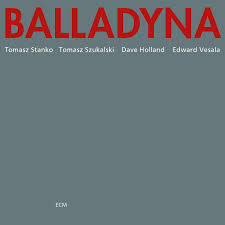
Stańko’s first ECM album as a leader was Balladyna, recorded with Tomasz Szukalski on tenor and soprano saxophones, Dave Holland on bass and Edward Vesala on drums. The album became a major international step for him, and Stańko would later regard it as fundamental to establishing his reputation beyond Poland. The personnel itself is revealing: two Polish voices, a Finnish drummer and an English bassist who had already played with Miles Davis. This was European jazz operating not as a national style but as an international network.
Dave Holland was particularly important to the group’s balance. A bassist with experience in Miles Davis’s electric-period groups and avant-garde contexts, Holland could provide structural clarity without restricting improvisational freedom. The music did not need a conventional walking bass line to establish coherence; Holland could create movement through melodic playing, rhythmic displacement and interaction. Vesala approached percussion with similar flexibility, leaving enormous space for Stańko and Szukalski. The ensemble could breathe without becoming static.
Balladyna is important not because it suddenly created the mature Stańko but because it captures a musician in transition. The free-jazz intensity of the previous period remains present, yet space is becoming more important and melody more exposed. The trumpet can emerge from silence rather than fight through continuous ensemble density. The record points toward later Stańko without sounding like those later albums. Artists rarely discover their mature language in one revelation; they gradually learn which parts of themselves they want to keep.
ECM Did Not Create Tomasz Stańko
Because Stańko eventually became so strongly associated with ECM, there is a temptation to attribute his musical identity to the label’s production aesthetic. The chronology argues against that. His fascination with freedom came earlier. Komeda came earlier. The Polish experience came earlier. The rough trumpet tone came earlier. His attraction to space and ambiguity was already developing. What ECM offered was an environment in which those characteristics could become exceptionally audible. Production can reveal an identity; it cannot substitute for one.
That distinction becomes especially important when we reach the 1980s, because the decade refuses the convenient image of Stańko as a permanently austere ECM poet. He experimented with different groups, electronics and musical languages. Projects such as C.O.C.X. and Freelectronic engaged with sounds that could include reggae, Latin influences and electronic textures. He was willing to let the music become messy, rhythmic and unpredictable rather than protect a recognizable aesthetic.
Stańko also worked with Cecil Taylor during this period, participating in some of the American pianist’s larger ensembles. The connection makes sense. Taylor’s music demanded absolute commitment; his improvisational structures could be extraordinarily dense and physically intense. For Stańko, this was far removed from the restrained lyrical settings that would later bring him a wider audience, but it belonged to the same underlying principle: music had to remain alive enough to become unpredictable.
Beyond the Myth of the Melancholic Trumpeter
This is why the familiar adjectives surrounding Tomasz Stańko need to be used sparingly: dark, melancholic, sparse, haunting, poetic. Some describe genuine qualities in his music, but none explains the career. Stańko could be aggressive, abstract and densely improvisational. He could experiment with electronics and produce rough textures that had little relationship with the romantic image later attached to his trumpet. The lyrical Stańko became powerful precisely because the turbulent Stańko remained somewhere inside him.
During the 1990s, his relationship with ECM entered a major new phase. The context was completely different from Balladyna. Stańko was no longer an emerging European avant-garde trumpeter looking for international visibility but an experienced musician who had spent decades moving through free jazz, composition, experimentation and changing ensembles. Albums including Matka Joanna and Leosia placed him with Bobo Stenson, Anders Jormin and Tony Oxley, a formidable group capable of understanding both structure and instability. Stenson could create harmonic space without making it passive, Jormin possessed weight and flexibility, and Oxley brought decades of experience in free improvisation. Stańko could now place his increasingly distilled trumpet language inside a group capable of responding to every ambiguity.
Litania: Returning to Komeda
Then, in 1997, Stańko returned explicitly to the music of Krzysztof Komeda with Litania. This was not nostalgia. More than three decades had passed since Astigmatic, and Stańko was no longer the young trumpeter inside Komeda’s ensemble. He had built his own career, led groups, entered European free jazz, recorded for ECM and developed an unmistakable instrumental identity. He could now return to Komeda from a position of independence.
The significance of Litania lies in the difference between remembering music and reproducing it. Stańko did not attempt to reconstruct the 1960s. The compositions had accumulated history, and so had he. The roughness of his trumpet now carried decades of experience; silence meant something different; phrases had become more economical; his relationship with melody had changed. Komeda’s material became a meeting place between two periods of Stańko’s life—the young musician who had learned beside the composer and the mature musician returning to that education from a distance.
The album also became an important international success and opened another phase in Stańko’s career. Yet just as he was looking backward toward Komeda, he was beginning a relationship that would push him forward.
The Young Polish Trio
Stańko encountered three remarkably young Polish musicians: pianist Marcin Wasilewski, bassist Sławomir Kurkiewicz and drummer Michał Miśkiewicz. The relationship eventually developed into one of the defining groups of his later career. In a sense, the dynamic reversed the experience of Stańko’s youth. He had once been the younger musician learning inside an older composer’s world; now he was the veteran. But he did not treat the trio as students whose job was to reproduce his ideas.
Their youth changed him.
Wasilewski, Kurkiewicz and Miśkiewicz possessed enough technical command to follow Stańko but enough independence to surprise him. The association gave the trumpeter renewed energy while the younger musicians continued developing voices of their own. This became one of the most important relationships in his entire career and would produce Soul of Things, Suspended Night and Lontano.
Across those recordings, Stańko’s mature language would become internationally recognizable to an audience much larger than the European avant-garde circles that had followed him for decades. The irony is revealing: a musician formed through free jazz would achieve some of his greatest recognition through restraint.
But the restraint was never surrender.
Every silence still contained the possibility of disruption.
Buy Amazon
The Quartet That Changed the Scale of His Career
When Tomasz Stańko began working with Marcin Wasilewski, Sławomir Kurkiewicz and Michał Miśkiewicz, the difference in age between the trumpeter and his rhythm section was enormous. Stańko had already passed through Komeda’s world, led one of the most important Polish free-jazz groups of the 1970s, recorded Balladyna for ECM, experimented through the 1980s and rebuilt his international profile during the following decade. The three younger musicians had grown up in a different Poland and entered jazz with another set of possibilities. Yet the relationship never sounded like a veteran hiring technically gifted accompanists. Stańko recognized that their independence was precisely what he needed. Their precision allowed him to become less predictable, while his refusal to dictate every detail forced them to react rather than simply execute.
The partnership also challenged the familiar assumption that late-career refinement means reducing risk. Stańko certainly became more economical, but economy and caution are not the same thing. A short phrase can be more dangerous than a long one if the musicians around it do not know what comes next. With Wasilewski, Kurkiewicz and Miśkiewicz, Stańko found a rhythm section capable of making silence active. They could maintain an atmosphere without freezing it, and they understood that his pauses were not empty spaces waiting to be filled. This would become fundamental to the recordings that transformed his international reputation in the 2000s.
Soul of Things
Released by ECM in 2002, Soul of Things introduced the Stańko quartet with the young Polish trio to a much broader international audience. The album is constructed largely around a sequence of pieces titled “Soul of Things Variations”, giving the recording an unusually continuous character. Rather than presenting a conventional collection of unrelated compositions, Stańko created something closer to a sustained investigation of a musical environment. The pieces move through different levels of intensity, but they remain connected by the quartet’s shared sense of space, tension and melodic possibility.
This is where descriptions of Stańko as “melancholic” become simultaneously understandable and inadequate. The trumpet can certainly sound wounded, solitary or introspective, but the emotional effect does not come from sadness being applied to every composition. It comes from instability. A melodic fragment may appear clear enough to suggest a ballad before the harmony shifts underneath it. Wasilewski can provide a beautiful chord and then leave it unresolved. Kurkiewicz can establish weight without locking the music into a repetitive bass pattern. Miśkiewicz can imply pulse without turning every passage into conventional timekeeping. Stańko moves across this unstable ground with remarkable patience.
The album’s importance also lies in what it does not do. It does not attempt to reproduce Litania. It does not return Stańko to the aggression of his early free-jazz years. It does not turn his ECM association into a formula of slow tempos and reverberation. Instead, the quartet discovers a way to make decades of experience coexist. Komeda’s lesson about composition and atmosphere remains somewhere in the background. Free improvisation survives in the possibility that the music can change direction. ECM’s production gives every gesture physical presence. The young rhythm section introduces another generation’s sense of interaction. Stańko is the center, but the music is not trapped inside his history.
Silence Is Not the Subject
Writing about Stańko often becomes obsessed with silence. The temptation is understandable because his mature playing uses pauses with unusual effectiveness, yet silence is not the subject of this music. Relationship is. A pause matters because of what another musician might do inside it, what came immediately before it and what the listener expects to happen next. Without those relationships, silence would simply be inactivity.
This distinction helps explain why the Wasilewski quartet became so effective. Stańko could play a phrase and stop, confident that the rhythm section would not automatically answer with decorative activity. Wasilewski might leave the phrase suspended. Kurkiewicz could alter the harmonic implication with a single bass movement. Miśkiewicz could introduce a small rhythmic gesture that redirected the ensemble. The group understood that restraint was collective. One musician playing sparsely while everyone else fills the available space does not create openness. All four had to participate in making room.
Suspended Night
Suspended Night followed in 2004 and pushed this language further. The album’s sequence of “Suspended Variations” again demonstrates Stańko’s interest in continuity rather than a collection of isolated performances. The quartet sounds more settled into its identity, but “settled” should not imply comfortable. If anything, familiarity allows greater risk because the musicians understand one another’s instincts well enough to disturb them.
The title is particularly appropriate. Much of the music feels suspended between states: composition and improvisation, movement and stillness, lyricism and abrasion. Stańko’s trumpet can establish a melody without allowing it to become sentimental. His tone remains grainy enough to complicate beautiful material. Wasilewski frequently provides harmonic clarity, but that clarity can dissolve almost immediately. The rhythm section avoids the heavy-handed dramatic gestures that might turn the album’s darker passages into cinematic cliché.
This is mature ensemble music in the strongest sense. The musicians are not trying to demonstrate how much they can contribute individually. They are determining how little information is necessary for the group to remain alive.
The International Audience Expands
The reception of Soul of Things and Suspended Night substantially expanded Stańko’s visibility outside the audiences that had followed European free jazz and ECM for decades. This late recognition is an important part of his story. Many musicians experience their broadest public attention early, when novelty and youth are easiest to market. Stańko’s trajectory moved differently. By the time these records reached listeners internationally, he had already spent roughly four decades developing his language.
That history is audible. The economy of the mature Stańko is convincing because it was earned through periods of density, experimentation and instability. He knew what happened when an ensemble played aggressively because he had lived inside that music. He knew what electronics and unconventional structures could do because he had explored them. He understood Komeda’s compositional world from direct experience. When he eventually chose fewer notes, the choice carried the weight of alternatives.
Late-career recognition therefore did not represent the discovery of a previously static musician. Listeners were encountering the latest stage of a career that had already changed repeatedly.
Lontano
The quartet completed its remarkable sequence with Lontano, recorded in 2005 and released in 2006. The title—Italian for “distant” or “far away”—seems almost designed for the adjectives habitually attached to Stańko’s music, but the album deserves more than atmospheric description. What had been developing through Soul of Things and Suspended Night now reached an extraordinary level of group confidence. The quartet could move from near-silence into denser improvisation without making those states feel contradictory.
Stańko’s trumpet is especially revealing. The famous roughness remains, yet he no longer seems interested in foregrounding it as an expressive device. The tone simply belongs to the music. A phrase can be lyrical, then fracture. A note can emerge cleanly before acquiring grain. There are moments when the instrument sounds almost vocal, not because Stańko imitates singing but because his phrasing has the irregularity of speech. Breaths matter. Hesitations matter. Sentences do not always finish where expected.
The rhythm section responds with similar flexibility. Wasilewski can move between spacious chordal playing and more active improvisation. Kurkiewicz provides a bass presence that remains structurally important without turning every passage into a conventional jazz foundation. Miśkiewicz treats rhythm as something that can be implied, interrupted or suddenly clarified. By this point, describing them merely as Stańko’s young trio no longer makes sense. They had become a major ensemble in their own right.
What the Quartet Gave Both Generations
The collaboration had consequences in both directions. Stańko gained a group that refreshed his musical language without asking him to abandon his identity. The younger musicians gained experience inside the world of one of Poland’s most important improvisers, but they were never required to become copies of his earlier collaborators. Their own trio would develop an increasingly significant international career, eventually recording for ECM under the name Marcin Wasilewski Trio.
This generational exchange is one of the most compelling aspects of Stańko’s career because it mirrors his relationship with Komeda without simply repeating it. Komeda had given the young Stańko an environment in which his individuality could emerge. Decades later, Stańko created something similar for younger Polish musicians. The circumstances were different, and so was the music, but the underlying principle survived: leadership could mean creating conditions for other voices rather than controlling them.
That is a more durable form of influence than imitation.
Leaving the Quartet at the Right Moment
One of the strengths of Stańko’s career was his willingness to change ensembles even when an existing group was working exceptionally well. The Wasilewski quartet had produced three internationally acclaimed ECM albums and developed a highly recognizable sound. Continuing indefinitely would have been understandable. It also carried the risk of turning discovery into formula.
Stańko moved again.
The decision reflects a pattern extending back through his career. Komeda’s group gave way to Stańko’s own quintet. The free-jazz period evolved into other collaborations. Balladyna did not become a permanent template. The 1980s were allowed to be unstable. The 1990s brought another ECM language. Then came the young Polish quartet.
For Stańko, a successful ensemble was not necessarily a destination.
Sometimes success was the signal that another question needed to be asked.
Dark Eyes and a New Scandinavian Group
The next major ECM chapter appeared with Dark Eyes, released in 2009. Stańko assembled a new group of younger Scandinavian musicians, including Danish guitarist Jakob Bro, Danish bassist Anders Christensen, Finnish pianist Alexi Tuomarila and Finnish drummer Olavi Louhivuori. The instrumentation immediately changed the musical environment. Guitar introduced a color that had not been central to the Wasilewski quartet, and Bro’s approach was particularly compatible with Stańko because he understood how texture and sustain could become compositional elements.
The album demonstrates again why “the ECM sound” is an inadequate explanation for Stańko’s records. Yes, there is space. Yes, the recording has the clarity associated with the label. But the ensemble’s personality comes from the musicians. Bro’s guitar changes the harmonic field. Tuomarila’s piano creates another relationship with Stańko’s trumpet. Christensen and Louhivuori provide a rhythmic foundation different from the Polish trio. The atmosphere changes because the people change.
Stańko remains recognizable.
The environment does not.
Younger Musicians as Creative Partners
By this stage, a pattern had become unmistakable. Stańko repeatedly sought younger musicians, but not because he wanted to surround himself with disciples. He valued their lack of investment in his past. A musician who had grown up admiring Balladyna or Litania might have been tempted to reproduce the established Stańko language. The most useful collaborators were those capable of respecting that history while forcing the trumpeter into another present.
This explains part of his remarkable late-career vitality. Stańko never treated age as a reason to protect what already worked. He remained curious about how his trumpet would respond to another generation’s rhythmic instincts, harmonic vocabulary and relationship with sound.
The mature tone remained.
The situations kept changing.
New York Changes the Atmosphere Again
Another major transition occurred when Stańko began spending substantial time in New York. The city had always occupied an almost mythic position within jazz, but Stańko did not arrive as a young European musician seeking validation from the American center. He came as an internationally established artist with decades of history behind him.
That difference is essential.
His New York period was not a pilgrimage toward authenticity.
It was another encounter.
Stańko listened to younger musicians in clubs, absorbed the city’s energy and eventually formed a new quartet with David Virelles on piano, Thomas Morgan on bass and Gerald Cleaver on drums.
Once again, the personnel transformed the context.
The New York Quartet
The New York group was extraordinary because each musician brought a highly developed individual language. Cuban-born pianist David Virelles possessed a harmonic imagination informed by jazz, contemporary composition and Afro-Cuban musical traditions. Thomas Morgan had become one of the most sensitive and adaptable bassists of his generation. Gerald Cleaver could move from subtle textural playing to forceful rhythmic interaction without making either feel like a separate mode.
Stańko did not need them to reproduce European melancholy.
They brought New York into the music.
But neither did the quartet turn Stańko into an American jazz musician in any conventional sense. His trumpet remained unmistakably connected to the history he carried from Poland, Komeda, European free improvisation and ECM.
The result was not assimilation.
It was conversation.
Wisława
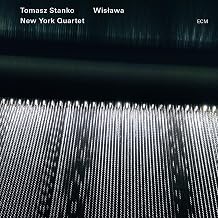
The first major document of this quartet was Wisława, released in 2013. The album was dedicated to the Polish poet Wisława Szymborska, winner of the 1996 Nobel Prize in Literature, with whom Stańko had developed a personal and artistic connection. He had performed in contexts involving her poetry, and her death in 2012 gave the project an additional emotional dimension.
This relationship is important because it corrects a common simplification surrounding Stańko’s earlier albums. The explicit Szymborska connection belongs particularly to Wisława, rather than being the conceptual foundation of Suspended Night. Here, the relationship between poetry and music is direct.
Yet Stańko does not attempt to translate individual poems into literal musical narratives.
The influence is more fundamental.
Szymborska’s poetry is celebrated for precision, irony, philosophical depth and an ability to make large questions emerge from apparently ordinary observations. Stańko’s mature music could operate similarly. A small gesture might imply a much larger emotional space.
Poetry Without Illustration
The relationship between poetry and jazz is often described too loosely. Instrumental music does not become poetic simply because it is slow or atmospheric. What makes Wisława interesting is the shared concern with economy.
Szymborska could build a philosophical problem from deceptively simple language.
Stańko could build musical tension from a few notes.
Neither needed excessive explanation.
The New York quartet understood this perfectly. Virelles did not surround every trumpet phrase with harmonic commentary. Morgan could make a single bass movement alter the emotional meaning of a passage. Cleaver could use percussion to create uncertainty rather than merely mark time.
The music has space because every musician understands the value of consequence.
A note matters because another note does not automatically follow it.
The Trumpet Becomes More Human, Not More Perfect
Stańko’s late playing is fascinating because the aging of the instrument’s physical voice did not diminish its expressive identity. If anything, the imperfections became increasingly meaningful. The tone could sound more fragile, breathier and less conventionally pure. But purity had never been the point.
Jazz contains a long history of musicians whose instrumental voices became more personal as conventional perfection became less relevant. Miles Davis is an obvious example, though Stańko’s trajectory remained his own. A cracked edge can communicate something a flawless tone cannot. Breath can become part of the note rather than noise surrounding it.
Stańko’s late trumpet sounds lived in.
That is different from sounding old.
December Avenue
The New York quartet continued with December Avenue, released in 2017. It became Stańko’s final album as a leader. The record does not behave like a planned farewell. There is no need for grand retrospective gestures, no attempt to summarize an entire career and no sense that the musicians are constructing a monument.
That makes it more affecting in retrospect.
Stańko was still moving.
Still writing.
Still responding to younger musicians.
Still interested in what another ensemble could reveal about his trumpet.
The music remains open-ended.
A career that had begun in postwar Poland had reached New York without resolving itself into a single style.
New York Was Not the Opposite of Europe
Stańko’s New York years also expose the weakness of simplistic American jazz versus European jazz narratives.
His entire career had depended on exchange.
Miles Davis and Ornette Coleman mattered in Poland.
Komeda transformed those possibilities within a Polish context.
Dave Holland entered Stańko’s ECM world on Balladyna.
Cecil Taylor later became a collaborator.
Scandinavian musicians shaped several ensembles.
The young Polish trio helped redefine his mature career.
Then Virelles, Morgan and Cleaver created another environment in New York.
Influence constantly crossed borders.
Stańko’s achievement was not escaping American jazz.
It was developing an identity strong enough to encounter American jazz without disappearing inside it.
The Sound Was the Continuity
Across all these changes, one element remained unmistakable: the trumpet.
Not because it sounded exactly the same in 1965, 1975, 2002 and 2017.
It did not.
The continuity came from a deeper set of decisions.
Stańko preferred tension over easy resolution. He allowed roughness to remain audible. He understood silence relationally. Melody could appear without becoming sentimental. Improvisation had to preserve the possibility of surprise. The musicians around him were expected to influence the direction rather than simply support it.
Those principles survived changes in tone, ensemble and geography.
That is what makes an instrumental voice more than a sound.
The Final Years
By the late 2010s, Stańko’s health had begun to decline. He was diagnosed with lung cancer and died in Warsaw on July 29, 2018, at the age of 76.
The loss was felt far beyond Poland because the scale of his career had changed dramatically over the preceding two decades. Listeners who had discovered him through Soul of Things, Suspended Night, Lontano, Wisława or December Avenue were connected to a musician whose history reached back to the formative years of modern Polish jazz.
But death inevitably encourages simplification.
Careers become compressed into adjectives.
For Stańko, those adjectives are predictable:
melancholic.
dark.
lyrical.
European.
ECM.
They are not wrong.
They are simply too small.
The real Tomasz Stańko story includes Komeda and Ornette Coleman, Astigmatic and free jazz, Zbigniew Seifert and Edward Vesala, Balladyna and Dave Holland, Cecil Taylor and electronics, Litania and the Wasilewski trio, Scandinavian musicians, New York, Szymborska and a trumpet tone that became more individual rather than more polished as the decades passed.
Buy Amazon
What Tomasz Stańko Actually Left Behind
Tomasz Stańko’s legacy is easiest to misunderstand when reduced to a sound. The grainy trumpet, the exposed notes, the pauses and the dark lyrical atmosphere are immediately recognizable, but they represent the surface of a much larger achievement. His career connected several stages in the development of postwar European jazz: the emergence of modern Polish jazz around Krzysztof Komeda, the confrontation with free improvisation during the 1960s and 1970s, the international networks that developed around labels such as ECM, and the arrival of younger European musicians who no longer needed to defend the idea that jazz made outside the United States could possess its own identity. Stańko participated in all of these transformations without settling permanently into any one of them.
That longevity matters because he did not simply survive changes in jazz culture. He repeatedly allowed those changes to alter his music. The young trumpeter beside Komeda was not the same musician who led the explosive quintet with Zbigniew Seifert. The leader of Balladyna was not the electronic experimenter of the 1980s. The Stańko who returned to Komeda on Litania had changed again, and the trumpeter who recorded Soul of Things with musicians decades younger than himself found yet another language. His New York quartet brought a final shift. What remained constant was not a formula but an attitude: the music had to leave enough uncertainty for discovery.
Polish Jazz Before and After Stańko
Stańko should not be described as the man who created Polish jazz. The country’s jazz history was already substantial, and figures including Krzysztof Komeda, Andrzej Trzaskowski, Jerzy Matuszkiewicz and others were central to its development. What Stańko did was carry that history through an unusually long sequence of transformations. He belonged to the generation that established a modern Polish jazz identity, but unlike many musicians associated primarily with a particular historical moment, he remained internationally relevant decades later.
That continuity helped make him a reference point for younger Polish musicians. His significance was not simply that they could imitate his trumpet tone. In fact, imitation would miss the lesson. Stańko demonstrated that a musician from Poland could absorb the central innovations of American jazz, participate in European improvisational culture and still develop an identity that did not require explanation through nationality alone. By the time musicians such as Marcin Wasilewski, Sławomir Kurkiewicz and Michał Miśkiewicz emerged, the question was no longer whether Polish musicians belonged in international jazz. Stańko’s generation had helped make that question obsolete.
Komeda Remained the Essential Beginning
Of all the relationships in Stańko’s career, Krzysztof Komeda remained the foundational one. This is not because Stańko spent his life reproducing Komeda’s compositions. The opposite is closer to the truth. Komeda provided an early example of how an individual musical language could emerge from jazz without denying its origins. Astigmatic demonstrated that composition, improvisation, atmosphere and cultural specificity could coexist without turning the music into a derivative version of an American model.
When Stańko returned to Komeda’s music on Litania more than thirty years later, the distance between the two periods made the tribute meaningful. A younger musician repeating the original arrangements would have produced nostalgia. Stańko brought decades of his own history to the material. Free jazz, ECM, electronics, European collaborations and changes in his trumpet tone now stood between him and the Komeda years. Memory had become another form of improvisation.
That distinction is central to understanding Stańko. Tradition was valuable because it could be revisited, questioned and transformed.
Astigmatic Was a Beginning, Not a Destination
The enormous reputation of Astigmatic can sometimes create a misleading impression that Polish modern jazz reached its defining statement in 1965 and everything afterward was an extension of that achievement. Stańko’s career argues against such a static view. The album was a beginning precisely because the musicians involved did not treat its language as something to preserve unchanged.
For Stańko, Komeda’s compositional openness eventually led toward more radical improvisation. The Tomasz Stańko Quintet of the early 1970s pushed far beyond the atmosphere commonly associated with Komeda. Music for K acknowledged the mentor while refusing to become a memorial. Later, Litania returned to the source from another direction. Across those stages, Stańko demonstrated something essential about musical inheritance: respect for an influential work does not require remaining inside it.
This also gives JazzLatitude’s separate examination of Astigmatic a different purpose from the present article. Komeda’s album deserves to be understood as its own artistic statement; Stańko’s career shows what happened when one of its essential musicians continued asking questions for another half-century.
The European Question
Stańko is frequently presented as evidence that European jazz achieved independence from American jazz. The claim contains an important truth but can easily become historically misleading. Jazz is an African American musical tradition, and Stańko’s development was deeply shaped by American musicians. Miles Davis mattered. Ornette Coleman mattered. Cecil Taylor mattered. Dave Brubeck’s 1958 Polish tour mattered to the young Stańko. Later collaborations with musicians including Dave Holland and American-based improvisers continued that exchange.
What changed was not that Europe escaped American influence.
What changed was the relationship with influence.
Stańko’s generation increasingly refused the assumption that mastering jazz meant reproducing the dominant American styles as faithfully as possible. Musicians could study Miles without becoming Miles, respond to Ornette without reproducing Ornette and participate in free jazz without erasing the cultural environments from which they came. European jazz became more confident not through isolation but through interaction.
Stańko embodies that process exceptionally well because the influences remain audible while the result is unmistakably his own.
There Was Never a Single “European Sound”
The same caution applies to the idea that Stańko somehow represents a universal European jazz aesthetic. Europe contained too many scenes and histories for that. Polish jazz developed differently from British free improvisation. German musicians confronted their own postwar cultural conditions. Scandinavian jazz followed multiple paths. Dutch improvisers created another ecosystem, as did musicians in France, Italy and elsewhere.
Stańko’s importance lies not in defining how Europe should sound but in demonstrating that it did not have to sound one way.
His music could be violent or spacious, acoustic or electronically altered, formally composed or highly improvisational. The fact that his later ECM recordings became particularly famous should not retroactively transform his entire career into an inevitable journey toward spacious lyricism. Those albums are powerful partly because they contain memories of everything that came before them.
The quietness has history inside it.
ECM and the Problem of the “ECM Sound”
Few labels are as visually and sonically identifiable as ECM, and Stańko became one of its major artists. The association was enormously productive, but it can encourage another simplification. When listeners describe Stańko’s music primarily as “the ECM sound,” cause and effect become confused.
Manfred Eicher’s production approach clearly mattered. ECM’s attention to acoustic detail, dynamics and spatial relationships created an environment in which Stańko’s trumpet could be recorded with exceptional presence. The roughness around the note became audible. Silence could have physical depth. Small changes in articulation mattered.
But Balladyna already contained a musician whose identity had been shaped by Komeda, free jazz and the Polish scene. ECM did not manufacture that identity. Later, the label continued documenting Stańko while his ensembles changed dramatically—from Bobo Stenson and Tony Oxley to the Wasilewski quartet, the Scandinavian group surrounding Dark Eyes and finally the New York quartet.
The label provided continuity.
Stańko supplied transformation.
Manfred Eicher and the Value of Listening
The relationship with Manfred Eicher nevertheless deserves attention because producer and musician shared an unusual concern with the architecture of a recording. Eicher’s strongest productions are not simply exercises in making instruments sound beautiful. They depend on decisions about sequence, duration, dynamics and the relationship between musical events.
Stańko’s mature playing benefited from that attention because his phrases increasingly relied on consequence. If a trumpet note is surrounded by dense production, its decay becomes irrelevant. If the recording preserves space around it, the end of the note becomes part of the performance.
This helps explain why the relationship with ECM endured. Stańko’s economy needed listeners in the studio as much as musicians around him. The production could not tell him what to play, but it could ensure that the smallest choices remained audible.
A Tone That Refused Perfection
One of Stańko’s most enduring contributions is his demonstration that an instrumental voice can become more distinctive by moving away from conventional perfection. His trumpet could contain air, roughness and unstable edges. The attack was not always clean. A note might crack slightly or fade into breath. These qualities were not technical failures to be corrected in pursuit of a more polished tone. They became part of his vocabulary.
Jazz has always valued recognizable instrumental identity, but modern recording and educational culture can encourage standardization. Players learn correct embouchure, projection, intonation and articulation for good reasons. Yet once those skills become ends rather than tools, individuality can disappear.
Stańko’s sound reminds us that technique ultimately serves expression. The important question is not whether every note conforms to an ideal trumpet tone. It is whether the musician can communicate something no other player would communicate in quite the same way.
Stańko could.
The Miles Davis Comparison—and Its Limits
The comparison with Miles Davis is unavoidable because both trumpeters demonstrated the expressive power of restraint, space and a highly personal tone. Stańko himself acknowledged Miles as an important influence. But comparison becomes unhelpful when it turns Stańko into a European variation of Davis.
Their histories were radically different. Miles developed inside the center of American jazz and repeatedly transformed that center from within. Stańko came of age in communist Poland, encountered jazz through a very different cultural environment and participated in the formation of a European improvisational identity. Miles’s use of silence could certainly teach Stańko something, but the emotional and historical meaning of Stańko’s mature language emerged from decades of other experiences.
Influence does not erase biography.
That is why Stańko ultimately sounds like Stańko.
Why Melancholy Became Such a Persistent Description
There is nevertheless a reason words such as melancholy appear so frequently around his music. His trumpet often creates an emotional ambiguity particularly compatible with introspection. The grain of the tone prevents lyrical melodies from becoming overly sweet. Slow phrases can feel unresolved. Harmonic space leaves listeners without obvious emotional instructions.
But “melancholy” becomes a problem when used as a substitute for listening.
Stańko’s music contains aggression, irony, abstraction, tension and rhythmic energy. Even the mature albums are rarely exercises in sadness. Soul of Things can shift dramatically in intensity. Lontano contains uncertainty that cannot be reduced to mood. The New York quartet brings another kind of motion entirely.
The darkness is one color.
It is not the entire palette.
Free Jazz Never Really Left
The continuity between Stańko’s early free-jazz experience and his late ECM recordings is one of the most important aspects of his development. On the surface, the music appears to have changed enormously. The explosive collective improvisation of the early quintet seems far removed from the spaciousness of Suspended Night.
But the underlying commitment is similar.
The music must remain capable of surprise.
That principle is the deeper legacy of free jazz in Stańko’s work. It does not require permanent dissonance or the absence of composition. It requires musicians to remain responsive enough that the performance cannot be completely predetermined.
The mature quartets may sound controlled, but they are not closed.
Stańko could leave a phrase unfinished because another musician might discover where it should go.
The Importance of Choosing the Right Musicians
Stańko’s ability as a bandleader therefore deserves as much attention as his trumpet playing. Across several decades, he repeatedly assembled ensembles whose members possessed strong identities of their own. Zbigniew Seifert, Edward Vesala, Dave Holland, Bobo Stenson, Tony Oxley, Marcin Wasilewski, Jakob Bro, David Virelles, Thomas Morgan and Gerald Cleaver represent very different musical worlds.
The common denominator was not style.
It was independence.
Stańko understood that his own improvisation became more interesting when the musicians around him could refuse the obvious response. This is particularly clear in the Wasilewski quartet. A less confident leader might have treated musicians so much younger as accompanists. Stańko allowed the generational difference to become creative tension.
That decision helped produce some of his most enduring recordings.
Marcin Wasilewski and the Generational Bridge
The relationship with Marcin Wasilewski, Sławomir Kurkiewicz and Michał Miśkiewicz also became one of Stańko’s most tangible contributions to the future of Polish jazz. The trio already possessed its own developing identity, but international exposure through Stańko and ECM helped place those musicians before a much larger audience. Their subsequent career demonstrated that they were never simply Stańko’s rhythm section.
This resembles the Komeda relationship in an important way. Komeda’s significance to Stańko was not that he instructed the younger trumpeter to sound like him. He provided an environment in which individuality could develop. Stańko later did something comparable for another generation.
Influence therefore moved through relationships rather than formulas.
Komeda did not create another Komeda.
Stańko did not create another Stańko.
That may be the healthiest form of musical lineage.
New York Completed the Circle Without Closing It
Stańko’s late move toward New York provides a fitting final chapter because it reverses the conventional narrative of European jazz seeking independence from America. After spending decades developing an unmistakably individual voice in Poland and across Europe, he entered New York not as a student but as a peer.
His quartet with David Virelles, Thomas Morgan and Gerald Cleaver did not erase his European history. It placed that history into another conversation. The rhythmic energy changed. The personalities changed. The city changed the context. Stańko remained identifiable.
This is a more useful model for understanding international jazz than the language of centers and peripheries. By the twenty-first century, the music was circulating through networks in which musicians from Poland, Cuba, Scandinavia, the United States and elsewhere could encounter one another without every exchange being interpreted as imitation of an American original.
Jazz remained historically African American.
Its contemporary geography had become global.
Stańko’s career lived inside both truths.
Wisława and the Polish Connection That Never Disappeared
Even during the New York period, Stańko’s Polish cultural identity remained present. Wisława made that connection explicit through its relationship with Wisława Szymborska. The project demonstrates how far Stańko had traveled without requiring him to abandon where he came from.
This is perhaps a better way to understand nationality in his music. Polishness is not a scale, chord progression or fixed melancholic atmosphere. It exists through biography, memory, language, artistic relationships and historical experience. Komeda was part of it. Szymborska was part of it. Kraków was part of it.
But none of those elements prevented Stańko from collaborating meaningfully with musicians from elsewhere.
Identity became a foundation rather than a border.
A Late Career Without Nostalgia
Perhaps the most impressive aspect of Stańko’s final decades is how little they depended on nostalgia. He certainly revisited Komeda on Litania, but even that project transformed the material rather than preserving it. Afterward, Stańko continued forming new bands, composing new music and surrounding himself with younger musicians.
He could easily have spent his later career touring established repertoire.
Instead came Soul of Things.
Suspended Night.
Lontano.
Dark Eyes.
Wisława.
And finally December Avenue.
These were not footnotes to an important career.
They became central to it.
For many listeners outside Poland, they were the beginning.
Where to Begin With Tomasz Stańko
For someone discovering Stańko today, no single album can explain the entire trajectory. Astigmatic is essential for understanding the Komeda period, although it is Komeda’s record rather than Stańko’s. Music for K reveals the young leader moving deeper into freedom. Balladyna captures the first major ECM chapter and the interaction with Dave Holland, Edward Vesala and Tomasz Szukalski. Litania provides the crucial return to Komeda from the perspective of maturity.
Then comes the extraordinary early-2000s sequence: Soul of Things, Suspended Night and Lontano. Heard together, those records document the development of the quartet with Wasilewski, Kurkiewicz and Miśkiewicz and explain why Stańko’s international audience expanded so dramatically during this period. Wisława then introduces the New York quartet and connects the late Stańko with Szymborska, while December Avenue provides the final statement without behaving like a farewell.
Listening chronologically reveals something that a greatest-hits approach cannot.
The famous sound was always changing.
The Essential Record Is Not Necessarily the Most Famous
If one recording had to serve as an entrance to Stańko’s career as a leader, Balladyna remains particularly valuable because it sits between several worlds. The intensity of his earlier free-jazz experience remains audible, yet the spaciousness associated with his later work is beginning to emerge. Dave Holland and Edward Vesala provide an international context, while Tomasz Szukalski maintains a strong Polish presence. ECM’s production exposes details without turning them into a formula.
For the mature Stańko, Soul of Things may be equally important. It demonstrates how the trumpet language had changed without losing its underlying tension. The difference between these recordings tells more about Stańko than either album can alone.
He should be heard through movement.
Why Stańko Matters Beyond Poland
Tomasz Stańko matters internationally not because he can be used as proof that Europe produced a trumpeter comparable to famous Americans. That framework keeps American jazz as the measuring device for every achievement elsewhere.
His importance is more specific.
Stańko demonstrated how deeply a musician could absorb jazz history without allowing that history to determine the final shape of his identity. He helped establish Polish modern jazz during a period of enormous cultural change, participated in European free improvisation, built long relationships with ECM and repeatedly used international ensembles to challenge his own habits.
Most importantly, he kept developing.
Longevity alone is not achievement.
Transformation is.
Final Thoughts: The Space Between the Notes
Return to the trumpet.
Not the mythology surrounding it.
Not “Nordic melancholy,” even though Stańko was Polish and the phrase never adequately described him. Not the convenient image of an ECM musician playing slowly inside enormous reverberant rooms. Not the idea that his career represented Europe’s escape from American jazz.
Listen instead to what happens around a phrase.
A note appears with a rough edge. It may be beautiful, but beauty is not guaranteed. The phrase moves somewhere unexpected and then stops. Another musician has to decide whether to answer. For a moment, the composition exists as possibility rather than certainty.
That moment contains much of Tomasz Stańko’s history.
It contains the teenager who encountered jazz in postwar Poland. The young improviser fascinated by Ornette Coleman. The trumpeter beside Krzysztof Komeda on Astigmatic. The leader of the radical early quintet. The musician entering ECM with Balladyna. The experimenter who refused to spend the 1980s protecting a marketable identity. The mature artist returning to Komeda through Litania. The bandleader surrounding himself with musicians young enough to be his sons. The European improviser arriving in New York with nothing left to prove.
His career did not move steadily toward silence.
It moved toward choice.
By the end, Stańko understood how much history a single note could carry and how little he needed to add once that note had been played.
That is why his trumpet remains recognizable.
Not because every record sounds the same.
Because across more than five decades, Tomasz Stańko learned how to make uncertainty sound like a voice of its own.