The Meeting of Two Musical Languages
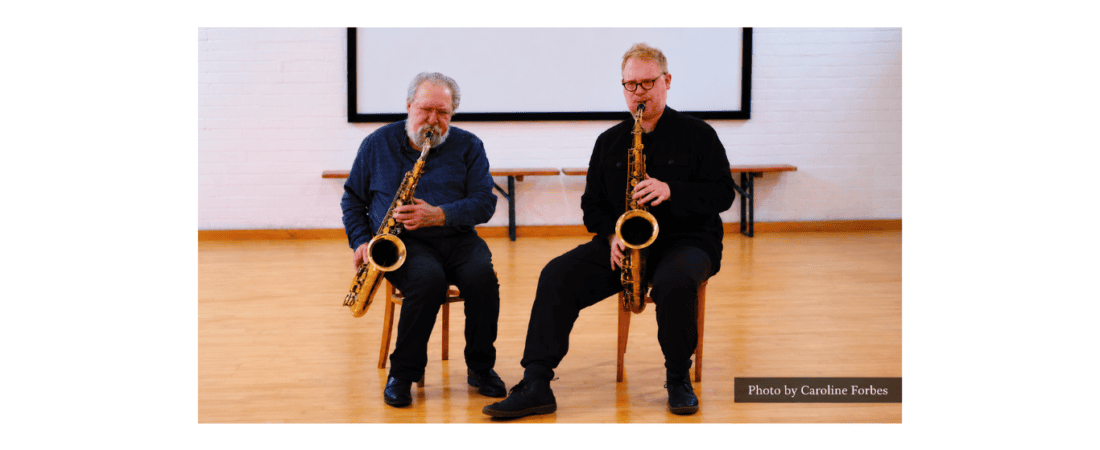
There is something unusually revealing about placing two tenor saxophones in a room without a rhythm section, harmonic accompaniment, or predetermined musical structure. The instruments share the same range, the same basic physical characteristics, and much of the same historical vocabulary, yet their similarities can make their differences more exposed. Every change in breath, articulation, density, and silence becomes part of a conversation in which neither musician can rely on the familiar architecture of a conventional ensemble. On May Spring Last a Lifetime, released by False Walls on August 7, 2026, British saxophonists Tom Challenger and Evan Parker explore precisely this condition. Their first album as a duo documents a relationship developed through years of informal playing, sustained curiosity, and the gradual discovery of what two musicians can accomplish when listening becomes as important as producing sound.
The recording, made at Arco Barco in Ramsgate, England, presents a meeting that carries considerable historical significance without depending upon the usual mythology of one generation passing knowledge to another. Parker is among the defining figures of European free improvisation, a musician whose work helped expand the expressive possibilities of the saxophone during the second half of the twentieth century. Challenger belongs to a later generation of British improvisers whose musical identities developed in an environment where many of those discoveries had already become part of the available vocabulary. Yet the relationship documented here is not a lesson conducted by an established master for a younger colleague. Both musicians approach the tenor saxophone as an instrument whose possibilities remain unresolved. Their common ground is not a fixed language but a shared willingness to question it.
That distinction gives May Spring Last a Lifetime its particular relevance. The album does not need to establish Parker’s historical importance or Challenger’s credentials through displays of virtuosity. Its underlying proposition is more demanding: what happens when two musicians with different experiences, instincts, and relationships to the instrument allow those differences to become the material of an improvisation? The answer cannot be reduced to technical innovation, although extended techniques form part of their vocabulary. Nor is it simply a celebration of spontaneous communication. The collaboration raises questions about musical identity, attention, memory, and the strange ability of improvisation to produce structures that neither participant could have designed independently.
A Collaboration Built Before the Recording
The origins of the album are important because they challenge the idea that free improvisation necessarily begins without preparation. Challenger and Parker had spent years playing together informally before committing their work to a recording. Their collaboration also included live performances, but the essential foundation was established through repeated encounters with no obligation to produce a finished artistic statement. This kind of preparation differs from rehearsing composed material. Rather than learning an arrangement, the musicians gradually learn one another’s tendencies: how a phrase might develop, when a sound is likely to disappear, how silence functions, and whether an unexpected gesture should be answered, resisted, or simply allowed to exist.
In a conversation published by False Walls to accompany the release, Challenger recalls an earlier quartet performance at London’s Vortex with bassist John Edwards and drummer Mark Sanders. The event brought together musicians deeply connected to Britain’s improvising community, and it provided an early context for the developing relationship between the two saxophonists. Parker, reflecting on his own instrumental practice, describes an increasingly distinct relationship with the tenor and soprano saxophones, suggesting that each instrument has become a separate area of musical exploration rather than an interchangeable vehicle for the same ideas.
This observation is particularly revealing when considering the decision to record a tenor saxophone duo. Parker’s reputation has often been associated with his extraordinary development of soprano saxophone techniques, including circular breathing, multiphonics, and rapidly interlocking patterns that can create the impression of several simultaneous musical lines. His tenor playing, however, occupies an equally significant place in his artistic history. It connects his contemporary work to the physical intensity and collective experimentation of the European improvising scene from which he emerged. For Challenger, the tenor also provides a space in which melodic fragments, timbral experimentation, and the physical properties of breath can become independent elements of musical construction.
Their decision to work with the same instrument therefore does not eliminate contrast. It makes contrast more subtle. Differences in attack, pressure, phrasing, and the treatment of resonance become increasingly meaningful because the instrumental foundations are so closely related. The listener is invited to recognize two individual voices while remaining open to moments when their identities become difficult to separate. In this environment, familiarity does not necessarily produce predictability. It creates the confidence required to move further into uncertainty.
Evan Parker and the Transformation of European Improvisation
To understand what Parker brings to this collaboration, it is necessary to consider the musical environment in which his language developed. Born in Bristol in 1944, Parker emerged during a period when European jazz musicians were reconsidering their relationship with American jazz traditions. The innovations of Ornette Coleman, Cecil Taylor, John Coltrane, and Albert Ayler had expanded the possibilities of improvisation, but European musicians increasingly sought approaches that did not depend upon reproducing those models. In Britain, figures such as Derek Bailey, John Stevens, and Parker became central to a developing practice in which improvisation could operate without predetermined harmonic sequences, conventional rhythmic organization, or even an agreed distinction between foreground and accompaniment.
Parker’s participation in the Spontaneous Music Ensemble and his subsequent collaborations with musicians across Europe helped establish a body of work that challenged traditional assumptions about instrumental performance. His involvement with Peter Brötzmann’s Machine Gun in 1968 placed him within one of the most forceful documents of European free jazz, while his long association with Alexander von Schlippenbach and Paul Lovens demonstrated how collective improvisation could develop a sustained internal logic without relying upon conventional composition. These projects were not stylistically identical. Their importance lies partly in the range of possibilities they opened, from concentrated collective interaction to highly physical, densely layered forms of musical expression.
Over subsequent decades, Parker developed an instrumental vocabulary that became immediately recognizable. Circular breathing allowed him to sustain musical activity beyond the normal limits of a single breath. Multiphonics expanded the saxophone’s capacity to produce complex combinations of pitches and noise. Rapidly articulated patterns created shifting rhythmic relationships that could suggest several independent musical streams. Yet reducing his achievement to these techniques would misunderstand their purpose. Parker’s innovations were not simply ways of making the saxophone sound unusual. They provided new possibilities for organizing time, constructing relationships between sounds, and sustaining improvisational thought.
His extensive solo recordings reveal one dimension of this exploration, but collaboration has remained equally fundamental. Parker’s work repeatedly demonstrates that individual vocabulary becomes most interesting when exposed to the unpredictability of another musician. A technique developed in solitude may acquire an entirely different function when another player interrupts it, imitates it, or introduces a sound that changes its perceived meaning. The saxophone becomes not merely a source of personal expression but an instrument through which musical relationships are continually negotiated.
This history gives his encounter with Challenger particular depth. Parker enters the collaboration carrying decades of discoveries, but those discoveries do not constitute a completed system. The very longevity of his career makes his continued curiosity significant. Rather than treating his established vocabulary as a definitive achievement, he remains interested in how another musician’s ideas might alter it. The encounter with Challenger therefore belongs to a long history of experimentation while refusing to become a retrospective exercise.
Tom Challenger and a Different Generation of British Jazz
Tom Challenger’s musical background reflects a British jazz environment transformed by the experiments of Parker’s generation. As a London-based saxophonist, composer, and educator, Challenger has developed a practice that moves between contemporary jazz, free improvisation, collaborative composition, and projects that challenge conventional instrumental roles. His work has included the group Ma, the experimental trio Dice Factory, and collaborations with pianist and organist Kit Downes. These different contexts reveal a musician interested not only in improvisational freedom but in the relationship between sound, structure, and the particular character of an ensemble.
His partnership with Downes is especially useful for understanding the breadth of his musical interests. Their work around the pipe organ, including the ECM album Obsidian, places the saxophone in an acoustic environment far removed from the familiar jazz rhythm section. The sustained tones, complex resonances, and architectural qualities of the organ require a different kind of attention. Rather than depending upon a steady pulse or conventional harmonic accompaniment, the saxophone must negotiate with sound that can occupy a space for long periods, changing the listener’s perception of duration and musical movement.
This sensitivity to instrumental environment helps explain Challenger’s compatibility with Parker. Both musicians understand that improvisation is shaped by more than the notes being played. The acoustic character of a room, the resonance of an instrument, the physical effort required to produce a sound, and the listener’s ability to distinguish individual voices can all become compositional factors. Challenger’s experience across different ensemble formats gives him a vocabulary flexible enough to participate in this process without imposing a single stylistic identity upon it.
There is also an important generational difference. Challenger did not need to participate in the original emergence of European free improvisation to inherit its possibilities. He entered a musical world in which the boundaries between jazz, experimental composition, electronic music, and improvisation had already become increasingly porous. The question for his generation was therefore not simply how to reject established conventions, but how to work creatively with a broad and sometimes contradictory inheritance.
In this sense, his collaboration with Parker becomes more interesting than a meeting between youth and experience. It represents an exchange between musicians whose relationships with musical history differ. Parker helped establish possibilities that Challenger could encounter as part of an existing tradition. Challenger, in turn, brings perspectives shaped by the subsequent development of that tradition and by musical practices that did not exist in the same form when Parker began his career. Neither position guarantees artistic authority. The value of the collaboration depends upon what happens when those different experiences become mutually available.
The Particular Demands of Two Tenor Saxophones
A saxophone duo without accompaniment presents a distinctive musical problem. In a conventional jazz ensemble, instruments frequently occupy recognizable roles. The bass can establish harmonic movement and rhythmic direction; drums can articulate pulse and energy; piano or guitar can provide harmonic context; a horn can develop melodic ideas against that framework. Free improvisation may challenge these divisions, but the presence of several contrasting instruments still provides an immediate variety of timbres and physical functions.
Two tenor saxophones begin from a narrower set of differences. Both musicians have access to comparable registers, similar methods of sound production, and related possibilities for articulation. Neither instrument naturally supplies the stable harmonic foundation associated with a piano or the continuous rhythmic reference of a drum kit. The musicians must therefore construct relationships from material that is often unstable. A sustained note may become a reference point, but it can disappear without warning. A repeated figure may suggest rhythm, yet the other player is under no obligation to maintain it. A noisy texture can occupy the foreground until a small change in breath suddenly becomes the most important event.
The absence of predetermined roles creates freedom, but it also increases responsibility. Every gesture changes the conditions under which the next gesture will be heard. Playing more forcefully may obscure a partner’s idea; playing less may expose details that would otherwise remain unnoticed. Silence can function as an invitation, a response, or an independent musical decision. The duo requires both musicians to remain attentive not only to what the other is doing but to how their combined activity is altering the larger musical environment.
Parker has described the duo format as particularly demanding because its simplicity leaves so little room for concealment. That observation reaches beyond technical performance. With only two musicians, every decision becomes relational. A phrase cannot be understood entirely apart from what surrounds it, and even a refusal to respond can acquire expressive meaning. The musicians must negotiate a balance between individual initiative and collective development without relying upon an external structure to settle the question.
Challenger’s reflections on the collaboration introduce another possibility. He describes moments when the two saxophones seem to generate more than two perceivable musical voices. The observation suggests that the identity of a sound does not always correspond neatly to the number of people producing it. Overlapping tones, contrasting articulations, multiphonics, and complex patterns can create the impression of several simultaneous layers. At other moments, individual identity may recede so completely that the music appears to operate as a single changing organism rather than an exchange between identifiable performers.
This instability is not merely an effect. It changes the way improvisation can be understood. The listener may begin by following one saxophonist and then the other, but the music invites attention toward relationships that cannot always be assigned to either player. What matters is no longer simply who produced a particular sound. It is what that sound becomes within the combined activity.
From Informal Encounters to May Spring Last a Lifetime
The recording at Arco Barco represents the moment when this developing relationship became a document intended for listeners beyond the musicians themselves. Recorded and mastered by Filipe Gomes, the session was released by False Walls as a continuous improvisation lasting approximately fifty-three minutes. The format matters because it preserves the sense of a sustained encounter rather than presenting the collaboration primarily as a collection of short, self-contained compositions.
The label’s decision to accompany the CD with an extended conversation between Challenger and Parker also reflects the nature of the project. Their discussion does not function simply as promotional commentary. It offers insight into how the musicians understand the act of improvising together, particularly the relationship between individual instrumental discovery and collective listening. The music and conversation approach the same questions from different directions: what can an instrument do, how does another musician change that understanding, and how can spontaneous activity produce forms that remain meaningful beyond the moment of performance?
False Walls provides an appropriate context for such a release. Its catalogue has maintained a strong interest in experimental music and improvisation, and May Spring Last a Lifetime marks Parker’s fifth appearance on the label. The album also belongs to a contemporary British musical environment in which spaces such as London’s Cafe OTO continue to support performances that move across the boundaries of jazz, experimental composition, and free improvisation. The duo’s album-launch performance there in July 2026 connected the recording to an active community of musicians and listeners rather than presenting it as an isolated studio achievement.
Yet the significance of the album ultimately lies in the relationship between the two saxophonists. Parker’s history gives the encounter depth, while Challenger’s presence prevents that history from becoming a closed narrative. Their shared instrument provides common ground, but their differences generate the possibility of discovery. The long period of informal playing gives them familiarity, while the absence of predetermined musical material preserves uncertainty.
These qualities make May Spring Last a Lifetime more than a document of two accomplished improvisers performing together. It becomes an examination of how musical knowledge can remain flexible, how individual identities can overlap without disappearing, and how the simple act of paying attention can produce an unexpectedly complex form of collective expression.
The deeper question, however, concerns what happens inside the recording itself. A continuous improvisation of this length cannot depend upon novelty alone. It must discover ways of sustaining interest, transforming material, allowing tension to develop, and recognizing when an idea has reached its natural conclusion. The relationship between two tenor saxophones becomes a constantly changing negotiation between similarity and difference, density and space, initiative and restraint.
It is within that negotiation that the album’s distinctive musical character begins to emerge.
Inside May Spring Last a Lifetime: Improvisation, Silence, and the Shape of Listening
The most revealing aspect of May Spring Last a Lifetime may not be the fact that Tom Challenger and Evan Parker recorded an extended improvisation together, but what happened after the performance ended. The session at Arco Barco in Ramsgate produced approximately fifty-three minutes of music, subsequently reorganized by Challenger into six sections. Their original sequence was altered, creating an album whose final architecture differs from the chronology of the recorded encounter. For musicians associated with free improvisation, where the immediate relationship between action and response is often treated as fundamental, this decision introduces an unusually productive question. If the order of events changes, does the music remain the same improvisation, or does the recording become a new composition constructed from spontaneous material?
The question is not merely philosophical. It reaches directly into the relationship between memory, listening, and musical form. Parker and Challenger approach improvisation as an activity in which decisions emerge from circumstances that cannot be completely anticipated. Yet once a performance has been recorded, those decisions become available for reconsideration. Sounds that originally appeared as responses to particular gestures can acquire different meanings when placed beside other material. A passage that functioned as a conclusion may become an opening. A moment of hesitation can suggest transition rather than interruption. The listener, unaware of the original sequence, encounters a coherent musical experience whose structure has been shaped both by spontaneous performance and subsequent reflection.
This tension between immediacy and reconstruction gives the album a character that extends beyond the familiar idea of two saxophonists exchanging ideas. The recording becomes an investigation into how musical events acquire meaning, and whether the meaning of an improvisation belongs exclusively to the moment in which it occurred.
The Recording Room as a Musical Environment
Arco Barco occupies an important place in Parker’s recent recording practice. His relationship with recording engineer Filipe Gomes developed through repeated sessions in which technical preparation gradually became secondary to mutual trust. Parker’s preference is to avoid the conventional studio procedure of stopping, evaluating takes, and beginning again. Instead, he favors allowing the recording to continue while the music develops according to its own internal rhythm.
This approach reflects a particular understanding of improvisational concentration. The musician does not arrive with an established sequence of pieces whose beginnings and endings must be reproduced. The duration of an improvisation depends upon physical energy, attention, imagination, and the changing possibilities of the instrument. Interrupting that process to evaluate a performance can alter the very conditions that made it possible.
For Parker, silence between musical episodes does not necessarily mean that the performance has ended. It may represent a period of thought, recovery, or transition. The absence of sound remains part of the activity rather than evidence that the activity has stopped.
The physical environment contributes another dimension. Arco Barco is not described by the musicians as an acoustically isolated laboratory. Parker mentions external sounds, including traffic and pigeons, that can become audible within the recording space. Such details complicate the traditional distinction between musical intention and environmental interference. In improvisation, an unexpected sound may alter a performer’s attention or become part of the circumstances through which the next musical decision emerges.
Challenger’s experience during the session illustrates this principle in a particularly ordinary way. At one point, he needed to replace a saxophone reed. What might normally be regarded as a practical interruption became part of a discussion about the boundaries of performance. If the act of changing a reed produces sounds, movements, and responses, at what point does musical activity actually stop?
The question matters because the duo’s working relationship had already blurred the distinction between practicing, playing, and talking. Their informal encounters allowed musical gestures to develop into conversation and conversation to lead naturally back into instrumental activity. The recording preserved something of this attitude, even when the final album required decisions about which events belonged within its structure.
Two Instruments, More Than Two Voices
The shared instrumental identity of the duo creates one of its most intriguing possibilities. Both musicians play tenor saxophone, yet the combination can generate textures that challenge the listener’s ability to distinguish individual sources. Challenger describes moments when the interaction seems to produce several perceptible voices rather than merely two instrumental lines.
This phenomenon is closely connected to the extended vocabulary developed within free improvisation. The saxophone is capable of producing far more than a sequence of conventionally pitched notes. Changes in air pressure, embouchure, fingering, and articulation can create unstable tones, multiphonics, breath textures, and complex combinations of sound. When two players employ these possibilities simultaneously, their instruments may overlap in ways that obscure the boundaries between them.
The resulting complexity does not necessarily depend upon volume or speed. A quiet sustained tone can interact with another sound to produce an unexpected resonance. Small changes in articulation may create the impression of movement within an otherwise static texture. Rapidly shifting patterns can make separate instrumental gestures appear interconnected, while contrasting registers may suggest an ensemble larger than the number of musicians present.
What becomes important is the listener’s changing perception of musical identity. In a conventional instrumental exchange, attention often moves between recognizable individuals. One musician introduces a phrase, another responds, and the relationship remains relatively clear. Challenger and Parker are interested in situations where this distinction becomes less reliable.
A sound may begin as an identifiable gesture from one saxophone before becoming absorbed into a larger texture. The listener may recognize an individual line only when it separates from the combined activity. At other moments, the interaction creates a composite sound whose internal components are difficult to isolate.
This is one reason the duo format can be more demanding than its apparent simplicity suggests. With fewer musicians, each contribution becomes more exposed, but the relationship between those contributions can also become unexpectedly intricate.
Listening Beyond Conversation
Improvised music is frequently described through the metaphor of conversation. The comparison is useful because musicians respond to one another, develop shared ideas, and sometimes introduce contrasting material. Yet Parker questions whether conversation adequately describes what happens during their performances.
He proposes dance as a more revealing analogy.
The distinction is significant. Conversation often implies a sequence of statements and responses, even when several participants speak simultaneously. Dance suggests relationships based upon movement, timing, proximity, balance, and the possibility of coordinated activity without a predetermined exchange of messages.
For two saxophonists, this perspective changes the meaning of listening. A musician does not necessarily need to answer a phrase with another phrase. The response may involve adjusting intensity, changing register, maintaining a sound, or withdrawing from the texture altogether. The interaction becomes a continuous negotiation of relationships rather than a succession of musical statements.
This understanding also helps explain why familiarity between Challenger and Parker matters. Their years of informal playing created an environment in which neither musician needed to establish authority through constant activity. Trust allows uncertainty to remain productive. A gesture can develop without requiring an immediate response, and an unexpected direction can be explored without the assumption that the other musician must follow.
Parker describes the challenge of maintaining individual freedom while ensuring that the collective activity does not collapse into unrelated gestures. If both musicians pursue incompatible directions without considering their relationship, the result may be cancellation rather than productive contrast.
The objective is not agreement at every moment. It is the ability to recognize when independence strengthens the music and when it threatens to dissolve the shared structure.
Within this framework, listening becomes more than a passive reception of sound. It is an active process of deciding how much attention to give, when to intervene, and when an emerging musical relationship should be allowed to continue without interference.
The Architecture of Silence
Silence occupies a particularly important position in May Spring Last a Lifetime. Without a rhythm section maintaining continuity, the musicians are free to allow musical activity to recede almost completely. These moments do not necessarily function as conventional pauses between compositions. They can become structural elements within the improvisation itself.
Parker’s recording philosophy encourages this openness. Rather than determining in advance how long a musical episode should last or how much silence should separate one passage from another, he allows duration to emerge from the performance.
Challenger’s subsequent editing introduces another perspective. While reorganizing the recorded material, he became attentive to moments that suggested a natural sense of closure or transition. These were not necessarily harmonic cadences in the traditional sense. They were points at which the combined activity appeared to arrive somewhere, even without a predetermined destination.
Such moments reveal an important continuity between free improvisation and other musical traditions. The absence of fixed composition does not eliminate the listener’s perception of form. Musical events can still suggest beginnings, development, tension, resolution, and closure.
The difference lies in how these relationships emerge.
Rather than following an established harmonic progression or written arrangement, Challenger and Parker allow musical form to develop through the changing relationship between their instruments. Silence becomes one of the elements through which those relationships can be recognized.
A pause may clarify the significance of what preceded it. An unexpected return to sound may create continuity across an apparent interruption. A sparse passage can acquire greater intensity precisely because the musicians resist the temptation to fill every available space.
The result challenges the assumption that musical complexity must involve continuous activity. In this setting, restraint can be as consequential as technical virtuosity.
Editing as a Second Form of Improvisation
Challenger’s decision to reorganize the recording into six sections introduces the album’s most distinctive conceptual element. The original performance was not simply divided into convenient tracks. Its sequence was changed, creating relationships between passages that did not occur in the same order during the session.
Parker initially approached this possibility from a different perspective. His recording practice had increasingly emphasized the integrity of the uninterrupted improvisational process. The idea of rearranging material after the event therefore represented a departure from his preferred method.
Yet the finished result persuaded him that the approach could produce a meaningful musical structure.
The disagreement is illuminating because neither musician treats improvisation as a rigid doctrine. Parker’s commitment to spontaneous continuity does not prevent him from recognizing the creative possibilities of Challenger’s editing. Challenger, meanwhile, does not regard the recorded event as untouchable simply because it emerged through improvisation.
His reasoning involves the nature of memory itself.
When musicians remember a performance, they do not necessarily reconstruct every event in its original chronological order. Certain gestures become prominent while others disappear. Relationships are reorganized through recollection, and the experience acquires a structure shaped by perception rather than exact documentation.
From this perspective, editing a recording is not necessarily a betrayal of improvisation. It can become another way of engaging with the musical material, acknowledging that the meaning of an event continues to change after its original occurrence.
The distinction between performance and composition consequently becomes less stable. The musicians improvised the sounds, but Challenger shaped their recorded sequence. The resulting album preserves the spontaneity of the individual gestures while presenting them within a structure developed through subsequent listening.
This does not make the record less authentic. It makes its relationship with authenticity more interesting.
A Record That Asks the Listener to Participate
The importance of May Spring Last a Lifetime ultimately lies in the way its musical and conceptual elements reinforce one another. The two saxophonists explore the boundaries of their instruments while simultaneously questioning the boundaries of collective performance. Their interaction can generate the impression of multiple voices, yet the underlying relationship remains intimate. Their improvisation develops without a predetermined form, yet the finished recording possesses an architecture shaped by careful attention.
For the listener, these qualities encourage a different relationship with time. Rather than waiting for recognizable themes, solos, or harmonic resolutions, attention shifts toward smaller events: a change in texture, the emergence of a sustained tone, the sudden separation of previously intertwined voices, or the significance of a silence that might otherwise pass unnoticed.
The album also challenges the idea that free improvisation is valuable primarily because it is unpredictable. Unpredictability alone cannot sustain meaningful musical communication. What matters is how musicians respond to circumstances they could not have anticipated, and how those responses create relationships that remain compelling when the performance is heard again.
Challenger and Parker demonstrate that spontaneity and reflection need not be opposites. Their collaboration depends upon immediate decisions, but its recorded form also acknowledges the creative possibilities of memory, editing, and reconsideration.
In doing so, May Spring Last a Lifetime becomes a document of musical freedom understood not as the absence of responsibility, but as an unusually demanding form of attention.
The freedom to produce any sound is only the beginning.
The more difficult achievement is knowing what that sound might mean when another musician is listening.
The Freedom to Listen: Two Generations and an Unfinished Musical Conversation
The history of free improvisation is often told through moments of rupture. Musicians reject established forms, abandon conventional harmonic structures, challenge the division between composition and performance, and discover sounds that previous generations might not have considered musical material. Such narratives are useful for understanding how new practices emerge, but they become less adequate when those practices survive long enough to develop histories of their own. By the time Tom Challenger and Evan Parker recorded May Spring Last a Lifetime, free improvisation was no longer an experimental proposition awaiting recognition. It had accumulated decades of recordings, institutions, collaborations, disagreements, and established approaches to instrumental technique. The question was no longer whether musicians could improvise without predetermined musical structures. It was what they might discover within a tradition that had already made freedom one of its defining principles.
This historical position gives the collaboration its particular significance. Parker belongs to the generation that helped establish European free improvisation as a distinct musical practice, while Challenger developed his artistic identity in a world where that achievement formed part of an extensive musical inheritance. Yet the album does not present these positions as opposites. There is no audible obligation for Parker to represent history or for Challenger to demonstrate modernity. Their relationship is based upon a shared understanding that improvisation remains meaningful only when its possibilities are continually reconsidered.
The distinction matters because experimental music can become conventional in ways that are difficult to recognize. Techniques originally developed to challenge instrumental expectations can eventually become familiar gestures. Certain forms of intensity, abstraction, and unpredictability acquire their own stylistic identities. Musicians may begin reproducing the outward characteristics of freedom without necessarily engaging in the deeper uncertainty that made those characteristics significant.
May Spring Last a Lifetime offers a different possibility. Its central concern is not the demonstration of an established experimental vocabulary, but the willingness to expose that vocabulary to another musician’s curiosity. The result is a collaboration in which experience provides resources rather than answers, and technical knowledge becomes valuable precisely because it can be questioned.
Evan Parker and the Continuing History of Free Improvisation
Evan Parker’s career presents an unusual challenge to conventional ideas about artistic development. Many musicians become associated with a particular period, movement, or technical innovation, and their later work is understood primarily in relation to those earlier achievements. Parker’s history certainly includes landmark recordings and collaborations that helped define European improvisation, but his artistic identity has never depended exclusively upon preserving the methods that made him influential.
His work with the Spontaneous Music Ensemble, the Alexander von Schlippenbach Trio, Derek Bailey, and numerous other musicians established an approach to collective performance in which the relationships between participants could become more important than any predetermined musical destination. His solo recordings expanded the saxophone’s technical and expressive vocabulary, particularly through sustained exploration of multiphonics, circular breathing, and intricate patterns of articulation. Yet these developments were never entirely separate from his broader interest in musical interaction.
What makes Parker’s continuing activity significant is the relationship between mastery and uncertainty. Decades of experience might reasonably be expected to produce greater control, but control is not necessarily the ultimate objective of his improvisational practice. The instrument remains capable of unexpected behavior, and the musician’s responsibility is not always to correct that behavior. Sometimes the more productive decision is to recognize an unanticipated event and allow it to alter the direction of the music.
In the conversation accompanying May Spring Last a Lifetime, Parker distinguishes between practicing physical command of the instrument and practicing the decisions involved in improvising with another person. The first activity can involve recognizable technical objectives: producing a particular note, refining articulation, or developing reliable physical responses. The second concerns circumstances in which the correct decision cannot be determined beforehand.
This distinction illuminates the enduring relevance of his work. Technical development provides possibilities, but improvisation requires musicians to decide what those possibilities mean in relation to an unfolding situation. The most accomplished player is not necessarily the one who exercises the greatest control at every moment. It may be the musician capable of recognizing when control should be loosened.
Parker’s willingness to reconsider his own recording philosophy in response to Challenger’s editing decisions offers a particularly clear example. His preference for uninterrupted recording emerged from extensive experience, yet he remained open to an approach that challenged its assumptions. Such openness suggests that the history of free improvisation is not simply a sequence of innovations gradually becoming accepted practice. It is also a continuing argument about how musical freedom should be understood.
Tom Challenger and the Possibilities of Inheritance
For Challenger, the relationship with Parker raises a different but equally important question: how does a musician develop an individual language within a tradition already defined by its resistance to convention?
The answer cannot be found simply in adopting more radical techniques or seeking increasingly unfamiliar sounds. Once experimentation becomes an established artistic practice, novelty alone offers an unreliable measure of originality. A younger musician may possess access to a wider range of recorded examples, technical information, and collaborative possibilities than earlier generations, but this abundance also creates the challenge of discovering a personal relationship with inherited material.
Challenger’s work across contemporary jazz, experimental ensembles, and collaborations involving unusual instrumental combinations suggests an interest in precisely this problem. His musical practice does not depend upon a single conception of improvisation. Instead, it moves between environments in which composition, spontaneous decision-making, acoustic space, and instrumental texture assume different degrees of importance.
His collaboration with Parker becomes an opportunity to reconsider these relationships through the apparently simple format of two tenor saxophones. There is no elaborate ensemble structure to organize the music, and no contrasting instrument to provide an immediately recognizable foundation. The musicians must discover their collective identity through the changing behavior of two closely related instruments.
Challenger’s contribution is especially apparent in his treatment of the recording after the session. Reorganizing the material into six sections was not merely a technical solution to questions of presentation. It reflected an understanding of musical form in which memory and perception become active participants.
The decision also demonstrates that artistic independence does not necessarily require rejecting an older musician’s approach. Challenger clearly respects Parker’s experience and the philosophy underlying his recording practice, but he does not regard that philosophy as an unquestionable rule. Their disagreement becomes productive because both musicians remain willing to reconsider their positions.
This is perhaps the most meaningful form of artistic inheritance. A tradition remains alive when its principles can be examined rather than merely repeated.
The British Improvising Scene as a Living Community
The collaboration also belongs to a wider musical environment whose history extends beyond individual artists. British free improvisation developed through networks of musicians, small performance spaces, independent record labels, and informal encounters that allowed experimental practices to evolve outside the expectations of mainstream commercial music.
During the late 1960s and subsequent decades, ensembles and individual performers established approaches that challenged conventional distinctions between jazz, experimental composition, and spontaneous music. Their activities contributed to an international network of improvisers whose work circulated through recordings, festivals, workshops, and collaborative performances.
The importance of this infrastructure should not be underestimated. Improvisation depends upon encounters, and encounters require places where musicians can meet without being compelled to reproduce established commercial formats. The development of an experimental musical language is therefore inseparable from the social environments that sustain it.
In contemporary Britain, venues such as London’s Cafe OTO continue to provide important opportunities for these exchanges. Challenger and Parker’s performance there during a Charles Hayward residency in 2024 belongs to this ongoing culture of collaboration. The event was not simply a preliminary appearance before a recording project. It formed part of a larger process through which the musicians developed their understanding of one another.
The Hot Tin in Faversham also played a role in their relationship, providing a setting for early duo rehearsals. Such details reveal how experimental music often develops through relatively modest circumstances. The historical significance of a recording may become apparent only later, but its foundations can lie in informal sessions, conversations, and repeated opportunities to play without immediate expectations.
False Walls participates in this environment through its commitment to documenting music that may not fit conventional commercial categories. Its release of May Spring Last a Lifetime, accompanied by an extensive booklet conversation, recognizes that the circumstances and ideas surrounding a performance can deepen the listener’s understanding without replacing the experience of the music itself.
The recording therefore documents more than two individual careers. It also reflects the continuing vitality of a musical community that has maintained space for experimentation across several generations.
Why Listening Is More Difficult Than Freedom
Freedom is an attractive concept in music because it suggests the removal of limitations. A musician can abandon predetermined harmony, refuse a regular pulse, explore unconventional instrumental sounds, and allow performances to develop without an agreed destination. Yet these possibilities create a paradox. When external structures disappear, the responsibility for constructing meaningful relationships becomes greater rather than smaller.
This is particularly evident in a duo.
With only two musicians, each gesture can alter the entire musical environment. There is little opportunity for an individual contribution to disappear within a larger ensemble texture, and the absence of fixed instrumental roles means that neither player can assume a permanent function.
The freedom to play anything therefore creates the responsibility to consider everything.
Listening becomes essential not because musicians must always agree, but because they need to understand the consequences of their independence. A sustained tone may provide stability for another player’s exploration. A sudden interruption may open an unexpected direction. Silence may create space for a gesture whose significance would otherwise remain obscured.
Parker’s preference for the metaphor of dance captures this process particularly well. The musicians are not necessarily exchanging statements in an orderly sequence. They are negotiating relationships of movement, timing, balance, and proximity. Sometimes their gestures converge; sometimes they remain independent; sometimes the combined activity produces a structure that neither participant could have anticipated.
Challenger’s observation that two saxophones can appear to generate several simultaneous voices adds another dimension. Listening is not always a matter of identifying one musician and then the other. It can involve recognizing patterns that emerge between them, including textures whose individual sources become difficult to distinguish.
The album consequently encourages a form of attention that differs from the expectations associated with conventional jazz performance. There may be no theme to recognize, no harmonic sequence to follow, and no predetermined solo order to organize the experience. Instead, the listener becomes attentive to changes in density, articulation, resonance, and the relationships between sounds.
This does not make the music inaccessible by definition. It simply asks the listener to participate in a different way.
Memory, Editing, and the Meaning of Authenticity
The decision to alter the sequence of the original recording remains one of the album’s most provocative features. Free improvisation is frequently valued for its immediacy, and the recording of a spontaneous performance can appear to offer a direct document of musical decisions as they occurred.
Yet recording is never entirely neutral.
Microphone placement, acoustic environment, editing, mastering, and playback conditions all influence how a performance is experienced. Even when a recording preserves the original chronology, the listener encounters an event separated from the circumstances in which it happened.
Challenger’s editing makes this separation explicit.
By reorganizing the recorded material, he acknowledges that the album is not identical to the original encounter. It is a representation shaped by subsequent decisions, and those decisions become part of its artistic identity.
His reflections on memory provide an important justification. Human recollection does not preserve experience as an uninterrupted sequence of perfectly ordered events. Memory selects, emphasizes, compresses, and rearranges. The meaning of an experience can change as it is reconsidered, even when the underlying events remain the same.
The album’s editing can therefore be understood as an extension of the musicians’ improvisational thinking. The original performance generated material through spontaneous interaction. Subsequent listening revealed possibilities for relationships that had not existed in the same chronological form. The final sequence became another creative response to the music.
Parker’s acceptance of this approach is significant because it demonstrates that artistic principles need not become prohibitions. His preference for uninterrupted performance remains meaningful, but it does not prevent him from recognizing another method of constructing musical coherence.
The collaboration thus challenges a simplistic opposition between spontaneous authenticity and deliberate composition. Both processes involve decisions, attention, and the organization of relationships. Their differences matter, but they need not be treated as mutually exclusive.
An Album That Refuses to Become a Conclusion
The title May Spring Last a Lifetime suggests continuity rather than finality, and this quality resonates with the musicians’ understanding of their collaboration. The album does not present itself as the definitive outcome of their years of playing together. It documents a particular stage in a relationship that remains open to further discovery.
Toward the end of their booklet conversation, Challenger emphasizes that the work between them is not finished. Each new encounter can reveal possibilities that previous sessions did not contain. Parker similarly reflects upon the responsibility of improvisers to engage with musical history without simply reproducing its established gestures.
These observations offer an alternative to the familiar narrative of artistic achievement. A recording is often treated as the culmination of preparation, the finished object toward which earlier activity was directed. Here, the album appears closer to a temporary document of an ongoing process.
That perspective is particularly appropriate for free improvisation. The music depends upon circumstances that cannot be reproduced exactly, and the relationships developed during one performance may change the conditions of the next. Familiarity grows, but certainty does not necessarily increase with it.
Indeed, greater familiarity may allow musicians to take risks that would have been impossible during their earliest encounters.
For Parker, this means that decades of experience do not eliminate the possibility of discovery. For Challenger, it means that collaboration with an influential predecessor can generate new questions rather than simply provide access to established knowledge.
The value of their relationship lies not in resolving these differences, but in maintaining the conditions under which they remain productive.
Final Thoughts: The Art of Remaining Open
May Spring Last a Lifetime occupies an interesting position within contemporary improvised music because its most important achievement is difficult to describe through conventional measures. The album does not depend upon a dramatic stylistic breakthrough, an unprecedented instrumental combination, or the symbolic importance of bringing two generations together.
Its significance is quieter and more demanding.
Two musicians with extensive but different experiences approach the same instrument without assuming that its possibilities have been exhausted. They develop a shared practice through repeated encounters, allow uncertainty to become part of their working relationship, and discover that listening can transform the meaning of individual musical gestures.
Their recording preserves the spontaneity of that relationship while also acknowledging the creative possibilities of reflection. Challenger’s editing challenges Parker’s preferred understanding of recorded improvisation, yet the disagreement becomes another form of collaboration rather than an obstacle.
The result is an album concerned not simply with what two saxophones can produce, but with how two musicians can continue learning from one another.
That distinction connects the recording to the deepest traditions of jazz and improvised music. The history of these practices is not only a history of technical innovation, harmonic development, or stylistic change. It is also a history of musicians discovering that another person’s presence can alter the limits of their own imagination.
Parker’s career has demonstrated this principle across decades of experimentation. Challenger approaches it from a different historical position, carrying the possibilities of a musical culture that Parker helped transform. Their meeting does not erase the distance between those experiences. It turns that distance into a source of creative energy.
And perhaps that is the most enduring lesson of May Spring Last a Lifetime.
Musical freedom does not guarantee discovery. Experience does not guarantee understanding. Technical mastery does not eliminate uncertainty.
What makes discovery possible is the willingness to remain attentive when familiar knowledge becomes insufficient.
Two tenor saxophones enter a room. Neither musician knows exactly what will happen. Years of practice, decades of history, and countless earlier performances are present, but none can determine the next sound.
One musician begins.
The other listens.
And the music finds somewhere neither could have reached alone.