
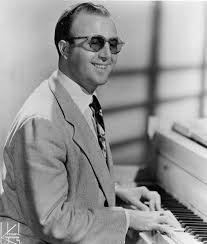
The Blind Prodigy from Battersea
To understand the immaculate elegance of George Shearing, one must first look at the sheer grit behind the sophistication. Born blind in the working-class streets of Battersea, London, Shearing didn’t just learn to play the piano; he learned to map the keyboard in his mind with the precision of a classical maestro. By the time he crossed the Atlantic in 1947, New York was in the throes of the furious, chaotic bebop explosion. While everyone else was trying to play faster and louder, Shearing did something far more radical: he cooled things down. He took the complex harmonic ideas of Charlie Parker, wrapped them in a polite British tailored suit, and delivered a sound so smooth it felt like late-night satin, yet so intellectually deep it stunned his peers.
The Chemistry of the Quintet: Locking the Block Chords
In 1949, Shearing changed the landscape of jazz with a single, legendary recording session for MGM: “Lullaby of Birdland”—a tune that became an anthem for the ages and a permanent crown jewel in The Jazz Compass. But his true stroke of genius was the invention of the “Shearing Sound.” He discarded the traditional piano-trio setup and formed a quintet featuring a vibraphone (played by Marjorie Hyams) and a guitar (Chuck Wayne). Shearing’s piano technique was revolutionary: he used “block chords” (or locked-hands style), where the melody was played in perfect unison by the piano, the vibes, and the guitar simultaneously. The result was a rich, thick, bell-like sonic texture that was incredibly accessible to the public, yet a marvel of harmonic geometry for musicians. It was the absolute epitome of high-art minimalism.
An Elegant Latitude
George Shearing was a man of bridges. He spent his life connecting classical counterpoint—the ghost of Johann Sebastian Bach—with the swinging syncopation of modern jazz. Later in his career, true to the global spirit of Jazz Latitude, he leaned into the infectious rhythms of Afro-Cuban jazz, collaborating with percussion giants like Armando Peraza to add a sun-drenched, tropical heartbeat to his cool, polite chords. He proved that sophistication doesn’t need to be cold or unapproachable. When Sir George Shearing touched the keys, he wasn’t just playing songs; he was inviting the listener into a smoke-free, beautifully lit penthouse of the mind, where every single note was exactly where it belonged.