The Prodigies of Tomasz Stańko
To fully appreciate the telepathic chemistry of the Marcin Wasilewski Trio, you have to look back at their origin story as teenage prodigies in Koszalin, Poland, during the early 1990s. They were barely out of high school when the legendary Polish trumpet titan Tomasz Stańko—the dark, poetic prince of European avant-garde—heard them play. Stańko didn’t just hire them; he adopted them as his permanent rhythm section for a decade, molding them in the fires of endless global tours and historic ECM albums like Soul of Things (2002). Under Stańko’s mentorship, the trio learned the supreme art of atmospheric tension. They discovered that jazz didn’t always need to scream or rush; it could whisper, brooding in the shadows of modal jazz while retaining a fierce, underlying emotional intensity.
The ECM Aesthetic: Painting with Silence and Light
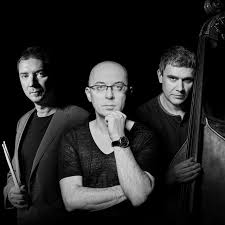
When the trio finally stepped out of Stańko’s shadow to record as leaders for ECM Records, they unlocked a spectacular, signature acoustic identity. For the high-art connoisseur diving into the catalog of The Jazz Compass, albums like Trio (2005), January (2008), and Spheres (2014) are absolute masterpieces of minimalist architecture. Wasilewski’s piano lines carry a heartbreaking, classical delicacy—reminiscent of Frédéric Chopin filtering through a Bill Evans prism—while Kurkiewicz’s woody, resonant bass and Miskiewicz’s impressionistic, shimmering cymbals create a vast ocean of space. The trio operates as a single, three-headed organism. Their genius lies in their telepathic improvisations, where they can transition from a delicate, melancholic whisper to a hard-swinging, muscular groove without a single cue.
The Borderless Latitude: From Pop to Post-Bop
True to the expansive, cross-cultural spirit of Jazz Latitude, the Marcin Wasilewski Trio has spent the last two decades proving that their musical geography has no boundaries. They are famous for their radical, sophisticated re-imaginations of non-jazz material, effortlessly transforming songs by pop icons like Prince (“Diamonds and Pearls”), Björk (“Hyperballad”), and cinema composer Ennio Morricone into deeply intellectual, modal jazz elegies. By bridging the gap between traditional Slavic lyricism, classical precision, and the driving freedom of modern American post-bop, they have established themselves as the ultimate modern compass for European jazz. They remind us that the finest high-art jazz is not a museum piece, but a living, breathing landscape where melody and deep emotion still reign supreme.