
Becoming Brazilian Away from Brazil
Between Two Cities
Vinicius Cantuária’s music often seems to exist in a room with the door left open. A samba rhythm may be present without insisting on itself; an acoustic guitar can carry the intimacy of bossa nova while electronic textures quietly alter the surrounding space; a melody can sound unmistakably Brazilian even when the musicians accompanying it belong to the experimental networks of downtown New York. This balance has made Cantuária difficult to place within a single category, but that difficulty is not a problem to be solved. It is one of the central facts of his career.
Descriptions such as neo-bossa nova, Brazilian jazz or contemporary MPB capture portions of what he does, yet none fully explains the continuity running through his work. Cantuária did not arrive in New York as an unknown musician who suddenly discovered an international language. By the time he moved there in 1994, he had already spent decades inside Brazilian popular music as a drummer, percussionist, guitarist, singer and songwriter. He had worked closely with Caetano Veloso, written songs that became widely known in Brazil and established a solo career of his own. New York did not create Vinicius Cantuária. It changed the environment around an identity that was already deeply formed.
The transformation was nevertheless profound. Distance altered the way he heard Brazil. Cantuária has repeatedly described the paradox himself: living outside the country intensified his relationship with Brazilian culture. In New York, surrounded by musicians from radically different backgrounds, he had more space to reflect on the music, literature and memories of the place he had left. Rather than diluting his Brazilian identity, migration concentrated it. At the same time, the city gave him access to collaborators for whom stylistic boundaries were already unstable — musicians who could move among experimental rock, electronic production, jazz improvisation, Brazilian music and avant-garde composition without requiring those territories to remain separate.
The result would eventually become one of the most distinctive Brazilian musical voices to emerge from New York in the 1990s and 2000s. But the story begins long before that move.
Before New York
Cantuária’s early career followed a path very different from the image of the restrained singer-guitarist that would later become familiar to international audiences. As a young musician he played drums with the Brazilian progressive-rock group O Terço, an experience that placed him inside a musical world far removed from the minimalism often associated with his later work. Rock, percussion and ensemble playing were part of his formation before the nylon-string guitar and intimate voice became the most immediately recognizable elements of his own records.
His trajectory soon brought him into the orbit of some of the central figures of Brazilian popular music. Most important was Caetano Veloso. Cantuária began working with him in the late 1970s and spent years performing in his band, contributing on guitar and percussion while also developing as a songwriter. The relationship gave him a privileged view of a musician for whom Brazilian tradition and international experimentation had never been mutually exclusive. Veloso’s work after Tropicália had already demonstrated that samba, rock, regional traditions, avant-garde ideas and international pop could coexist without requiring a Brazilian artist to surrender cultural specificity.
Cantuária absorbed that lesson without becoming a stylistic copy of Caetano. His own temperament was different, and the qualities that would later define his recordings — understatement, rhythmic subtlety, intimacy and an attraction to unusual sonic environments — gradually emerged through experience rather than manifesto. His songwriting also began to establish an identity independent of his role as an instrumentalist.
The crucial early breakthrough was “Lua e Estrela,” recorded by Caetano Veloso on Outras Palavras in 1981. The song became one of Cantuária’s best-known compositions and helped make his name familiar to a much larger Brazilian audience. Its success matters not merely as a biographical milestone but because it reveals something that remained central throughout his career: Cantuária understood the power of a song before he became internationally associated with sophisticated arrangements and cross-cultural collaborations. Melody came first.
After leaving Veloso’s band in the early 1980s, Cantuária increasingly pursued his own work. His first self-titled solo album appeared in 1982, followed by records including Gávea de Manhã, Sutis Diferenças, Siga-me and Nu Brasil. These recordings belonged to the broad landscape of Brazilian popular music rather than to a narrowly defined jazz career. He was a singer-songwriter and multi-instrumentalist moving through a scene populated by musicians with whom he had already developed longstanding connections.
This earlier period is essential because later international accounts sometimes make Cantuária’s career appear to begin with the sophisticated Brazilian-New York synthesis of the 1990s. It did not. The New York records are more revealing when heard as a second chapter: the work of an experienced Brazilian musician discovering what happened when familiar materials were placed in an unfamiliar environment.
Leaving Brazil to Hear It More Clearly
Cantuária moved to New York in 1994. For many musicians, migration to a major international center can create pressure to become less specific, to translate one’s work into a generalized global style. Cantuária’s experience moved in the opposite direction. He later reflected that being away from Brazil made him think about the country more intensely. Distance produced nostalgia, but also perspective. He could examine Brazilian musical language from outside its everyday environment.
New York offered another advantage: a community of musicians already accustomed to cultural collision. The downtown scene had spent years erasing convenient divisions between rock, experimental composition, improvisation, funk and music from outside the United States. Cantuária’s Brazilian vocabulary entered that environment not as an exotic object but as another living musical language capable of interaction.
Arto Lindsay became particularly important. Born in the United States but raised partly in Brazil, Lindsay possessed an unusual relationship with Brazilian music himself. His career had moved from the abrasive experimentation of DNA and the no-wave scene toward projects in which Brazilian songwriting, electronic texture and unconventional guitar language could occupy the same record. He understood both the intimacy of Brazilian song and the possibilities of destabilizing its surroundings.
Through Lindsay and the broader New York network, Cantuária encountered musicians including Ryuichi Sakamoto, Bill Frisell, Marc Ribot, Naná Vasconcelos, Cyro Baptista and others whose careers resisted simple categories. Cantuária contributed to Lindsay’s work and appeared on Sakamoto’s Smoochy, while simultaneously developing the material that would establish the next phase of his own recording career.
These relationships were not valuable because international collaborators somehow modernized Brazilian music for him. Cantuária had already spent his career inside a Brazilian culture defined by transformation. The more interesting exchange worked in both directions. His rhythmic understanding, guitar language and songwriting entered a New York scene eager for different approaches to structure and groove, while the city’s musicians and studios gave him new ways to frame those elements.
Sol na Cara
Released in 1996, Sol na Cara became the decisive document of this transition. The album retains the intimacy of Brazilian song while surrounding it with arrangements that rarely behave as straightforward reproductions of bossa nova or samba. Cantuária sings and plays guitar and percussion, but the record also draws on the presence of Ryuichi Sakamoto, Arto Lindsay and other collaborators. Lindsay co-produced the album, while Sakamoto contributed keyboards, piano and arrangements as well as co-writing material with Cantuária.
The opening “Sem Pisar no Chão,” written by Cantuária with Caetano Veloso, immediately establishes the album’s refusal to separate song from atmosphere. The Brazilian foundation is clear, but the production leaves unusual spaces around the voice and guitar. Electronic elements do not arrive as announcements of modernity. They remain integrated into the arrangement, changing the texture without overwhelming the composition.
That restraint is crucial. During the 1990s, Brazilian music was repeatedly repackaged internationally through ideas of exoticism, lounge nostalgia or simplified bossa-nova sophistication. Sol na Cara avoids those traps because Cantuária does not present Brazilian rhythm as scenery. Samba and bossa nova are internal languages. They can therefore be reduced, fragmented or placed beside electronics without losing their identity.
“Rio Negro” makes the relationship with Brazil explicit even in its title, but the album’s sense of place is rarely picturesque. Cantuária is not offering a postcard of Rio de Janeiro for an international audience. His Brazil is remembered, reconstructed and altered by distance. That gives the music an unusual emotional quality: familiarity and displacement exist simultaneously.
“Samba da Estrela” illustrates another side of his writing, drawing more visibly on Brazilian rhythmic tradition while maintaining the album’s carefully controlled scale. “Ludo Real,” written with Chico Buarque, reinforces the connection between Cantuária and the sophisticated tradition of Brazilian songwriting from which he emerged. The presence of these collaborators is not ornamental. Caetano and Chico belong to Cantuária’s musical history, while Lindsay and Sakamoto represent the environment into which that history was now moving.
Jobim Without Nostalgia
One of the album’s most revealing choices is Antônio Carlos Jobim’s “Este Seu Olhar.” By the mid-1990s, Jobim’s international reputation was inseparable from the global mythology of bossa nova. Revisiting one of his compositions therefore carried the risk of becoming an exercise in elegant nostalgia. Cantuária avoids that problem by treating the song as living repertoire rather than historical property.
This approach would become increasingly important throughout his career. Jobim was not a museum figure to be reproduced with period authenticity. His songs were durable structures capable of surviving different arrangements, musicians and eras. Cantuária could respect the melodic and harmonic intelligence of the composition while allowing it to exist within his own quieter, contemporary environment.
The same principle explains why calling Cantuária a neo-bossa nova musician is both understandable and insufficient. João Gilberto’s revolution in voice, guitar and rhythmic compression is clearly part of the historical background against which Cantuária works, and Jobim’s songwriting remains a major reference. But Cantuária’s music also contains the experience of Brazilian rock, MPB, percussion, experimental New York, electronic production and decades of collaboration. His work does not revive bossa nova. It asks what Brazilian song can become after bossa nova has already changed the world.
A New Chapter, Not a Reinvention
Sol na Cara did not erase the musician Cantuária had been in Brazil. It revealed how portable that musical identity was. The songs could travel from Rio to New York, enter studios with experimental musicians and electronic textures, and still retain the rhythmic and melodic logic from which they emerged. The transformation occurred not through rejection of the past but through a change of context.
That would become the foundation of the next stage of his career. With Tucumã and then Vinicius, Cantuária would deepen his relationship with the New York musical community and bring musicians from jazz, experimental music and Brazilian traditions into increasingly subtle combinations. Bill Frisell, Joey Baron, Brad Mehldau, Marc Johnson, Naná Vasconcelos and others would enter his recordings without turning them into conventional jazz albums.
The distinction is important. Vinicius Cantuária did not move from Brazilian popular music into jazz in a straight line. He created a space in which those categories became less useful. The guitar could suggest João Gilberto without imitating him; a rhythm could carry samba without announcing itself as samba; an improviser from New York could enter a Brazilian song without converting it into a jazz standard.
By the end of Sol na Cara, the geography of Cantuária’s career had changed permanently. Rio remained inside the music, but New York had given it another room in which to breathe. The distance between those cities would become one of his richest creative spaces.
Buy Amazon
New York Becomes Part of the Music
After Sol na Cara
Sol na Cara established the terms of Vinicius Cantuária’s new life in New York, but it did not settle them. If anything, the album opened possibilities that subsequent recordings could explore more deeply. Cantuária now occupied an unusual position. He possessed the experience of a Brazilian musician who had worked for years inside MPB and popular song, yet he was increasingly connected to a New York community in which jazz improvisation, experimental rock, electronic production and music from multiple traditions circulated freely. The challenge was not to choose between these environments but to make the relationship between them feel natural.
That process continued with Tucumã, released in 1999. The album widened the network surrounding Cantuária while preserving the intimacy that had distinguished Sol na Cara. Musicians including Bill Frisell, Joey Baron, Marc Johnson and Brad Mehldau entered a musical space whose center remained Cantuária’s voice, guitar, percussion and songwriting. Their presence could easily have turned the record into an international all-star project, but the opposite happens. The arrangements remain economical, and the collaborators adapt themselves to the scale of the songs rather than treating them as platforms for display.
This is one of the recurring strengths of Cantuária’s work. He invites musicians with highly recognizable identities and somehow prevents those identities from overwhelming the composition. Frisell can remain unmistakably Frisell without converting the music into one of his own records. Mehldau can contribute his harmonic imagination without turning a Brazilian song into an extended piano feature. Joey Baron can bring extraordinary rhythmic sensitivity while respecting the small movements on which Cantuária’s grooves depend. The music absorbs personalities rather than collecting them.
Tucumã and the Art of Reduction
The title Tucumã refers to a Brazilian palm and its fruit, immediately placing the album within a Brazilian field of reference even though much of its musical environment reflects Cantuária’s New York life. That combination of geographic memory and present experience is central to the record. Brazil does not appear as an untouched origin to which the musician nostalgically returns; it travels with him, changing as it encounters different people and sounds.
Cantuária’s guitar is crucial to this continuity. His relationship with the instrument inevitably invites comparisons with João Gilberto because of the importance of rhythmic compression, understatement and the integration of voice and guitar. Yet Cantuária’s approach belongs to another generation and another set of experiences. He is willing to leave more of the surrounding sonic environment open to collaborators, percussion, electric guitar and studio texture. The guitar establishes a rhythmic and harmonic center without demanding that everything else conform to the classic bossa nova model.
This creates room for improvisers. A musician such as Frisell does not need to compete with a dense arrangement because Cantuária’s songs contain openings where a sustained electric-guitar note or unusual timbre can alter the atmosphere. Marc Johnson’s bass can give the music harmonic depth without turning it into conventional jazz accompaniment. Baron can respond to the Brazilian rhythmic foundation while retaining the flexibility of an improvising drummer. The result is not fusion in the sense of placing two clearly defined genres side by side. The borders become difficult to locate.
That ambiguity is important because Cantuária’s international career coincided with a period when Brazilian music was frequently marketed through easily recognizable stylistic signs. Bossa nova could be packaged as sophistication, samba as rhythmic exuberance, and electronic remixes as evidence of modernization. Cantuária’s music resists these simplified categories. He does not need to exaggerate Brazilian identity because it is already embedded in the phrasing. Nor does he need to make electronics or jazz improvisation conspicuous in order to demonstrate contemporaneity.
The modernity of Tucumã lies in how little it needs to announce itself.
Bill Frisell: A Conversation Begins
Bill Frisell became one of Cantuária’s most important collaborators because the two guitarists share a particular understanding of space. Their instrumental languages are very different. Cantuária’s guitar grows from Brazilian rhythmic traditions and the intimate relationship between accompaniment and song, while Frisell developed one of the most distinctive electric-guitar voices in American improvised music, drawing from jazz, country, folk, rock and electronic processing. What connects them is an unwillingness to fill every available moment.
Frisell often makes a single note function like an environmental change. His sustained tones and carefully chosen harmonies can alter the emotional color of a song without interrupting its movement. That quality suits Cantuária particularly well. The Brazilian guitarist does not need another musician to reproduce his rhythmic language; he needs someone capable of listening to it and finding another position inside the same composition.
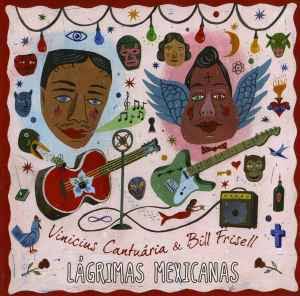
Their collaboration would eventually reach its most concentrated form on Lágrimas Mexicanas, but the relationship developed over years. This gradual evolution matters. The later duo album was not the product of a marketing concept pairing two celebrated guitarists. It emerged from an established musical friendship in which both musicians had already learned how their differences could coexist.
Cantuária’s New York period is filled with relationships of this kind. Rather than creating a fixed band and defending a single ensemble sound, he built a network of collaborators who could enter different projects according to what the songs required. That flexibility gave his records continuity without uniformity.
Vinicius
The album Vinicius, released in 2001, pushed this approach further. By placing his own first name at the center of the title, Cantuária seemed almost to acknowledge that the synthesis developed since moving to New York had become sufficiently coherent to stand as an identity in itself. Brazilian songwriting, understated vocals, acoustic guitar, percussion, electronics and improvisational collaboration no longer needed to be explained as separate ingredients.
The record again draws on musicians from different environments, including Brad Mehldau, Bill Frisell, Joey Baron and Marc Johnson. Yet the strongest impression is not stylistic variety but continuity. Cantuária’s songs establish a gravitational center strong enough to make those different instrumental voices belong to the same world.
Mehldau is an especially interesting presence because his own career at the time was expanding the expectations surrounding contemporary jazz piano. His improvisational language could be harmonically dense and structurally ambitious, but in Cantuária’s music the relevant quality is his ability to listen and adapt. The encounter demonstrates something central to Cantuária’s work: collaboration does not require musicians to abandon their personalities, but it does require them to understand the scale of the song.
The same principle applies to rhythm. Cantuária is a percussionist as well as a guitarist and singer, and his understanding of groove comes from inside the physical experience of playing rhythm. Even when a track appears almost weightless, the pulse is rarely vague. Samba and related Brazilian patterns may be reduced to small gestures, but reduction does not mean disappearance. The rhythm can survive in the guitar attack, the placement of a vocal phrase or a percussion detail rather than in a full ensemble explicitly stating the pattern.
This is one reason his music can feel quiet without becoming static. Beneath the surface there is nearly always motion.
Naná Vasconcelos and a Wider Brazilian Memory
The presence of Naná Vasconcelos in Cantuária’s musical world provides another important connection. Vasconcelos had spent decades demonstrating that Brazilian percussion could operate far beyond conventional expectations of accompaniment. His work with musicians across jazz, experimental music and international improvisation transformed the berimbau and a vast range of percussion into vehicles for texture, melody and atmosphere.
For Cantuária, this represented a Brazilian experimental tradition that existed independently of New York. It is therefore misleading to imagine his career as a movement from a traditional Brazil toward an experimental United States. Brazilian music itself contained enormous traditions of experimentation, from Tropicália and post-bossa songwriting to instrumental improvisation and the work of figures such as Hermeto Pascoal, Egberto Gismonti and Vasconcelos.
Cantuária’s New York years allowed these histories to interact with another experimental environment. The significance lies in the conversation, not in a narrative of modernization imported from abroad.
Arto Lindsay represents perhaps the clearest embodiment of that two-way movement. His childhood in Brazil, involvement in New York no wave and later engagement with Brazilian songwriting made him almost impossible to assign exclusively to either country. Cantuária’s collaborations with Lindsay similarly undermine the idea that Rio and New York are opposite poles. The cities become overlapping spaces connected by musicians who have spent significant portions of their lives moving between languages and cultures.
The Voice at the Center
Amid these collaborations, Cantuária’s singing remains one of the most distinctive elements of his work. His voice is not built around projection or dramatic range. It operates close to the listener, often almost conversationally, preserving the intimacy historically associated with bossa nova while developing its own grain and phrasing.
The understatement is deceptive. Singing softly requires precise control because small changes become more exposed. Cantuária can shift the placement of a phrase against the guitar rhythm, delay a word or allow a syllable to carry across a harmonic change. The effect is rhythmic as much as melodic. Voice and guitar function together, each modifying the listener’s perception of the other.
This helps explain why elaborate accompaniment would often be counterproductive. Cantuária’s music depends on maintaining enough open space for these micro-adjustments to remain audible. Collaborators who understand this can make a substantial contribution with remarkably little material.
The same aesthetic separates Cantuária from simplistic ideas of virtuosity. He is a highly skilled multi-instrumentalist, but technique in his music is rarely presented as spectacle. The relevant virtuosity lies in coordination: singing a phrase while the guitar establishes an independent rhythmic pattern, introducing percussion without disturbing the song’s balance, or creating enough space for another musician to alter the harmony with a single intervention.
Neither Rio nor New York Alone
By the early 2000s, describing Cantuária simply as a Brazilian musician living in New York no longer captured what had happened. New York had become part of his musical identity, just as Brazil remained fundamental to it. The relationship was no longer one of origin and destination.
This is the deeper meaning of the Rio-New York continuum that runs through his career. It is not a romantic image of two glamorous cities connected by sophisticated music. It is the practical reality of a musician whose songs carry memories, rhythms and harmonic habits across geography, and whose collaborations alter those materials without erasing them.
The records from Sol na Cara through Tucumã and Vinicius established that language with increasing confidence. They demonstrated that Brazilian song could remain culturally specific while participating in an international improvisational environment, and that musicians from different traditions could contribute without forcing the music into a generic fusion style.
Cantuária had found a musical space in which João Gilberto and experimental New York did not need to be opposites, where samba could exist without being loudly announced and where a jazz improviser could enter a Brazilian song without converting it into jazz.
The next phase would test that intimacy even further. With Bill Frisell, Cantuária would eventually reduce the environment to an extended conversation between two musicians on Lágrimas Mexicanas. He would also return explicitly to Antônio Carlos Jobim, confronting one of the deepest sources of his musical language without turning homage into nostalgia. These projects would reveal that the most important journey in Cantuária’s career was never simply from Rio to New York. It was the movement back and forth between memory and reinvention.
Buy Amazon

The Freedom to Remain Unclassifiable
Lágrimas Mexicanas: Two Guitarists, One Conversation
By the time Vinicius Cantuária and Bill Frisell recorded Lágrimas Mexicanas, their musical relationship had already developed through years of collaboration. That history is essential to understanding the album. What might appear on paper to be an unusual meeting between a Brazilian singer-songwriter and one of the most distinctive American guitarists of his generation does not sound like a collision of separate traditions. The music is too relaxed for that. Cantuária and Frisell had already learned how to inhabit the same space.
Released in 2011, Lágrimas Mexicanas strips away much of the larger collaborative environment surrounding Cantuária’s earlier New York recordings. The reduction brings the musicians closer together. Guitars, voice, percussion, loops and electronic details form an intimate landscape in which neither performer needs to dominate. Cantuária provides much of the rhythmic foundation, while Frisell moves through the songs with the combination of restraint and harmonic unpredictability that has defined so much of his work.
The album’s title suggests Mexico, yet its musical geography is deliberately unstable. Brazilian rhythm, American guitar language, Latin American imagery, blues-inflected harmony and electronic atmosphere overlap without being organized into a demonstration of stylistic fusion. The record instead reflects something that had become increasingly characteristic of Cantuária’s career: geography as lived experience rather than genre.
This is why the partnership with Frisell works so well. Both musicians have spent much of their careers resisting the idea that musical traditions must remain in clearly separated territories. Frisell can draw on country music, jazz, folk, blues and experimental sound without treating any of them as costumes. Cantuária approaches samba, bossa nova, MPB and contemporary production with a comparable freedom. Neither musician needs to announce where an influence comes from before using it.
The songs therefore unfold as conversations rather than stylistic statements. One guitarist may establish a rhythmic figure while the other responds with a sustained tone; percussion can quietly shift the direction of the groove; a vocal melody can carry the emotional center while the guitars alter the landscape around it. What matters is not technical display but the quality of attention between the two players.
The album represents a mature stage of the principle already present on Sol na Cara: leave enough space for another musician to change the meaning of a song.
Beyond the Idea of Fusion
Cantuária’s career is sometimes described through the language of fusion, but the term can be misleading. Fusion implies that previously separate musical substances are being combined. In Cantuária’s world, those separations often cease to matter in the first place. A Brazilian musician who spent years playing with Caetano Veloso, moved to New York, worked with Arto Lindsay and Ryuichi Sakamoto, collaborated with jazz improvisers and continued writing songs in Portuguese does not experience those traditions as neatly divided compartments.
His work is better understood through accumulation. Each stage of his life adds another possibility without requiring him to erase what came before. The drummer and percussionist remains inside the guitarist. The songwriter who wrote “Lua e Estrela” remains inside the experimental collaborator. The musician shaped by João Gilberto and Antônio Carlos Jobim remains present even when the arrangement contains loops, electric-guitar textures or musicians associated with contemporary jazz.
This accumulated identity explains the naturalness of Cantuária’s international collaborations. They rarely feel like attempts to prove versatility. He does not need to demonstrate that Brazilian music can coexist with jazz or experimental production; decades of Brazilian music had already established that possibility. Instead, he uses whatever combination of musicians and sounds allows a particular song to breathe.
That distinction also protects his work from the idea that Brazilian music becomes more contemporary when it encounters New York. Cantuária arrived in the city carrying traditions that were themselves products of constant transformation. Bossa nova had radically reconsidered samba, harmony and vocal delivery. Tropicália had destabilized ideas of cultural purity. MPB had absorbed and contested rock, funk, jazz, regional traditions and international pop. Brazilian instrumentalists had been exchanging ideas with improvisers around the world for decades.
New York did not provide modernity to Cantuária. It provided another environment in which an already modern Brazilian musical imagination could continue evolving.
Returning to Jobim
Few figures loom larger over the international understanding of Brazilian music than Antônio Carlos Jobim. For a musician such as Cantuária, that legacy creates both opportunity and difficulty. Jobim’s compositions are among the most durable achievements of twentieth-century popular song, but their global familiarity can encourage repetition. The challenge is not simply to perform them beautifully. It is to discover why they remain alive.
Cantuária eventually confronted that challenge directly with Vinicius Canta Antonio Carlos Jobim. The project makes explicit a relationship that had long been present in his music. Jobim had already appeared in Cantuária’s repertoire, and the intimacy of voice and guitar inevitably placed his work within the history transformed by bossa nova. A dedicated Jobim project, however, required Cantuária to approach that inheritance without allowing reverence to become imitation.
His solution is consistent with the rest of his career. Rather than reconstructing the atmosphere of the late 1950s and early 1960s, he treats Jobim’s compositions as contemporary songs. Their harmonic architecture is respected, but they are allowed to inhabit Cantuária’s own musical present. The point is not to reproduce João Gilberto’s revolutionary relationship between guitar and voice or to recreate the orchestral elegance associated with Jobim’s classic recordings. Those achievements already exist.
What Cantuária can offer is distance: the perspective of a musician born into a Brazil that bossa nova had already transformed, who later carried that musical inheritance through MPB, rock, New York experimentation and international collaboration. When he returns to Jobim, he does so from the other side of that history.
This is an important difference between preservation and continuity. Preservation tries to protect a work from change. Continuity allows it to change precisely because it remains meaningful.
The Shadow of João Gilberto
João Gilberto is equally unavoidable when discussing Cantuária, although the comparison requires care. Any Brazilian singer-guitarist who values understatement, rhythmic precision and intimacy will inevitably be heard against the revolution João created. His reorganization of samba rhythm on the guitar and his radical approach to vocal dynamics altered the possibilities of Brazilian popular music permanently.
Cantuária belongs to the generations that followed that transformation. He does not need to repeat it.
What he inherits from João is less a collection of gestures than an understanding of scale. Quietness can carry intensity. Rhythm does not require volume. A guitar can simultaneously establish harmony, percussion and forward motion. A singer does not need theatrical projection to command attention.
Cantuária extends those principles into environments João Gilberto never needed to inhabit. Electronics, electric guitars, New York improvisers and contemporary studio production can surround the song while its internal balance remains intact. The lineage is therefore audible without becoming restrictive.
That ability to acknowledge a tradition without being trapped inside it may be one of Cantuária’s most significant achievements.
Psychedelic Rio and the Persistence of Curiosity
Later projects continued to demonstrate that Cantuária had little interest in settling into the role of elder statesman reproducing an established style. Psychedelic Rio, released in the late 2010s, carries a title that might initially suggest a dramatic stylistic departure, but its deeper significance lies in continuity. Cantuária remains attracted to texture, repetition, rhythmic ambiguity and the possibility of allowing Brazilian songwriting to interact with unexpected sonic environments.
The word “psychedelic” is useful less as a genre designation than as an indication of loosened boundaries. Cantuária’s Rio is not frozen in the imagery of classic bossa nova, just as his New York is not reducible to jazz or the downtown avant-garde. Both cities have changed during his lifetime, and his music reflects that movement.
This continuing curiosity separates him from musicians whose international careers become dependent on a recognizable export identity. Cantuária could easily have spent decades producing elegant variations on the sound that first attracted international attention. Instead, his discography repeatedly changes the surrounding context. Ensembles expand and contract. Electronics become more or less prominent. Collaborators enter and leave. Repertoire moves between original compositions and reinterpretations of Brazilian song.
The center holds because the identity is deeper than the arrangement.
What Cantuária Changed
It would be tempting to conclude Cantuária’s story by declaring him the inventor of a genre or the architect of a movement. Such claims make careers easier to summarize, but they obscure what makes his work interesting. He did not single-handedly create “neo-bossa nova,” nor did Brazilian music require him to rescue it through contact with New York. The history is richer than either narrative.
Cantuária’s importance lies partly in demonstrating a different model of international Brazilian musicianship. He could remain unmistakably Brazilian without allowing international audiences to dictate what Brazilian music was supposed to sound like. Samba did not need to arrive with maximum rhythmic visibility. Bossa nova did not need to be reproduced as retro sophistication. Jazz musicians could participate without the music becoming a conventional jazz project. Electronics could enter without being used as proof that the music had become modern.
This freedom was possible because Cantuária understood tradition as vocabulary rather than obligation.
His career also illuminates a larger story about Brazilian musicians abroad. Migration does not necessarily produce cultural distance. In Cantuária’s case, leaving Brazil intensified his relationship with it. New York gave him the physical and psychological distance from which Brazilian music could be reconsidered, while his collaborations made clear how easily that language could participate in conversations far beyond national categories.
The movement was reciprocal. Cantuária brought something to New York as much as New York gave something to him.
The Rio–New York Continuum
Rio and New York remain useful coordinates in Cantuária’s biography, but neither city can fully contain his music. Rio represents childhood, Brazilian popular culture, samba, songwriting, Caetano Veloso, Jobim and the enormous musical history from which he emerged. New York represents migration, experimentation, new collaborators and the experience of seeing Brazil from a distance. Yet after decades of movement between those worlds, separating them becomes increasingly artificial.
The continuum exists inside the songs.
A guitar pattern can carry a rhythmic memory from Brazil while an electric line from Bill Frisell opens another harmonic direction. A composition can retain the concision of Brazilian popular song while musicians associated with improvisation reshape its edges. Portuguese lyrics can inhabit a New York studio without becoming exotic objects. Jobim can coexist with electronics. Silence can be as structurally important as percussion.
None of these combinations requires a new genre name.
That may be why Cantuária’s work has aged so well. Music marketed primarily through novelty often becomes attached to the moment that produced it. Cantuária’s best recordings depend instead on relationships: between rhythm and melody, voice and guitar, memory and migration, composition and improvisation. Those relationships remain open to reinterpretation.
The Art of Carrying Home
There is a quiet paradox at the center of Vinicius Cantuária’s career. He had to leave Brazil to discover another way of remaining connected to it. The move to New York expanded his community, altered his recording environment and introduced collaborators who would become central to his work, but it did not dissolve the musical identity he had formed during decades in Brazil.
Instead, distance turned that identity into something portable.
From “Lua e Estrela” and his years with Caetano Veloso to Sol na Cara, Tucumã, Vinicius, the dialogue with Bill Frisell, his return to Jobim and the exploratory projects of his later career, Cantuária has repeatedly demonstrated that tradition survives not by remaining untouched but by continuing to move. His Brazil is neither a preserved past nor a stylistic label. It is a language capable of traveling.
And perhaps that is the most revealing way to understand the intimacy of his music. Beneath the changing collaborators, cities and production methods, Cantuária has remained fundamentally committed to the song: a melody, a rhythm, a voice and enough open space for another possibility to enter.
Rio gave him the language. New York changed the conversation. Vinicius Cantuária spent the decades between them proving that he never had to choose one over the other.