
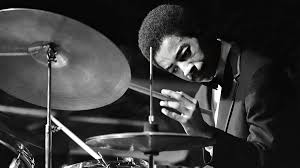
The Teen Prodigy and the Miles Davis Earthquake
To grasp the absolute shockwave that Tony Williams represented, you have to picture Miles Davis in 1963, searching for a spark to reinvent his music, walking into a Boston club and being completely paralyzed by a 17-year-old kid behind the drums. Miles hired him on the spot. Alongside Herbie Hancock, Ron Carter, and Wayne Shorter, Williams became the motor of the Second Great Quintet—arguably the most telepathic acoustic lineup in history. Tony discarded the traditional role of the drummer as a polite metronome. Instead, he introduced “metric modulation”—a dizzying technique where he could shift tempos, drop volcanic polyrhythms, and play across the bar lines while keeping a flawless, driving pulse on his signature heavy yellow Gretsch kit. He single-handedly dragged jazz drumming out of the post-bop era and into a hyper-modern, elastic dimension.
The Lifetime Manifesto: Inventing Jazz-Rock Fusion
By the late 1960s, Tony Williams’s restless creative mind could no longer be contained by acoustic boundaries. In 1969, before Miles recorded Bitches Brew, Tony left the quintet to form The Tony Williams Lifetime alongside guitar genius John McLaughlin and organist Larry Young. For the high-art connoisseur exploring the evolutionary leaps of The Jazz Compass, their debut album Emergency! (1969) is an absolute holy scripture of avant-garde noise. Williams cranked up the volume, stepped up to the microphone, and delivered a raw, blistering, and fiercely complex sonic assault that combined the heavy, distorted thunder of Jimi Hendrix with the supreme intellectual rigor of post-bop jazz. It was the exact birth certificate of Jazz Fusion, a record that terrified traditional purists but blew open the doors to the future of instrumental music.
The Infinite Latitude of a Rhythmic Visionary
True to the borderless, forward-thinking spirit of Jazz Latitude, Tony Williams spent his life proving that rhythm was a living, breathing architecture. He was an absolute master of contrast; he could drive an orchestra with a delicate, military-precise snare roll or drop a heavy, rock-infused bass drum bomb that felt like a localized earthquake. In the 1980s, he returned to his acoustic roots with a legendary hard bop quintet for Blue Note Records, proving that even as a seasoned veteran, his phrasing remained as sharp, urgent, and youthful as it was in his teenage years. Though his journey was cut tragically short by a sudden heart attack in 1997 at age 51, Tony Williams remains fixed on our musical map as the ultimate revolutionary who took the safety rails off the drum set and taught jazz how to manipulate time itself.