The Blacksmith of the Polyphony
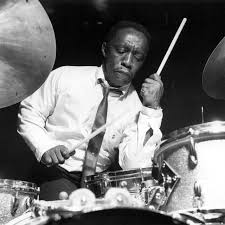
To truly map the explosive shift from bebop to hard bop in the mid-1950s, you have to stand directly in front of Art Blakey’s bass drum. Born in Pittsburgh, Blakey started out playing piano before a local club owner forced him to switch to drums at gunpoint to make room for a young Erroll Garner. It was the greatest accidental detour in music history. Blakey brought a raw, industrial power to the drum set, heavily influenced by his formative travels to Africa in the late 1940s, where he immersed himself in Islamic culture and ancient polyrhythmic codes. He abandoned the polite, understated time-keeping of the swing era, transforming his hi-hat into an iron-clad anvil on beats two and four, and using his signature, thunderous press-roll on the snare drum to launch soloists into outer space.
The Jazz Messengers: The Ultimate Proving Ground
In 1954, alongside pianist Horace Silver, Blakey co-founded The Jazz Messengers—an institution that would become the most prestigious, hard-swinging academy in jazz history for over three decades. For the high-art connoisseur diving into The Jazz Compass, masterpieces recorded for Blue Note Records like Moanin’ (1958) and A Night at Birdland (1954) are absolute holy scriptures. Blakey wasn’t just a bandleader; he was a master curator of raw youth. He had a prophetic eye for talent, recruiting and molding every future giant of the genre—from Lee Morgan and Wayne Shorter to Wynton Marsalis. Blakey’s musical philosophy was beautifully brutal: he would push his young horn players to the absolute edge of their technical and emotional limits, driving them from behind the kit with an aggressive, volcanic groove that refused to let anyone play it safe.
The Global Horizon: Preaching the Gospel of Groove
True to the borderless, forward-thinking latitudes of Jazz Latitude, Art Blakey viewed his music not as mere entertainment, but as a spiritual gospel that needed to be preached to every corner of the earth. The Jazz Messengers became global cultural diplomats, taking their soul-drenched, blues-infused hard bop to ecstatic audiences in Europe, Africa, and Japan—where Blakey was treated with the reverence of a reigning monarch. He proved that the core of jazz was an ancestral, universal language that bypassed the intellect and struck straight at the human ribcage. When Art Blakey finally put down his sticks in 1990, he left behind a permanent, thundering coordinate on our musical map—a legacy that reminds us that jazz is, and always will be, a celebration of pure, unadulterated vital energy.