The Chicago Dissident and the Birth of the Cool
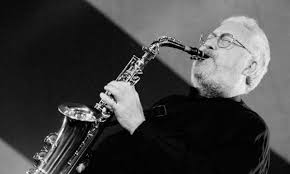
To truly measure the immense artistic spine of Lee Konitz, you have to imagine a young man standing in the middle of 1940s New York, completely surrounded by the overwhelming sonic explosion of Charlie “Bird” Parker, and choosing not to follow him. Under the rigorous, quasi-mathematical guidance of pianist and theorist Lennie Tristano, Konitz developed a radical counter-cultural approach to the alto saxophone. Instead of Parker’s blues-drenched, hyper-speed rhythmic fireworks, Lee brought a pale, light, and transparent tone to the horn—entirely devoid of heavy vibrato. This cool, intellectual precision made him the definitive, indispensable alto voice for Miles Davis’s legendary Birth of the Cool (1949–1950) sessions, establishing a brand-new emotional landscape that proved jazz could completely enthrall an audience through understated brilliance.
The West Coast Convergence and the Art of Pure Improv
For the high-art connoisseur searching for the structural milestones on The Jazz Compass, Lee Konitz’s mid-century discography is an absolute goldmine of linear counterpoint. In the early 1950s, his collaborations with baritone saxophonist Gerry Mulligan and trumpeter Chet Baker came to define the smart, breezy aesthetics of West Coast Jazz. Yet, Konitz always resisted easy categorization. He was a musician’s musician, fascinated by the architecture of the melody itself. Masterpieces like Subconscious-Lee (1950) showcased his uncanny ability to take standard chord progressions and completely reinvent them on the fly, teetering on long, serpentine phrases that felt like a high-wire tightrope walk over uncharted harmonic territories. He stripped jazz of its showmanship, focusing entirely on the raw, holy act of real-time composition.
The Vanguard Voyager Across the Eternal Latitude
True to the borderless, forward-thinking latitudes of Jazz Latitude, Lee Morgan’s contemporary, Lee Konitz, mapped out a creative geography defined by total, uncompromised longevity. He never froze into a nostalgia act. Across his historic seven-decade career, Konitz remained a restless vanguard explorer, recording challenging, intimate avant-garde duets with everyone from guitar master Bill Frisell to modern piano wizards like Brad Mehldau. He played with the fierce curiosity of a student until his final days, passing away in 2020 at the age of 92. Lee Konitz left behind an immovable, brilliant coordinate on our musical map—a monument that stands as a eternal reminder that the greatest form of artistic courage is simply to find your own voice, trust it completely, and let it sing with absolute purity.