The Metamorphosis of the Session: From Pubs to the Avant-Garde
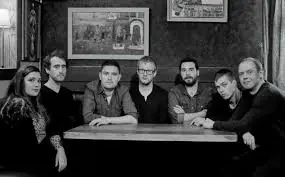
To understand the quiet revolution of Ensemble Ériu, one must first dismantle the stereotype of Irish traditional music as merely high-energy pub tunes. Founded in 2011 by concertina virtuoso Jack Talty and bassist/composer Neil O’Loghlen, the group set out to prove that the ancient melodies of the West of Ireland possessed a deep, overlooked chamber-music quality. Drawing from their deep roots in County Clare, they brought together a unique septet that mirrors an unconventional chamber orchestra: concertina, double bass, clarinet, marimba, flute, drums, and electric guitar. Instead of just playing the reels and jigs in standard arrangements, Ériu began to peel back the layers of these century-old tunes, stretching their time signatures and altering their harmonic structures to create a landscape of stunning, cerebral intensity.
The Reichian Grid: Modal Landscapes and the Art of the Slow Burn
The true artistic masterstroke of Ensemble Ériu is their brilliant encapsulation of American minimalism within a Celtic framework. For the high-art collector diving into the treasures of The Jazz Compass, their self-titled debut album (2013) and the monumental Imbas (2016)—released on the visionary Diatribe Records—are essential sacred texts. Influenced heavily by the rhythmic phasing of Steve Reich, the modal freedom of Miles Davis, and the delicate textures of The Necks, the septet builds its songs through hypnotic, slowly evolving loops. A simple, ancient fiddle melody is introduced, only to be caught in a spinning wheel of marimba patterns, swelling electric guitars, and jazz-inflected bass lines. It is a masterclass in atmospheric tension, proving that ultimate sophistication lies in the power of the slow burn.
The Ancient Latitude: Redefining Global Folk-Jazz
True to the borderless, forward-thinking spirit of Jazz Latitude, Ensemble Ériu’s music functions as a timeless bridge connecting historical memory with contemporary intellect. In 2015, they won the prestigious Graduates Award for their radical reimagining of the archival recordings of legendary Clare whistle player Willie Clancy. By placing Clancy’s mid-century field recordings inside a lush, avant-garde jazz envelope, they didn’t just preserve history; they gave it a futuristic pulse. Ensemble Ériu reminds us that the best modern jazz doesn’t need to mimic the traditional American landscape to be authentic. By digging into the microtonal beauty and the raw, untamed soul of Irish folklore, they have mapped a brilliant new coordinate where ancestral roots and avant-garde jazz walk hand in hand into the infinite unknown.