
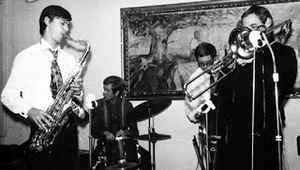
Four Norwegian Musicians at the Edge of a New Language
Before the Familiar Image of Jan Garbarek
There is a version of Jan Garbarek that became so recognizable that it can obscure the musician who existed before it. For many listeners, his name evokes long melodic lines suspended over spacious arrangements, an unmistakably penetrating saxophone tone, folk-derived melodies, carefully measured silence and the expansive atmosphere associated with some of ECM’s most internationally successful recordings. That Garbarek is real, but he was not born fully formed. Go back to Afric Pepperbird, recorded in Oslo in September 1970, and the picture changes dramatically. The saxophone can be abrasive, urgent and almost violent. Terje Rypdal’s guitar does not decorate a tranquil landscape; it destabilizes the music. Arild Andersen’s bass alternates between anchoring the ensemble and helping pull it apart, while Jon Christensen treats rhythm as an open field rather than a fixed grid. The quartet sounds young because it was young, but more importantly it sounds as though its members have discovered that the vocabulary they inherited can be pushed somewhere they have not yet completely mapped.
That uncertainty is one of the great attractions of Afric Pepperbird. It would be easy, with more than half a century of hindsight, to describe the album as the birth of the “Nordic sound,” the instant European jazz liberated itself from American influence or the moment the ECM aesthetic suddenly appeared. All three ideas are too neat. European jazz already possessed multiple identities, and musicians across the continent had been developing distinctive approaches long before Garbarek entered the studio. ECM itself was still young, and the spacious, contemplative characteristics later associated with the label were only one part of its developing identity. Afric Pepperbird is valuable precisely because it resists the mythology that eventually accumulated around both Garbarek and ECM. It captures four Norwegian musicians whose understanding of American jazz was profound but who were beginning to discover that influence did not require imitation. The album is not a clean declaration of independence. It is the sound of independence being negotiated.
Oslo, 1970
When the Jan Garbarek Quartet entered Arne Bendiksen Studio on September 22 and 23, 1970, Norwegian jazz occupied a very different position from the one it would hold internationally a decade later. The musicians were working within a European jazz culture that had absorbed bebop, cool jazz, modal improvisation and the increasingly radical consequences of the free-jazz revolution. American musicians remained central reference points, but European players were no longer simply reproducing imported styles. Festivals, clubs, radio institutions and networks of touring musicians had created environments in which local scenes could develop sustained identities of their own.
Garbarek was twenty-three. Rypdal was twenty-three. Andersen was twenty-four. Christensen was twenty-seven. Their youth matters because Afric Pepperbird does not sound like a carefully codified aesthetic statement. It sounds like musicians testing how far their shared language can stretch. The quartet had already worked together before ECM entered the story, most notably on the music associated with Esoteric Circle, recorded in 1969 under the guidance of George Russell. Russell’s presence in Scandinavia was significant for a generation of musicians because his theoretical ideas and open conception of jazz offered alternatives to simply following the established American mainstream. Yet Garbarek’s development was also inseparable from the impact of John Coltrane and the post-Coltrane saxophone world. Albert Ayler, Pharoah Sanders and the wider free-jazz movement had radically expanded what the instrument could express, from multiphonics and overblowing to cries, fractured phrases and extremes of register. Afric Pepperbird belongs to that aftermath, but the quartet does not sound like four Norwegians attempting to reproduce a New York loft session. Something more complicated is already happening.
The geographical setting matters, but not because Norwegian mountains or winter skies somehow predetermined the music. Culture does not operate that mechanically. What mattered was that these musicians were working at a certain distance from the institutional center of American jazz while remaining intensely connected to its recordings, ideas and visiting performers. That combination created room for interpretation. The question was gradually changing from “How do we play this music correctly?” to “What can we do with everything we have learned?”
Four Musicians, Four Future Paths
One reason Afric Pepperbird feels historically charged today is that nearly every member of the quartet would become central to the development of European jazz. Garbarek’s association with ECM would extend across decades and eventually make him one of the label’s defining artists. Terje Rypdal would build a highly individual body of work in which jazz improvisation, rock guitar, orchestral thinking and composition continually overlapped. Arild Andersen would emerge as one of Europe’s major bassists and bandleaders, while Jon Christensen would become one of the most influential drummers associated with the Scandinavian jazz scene, appearing on recordings with Garbarek, Keith Jarrett, Bobo Stenson and numerous others.
In 1970, however, those histories had not yet been written. Hearing Afric Pepperbird only through what its musicians later became can therefore distort the album. Christensen does not yet sound like a drummer fulfilling a predetermined ECM role. Rypdal is not supplying “Nordic atmosphere.” Andersen is not merely providing elegant acoustic depth. Garbarek has not settled into the long, sculpted melodic arcs that would make his tone instantly recognizable to an international audience. Their identities are present, but they are still volatile.
This is particularly important in understanding the relationship among the instruments. There is no piano, which removes a conventional source of harmonic definition. Rypdal’s guitar can supply chords, but he frequently uses it in ways that complicate rather than stabilize the music. Andersen therefore carries considerable responsibility for defining harmonic movement, while Christensen’s percussion can either reinforce momentum or fracture it. Garbarek is the nominal leader, but the ensemble does not function as a saxophonist placed in front of a rhythm section. The music repeatedly becomes collective.
“Skarabée”: Opening Without a Map
“Skarabée” introduces the album with a useful contradiction. The quartet is capable of tremendous intensity, yet it does not simply begin by overwhelming the listener. Instead, the music establishes a field of interaction in which Garbarek’s horn, Rypdal’s guitar, Andersen’s bass and Christensen’s percussion continually adjust to one another. Garbarek’s writing provides enough shape to prevent the performance from becoming arbitrary, but the composition leaves substantial room for the musicians to determine its character through improvisation.
The saxophone immediately reveals how different this Garbarek can sound from the musician listeners may know through later recordings. His tone already possesses remarkable projection and individuality, but it is rougher around the edges, more willing to break apart. The influence of Coltrane can be heard not as a collection of copied phrases but as permission to push the instrument beyond conventional beauty. Garbarek can produce a line that begins with melodic logic and then intensifies until tone itself becomes expressive material. Breath, attack and register matter as much as the sequence of pitches.
Rypdal’s presence is equally important. A conventional accompanist could have provided harmonic security underneath the saxophone, but Rypdal often does something more disruptive. His chords can establish temporary centers while his textures create friction around them. In extended passages across the album, the guitar sometimes becomes the element holding the music together while bass and drums move more freely. That inversion of expected roles is one reason the quartet sounds so alive: stability is not assigned permanently to any single instrument.
Arild Andersen and the Moving Center
Andersen is particularly fascinating because the bass often becomes the point around which the quartet reorganizes itself. His later reputation as a bassist of enormous tonal and melodic authority can already be anticipated, but Afric Pepperbird shows him operating in a setting where conventional accompaniment is only one option. His lines can establish pulse, suggest harmony or create repeated figures that give the other musicians something to resist.
This becomes crucial when Garbarek and Rypdal move toward greater abstraction. Without a pianist, harmonic information can become deliberately ambiguous. Andersen has the power to clarify that ambiguity with a single note, but he can also refuse to clarify it. The bass then becomes another participant in the uncertainty, allowing the music to hover between recognizable structures and freer collective improvisation.
His compositions contribute to the unusual architecture of the album as well. Afric Pepperbird contains substantial pieces alongside brief miniatures, and Andersen is responsible for “Mah-Jong,” “MYB” and “Concentus.” These shorter tracks prevent the album from becoming a sequence of extended free-jazz excursions. They function almost like compressed studies, changing scale and perspective before the quartet returns to larger forms.
“Mah-Jong”: Less Than Two Minutes, Still Part of the Argument
At under two minutes, “Mah-Jong” could easily be treated as an interlude, but its brevity is part of the album’s design. After the broader terrain of “Skarabée,” the piece concentrates attention. The quartet does not need ten minutes to establish an atmosphere or explore an idea; a fragment can alter the listener’s expectations just as effectively.
This alternation between extended exploration and miniature form distinguishes Afric Pepperbird from the stereotype of early European free jazz as uninterrupted abstraction. The musicians are interested in form even when form becomes unstable. They understand contrast. Density becomes more powerful when followed by restraint, and an explosive improvisation can acquire different meaning when placed beside something concise.
The album therefore develops not only through individual solos but through sequencing. Its eight pieces continually change the scale at which the quartet operates.
“Beast of Kommodo”: The Quartet Opens Up
Then comes “Beast of Kommodo,” the longest piece on the record and one of its defining performances. Here the quartet’s collective identity becomes impossible to ignore. Garbarek can move from concentrated lines into more extreme tonal gestures, but the performance does not simply become a saxophone feature. Rypdal, Andersen and Christensen continually alter the environment around him, creating a form that feels unstable without becoming directionless.
Christensen is essential. His importance to European jazz would eventually be associated with a remarkably flexible conception of time, and Afric Pepperbird already demonstrates why. Rather than treating the drums exclusively as a device for maintaining meter, he approaches percussion as an interactive voice. Cymbals, accents, silence and sudden changes of density reshape the music from inside. He can propel without imposing a rigid grid.
This gives Garbarek enormous freedom. A saxophonist does not need to fight against a fixed rhythmic structure because Christensen is listening to the direction of the improvisation and responding to it. Andersen can reinforce or resist that direction, while Rypdal creates another layer of harmonic and textural possibility. The result can sound turbulent, but the turbulence is organized through attention.
That distinction matters. Free improvisation is often described through metaphors of chaos, as though musicians simply abandon structure and hope intensity will replace it. Beast of Kommodo demonstrates something more demanding. When predetermined structure becomes less dominant, listening becomes more important, not less. Every musician must recognize changes quickly enough to help transform them into collective form.
Garbarek Before Restraint Became a Signature
The performance also challenges one of the easiest retrospective narratives about Garbarek: that his development was a straightforward movement from American free jazz toward Scandinavian lyricism. The reality is more interesting. The qualities associated with his later playing—clarity, concentration, distinctive tone, attention to space—are already emerging inside music that can be extremely aggressive. They do not replace intensity; they grow from learning how to control it.
Garbarek’s early exposure to Coltrane was decisive, as it was for countless saxophonists of his generation. But influence becomes most productive when a musician eventually discovers what cannot be borrowed. Coltrane’s spiritual urgency, harmonic exploration and transformation of saxophone technique could open doors, but walking through those doors required individual decisions. By Afric Pepperbird, Garbarek was already beginning to understand that the power of a saxophone voice did not depend on reproducing the circumstances that had created American free jazz.
Nor did becoming European require him to reject those influences. The strongest music on the album lives inside that tension. American jazz language remains present, yet the musicians are beginning to reorganize it according to their own experiences.
ECM Before “The ECM Sound”
The album’s position within ECM history makes this process even more compelling. Founded by Manfred Eicher in 1969, ECM was still at the beginning of its development when Afric Pepperbird was recorded. Later descriptions of an “ECM sound” would emphasize space, clarity, restraint and a particular approach to studio atmosphere, but applying that mature identity backward can make early recordings seem more predetermined than they actually were.
Afric Pepperbird is evidence against that simplification. The recording can be spacious, but the music inside that space is often fierce. The quartet does not behave as though it has been instructed to become elegant or contemplative. Garbarek can roar. Rypdal can create abrasive textures. Christensen can turn percussion into a field of collisions. Andersen can push the ensemble from below.
Producer Manfred Eicher and engineer Jan Erik Kongshaug captured the quartet at Arne Bendiksen Studio without smoothing away those contrasts. That would become one of the important characteristics of ECM at its best: production did not necessarily dictate a single musical style. It could create conditions in which radically different musical personalities remained identifiable.
The label would eventually become inseparable from Garbarek’s international career, but in 1970 neither artist nor company could know how consequential the relationship would become. Afric Pepperbird was ECM 1007, an early entry in a catalogue that would eventually reshape perceptions of European jazz.
Not the Birth of European Jazz, but a Moment of Arrival
This is why calling Afric Pepperbird the moment European jazz finally escaped American imitation diminishes rather than enlarges its achievement. European musicians had been developing significant jazz traditions for decades, and the continent contained multiple scenes with different histories and relationships to American music. Django Reinhardt had already created one of jazz guitar’s most distinctive languages. British, French, German, Polish, Dutch, Italian and Scandinavian musicians were pursuing their own directions. The emergence of Garbarek’s quartet belongs within that larger history.
What Afric Pepperbird does represent is a remarkable moment of arrival. Four young Norwegian improvisers entered an international recording context with enough confidence to sound like themselves even while their identities were still evolving. Their music acknowledged Coltrane, free jazz and the broader American tradition without treating those sources as boundaries.
That is a more meaningful form of originality than pretending influence never existed.
The quartet had learned the language.
Now it was discovering its accent.
And on the other side of “Beast of Kommodo,” the album was about to become stranger still.
Buy Amazon
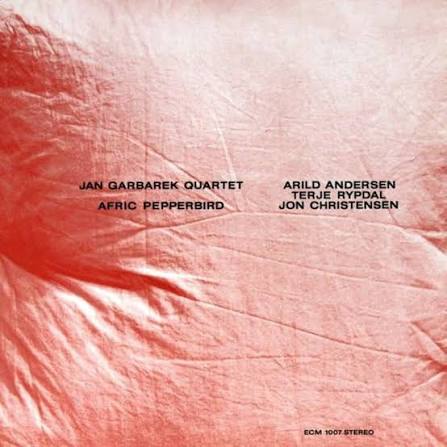
Finding a Voice Inside the Storm
“Blow Away Zone”: Intensity Without a Single Center
If “Beast of Kommodo” demonstrates how far the Jan Garbarek Quartet could stretch an extended performance, “Blow Away Zone” shows that intensity did not require the ensemble to abandon organization. The piece belongs to the same restless world as the first half of Afric Pepperbird, but the quartet continually shifts the location of musical authority. Garbarek may occupy the foreground for a moment, yet the performance is never simply a saxophone solo with accompaniment. Terje Rypdal’s guitar can suddenly redefine the harmonic environment, Arild Andersen can redirect the movement through the bass, and Jon Christensen can change the perceived weight of the music without announcing a new section. What holds the performance together is not a conventional hierarchy but a shared ability to recognize when another musician has altered the direction of the piece.
That collective intelligence is crucial to understanding why Afric Pepperbird remains compelling beyond its historical importance. Free jazz can sometimes be discussed as though freedom were principally a matter of removing rules: abandon chord changes, loosen meter, escape predetermined form. But removing a structure does not automatically create meaningful freedom. It transfers responsibility from the composition to the musicians. Garbarek’s quartet understands that responsibility. When harmonic information becomes ambiguous, Andersen must decide whether to clarify it or deepen the ambiguity. When Christensen loosens the pulse, Rypdal can either reinforce time or move further away from it. When Garbarek pushes toward extremes of register and tone, the other musicians must determine whether to follow his intensity, oppose it or create enough space around it for the gesture to retain its force. The music is therefore less chaotic than it initially appears. Its order simply exists in the interaction rather than exclusively on the page.
Terje Rypdal and the Guitar That Refuses to Behave
Rypdal deserves particular attention because his presence helps prevent the quartet from settling into a familiar saxophone-led free-jazz configuration. His guitar rarely behaves like a substitute piano. He can provide harmonic information, but he is equally interested in texture, sustain, distortion, attack and the expressive possibilities created when a guitar stops functioning primarily as a chordal instrument. That approach would become central to his later work, where rock, jazz improvisation and composition could coexist without requiring clean stylistic boundaries.
In 1970, electric guitar carried associations that were changing rapidly. Rock had expanded the instrument’s sonic vocabulary, while jazz guitar was undergoing its own transformation. Rypdal absorbed those possibilities without simply importing rock gestures into jazz. On Afric Pepperbird, the guitar becomes a source of instability. It can create a surface against which Garbarek’s saxophone pushes, but it can also become a second linear voice, forcing the listener to reconsider which instrument is actually leading. This makes the quartet fundamentally different from a horn-plus-rhythm-section model. Garbarek may be the named leader, yet Rypdal can change the emotional temperature of a passage with a single sustained sound or sharply articulated intervention.
The relationship between saxophone and guitar is especially productive because their timbral identities are so different. Garbarek’s horn is physical, breath-driven and capable of moving from focused tone into screams and fractured overtones. Rypdal’s electric guitar can sustain beyond the natural decay of an acoustic instrument and can transform its tone electronically. When the two overlap, the music gains a tension between human breath and electrical extension. Neither sound cancels the other. Instead, the contrast enlarges the quartet’s expressive range.
“MYB” and the Importance of Small Forms
After the longer pieces, Andersen’s brief “MYB” again changes the album’s scale. Its compactness is not incidental. One of the strengths of Afric Pepperbird is that it refuses to equate freedom with duration. The quartet can explore an idea across an extended performance, but it can also compress an atmosphere into a miniature. The shorter compositions create structural punctuation, giving the listener a different relationship with time before the ensemble enters another large improvisational field.
This is one reason the album rewards being heard as a sequence rather than as a collection of isolated performances. “Skarabée,” “Mah-Jong,” “Beast of Kommodo,” “Blow Away Zone” and “MYB” do not merely present different themes. They alter the listener’s expectations about scale. Long forms make brief forms feel concentrated; brief pieces make the return to expansion more dramatic. Andersen’s contributions are especially important in creating this balance because his writing introduces another compositional personality alongside Garbarek’s.
It also reinforces the bassist’s role as more than an accompanist. Andersen is helping shape the album at the level of composition and sequencing, just as his playing shapes it from within individual performances. This was an ensemble of unusually strong personalities before those personalities became internationally famous.
Jon Christensen and Time Without a Cage
Christensen’s drumming may be the element most easily misunderstood when Afric Pepperbird is viewed through the later mythology of Scandinavian jazz. His subsequent work became closely associated with an elastic approach to rhythm, particularly through recordings with Garbarek, Keith Jarrett and other ECM artists. But elasticity should not be confused with softness. On Afric Pepperbird, Christensen can be explosive. What distinguishes him is not restraint as an aesthetic rule but his refusal to reduce the drums to a metronomic function.
He treats time as something that can be suggested from several directions. A cymbal pattern may imply forward motion without continuously marking the beat. A sudden accent can reorganize a phrase. The density of the percussion can increase or collapse according to the improvisation rather than according to a predetermined arrangement. This gives the quartet tremendous flexibility because rhythmic responsibility becomes collective. Andersen may temporarily make the pulse explicit, Rypdal can contribute rhythmic figures through guitar attack, and Garbarek’s phrasing itself can create momentum.
Christensen’s importance becomes even clearer when compared with conventional assumptions about free jazz. Freedom from a fixed pulse can easily produce music that feels suspended from time altogether. Christensen instead creates multiple ways of experiencing time. The listener may lose the certainty of a conventional swing pattern without losing the sense that the performance is moving. His drumming makes rhythm less predictable while keeping it consequential.
That approach would become enormously influential within European jazz, but Afric Pepperbird captures it before it had hardened into an identifiable style. Christensen is not demonstrating “ECM drumming.” He is solving musical problems in real time.
“Concentus”: Compression Before the Title Track
Andersen’s “Concentus” provides another brief change of scale before the album moves toward its title composition. As with “Mah-Jong” and “MYB,” its function becomes clearer when heard in relation to the extended pieces surrounding it. The quartet is capable of enormous intensity, but the record does not simply accumulate intensity until the listener becomes exhausted. These smaller forms interrupt the trajectory and reset the ear.
The title itself suggests coming together, and that idea describes something fundamental about the album. Four musicians with increasingly recognizable identities are learning how to operate as a unit without erasing their differences. Garbarek does not need Rypdal to sound like a conventional accompanist. Christensen does not require Andersen to define every beat. Andersen can become melodic without abandoning foundation. The quartet achieves coherence not through uniformity but through negotiated difference.
This is perhaps the most significant development across Afric Pepperbird. The album begins with musicians whose influences are audible and ends with an ensemble whose internal logic is becoming more important than the sources from which its vocabulary originated.
The Title Track and the Question of Identity
“Afric Pepperbird,” the title track, is where the album’s historical reputation and its actual musical character most clearly collide. The name itself has invited interpretation, and decades of writing about Garbarek have encouraged listeners to hear the recording retrospectively as the announcement of something specifically Nordic. Yet the music refuses to fit comfortably into a national metaphor. Its energy, improvisational vocabulary and instrumental interaction belong to an international jazz conversation. The quartet’s originality emerges not because it has escaped that conversation, but because it participates in it from a distinct position.
Garbarek’s saxophone is central, but again the power of the performance depends on the ensemble. His phrasing can move between recognizable melodic fragments and increasingly abstract gestures, while the rhythm section refuses to provide a passive background. Andersen and Christensen continually reshape the ground beneath him, and Rypdal’s guitar introduces another layer of tension. The piece demonstrates how thoroughly the quartet has learned to create form collectively.
What is beginning to emerge is not yet the spacious lyricism that would later become associated with Garbarek. Instead, the title track reveals a musician learning how to concentrate intensity. The most important development is not that he suddenly sounds Norwegian rather than American. It is that his tone is becoming unmistakably his own.
Individual identity in jazz rarely appears through a clean break with influence. Charlie Parker absorbed Lester Young and others. John Coltrane passed through the languages of Dexter Gordon, Sonny Rollins and Miles Davis before arriving at a conception that transformed the saxophone. Garbarek’s path similarly involved absorption, imitation, resistance and eventually transformation. Afric Pepperbird catches him while that process remains audible.
Coltrane’s Shadow, Without the Need to Escape It
The influence of Coltrane deserves careful treatment because it is sometimes used as evidence that early Garbarek had not yet become fully original. That misunderstands how jazz develops. Influence is not a flaw to be overcome as quickly as possible. It is one of the primary mechanisms through which the music renews itself.
For saxophonists who came of age in the 1960s, Coltrane was almost impossible to ignore. He had expanded harmonic improvisation, transformed the relationship between technique and emotional intensity, explored modal structures, pushed toward freer forms and demonstrated that a musician’s development could remain radically unfinished even after international recognition. His death in 1967 did not end that influence; it intensified it.
Garbarek absorbed aspects of this language, but Norway in 1970 was not New York in 1965. The social environment, collaborators and musical institutions surrounding him were different. Rypdal did not play like McCoy Tyner. Andersen was not Jimmy Garrison. Christensen was not Elvin Jones or Rashied Ali. The quartet therefore could not reproduce Coltrane’s music even if it had wanted to. Every attempt to work through that influence was altered by the personalities of the musicians involved.
That is how influence becomes transformation.
The goal is not to erase the shadow.
It is to discover what can grow inside it.
George Russell and Another Route Toward Freedom
George Russell provides another important piece of this story. His relationship with Scandinavian musicians during the 1960s offered a different model of modern jazz, one that combined advanced compositional thinking with openness toward new forms of improvisation. Garbarek, Rypdal, Andersen and Christensen all encountered a musical environment in which Russell’s ideas mattered, and the experience surrounding Esoteric Circle helped prepare the quartet for the kind of interaction heard on Afric Pepperbird.
Russell is important precisely because he complicates any simple opposition between “American jazz” and “European jazz.” An American composer and theorist working with Scandinavian musicians becomes part of the development of a supposedly European identity. The exchange moves in both directions. European jazz did not become distinctive by sealing itself off from America. It became distinctive through sustained encounters in which ideas were absorbed and reorganized locally.
This was happening across the continent. Musicians traveled. Records circulated. Festivals created networks. American artists settled temporarily or permanently in European cities. Radio and public cultural institutions supported forms of music that commercial markets might have ignored. The resulting jazz cultures were neither copies of the United States nor isolated national traditions.
Afric Pepperbird belongs to this interconnected world.
Manfred Eicher as Listener Rather Than Mythmaker
Manfred Eicher’s production also deserves to be separated from the mythology that later surrounded ECM. It is tempting to imagine Eicher entering the studio with a complete blueprint for the label’s future identity, but Afric Pepperbird suggests a more interesting process. The producer was listening to musicians whose artistic directions were still developing, and the label itself was discovering what it could become.
The recording gives the quartet room without neutralizing its aggression. That is significant. Space in ECM recordings would later become associated so strongly with contemplation that it is easy to forget space can also make intensity more exposed. When Garbarek’s saxophone erupts, the surrounding openness does not soften the gesture. It makes the gesture more visible. When Christensen changes the rhythmic density, the shift becomes easier to perceive. When Andersen or Rypdal moves into the foreground, the recording allows that change in balance to matter.
Production serves interaction rather than replacing it with an aesthetic concept.
This distinction helps explain why ECM could eventually contain such different artists. The label developed recognizable production values, but its strongest recordings did not require every musician to sound the same. Garbarek, Keith Jarrett, Paul Motian, Art Ensemble of Chicago, Dave Holland, Terje Rypdal and others could occupy very different musical worlds while remaining part of the same catalogue.
Afric Pepperbird belongs near the beginning of that discovery.
The Myth of the “Nordic Sound”
Few phrases have become more convenient—and more limiting—than “Nordic sound.” It can describe certain recognizable tendencies: spacious arrangements, attention to silence, folk influence, distinctive approaches to melody and an atmospheric quality found in some Scandinavian recordings. The problem begins when those tendencies are treated as natural consequences of geography.
Norwegian musicians do not play spaciously because Norway contains mountains and fjords. Swedish improvisers are not melodically restrained because winters are long. Danish jazz does not acquire a particular rhythmic character from northern light. Such metaphors can be attractive in magazine writing, but repeated often enough they turn musicians into scenery.
Afric Pepperbird makes the weakness of that stereotype obvious because it is so difficult to describe as glacial. The album can be hot, crowded, abrasive, restless and confrontational. Its musicians were Scandinavian, but Scandinavian identity did not dictate a single emotional temperature.
What later became recognizable in Garbarek’s music developed through choices: changes in repertoire, collaborators, compositional interests, tone, production and his evolving relationship with space. Those choices deserve to be understood as artistic decisions rather than climatic destiny.
The remarkable thing about Afric Pepperbird is not that four Norwegian musicians somehow discovered the sound of snow.
It is that they discovered they did not need a metaphor to justify sounding like themselves.
From Afric Pepperbird Toward Sart
The next stages of Garbarek’s career would make the transformation increasingly visible. Sart, recorded in 1971 with Rypdal, Andersen and Christensen joined by Bobo Stenson, would continue the process while expanding the ensemble’s harmonic possibilities. Later projects would bring further changes, and Garbarek’s relationships with musicians including Stenson and Keith Jarrett would open new approaches to melody, composition and ensemble space.
Seen from that perspective, Afric Pepperbird is neither an isolated explosion nor a fully completed manifesto. It is a beginning in the most meaningful sense: not because nothing important existed before it, but because the musicians discovered possibilities they would spend years developing.
Garbarek would become more economical.
Rypdal would expand his compositional world.
Andersen would become an increasingly important leader.
Christensen would redefine rhythmic possibility across countless sessions.
ECM would become one of the most influential independent jazz labels in the world.
But none of those outcomes was guaranteed when four young Norwegian musicians entered an Oslo studio in September 1970.
That uncertainty remains inside the recording.
And it is one reason Afric Pepperbird still feels alive.
What Came After the Fire
Sart and the Refusal to Stand Still
The importance of Afric Pepperbird becomes clearer when it is heard not as a destination but as the beginning of a remarkably rapid period of change. Jan Garbarek did not spend the following years refining a fixed formula discovered in September 1970. He kept moving. Sart, recorded the following year, retained Terje Rypdal, Arild Andersen and Jon Christensen while adding pianist Bobo Stenson, immediately changing the balance of the ensemble. The presence of piano introduced another source of harmony, color and rhythmic information, allowing Garbarek to occupy a different relationship with the group. The fierce post-Coltrane energy had not disappeared, but it was increasingly being organized through composition, texture and a more deliberate use of space.
This is one reason the familiar story of Garbarek progressing from American influence toward a fully formed “Nordic” language is inadequate. His development was less a straight line than a sequence of encounters. Every new ensemble changed what was possible. Rypdal encouraged one kind of interaction; Stenson another. Christensen’s approach to rhythm allowed Garbarek to phrase with unusual freedom, while Andersen’s bass provided both foundation and counterpoint. Later collaborations would alter the equation again. Garbarek’s identity emerged through these relationships rather than through isolation from them.
The transformation can already be heard when moving from Afric Pepperbird into the early 1970s recordings. The saxophonist becomes increasingly selective. Long streams of notes give way more often to concentrated phrases. Silence acquires greater structural importance. Melody begins to carry weight that previously might have been supplied by sheer intensity. None of this represents a rejection of the earlier music. Garbarek was learning how to retain its emotional force while requiring fewer gestures to express it.
Bobo Stenson and the Expansion of Space
The relationship with Bobo Stenson became particularly important during this period. Stenson belonged to the same expanding Scandinavian jazz network, but the pianist brought a harmonic sensibility that could accommodate freedom without constantly pushing the music toward maximum density. With Stenson, Garbarek could explore a different kind of openness, one in which the music did not need to erupt in order to remain unsettled.
Their later work together, including Witchi-Tai-To, would demonstrate how far Garbarek had traveled from the raw volatility of Afric Pepperbird without losing the sense of searching that made the earlier album compelling. The repertoire itself became increasingly revealing. Rather than constructing identity solely through original compositions, Garbarek could interpret music associated with Don Cherry, Jim Pepper, Carla Bley and others, placing compositions from different corners of modern jazz inside the same ensemble language.
That approach suggests another way to understand originality. A distinctive voice does not require a musician to compose every piece or sever connections with predecessors. Interpretation itself can become authorship. The way Garbarek shapes a melody, controls his tone and decides how much space to place around a phrase gradually becomes identifiable regardless of who wrote the composition.
This is the Garbarek who begins to emerge from the turbulence of Afric Pepperbird: not a musician escaping influence, but one learning how to make influence pass through an increasingly personal filter.
Keith Jarrett and Another Kind of European-American Exchange
Garbarek’s subsequent association with Keith Jarrett further complicates any attempt to divide jazz neatly into American and European camps. When Jarrett formed what became known as his European Quartet with Garbarek, bassist Palle Danielsson and drummer Jon Christensen, the ensemble embodied exchange rather than separation. An American pianist and composer worked with Scandinavian musicians to create music that belonged fully to neither a conventional American mainstream nor a narrowly defined European school.
Albums such as Belonging and My Song would bring Garbarek to a much larger international audience and reveal a saxophonist whose language had become significantly more economical. The ferocity audible on Afric Pepperbird had not vanished; it had been concentrated. Garbarek could sustain a note, shape its attack and allow its decay to carry emotional information that earlier performances might have expressed through a torrent of sound.
Jarrett’s compositions also placed melody at the center of the ensemble in ways that encouraged this development. Garbarek discovered that a simple line could remain open enough for improvisation while possessing an identity strong enough to survive transformation. Christensen, meanwhile, provided continuity between Garbarek’s earlier Norwegian groups and the European Quartet, bringing the same fundamental belief that time could remain flexible without losing momentum.
The collaboration demonstrates why the idea of European jazz achieving independence by escaping American jazz is historically misleading. Garbarek’s most important developments repeatedly involved international exchange. What changed was the balance of that exchange. European musicians increasingly entered it with established identities of their own.
From Force to Concentration
Listening to Garbarek across the 1970s reveals one of the most fascinating changes in modern saxophone playing: the movement from expressive abundance toward expressive concentration. On Afric Pepperbird, he often seems interested in discovering how much the instrument can contain. Register, volume, overtones and rapid improvisational movement become part of an expansive vocabulary. Later, the question increasingly becomes how much meaning can be placed inside a smaller number of sounds.
This should not be mistaken for a simple transition from free jazz to lyricism. Garbarek remained capable of intensity, and his later work could be powerful precisely because the possibility of eruption remained inside the tone. Restraint has greater meaning when the listener senses what is being restrained.
The change also reflects maturation. Young musicians often establish themselves by demonstrating possibility. Mature musicians increasingly decide which possibilities matter. Garbarek’s technique did not diminish as his playing became more spacious; his choices became more selective.
Afric Pepperbird is therefore valuable partly because it allows us to hear the material from which that selectivity emerged. The later tone did not appear out of nowhere. It was forged inside performances where the saxophone was being pushed toward its physical limits.
Before the silence, there really was fire.
Terje Rypdal Beyond the Quartet
The album also becomes richer when heard as an early intersection in Terje Rypdal’s career rather than simply a Garbarek record with guitar. Rypdal would soon establish one of the most distinctive bodies of work in European jazz, moving freely among electric improvisation, rock-derived sonorities, orchestral composition and expansive forms. His ECM recordings would demonstrate how little interest he had in remaining inside a single stylistic category.
The seeds of that independence are already audible on Afric Pepperbird. Rypdal does not behave as though the guitarist’s responsibility is to support the saxophone leader. His interventions can change the entire direction of the quartet. The electric guitar introduces a sonic vocabulary different from Garbarek’s acoustic horn, but the contrast becomes productive rather than disruptive.
Their subsequent paths would diverge, yet the album preserves a moment when two major musical identities were still developing in close proximity. Rypdal would not become part of a standardized “Garbarek sound,” just as Garbarek would not become part of a standardized “Rypdal sound.” Their importance lies partly in how differently they used the possibilities opening around them.
That diversity is another reason the phrase “Nordic sound” becomes inadequate when applied too broadly. Rypdal, Garbarek, Andersen and Christensen came from overlapping musical environments, but they did not emerge with interchangeable aesthetics.
Arild Andersen and the Bassist as Bandleader
Andersen’s later career reinforces the same point. His role on Afric Pepperbird is already substantial, both as bassist and composer, but over the following decades he would build a major career as a leader, developing ensembles that reflected his own approach to composition and improvisation. His trajectory demonstrates how fertile this Norwegian generation proved to be: the musicians surrounding Garbarek were not merely sidemen waiting for a leader to define them.
The bass on Afric Pepperbird often functions as a moving center because Andersen understands how to preserve coherence without reducing the music’s freedom. That skill would remain essential throughout his career. The double bass can provide gravity while also becoming melodic, rhythmic and textural material.
In retrospect, the quartet almost resembles a meeting of future bandleaders. This helps explain the intensity of its interaction. Strong musical personalities do not necessarily produce competition. When they listen closely, they produce multiple possible directions at once.
The excitement of Afric Pepperbird comes partly from hearing those possibilities before they separated into individual careers.
Jon Christensen and the Art of Elastic Time
Christensen’s influence may be even more difficult to summarize because it spread through so many ensembles. His collaborations with Garbarek, Keith Jarrett, Bobo Stenson, Terje Rypdal and numerous other musicians helped establish a rhythmic vocabulary in which pulse could remain powerful without being continuously stated.
That vocabulary became so influential that later generations could make it sound inevitable. Afric Pepperbird reminds us that it was not. Christensen was part of a generation actively discovering alternatives to both conventional swing and the complete dissolution of pulse. His drumming could be forceful, fragmented, spacious or propulsive according to the needs of the moment.
This flexibility became particularly important in ECM ensembles, where compositions often required musicians to move between clearly defined rhythmic sections and much more open improvisational environments. Christensen could make those transitions feel organic because he did not treat time as a fixed object.
On Afric Pepperbird, the approach remains rawer. The music can surge suddenly, collapse and rebuild itself. But the essential idea is already present: rhythm does not have to function as a cage.
It can function as possibility.
ECM Was Becoming Something Too
Just as the musicians were developing, ECM was developing alongside them. The label that recorded Afric Pepperbird in 1970 was not yet the cultural institution it would become. Its catalogue was small, its international identity still forming and the visual and sonic associations now immediately attached to the ECM name had not yet accumulated decades of reinforcement.
This makes early recordings particularly valuable because they reveal a label discovering its possibilities rather than simply applying a formula. Manfred Eicher’s role as producer would become increasingly influential, but ECM’s significance was never reducible to reverberation, spacious recording or minimalist cover design. Its deeper achievement was creating a sustained environment in which musicians could develop across multiple albums.
Garbarek became one of the clearest examples. Instead of capturing a single successful recording and then moving on, ECM documented his transformation across years and eventually decades. The catalogue allows listeners to hear artistic development almost as a continuous narrative.
Afric Pepperbird is one of the earliest chapters.
Its importance comes not from already containing everything Garbarek would become, but from containing so much that he would eventually leave behind.
Why the Album Still Sounds Unsettled
More than half a century later, Afric Pepperbird remains striking because it does not settle comfortably into the image history constructed around it. Anyone approaching the record expecting gentle Scandinavian atmosphere may be surprised by its aggression. Anyone expecting an imitation of American free jazz will encounter a quartet whose internal relationships are too distinctive for that description. Anyone searching for a perfectly formed ECM aesthetic will hear a young label recording music far more unruly than the stereotype suggests.
The album lives between categories.
That is exactly where it should remain.
Historical importance sometimes turns recordings into monuments. Listeners are told that a particular album “invented” a style, “changed everything” or represents the exact moment a new movement began. Such narratives are convenient because they transform complicated cultural developments into memorable stories. But jazz rarely moves through isolated explosions. Musicians influence one another, scenes overlap, ideas travel and changes accumulate unevenly.
Afric Pepperbird did not invent European jazz.
It did not single-handedly create a Nordic sound.
It did not erase American influence.
Its achievement is more credible and more interesting: it documented four musicians realizing that the language they had inherited was flexible enough to become something personal.
The Problem With Turning Music Into Geography
Garbarek’s career would later become surrounded by geographical metaphors. Ice, fjords, mountains, tundra, winter light and vast northern landscapes repeatedly appeared in descriptions of his tone. Some listeners genuinely experience those associations, and there is nothing wrong with responding imaginatively to music. The problem comes when metaphor replaces analysis.
Garbarek’s tone was shaped by breath, embouchure, listening, practice, musical influences and aesthetic decisions—not by temperature. Christensen’s rhythmic freedom was developed through years of playing, not produced by Norwegian geography. Andersen’s melodic conception of the bass did not emerge from mountains, nor did Rypdal’s electric guitar acquire its identity from snow.
When these musicians are reduced to landscapes, their work begins to sound inevitable rather than chosen.
Afric Pepperbird demonstrates how wrong that assumption is. Nothing about the record feels inevitable. Its musicians are experimenting, negotiating and sometimes pushing against one another. The music contains decisions whose outcomes could have been different.
That uncertainty is far more exciting than mythology.
The Importance of the Record Today
So why return to Afric Pepperbird now?
Not because it is a pristine artifact from the birth of the ECM sound. Not because it represents an imaginary moment when European jazz defeated American influence. And certainly not because it can be reduced to a collection of atmospheric adjectives.
We return because the record captures musicians in transition.
Garbarek had not yet become the internationally recognizable saxophonist of Witchi-Tai-To, the Keith Jarrett European Quartet or his later projects. Rypdal had not yet fully developed the expansive musical universe of his own ECM catalogue. Andersen and Christensen were still at relatively early stages of careers that would profoundly shape European improvisation.
The future is audible, but incomplete.
That incompleteness gives the album energy. Every performance feels connected to a question the musicians have not completely answered.
How much structure is necessary?
How freely can rhythm move?
What does a European musician do with the overwhelming inheritance of American jazz?
How does influence become identity?
How can four strong individual voices become an ensemble without surrendering their differences?
The answers would change repeatedly over the following decades.
On Afric Pepperbird, the questions are still open.
Before the Silence, There Was Fire
Jan Garbarek would eventually become one of the most recognizable saxophonists in European jazz. A few notes could identify him. His ability to place melody inside space would influence generations of musicians, while his collaborations would extend far beyond conventional jazz contexts.
Knowing that future makes Afric Pepperbird even more fascinating.
Here is Garbarek before economy became one of his greatest strengths, before the spaciousness, before the international image and before critics learned to describe almost everything around him as crystalline.
He is searching.
So are Rypdal, Andersen and Christensen.
So, in its own way, is ECM.
The album catches all of them at a moment when certainty would have been less valuable than curiosity. They had absorbed bebop, modal jazz, Coltrane, free improvisation, George Russell and the rapidly expanding musical culture around them. But they were no longer satisfied simply to demonstrate that they understood those languages.
They wanted to discover what happened when those languages passed through their own experience.
That is the enduring significance of Afric Pepperbird.
Not the birth of a mythic northern sound.
Not a frozen landscape translated into music.
Not the instant European jazz suddenly became independent.
Something much more human happened in Oslo in September 1970.
Four young musicians listened to everything they had inherited, entered a studio and began deciding what they wanted to keep.
The rest they were willing to transform.