
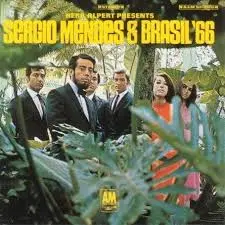
If Tom Jobim was the architect of Bossa Nova and João Gilberto its rhythmic master, Sérgio Mendes was its greatest strategic visionary and global ambassador. In the early 1960s, Mendes was already a respected jazz pianist in Rio de Janeiro, leading the Sexteto Bossa Rio. However, it was after moving to the United States and forming the legendary Brasil ’66 that he orchestrated a revolution: merging Brazilian syncopation with the clarity of American pop and the sophistication of jazz arrangements.
The secret of Brasil ’66 lay in the innovative combination of two female voices (originally Lani Hall and Janis Hansen) singing in unison, floating over a powerful rhythmic foundation of piano, bass, drums, and percussion. The 1966 release of ‘Mas Que Nada’ (written by Jorge Ben Jor) was the ‘ground zero’ of this explosion. For the first time, a song entirely in Portuguese became a massive hit on the Billboard charts, proving that the language of Brazilian music was universal.
Under the guidance of Herb Alpert and the A&M Records label, the group reinvented classics by the Beatles, Burt Bacharach, and Simon & Garfunkel, giving them a tropical ‘sunbath.’ Yet, Sérgio Mendes never abandoned his roots: he introduced the world to the compositions of Edu Lobo, Milton Nascimento, and Ivan Lins, ensuring that the DNA of high-quality Brazilian music remained center stage. With Brasil ’66, Sérgio Mendes didn’t just play for the world; he made the world want to be Brazilian.