Singapore and the Emergence of a Distinctive Jazz Identity
Jazz has always been a music of movement. Born from the African American experience and shaped by the cultural transformations of the twentieth century, it gradually crossed geographical boundaries, finding new audiences and artistic expressions in cities far removed from its origins. From New Orleans and Chicago to Paris, Tokyo, and Copenhagen, jazz developed through encounters between traditions, musicians, and communities. In Southeast Asia, Singapore has emerged as one of the cities contributing to this continuing international conversation, combining a cosmopolitan cultural environment with a growing commitment to musical education and artistic excellence.
At the center of this development stands the Jazz Association Singapore Orchestra (JASSO), an ensemble that represents more than the preservation of the big-band tradition. Its existence reflects an ambition to establish Singapore as a significant participant in the global jazz community while creating opportunities for local musicians to develop their artistic identities. The orchestra’s story is closely connected to the Jazz Association (Singapore), an organization established in September 2016 with the purpose of promoting jazz performance, education, and public engagement.
JAZZ
Singapore provides a particularly interesting environment for such an initiative. Its cultural landscape has been shaped by Chinese, Malay, Indian, Eurasian, and international influences, creating a society in which musical traditions coexist and interact. Jazz, with its emphasis on improvisation, rhythmic flexibility, and collective interpretation, offers a natural framework for these encounters. Rather than requiring musicians to abandon their cultural backgrounds, the music provides opportunities to reinterpret familiar melodies, rhythmic ideas, and artistic experiences through a shared musical language.
The development of a professional jazz orchestra in this environment therefore carries a significance that extends beyond the concert stage. It raises questions about how jazz traditions are transmitted across generations, how musicians develop distinctive voices within established musical forms, and how a relatively young jazz institution can contribute to an art form whose history spans more than a century.
Jeremy Monteiro: A Life Dedicated to Jazz
Any examination of JASSO must begin with Jeremy Monteiro, the pianist, composer, and bandleader whose career has played an important role in bringing Singaporean jazz to international attention. Widely known as Singapore’s “King of Swing,” Monteiro has spent decades building connections between the country’s musical community and established jazz artists around the world.
His professional career began in the 1970s, during a period when jazz in Singapore was developing largely through hotels, clubs, and live entertainment venues. These environments offered working musicians opportunities to perform regularly, develop their improvisational skills, and encounter a broad range of musical influences. Monteiro began performing professionally in 1976 and subsequently worked as a pianist and bandleader at Singapore’s BClub 392, an important venue in his early career.
JASS
A defining moment came in 1988, when Monteiro appeared at the Montreux Jazz Festival, leading a group of established international musicians under the name Monteiro, Young & Holt and Friends. According to his official biography, this appearance made him the first Southeast Asian musician to lead such an ensemble on the festival’s main stage. The achievement demonstrated that a musician emerging from Singapore could participate meaningfully in the international jazz scene, not merely as a representative of a regional tradition but as an artist working within the broader language of jazz.
JASS
Throughout his career, Monteiro has collaborated with musicians including James Moody, Benny Golson, Michael Brecker, Randy Brecker, Charlie Haden, and Toots Thielemans. These encounters helped establish an international artistic network while reinforcing his commitment to the fundamentals of jazz: swing, melodic invention, improvisational dialogue, and the expressive possibilities of ensemble playing. His musical outlook reflects a respect for tradition without treating that tradition as something fixed or untouchable.
The creation of the Jazz Association (Singapore) in 2016 marked a further development in this journey. Working alongside co-founders Albert Chiu, Edmund Lam, and Susan Leong, Monteiro helped establish an organization intended to support jazz not only through performances but also through education, scholarships, community outreach, and international collaboration. In March 2017, the association received charitable status, giving its cultural mission a formal institutional foundation.
JASS
For Monteiro, the orchestra became a means of translating decades of professional experience into a collective artistic project. Instead of focusing exclusively on individual performances or recordings, the initiative offered a structure through which established musicians could work together while younger performers gained access to demanding professional environments.
The Birth of the Jazz Association Singapore Orchestra
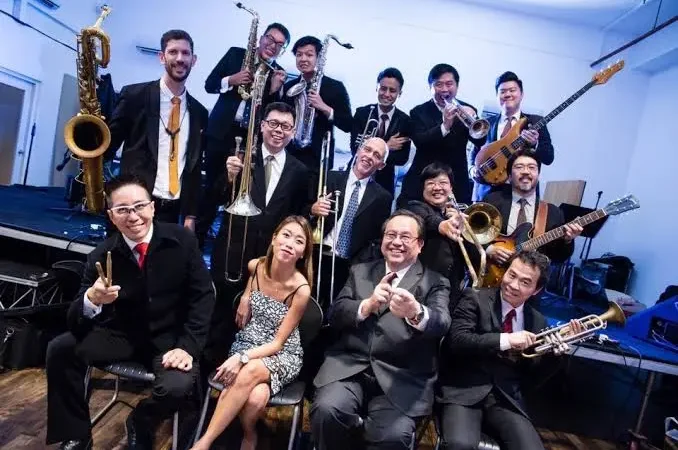
The Jazz Association Singapore Orchestra was established in 2017 as the principal professional ensemble of the Jazz Association (Singapore). Bringing together approximately twenty Singaporean and Singapore-based musicians, alongside selected performers from its youth orchestra, JASSO was conceived as a platform for musical excellence, professional collaboration, and international representation. Its structure draws upon the established big-band tradition, in which brass, saxophones, and rhythm instruments interact through carefully developed arrangements while leaving space for individual improvisation.
JAZZ
The formation of such an ensemble requires more than assembling accomplished instrumentalists. Big-band performance depends on a particular kind of musical discipline: precision in articulation, balance between instrumental sections, rhythmic cohesion, and the ability to move between written orchestration and spontaneous expression. Unlike smaller jazz groups, where musical decisions can emerge through immediate interaction among a handful of players, a large orchestra must coordinate the contributions of many musicians without sacrificing the freedom that gives jazz its distinctive character.
For JASSO, these challenges were accompanied by the task of developing an identity within Singapore’s musical environment. The orchestra could draw upon the traditions established by Duke Ellington, Count Basie, Thad Jones, and other influential bandleaders, yet its artistic purpose was not simply to reproduce the sound of American big bands. Its broader mission involved creating opportunities for Singaporean musicians, composers, and arrangers to participate in that tradition while contributing their own experiences and musical perspectives.
The orchestra made its inaugural appearance at the 13th JZ Festival in Shanghai in October 2017. Significantly, its first performance took place outside Singapore, placing the ensemble immediately within an international festival environment. A fourteen-piece version of the orchestra traveled to Shanghai, introducing audiences to a group representing Singapore’s developing jazz community.
JAZZ
+1
The symbolism of that debut was considerable. Shanghai, with its own long and complex relationship with jazz, provided a setting in which musical traditions from different Asian cities could meet. For a newly established orchestra, appearing at an international festival represented both an artistic opportunity and a statement of intent: Singaporean jazz musicians were seeking a place within a wider network of professional performers, festivals, and audiences.
The years that followed confirmed the orchestra’s international ambitions. In November 2018, JASSO performed at the EFG London Jazz Festival, one of Europe’s prominent jazz events. In January 2019, the ensemble appeared at the Jazz Education Network Conference in Reno, Nevada, as the JEN President’s Choice, with Monteiro directing a performance that included vocalists Carmen Bradford and Melissa Tham. These engagements helped extend the orchestra’s visibility beyond Southeast Asia while connecting its musicians with international jazz communities.
jazzassociation.sg
+1
Building a Musical Community Beyond the Concert Hall
One of the most important aspects of JASSO’s development is its relationship with education and community engagement. The orchestra operates within an institution whose objectives include expanding public access to jazz, supporting emerging musicians, and encouraging the development of a sustainable professional environment. This distinguishes its mission from that of an ensemble created solely to present concerts or pursue commercial success.
The Jazz Association Singapore Youth Orchestra, known as JASSYO!, plays an important role in this structure. Established to nurture younger jazz musicians, the youth ensemble offers opportunities for artistic development and performance experience. Its relationship with the professional orchestra creates a pathway through which developing musicians can encounter the technical and interpretative demands of large-ensemble jazz. The youth orchestra made its debut at the inaugural Lion City Youth Jazz Festival in May 2017, an event that also brought international jazz figures into contact with aspiring Singaporean performers.
JAZZ
This educational dimension reflects a broader understanding of how jazz survives and evolves. The music has historically depended upon the transmission of knowledge between generations, whether through informal encounters in clubs, mentorship relationships, jam sessions, or structured educational programs. Technical proficiency alone cannot communicate the full complexity of jazz performance. Musicians must also develop an understanding of phrasing, rhythmic placement, harmonic imagination, and the subtle forms of communication that allow an ensemble to function as a creative collective.
JASSO’s community activities have also demonstrated how orchestral jazz can engage with local musical traditions. During an outreach concert at Nanyang Technological University in March 2018, the repertoire included compositions by Monteiro and Singaporean musician Chok Kerong, a rearrangement of the Malacca-Portuguese folk song Jingkli Nona, and a blues-and-gospel interpretation of Singapore’s national song One People, One Nation, One Singapore. The program moved between swing, Latin and bossa nova influences, and locally significant musical material.
JASS
Such programming illustrates the possibilities that arise when jazz orchestration is understood as a flexible artistic language rather than a fixed historical formula. Familiar melodies can acquire new harmonic colors, rhythmic patterns can be transformed, and music associated with particular cultural communities can enter into dialogue with the improvisational traditions of jazz. The result is not necessarily the creation of an entirely new genre, but a widening of the expressive possibilities available to musicians and audiences.
This approach also has implications for how Singapore’s jazz identity may continue to develop. A sustainable jazz culture requires more than occasional appearances by international stars. It depends upon local musicians having opportunities to perform, composers being encouraged to create original work, young artists receiving guidance, and audiences developing a lasting relationship with the music.
As the Jazz Association (Singapore) marks its tenth anniversary in 2026, the existence of JASSO provides a tangible example of these ambitions taking institutional form. What began as an initiative to strengthen jazz in Singapore has developed into a platform connecting performance, education, cultural exchange, and international visibility.
A New Chapter in the International Language of Jazz
The significance of the Jazz Association Singapore Orchestra lies not simply in the number of concerts it has performed or the international stages it has reached. Its broader contribution is connected to the changing geography of jazz itself. The music’s history remains inseparable from its African American origins, yet its continuing vitality also depends upon the ways musicians around the world engage with that history, study its language, and bring their own creative perspectives into the conversation.
JASSO occupies an interesting position within this process. It draws upon the collective discipline and orchestral possibilities of the big-band tradition while operating in a city whose cultural identity has been shaped by centuries of exchange. Through Jeremy Monteiro’s leadership, the participation of established professionals, and the development of younger musicians, the orchestra represents an effort to make jazz a lasting component of Singapore’s artistic life.
For Singapore, JASSO represents both an achievement and an ongoing project. Its first decade has demonstrated the value of building an orchestra capable of connecting local musicians with international jazz networks. The next question concerns the music itself: how the ensemble interprets the big-band tradition, how its arrangers and soloists develop a recognizable artistic voice, and how the cultural experiences of Singapore find expression within its repertoire.
Those questions lead naturally to the orchestra’s musical identity, where the interaction between tradition, arrangement, improvisation, and cultural influence becomes the central subject.
THE ART OF THE BIG BAND: TRADITION, ARRANGEMENT, AND THE MUSICAL IDENTITY OF JASSO
The Big Band as a Living Musical Tradition
The history of the jazz orchestra is inseparable from the development of jazz itself. From the sophisticated arrangements of Duke Ellington to the irresistible rhythmic momentum of Count Basie, the big band became one of the most recognizable expressions of twentieth-century American music. Yet its importance extends far beyond the Swing Era. Throughout the decades, composers, arrangers, and instrumentalists have continuously expanded the possibilities of large-ensemble jazz, transforming the orchestra into a vehicle for harmonic experimentation, improvisational freedom, and increasingly complex musical narratives.
For the Jazz Association Singapore Orchestra (JASSO), this heritage provides both a foundation and an artistic challenge. Under the musical direction of Jeremy Monteiro, the ensemble operates within a tradition that demands precision, discipline, and a profound understanding of collective musical expression. At the same time, its identity is shaped by the contemporary musical environment of Singapore, where musicians encounter a broad range of cultural influences and international artistic practices.
The orchestra’s significance becomes particularly apparent when considering the place of big-band music in contemporary jazz. While smaller ensembles often dominate the modern jazz landscape, large orchestras continue to offer possibilities that cannot be reproduced by a quartet or quintet. The interaction between brass and woodwinds, the layered harmonies, the carefully constructed contrasts between ensemble passages and individual solos, and the ability to move from intimate textures to overwhelming orchestral intensity give the big band a distinctive expressive range.
JASSO embraces these possibilities while contributing to the preservation and renewal of orchestral jazz in Southeast Asia. Rather than treating the big-band format as a historical artifact, the ensemble approaches it as a living musical structure capable of accommodating new compositions, arrangements, and interpretations.
The Architecture of Sound: Inside the Jazz Orchestra
A professional jazz orchestra is built upon an intricate relationship between individual musicians and the collective ensemble. In a conventional big-band configuration, saxophones, trumpets, trombones, and a rhythm section form the principal instrumental groups. Each section possesses its own expressive characteristics, yet the orchestra’s identity emerges from the interaction among them.
The saxophone section frequently provides warmth, melodic continuity, and harmonic depth. Its ability to move between lyrical passages and tightly coordinated rhythmic figures makes it particularly versatile. Trumpets contribute brilliance, projection, and dramatic emphasis, while trombones introduce a broader tonal spectrum, ranging from powerful ensemble statements to subtle harmonic support. The rhythm section, generally consisting of piano, bass, and drums, establishes the musical foundation while responding dynamically to the orchestral arrangement.
Within JASSO, these traditional relationships create a framework for the musicians’ collective interpretation. The challenge is not merely to execute written passages accurately but to develop a shared understanding of phrasing, articulation, and rhythmic placement. In jazz, the distinction between a technically correct performance and a genuinely compelling one often lies in details that cannot be fully captured by musical notation.
Swing, for example, is not simply a rhythmic formula. It involves a subtle interaction between pulse, accentuation, anticipation, and relaxation. A saxophone section playing a synchronized phrase must achieve a common sense of rhythmic movement, while the rhythm section must maintain enough flexibility to support the soloists without restricting their expressive freedom. These qualities are particularly demanding in an orchestra composed of musicians with different professional experiences and stylistic backgrounds.
Jeremy Monteiro’s experience as a pianist and bandleader is relevant in this context. Having performed extensively with international jazz musicians, he brings to the orchestra an understanding of the relationship between individual expression and collective discipline. His artistic background is rooted in the language of swing and mainstream jazz, but his career has also encompassed Latin jazz, contemporary compositions, and collaborations that extend beyond conventional stylistic boundaries.
This breadth of experience provides a useful foundation for directing an orchestra whose ambitions involve both the preservation of jazz traditions and the development of a distinctive musical personality.
Jeremy Monteiro and the Language of Swing
Monteiro’s musical identity has long been associated with the expressive qualities of swing. His approach to the piano reflects an appreciation for melodic clarity, rhythmic vitality, and the conversational nature of improvisation. These characteristics are particularly important in the orchestral environment, where the musical director must balance the structural demands of an arrangement with the spontaneous contributions of individual performers.
In the history of jazz, the most influential bandleaders have often been distinguished not only by their compositions or instrumental abilities but also by their capacity to recognize the musical personalities within their ensembles. Duke Ellington famously wrote with particular musicians in mind, using their distinctive sounds as essential elements of his orchestral language. Count Basie developed an approach in which rhythmic economy, ensemble precision, and carefully positioned solo statements created an unmistakable collective identity.
Although JASSO operates in a different historical and cultural environment, these principles remain relevant. A jazz orchestra becomes artistically meaningful when its musicians are able to contribute more than technical proficiency. The ensemble must develop a shared musical sensibility, allowing individual voices to emerge naturally within the larger structure.
Monteiro’s role as musical director therefore extends beyond conducting performances. It involves establishing artistic priorities, selecting repertoire, encouraging musical interaction, and creating an environment in which professional musicians can develop a cohesive ensemble sound.
His international career also provides a connection between Singapore’s jazz community and the broader history of the music. Collaborations with musicians associated with bebop, hard bop, and other major developments in jazz have exposed Monteiro to different approaches to improvisation and ensemble performance. Such experiences can inform the interpretative decisions made within JASSO, particularly when the orchestra approaches repertoire associated with established jazz traditions.
The objective, however, is not simply to reproduce the sound of celebrated American orchestras. The more interesting artistic possibility lies in understanding their musical principles and applying them to new compositions, arrangements, and cultural contexts.
Arranging as an Act of Musical Creation
One of the defining characteristics of orchestral jazz is the central role of the arranger. While improvisation is frequently regarded as the most visible expression of jazz creativity, the arranger provides the architecture within which much of that creativity unfolds.
A successful big-band arrangement requires a sophisticated understanding of harmony, orchestration, rhythmic development, and dramatic structure. The arranger must decide how melodic material will be distributed among instrumental sections, how harmonic tension will develop, where improvisational passages will occur, and how the ensemble will move between contrasting textures.
These decisions transform a composition into an orchestral experience. A familiar melody can acquire an entirely different character when interpreted through the rich harmonic possibilities of a saxophone section or the dramatic contrast between muted brass and an energetic rhythm section. Similarly, a relatively simple rhythmic idea can become the foundation for an elaborate musical development involving counterpoint, sectional exchanges, and extended improvisation.
For an orchestra such as JASSO, arranging also provides an opportunity to explore musical material connected to Singapore’s cultural environment. The country’s diverse musical traditions offer melodies, rhythmic structures, and expressive characteristics that can be reinterpreted within the language of jazz.
This does not necessarily imply the creation of an explicitly hybrid musical style. Cultural influence can operate through subtle choices of phrasing, harmonic color, rhythmic emphasis, or melodic development. The important consideration is whether these elements become part of a coherent musical expression rather than functioning merely as decorative references.
The orchestra’s programming has demonstrated an interest in original compositions by Singaporean musicians alongside established jazz repertoire and arrangements of locally meaningful songs. This balance between tradition and contemporary creativity is essential for the long-term development of an ensemble seeking to establish its own artistic identity.
It also highlights an important distinction between preservation and artistic renewal. Preserving jazz does not require reproducing historical performances without variation. Instead, it involves maintaining a meaningful relationship with the musical principles that shaped the tradition while allowing new generations of musicians to reinterpret them.
Original Compositions and the Search for an Orchestral Voice
The development of an original repertoire represents an important stage in the evolution of any jazz orchestra. Established compositions provide opportunities to demonstrate technical proficiency and stylistic understanding, but original works allow an ensemble to articulate its own artistic priorities.
For JASSO, the promotion of Singaporean composers and arrangers is particularly significant. Original compositions create opportunities for local musicians to explore their creative identities while contributing to a body of work associated with the orchestra and its cultural environment.
The importance of this process extends beyond individual performances. A growing repertoire of original works can become part of the musical heritage of a community, offering future musicians material through which to understand the artistic developments of their predecessors.
The orchestra’s Pinnacle 2025 concert, which placed Singaporean jazz compositions at the center of its programming, illustrates this commitment. By presenting music created within the country’s jazz community, JASSO emphasized the importance of original artistic production alongside its engagement with international repertoire.
Such initiatives also challenge the assumption that jazz creativity must remain concentrated in the traditional centers of the music. While New York, Chicago, New Orleans, and other American cities retain their historical importance, the international development of jazz has produced increasingly diverse communities of composers and performers.
Singapore’s contribution to this broader landscape is still developing, and it would be premature to describe the country as possessing a single, clearly defined national jazz style. Nevertheless, the existence of institutions capable of commissioning, arranging, performing, and promoting original works creates conditions in which distinctive musical approaches can emerge.
The artistic significance of JASSO therefore lies partly in its ability to provide a professional environment for this experimentation. An orchestra offers composers access to a broad instrumental palette, allowing them to explore ideas that would be difficult to realize within smaller ensembles.
Improvisation Within the Collective Structure
Improvisation remains one of the essential characteristics of jazz, even in its most carefully orchestrated forms. Within a big band, however, improvisational freedom operates in a different relationship to musical structure than it does in a small ensemble.
A quartet may develop a performance through relatively open interaction, with musicians responding continuously to changes in harmony, rhythm, and melodic direction. A jazz orchestra generally requires a more clearly defined architecture, with written passages establishing the broader musical narrative.
Yet this structure does not eliminate spontaneity. On the contrary, the contrast between composed material and improvised expression can become one of the most compelling aspects of orchestral jazz.
A soloist may emerge from a tightly coordinated ensemble passage, introducing a new rhythmic perspective or harmonic direction. The orchestra may then respond through background figures, sectional exchanges, or a gradual increase in intensity. In such moments, the relationship between the individual and the collective becomes a central element of the musical experience.
For JASSO, this balance is particularly relevant because its professional musicians bring different artistic backgrounds to the ensemble. Their individual approaches to improvisation can contribute to the orchestra’s expressive range, provided that the arrangements allow sufficient space for personal interpretation.
The quality of an orchestral performance therefore depends not only on the written score but also on the musicians’ capacity to listen, respond, and communicate. These skills are developed through experience, rehearsal, and the gradual formation of a shared musical understanding.
In this respect, the jazz orchestra functions as both a musical institution and a collaborative community. Its artistic identity emerges through the interaction of personalities, traditions, and creative decisions rather than through the authority of a single individual.
Singapore’s Musical Diversity and the Possibilities of Jazz
Singapore’s multicultural environment provides an additional dimension to the artistic possibilities available to JASSO. The city has long served as a meeting point for different communities, languages, and cultural practices, and its musical landscape reflects this historical complexity.
Chinese orchestral traditions, Malay musical forms, Indian classical and popular music, Western classical performance, and contemporary international genres coexist within Singapore’s cultural institutions and everyday life. Jazz musicians working in this environment may encounter a particularly wide range of musical influences, whether through formal education, professional collaboration, or personal experience.
The relationship between these traditions and jazz should not be understood as automatic or inevitable. Cultural diversity does not, by itself, produce a distinctive musical language. Such developments depend upon the choices of individual musicians and composers, the depth of their engagement with different traditions, and their ability to integrate those influences into meaningful artistic structures.
Nevertheless, Singapore offers a setting in which these encounters can occur. For a professional orchestra, the possibilities include arrangements of regional melodies, collaborations with musicians from other traditions, and original compositions that explore rhythmic or harmonic ideas beyond conventional big-band repertoire.
The broader significance of these possibilities lies in the continuing international development of jazz. Throughout its history, the music has absorbed influences from Latin America, Europe, Africa, and Asia while maintaining a recognizable relationship with its foundational traditions. These exchanges have produced new approaches to composition, improvisation, and ensemble performance.
JASSO participates in this evolving landscape from a Singaporean perspective. Its artistic development will depend not only on technical accomplishment but also on the extent to which its musicians and arrangers can transform their diverse experiences into a coherent and recognizable orchestral voice.
Beyond Nostalgia: The Contemporary Relevance of the Big Band
The continued existence of professional jazz orchestras raises an important question about the place of large ensembles in contemporary musical culture. Big bands require considerable resources, rehearsal time, organizational support, and sustained artistic commitment. In an industry increasingly shaped by digital distribution, smaller performance formats, and changing audience habits, maintaining such an ensemble can be particularly challenging.
Yet the artistic possibilities of the jazz orchestra remain substantial. Its capacity to combine intricate composition with spontaneous improvisation offers a form of musical expression that continues to attract composers, arrangers, and performers.
Contemporary large-ensemble jazz has demonstrated that the format can accommodate a remarkable range of approaches, from the continuation of swing and bebop traditions to experimental orchestration, contemporary classical influences, and collaborations across musical genres.
For JASSO, this broader environment provides both inspiration and a demanding artistic context. The orchestra must remain connected to the historical language of jazz while demonstrating why that language continues to matter to contemporary audiences.
Its educational activities, commitment to original compositions, and international appearances suggest an understanding that artistic sustainability depends upon more than the reproduction of familiar repertoire. A professional jazz orchestra must cultivate musicians, encourage creative work, and establish relationships with audiences who recognize the continuing relevance of the music.
The achievement of JASSO is therefore not simply that Singapore possesses a professional big band. More importantly, the orchestra forms part of an institutional effort to sustain jazz as an active and evolving artistic practice.
An Orchestra Looking Toward the Future
The musical identity of the Jazz Association Singapore Orchestra remains connected to a larger process of artistic development. Its foundations are rooted in the established traditions of orchestral jazz, but its future depends upon the creativity of the musicians, composers, and arrangers who contribute to its repertoire.
Jeremy Monteiro’s leadership provides an important connection to the international history of jazz, while the orchestra’s institutional structure creates opportunities for younger generations to participate in that tradition. Together, these elements establish a framework through which Singaporean jazz can continue to develop beyond individual performances and isolated artistic initiatives.
The challenge for JASSO is to transform these opportunities into a lasting musical identity. This requires a sustained commitment to original composition, interpretative excellence, and the development of a repertoire that reflects both the international language of jazz and the creative experiences of the musicians who perform it.
As the orchestra continues to participate in festivals, educational initiatives, and international collaborations, its significance increasingly extends beyond the boundaries of Singapore. It becomes part of a broader discussion about the changing geography of jazz, the role of cultural institutions in sustaining musical traditions, and the ways in which new generations of musicians contribute to the evolution of an established art form.
The story of JASSO is ultimately one of continuity and possibility. The orchestra draws upon a musical heritage developed over more than a century, yet its existence demonstrates that the big-band tradition can find new expressions in different cultural environments.
From the rhythmic sophistication of swing to the expressive freedom of contemporary orchestral jazz, JASSO represents an effort to keep this tradition active, relevant, and open to new artistic perspectives. Its musical journey also points toward a larger question: how can a jazz orchestra rooted in Singapore contribute to the international development of the music while strengthening the cultural community from which it emerged?
The answer lies partly beyond the rehearsal room and the concert stage, in the international relationships, educational initiatives, and cultural exchanges through which Singapore continues to establish its place within the global jazz community.
SINGAPORE AND THE GLOBAL JAZZ CONVERSATION: INTERNATIONAL CONNECTIONS, CULTURAL EXCHANGE, AND THE FUTURE OF JASSO
From Singapore to the International Jazz Stage
The international development of jazz has always depended upon the movement of musicians, ideas, and artistic traditions across geographical boundaries. From the earliest recordings that carried the music beyond the United States to the emergence of influential jazz communities in Europe, Latin America, Africa, and Asia, the history of jazz has been shaped by encounters between different cultural environments. These exchanges have not diminished the music’s African American foundations; rather, they have demonstrated its extraordinary capacity to inspire creative participation across generations and continents.
For the Jazz Association Singapore Orchestra (JASSO), international engagement represents an essential dimension of its artistic mission. Since its establishment in 2017, the ensemble has sought opportunities to perform beyond Singapore, introducing its musicians to international audiences while establishing relationships with jazz institutions, festivals, and professional communities. These activities reflect a broader ambition to position Singapore not merely as a destination for visiting international artists but as a place capable of contributing its own musicians, compositions, and artistic perspectives to the global jazz landscape.
The orchestra’s inaugural performance at the JZ Festival in Shanghai in October 2017 established this international orientation from the beginning. Rather than making its debut exclusively before a domestic audience, JASSO entered the professional jazz circuit through one of Asia’s prominent jazz festivals. The appearance represented an opportunity to demonstrate the quality of Singapore’s musicians while participating in a cultural environment with its own distinctive jazz history.
Shanghai occupies a particularly interesting place in the development of Asian jazz. During the early twentieth century, the city became an important center for international popular music, with jazz and dance orchestras performing in hotels, clubs, and entertainment venues. Although political and cultural transformations subsequently altered this musical environment, Shanghai’s contemporary jazz scene has reconnected with aspects of that historical legacy. JASSO’s debut in the city therefore carried a symbolic resonance, bringing together musicians from Singapore with audiences in another Asian metropolis whose relationship with jazz has evolved through different historical circumstances.
The orchestra’s subsequent international appearances further expanded its visibility. Its participation in the EFG London Jazz Festival in November 2018 placed Singaporean musicians within one of Europe’s established jazz events, while its appearance at the Jazz Education Network Conference in Reno, Nevada, in January 2019 introduced the ensemble to a community closely associated with jazz education, professional development, and institutional collaboration.
These performances represented more than opportunities for international exposure. They provided settings in which JASSO could encounter different musical expectations, professional practices, and artistic approaches. For a relatively young orchestra, such experiences can contribute significantly to ensemble development, encouraging musicians to refine their collective sound while gaining a broader understanding of the international standards associated with professional jazz performance.
International Collaboration as an Artistic Philosophy
Jazz has historically flourished through collaboration. Its development cannot be separated from the countless encounters between musicians who brought different experiences, technical approaches, and artistic sensibilities into shared performance environments. The music’s improvisational character makes these encounters particularly meaningful, allowing performers to establish relationships through musical dialogue rather than relying exclusively on predetermined structures.
Jeremy Monteiro’s career offers an important example of this tradition. His collaborations with internationally recognized musicians have connected Singapore’s jazz community with artists whose careers encompass several generations of jazz history. Performers such as James Moody, Benny Golson, Toots Thielemans, and the Brecker brothers represent different aspects of the music’s evolution, from bebop and hard bop to contemporary improvisation and the expanding possibilities of jazz fusion.
These artistic relationships have contributed to Monteiro’s musical development while reinforcing the importance of international exchange within his broader professional philosophy. For JASSO, his experience provides a valuable foundation for engaging with musicians and institutions beyond Singapore.
The orchestra’s appearance at the 2019 Jazz Education Network Conference illustrates how such relationships can operate within a large-ensemble context. The participation of American jazz vocalist Carmen Bradford, whose career includes a significant association with the Count Basie Orchestra, created a connection between JASSO and one of the most influential traditions in orchestral jazz. Bradford’s experience with the Basie legacy brought an additional dimension to the performance, emphasizing the continuing relevance of swing, ensemble discipline, and the expressive relationship between vocalist and orchestra.
Such collaborations also reveal an important characteristic of the international jazz community: musical traditions are transmitted not only through recordings, compositions, and formal instruction but also through direct artistic encounters. A visiting soloist may introduce different approaches to phrasing or improvisation, while local musicians contribute their own interpretations and experiences. The resulting performances become opportunities for mutual exchange rather than one-directional demonstrations of established musical authority.
For Singapore, the development of these relationships is particularly important. A sustainable jazz community benefits from access to international expertise, but its long-term vitality also depends upon creating opportunities for local musicians to participate as artistic equals. JASSO’s international engagements suggest an effort to establish this balance, allowing Singaporean performers to develop professional relationships within the wider jazz world.
The Role of Jazz Education in Building a Musical Future
One of the central challenges facing jazz communities around the world is the transmission of musical knowledge between generations. Unlike certain classical traditions, in which institutional systems have developed over centuries, jazz education emerged through a combination of informal mentorship, professional apprenticeship, community interaction, and, more recently, formal academic programs.
Historically, many influential jazz musicians developed their artistic identities through direct participation in working ensembles. Clubs, touring orchestras, jam sessions, and recording studios served as environments in which younger performers could learn from established musicians. The process involved far more than acquiring technical proficiency. Musicians developed an understanding of stylistic conventions, rhythmic interaction, improvisational vocabulary, and the social relationships that shape collective performance.
As jazz became increasingly integrated into universities, conservatories, and specialized educational institutions, these traditional learning environments were complemented by more structured approaches to musical instruction. Contemporary jazz education now encompasses harmony, arranging, composition, improvisation, ensemble performance, and historical study, creating opportunities for musicians to engage systematically with the music’s complex heritage.
The Jazz Association (Singapore) has incorporated education into its institutional mission, recognizing that the development of professional performance opportunities must be accompanied by sustained investment in younger musicians. The Jazz Association Singapore Youth Orchestra, JASSYO!, provides an important component of this approach, offering emerging performers opportunities to develop their abilities within a large-ensemble environment.
The relationship between JASSYO! and the professional JASSO ensemble creates a particularly valuable structure. Young musicians can encounter the discipline required for orchestral jazz while observing the professional practices of more experienced performers. Rehearsals, performances, and educational activities provide opportunities to understand how individual preparation contributes to collective musical excellence.
This experience is especially important in the context of big-band performance. Unlike small ensembles, where musicians may exercise considerable freedom in shaping arrangements during performance, a jazz orchestra requires a sophisticated balance between written material and spontaneous interpretation. Young performers must learn to understand their individual responsibilities within a larger musical architecture while maintaining the rhythmic flexibility and expressive sensitivity essential to jazz.
The educational mission also extends beyond instrumental technique. Exposure to jazz history, composition, arranging, and international artistic practices can encourage younger musicians to develop broader creative ambitions. Rather than viewing jazz exclusively as a repertoire to be mastered, students can begin to understand it as a living tradition in which they may eventually contribute original ideas.
For Singapore, this process has cultural significance. The development of successive generations of musicians creates the possibility of a more sustainable artistic environment, reducing dependence upon isolated initiatives or individual personalities. Institutions such as the Jazz Association (Singapore) can provide continuity, supporting musicians through different stages of their development while strengthening the broader cultural infrastructure surrounding the music.
Singapore’s Place in the Asian Jazz Landscape
The emergence of JASSO should also be understood within the wider development of jazz across Asia. Although the music’s international history is often narrated primarily through American and European experiences, Asian cities have maintained significant jazz communities for decades, developing their own relationships with performance, education, recording, and cultural exchange.
Japan provides one of the most established examples, with a jazz culture that encompasses dedicated listening venues, record collecting, festivals, professional ensembles, and internationally recognized musicians. Cities such as Tokyo and Osaka have developed musical environments in which jazz occupies an important position within both popular culture and specialized artistic communities.
Elsewhere, South Korea, China, Taiwan, Indonesia, Thailand, Malaysia, and the Philippines have contributed to an increasingly diverse regional landscape. These communities differ considerably in their histories, institutional structures, and musical priorities, but together they demonstrate the continuing expansion of jazz beyond its traditional geographical centers.
Singapore occupies a distinctive position within this environment. Its international connectivity, multilingual population, and developed cultural infrastructure provide opportunities for collaboration with musicians and institutions throughout the region. At the same time, its relatively small domestic market creates practical challenges for sustaining specialized artistic activities, particularly those requiring substantial financial and organizational resources.
A professional jazz orchestra represents a significant commitment under these circumstances. Large ensembles require rehearsal facilities, experienced musicians, administrative coordination, suitable performance venues, and consistent financial support. Maintaining artistic quality while developing audiences can be demanding even in cities with long-established jazz traditions.
JASSO’s existence therefore reflects the importance of institutional commitment in supporting artistic development. Its activities demonstrate that a jazz community need not be defined solely by the number of clubs or commercial performances available within a city. Educational programs, professional ensembles, festivals, and collaborative initiatives can contribute to a more comprehensive musical environment.
The orchestra’s international appearances also create opportunities for Singapore to participate in regional and global networks of jazz performance. These relationships may encourage future collaborations, exchanges between educational institutions, and the circulation of original compositions by Singaporean musicians.
The broader significance lies in the gradual development of a jazz landscape in which artistic influence moves in multiple directions. Rather than viewing Asian musicians primarily as interpreters of established American or European traditions, contemporary jazz increasingly recognizes the creative contributions emerging from different cultural environments.
JASSO’s work forms part of this transformation, although its long-term artistic influence will ultimately depend upon the continued development of its repertoire, musicians, and institutional relationships.
Original Music and the Cultural Identity of Singapore
One of the most promising directions for JASSO involves the development and international presentation of original compositions by Singaporean musicians. While performances of established jazz standards remain important for maintaining connections with the music’s history, original repertoire provides opportunities for artists to articulate their own experiences and creative priorities.
Singapore’s multicultural society offers a particularly interesting context for such work. The country’s musical environment encompasses traditions associated with its Chinese, Malay, Indian, Eurasian, and international communities, creating opportunities for musicians to encounter a broad range of melodic, rhythmic, and expressive practices.
The relationship between these traditions and jazz requires careful artistic consideration. Cultural identity cannot be reduced to the superficial incorporation of recognizable melodies or rhythmic patterns. Meaningful musical integration depends upon a deeper understanding of the traditions involved and the ability to transform their elements into coherent compositional structures.
Jazz has demonstrated considerable flexibility in this regard. Throughout its history, musicians have engaged with Latin American rhythms, African musical traditions, European harmonic practices, and various forms of popular and folk music. These encounters have produced distinctive artistic developments, although their historical circumstances and cultural implications have differed considerably.
For Singaporean composers, the big-band format offers a particularly rich environment for exploring such possibilities. The combination of brass, woodwinds, and rhythm instruments provides a broad range of orchestral colors, while the interaction between written composition and improvisation allows musical ideas to evolve through performance.
JASSO’s commitment to presenting original works, including programs such as Pinnacle 2025, suggests an understanding of the importance of developing a repertoire connected to the country’s own musicians. Such initiatives can encourage composers and arrangers to experiment with orchestral forms while providing audiences with opportunities to encounter contemporary Singaporean jazz.
The significance of this approach extends beyond the immediate concert experience. Original compositions can become part of an evolving cultural archive, documenting the artistic interests and musical perspectives of a particular generation. Recordings, published arrangements, and recurring performances may eventually allow these works to circulate beyond their original context.
For an orchestra seeking international recognition, the development of original repertoire also provides an opportunity to establish a more distinctive artistic profile. Technical excellence and convincing interpretations of established jazz compositions are essential, but an ensemble’s lasting identity often emerges through the music created specifically for its musicians.
The Challenge of Sustaining a Professional Jazz Orchestra
The artistic ambitions of JASSO must be considered alongside the practical realities of maintaining a professional jazz orchestra in the twenty-first century. Large ensembles occupy a demanding position within contemporary musical culture, requiring substantial resources while operating in an environment where commercial opportunities for orchestral jazz are often limited.
The challenges begin with personnel. A conventional big band may require seventeen or more instrumentalists, and the coordination of rehearsals and performances becomes increasingly complex when musicians maintain independent professional commitments. The development of a consistent ensemble sound depends upon repeated collaboration, making continuity particularly valuable.
Financial sustainability presents another significant consideration. Concert production involves venue expenses, technical requirements, administration, transportation, and appropriate compensation for musicians. International touring introduces additional costs, while educational programs require resources that may not generate immediate commercial returns.
These circumstances help explain the importance of charitable organizations, institutional partnerships, sponsorships, and philanthropic support in sustaining jazz orchestras around the world. Such structures can provide opportunities for artistic activities that would be difficult to maintain through ticket sales alone.
For the Jazz Association (Singapore), its charitable status and broader cultural mission create a framework through which performance, education, and community engagement can operate as interconnected objectives. The professional orchestra is therefore part of a larger institutional structure rather than an isolated commercial ensemble.
This approach offers potential advantages. Educational initiatives can cultivate future musicians and audiences, while international performances contribute to artistic development and institutional visibility. Original compositions strengthen the orchestra’s repertoire, and community engagement helps establish jazz as a meaningful component of Singapore’s cultural life.
Nevertheless, institutional support does not eliminate the need for continuous artistic renewal. A professional orchestra must remain relevant to changing audiences while preserving the standards that justify its existence. Programming decisions, collaborations, educational activities, and the development of new repertoire all contribute to this process.
The future of JASSO will therefore depend upon its capacity to balance artistic ambition with organizational sustainability. Its achievements during its first decade provide a foundation, but the continuing vitality of the ensemble will require sustained commitment from musicians, institutional partners, and audiences.
Ten Years of Jazz Association (Singapore): A Cultural Milestone
The tenth anniversary of the Jazz Association (Singapore) in 2026 provides an opportunity to consider the broader significance of the organization’s work. Established in 2016, the association has sought to strengthen Singapore’s jazz community through professional performance, education, and international collaboration.
Over the course of a decade, the creation of JASSO and JASSYO! has provided institutional platforms for musicians at different stages of their development. The professional orchestra has represented Singapore at international events, while the youth ensemble has contributed to the cultivation of emerging performers.
These initiatives illustrate the importance of long-term cultural planning. Musical communities rarely develop through isolated events alone. Their growth depends upon continuity, access to educational opportunities, professional networks, and environments in which musicians can refine their artistic identities.
The anniversary also invites reflection upon the changing international perception of Singaporean jazz. The country’s musicians have participated in the global jazz community for decades, but the establishment of a professional orchestra with a defined institutional mission represents an additional stage in the development of that presence.
Jeremy Monteiro’s role in this process is particularly significant. His career has connected Singapore with international jazz traditions, while his involvement in the association reflects an effort to translate individual artistic achievement into broader opportunities for the musical community.
Yet the long-term success of such an initiative ultimately depends upon its capacity to extend beyond its founders. The development of younger musicians, the encouragement of original composition, and the creation of sustainable professional structures are essential if the orchestra is to remain artistically relevant for future generations.
In this sense, the tenth anniversary represents both a celebration of past achievements and an invitation to consider the possibilities ahead.
The Future of Jazz in Singapore
The future of JASSO will unfold within a global jazz environment characterized by increasing diversity, technological transformation, and changing relationships between musicians and audiences. Digital platforms have expanded access to recordings and performances, allowing artists from different regions to reach listeners without relying exclusively on traditional record labels or established international touring networks.
For Singaporean jazz musicians, these developments create opportunities to introduce their work to audiences far beyond the country’s geographical boundaries. Recordings, concert videos, educational materials, and online collaborations can contribute to international visibility while preserving performances for future generations.
At the same time, digital access cannot replace the experience of live ensemble performance. The distinctive qualities of orchestral jazz emerge through the physical interaction of musicians, the acoustic relationships between instrumental sections, and the spontaneous decisions that shape each performance.
For a professional jazz orchestra, maintaining this balance between technological opportunity and live musical experience will be increasingly important. Digital platforms can support visibility and education, but the artistic identity of an ensemble continues to depend upon sustained rehearsal, performance, and creative collaboration.
Another important consideration involves the development of younger audiences. Jazz institutions around the world face the challenge of communicating the music’s relevance to listeners whose musical experiences may be shaped by contemporary popular genres and digital culture. Educational outreach, accessible programming, and collaborations with musicians from different backgrounds can help introduce new audiences to the expressive possibilities of jazz.
JASSO is well positioned to participate in these efforts through its relationship with the Jazz Association (Singapore) and its educational initiatives. The orchestra’s professional activities and youth development programs provide complementary opportunities to engage musicians and listeners across generations.
The development of original Singaporean compositions may also contribute to this process. Music that reflects contemporary artistic experiences can establish connections with audiences while demonstrating that jazz remains an evolving form of creative expression rather than a repertoire confined to the past.
Ultimately, the future of JASSO will be shaped by the choices of its musicians, artistic leadership, and supporting institutions. The orchestra’s continued development offers an opportunity to strengthen Singapore’s position within the international jazz community while contributing to the broader evolution of large-ensemble jazz.
A New Geography of Jazz: Final Reflections
The story of the Jazz Association Singapore Orchestra reflects one of the most compelling developments in contemporary jazz: the emergence of artistic communities that engage deeply with the music’s historical traditions while contributing new perspectives from different parts of the world.
Jazz remains inseparable from the African American cultural experiences that gave rise to its distinctive language. Its history encompasses struggles for expression, artistic innovation, and the development of musical forms that transformed twentieth-century culture. Any understanding of its international evolution must acknowledge these foundations.
At the same time, the music’s continuing vitality has been demonstrated through its capacity to inspire musicians across geographical and cultural boundaries. From Europe and Latin America to Africa and Asia, jazz has become a medium through which artists explore questions of identity, collaboration, improvisation, and collective expression.
JASSO participates in this international conversation from Singapore, a city whose cultural character reflects centuries of exchange and interaction. Through its professional performances, educational initiatives, and commitment to original music, the orchestra contributes to the development of a jazz community capable of connecting local artistic experiences with international traditions.
Jeremy Monteiro’s leadership provides an important link between generations, bringing decades of professional experience into an institutional project designed to support the future of jazz in Singapore. His contribution illustrates how individual artistic achievement can become the foundation for broader cultural development when accompanied by a commitment to education and collaboration.
The orchestra’s international appearances demonstrate the possibilities of this approach, but its significance cannot be measured exclusively through prestigious festivals or professional recognition. Equally important are the opportunities created for younger musicians, the original compositions introduced to audiences, and the continuing development of an environment in which jazz can flourish.
The Jazz Association Singapore Orchestra represents a reminder that the history of jazz is not complete. Its traditions continue to evolve through the contributions of musicians who approach the music with respect, curiosity, and a willingness to explore new artistic possibilities.
The future of orchestral jazz may emerge from established centers such as New York, Chicago, or London, but it may also develop through institutions in cities whose contributions are still becoming internationally recognized. Singapore belongs to this expanding musical geography, and JASSO provides one of the clearest expressions of its ambitions.
For the international jazz community, the orchestra’s journey offers a perspective on the relationship between tradition and renewal. The big band, a format associated with some of the most influential chapters in jazz history, remains capable of inspiring new generations of musicians in cultural environments far removed from its origins.
For Singapore, the achievement is both artistic and institutional: the establishment of an orchestra that can perform on international stages while contributing to the education and development of musicians within its own community.
And for jazz itself, JASSO represents another chapter in a story defined by movement, collaboration, and creative possibility.
The music continues to travel, and with every new generation of musicians willing to engage with its traditions, the international language of jazz acquires new voices.
From Singapore to the world, the Jazz Association Singapore Orchestra reminds us that jazz is not merely a history to be preserved, but a living conversation to be continued.
Jazz Latitude — Exploring Jazz Beyond Borders