
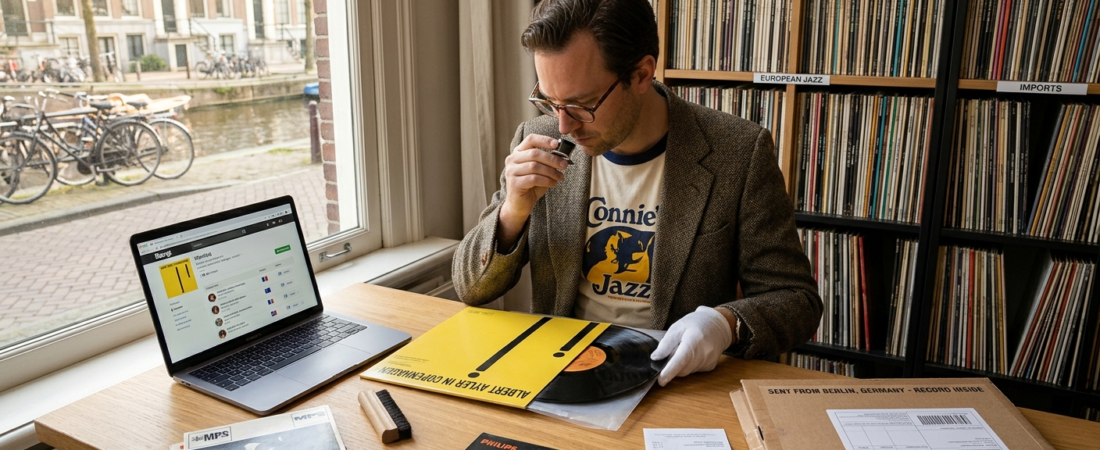
For serious jazz vinyl collectors in North America and across the globe, Discogs has completely revolutionized the crate-digging landscape. No longer are we limited to the stock of our local brick-and-mortar record shops; we now have access to a global inventory of millions of LPs at our fingertips.
However, when hunting for rare jazz releases—especially iconic European jazz titles on labels like Saba/MPS, Fontana, SteepleChase, or rare continental pressings of American Blue Note and Prestige titles—the most lucrative listings often come from sellers based in the European Union and the United Kingdom.
Buying internationally requires strategy. High shipping rates, varying grading standards, and complex import regulations can quickly turn a dream score into an expensive nightmare. Here is your definitive tactical guide to safely sourcing rare jazz vinyl from European sellers on Discogs.
1. Targeting the Right European Jazz Labels
Before you start filtering sellers, you need to know exactly what continental pressings are worth importing. Europe has a rich history of pristine analog jazz mastering that often rivals or surpasses original American pressings.
- Saba / MPS (Germany): Known as the “Rolls Royce” of European jazz recording. Engineers like Rolf Donner captured artists like Oscar Peterson, Bill Evans, and Albert Mangelsdorff with astonishing dynamic range and dead-silent vinyl surfaces. Look for German sellers offering the original “Pink Label” or “Tree Logo” pressings.
- Fontana (UK/Netherlands): Famous for releasing legendary European modern jazz sessions, such as the Tubby Hayes or Michael Garrick catalogs. Original UK Fontana pressings are highly coveted for their heavy wax and deep, warm mono mixes.
- SteepleChase (Denmark): Based in Copenhagen, this label captured spectacular mid-70s sessions from expatriate American legends like Chet Baker, Dexter Gordon, and Jackie McLean. Danish pressings are renowned for their transparent, airy soundstages.
2. Navigating the Shipping and VAT Trap
The absolute biggest hurdle when buying from Europe is the cost of logistics. To maximize your budget, you must understand how European shipping structures work.
The Weight Threshold Strategy
European postal services (like Deutsche Post in Germany, La Poste in France, or Royal Mail in the UK) calculate international shipping based on rigid weight tiers.
- The Sweet Spot: A single record with a standard cardboard mailer typically weighs under $500\text{g}$. However, shipping two or three records often fits into the exact same shipping price bracket (up to $1\text{kg}$ or $2\text{kg}$ depending on the country).
- Tactical Move: Never buy just one LP from a high-end European seller if you can help it. Always browse their internal Discogs store to find a second or third title. Combining shipping drastically drops your “per-record” delivery cost.
Understanding VAT (Value Added Tax)
If you are ordering from outside Europe, Discogs is legally required to collect local marketplace taxes (like sales tax or VAT) at checkout for certain regions. Keep an eye on the final checkout screen to factor these costs into your total investment before hitting buy.
3. Deciphering the “Goldmine” Grading Standards Internationally
While Discogs officially uses the Goldmine Grading Standard, interpretation varies drastically between American and European sellers.
The European Grading Reality: Many European collectors are notoriously conservative when grading jazz vinyl. A European Very Good Plus (VG+) copy often arrives looking and sounding like a US Near Mint (NM). However, to protect your investment, always look for the phrase “Visual and Audio Graded” in the item description.
Red Flags to Avoid:
- Sellers who use generic descriptions like “Good vintage condition for its age.” Jazz requires quiet surfaces; demanding a specific description of surface noise or spindle wear is completely acceptable for high-value items.
- Always check the seller’s feedback profile—specifically their negative feedback. Look to see if other jazz or classical buyers have complained about inaccurate grading regarding background crackle or non-fill issues.
4. How to Verify Authentic Pressings via Matrix Codes
European countries frequently pressed localized versions of American albums under license (e.g., Blue Note titles pressed by Artone in Holland, or Prestige titles pressed by Interdisc in the UK). These are often much cheaper than US originals but sound phenomenal.
To ensure you are getting the exact sonic profile you want, always message the seller to verify the Matrix Inscriptions in the deadwax before buying:
| US Original Feature | European License Counterpart | What to look for in the Deadwax |
| Blue Note (US Original) | Blue Note / Artone (Holland) | Look for machine-stamped matrix codes alongside the original American “RVG” or “VAN GELDER” stamps. This proves the Dutch pressing was made using the exact same master metal parts as the US version. |
| Prestige (US Original) | Prestige / Interdisc (Europe) | Check for the presence of the original American mastering stamps in the vinyl deadwax to guarantee true analog tape source fidelity. |
5. Summary Checklist for International Discogs Success
Before you click “Place Order” on that rare European jazz gem, run through this quick checklist:
- Combine and Conquer: Did you check the seller’s store for other jazz LPs to maximize the shipping weight bracket?
- The Audio Check: Did the seller play-test the record, or is it strictly a visual grade? (Crucial for quiet, acoustic modal jazz albums).
- Packaging Protection: Message the seller and explicitly request: “Please ship the vinyl outside of the inner sleeve to prevent seam splits during international transit.” Any professional jazz seller will gladly accommodate this request.
By treating Discogs not just as a search engine, but as a technical database, you can safely navigate the European market, uncover magnificent analog pressings, and scale the sonic quality of your jazz collection to international heights.