
Before Speed Became the Story
The Problem With Calling Hiromi a Virtuoso
There is an obvious way to write about Hiromi Uehara, and it is also the least interesting. Watch almost any concert performance and the vocabulary arrives immediately: speed, energy, precision, intensity, technique. Her hands move across the piano with extraordinary physical confidence; rhythmic patterns can accelerate without losing definition; abrupt changes of meter seem less like obstacles than invitations; and passages that would function as climaxes for many pianists can appear in the middle of one of her compositions before the music turns somewhere else entirely. The spectacle is real. The mistake is assuming that the spectacle explains the musician.
Hiromi’s career makes more sense when virtuosity is understood as a means of movement rather than a destination. From the beginning, she has been interested in music that can change identity while it is happening. Jazz improvisation, classical technique, rock dynamics, intricate composition, humor, repetition and rhythmic displacement do not appear in separate compartments. They collide, interrupt and reshape one another. Her playing can be excessive because excess is sometimes part of the composition; it can also become unexpectedly spare. The pianist capable of filling the instrument with dense rhythmic information is equally interested in what happens when a melody is left almost alone.
That contrast has been present since Another Mind, her 2003 debut. It would develop through Brain, Spiral, Hiromi’s Sonicbloom, solo piano, the Trio Project and the ensembles that followed, but the essential principle was already audible: categories were useful only until the music needed to move beyond them.
Hiromi herself resisted defining the result. Jazz, classical music and rock were all things she had listened to and learned from, but she did not see a reason to turn their combination into another label. That position can sound almost routine now, when musicians routinely describe themselves as genre-fluid, but in Hiromi’s case it was not branding. It described the way she had learned to hear.
Hamamatsu Before Boston
Born in Hamamatsu, Japan, in 1979, Hiromi began studying piano at six. Her early teacher encouraged more than mechanical accuracy, using color and imagery to help her understand musical character. That approach mattered. Technique was important, but technique had to produce an emotional result. Even at the beginning, playing correctly and communicating were not treated as identical achievements.
Her education at the Yamaha School of Music expanded that foundation. Yamaha’s presence in Hamamatsu made the city an unusually appropriate environment for a young pianist interested in both disciplined study and contemporary musical possibilities. Hiromi encountered jazz early, including Oscar Peterson, while continuing to develop within a formal musical environment. She was also composing while still young.
Classical training therefore did not precede jazz as though one identity had to be abandoned for another. The two developed alongside each other. At fourteen she performed with the Czech Philharmonic Orchestra, an experience that placed her inside large-scale ensemble music before she had begun a professional jazz career. At seventeen another encounter pointed in a very different direction: she had an opportunity to perform with Chick Corea.
Corea represented a particularly relevant model for the young pianist. His career had never respected a simple boundary between acoustic jazz and electric music, intricate composition and improvisation, lyricism and rhythmic intensity. From Miles Davis and Return to Forever to duets and solo performances, Corea demonstrated that technical command could support several musical identities rather than imprison a pianist inside one.
The importance of that encounter should not be exaggerated into a single moment that determined Hiromi’s future. Her musical language was the product of years of listening and study. But playing with Corea at seventeen provided an early glimpse of a professional world in which stylistic curiosity did not need to be corrected.
It could become the career.
Berklee and the Discipline Behind the Energy
Hiromi moved to Boston in 1999 to attend Berklee College of Music. She graduated in 2003, but her first album was already taking shape before she left the school. Berklee offered something different from the environment in which she had grown up: musicians from numerous countries, traditions and instrumental backgrounds working within a culture that treated improvisation, arranging, composition and contemporary performance as interconnected disciplines.
For a musician already reluctant to accept rigid categories, this was fertile ground.
The period also brought her into contact with Ahmad Jamal, whose presence in Hiromi’s early professional story is particularly revealing. At first glance, Jamal and Hiromi can seem like opposites. Hiromi’s public image would become associated with physical energy and dense technical activity, while Jamal’s art is frequently celebrated for space, dynamics, restraint and an almost architectural understanding of the piano trio.
But influence does not require imitation.
Jamal recognized something in the young pianist and became involved in the production of Another Mind. What Hiromi could learn from his example was not a surface style but a deeper principle: musical drama depends on relationships. Density has meaning because space exists around it. Repetition can change perception. A rhythm section is not merely accompaniment. A pianist can shape time by deciding what not to play as much as by deciding what to add.
This becomes important when listening to Hiromi beyond the speed. Her music may occupy a very different expressive world from Jamal’s, but it is rarely indifferent to structure. Even passages of apparent eruption have destinations. Themes return altered. Rhythmic ideas are developed rather than simply displayed. The physical excitement of performance can disguise how carefully many of these journeys have been designed.
Hiromi was learning how to build compositions capable of containing her appetite for movement.
Another Mind
Recorded in New York in September 2002 and released in 2003, Another Mind introduced Hiromi with unusual confidence. She had not yet graduated from Berklee when the project was developing, but this was not a tentative student recording. Ahmad Jamal and Richard Evans produced the album, and the personnel included bassist Mitch Cohn, drummer Dave DiCenso, bassist Anthony Jackson, guitarist David Fiuczynski and alto saxophonist Jim Odgren. More importantly, all of the compositions and arrangements were Hiromi’s.
The opening “XYZ” establishes the central problem for anyone trying to classify her. The music has the instrumental vocabulary and improvisational freedom of jazz, yet its rhythmic insistence and compositional architecture point elsewhere as well. Hiromi does not seem interested in proving that she can negotiate changes. She wants the changes themselves to become part of the narrative.
“Double Personality” makes the principle explicit in its title. Contrasting identities are not defects to be reconciled but sources of musical energy. Across the album, Hiromi moves between tightly constructed passages and sections that open into improvisation, between acoustic piano and keyboards, between rhythmic aggression and melodies that can be almost disarmingly direct.
What makes the debut significant is not that a young pianist could play difficult material. Jazz history contains no shortage of formidable technicians. The more important achievement is that Hiromi already sounds like a composer designing situations for improvisation.
Technique enters because the compositions require it.
This distinction would become central to her development. Hiromi’s most demanding passages are often difficult not simply because they contain many notes, but because the music asks the player to maintain several kinds of information simultaneously: rhythmic subdivision, dynamic shape, melodic direction, ensemble interaction and structural memory. Speed becomes only the most visible layer.
Humor as Musical Intelligence
One aspect of Hiromi’s music that disappears when she is described only through intensity is humor. Her compositions can be playful, exaggerated and deliberately theatrical. Titles such as “The Tom and Jerry Show” reveal an imagination comfortable with movement that borders on cartoon logic: chase, interruption, sudden direction change, collision.
This is not a minor decorative quality. Humor affects the way she constructs form.
Jazz has always contained wit, from rhythmic surprise and quotation to the stage personalities of musicians who understood performance as communication. Hiromi extends that tradition through a highly visual compositional imagination. A piece can behave like a sequence of scenes. One section appears to set up expectations precisely so the next can overturn them. Sudden stops and accelerations become dramatic gestures rather than technical exercises.
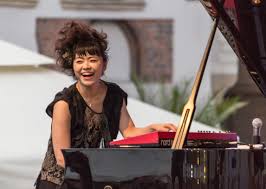
Her physical presence at the piano reinforces this dimension. Hiromi does not perform with the detachment sometimes associated with concert virtuosity. She smiles, reacts, moves and visibly engages with the musicians around her. For some listeners, that exuberance can initially seem almost too theatrical. Yet separating the gestures from the music misses the point. Her compositions themselves often possess the same animated quality.
The stage does not create the personality. It makes audible structure visible.
Brain: Refusing the Safe Second Album
The success of Another Mind could easily have encouraged Hiromi to refine the same formula. Instead, Brain arrived in 2004 with an even stronger sense that the piano could exist inside multiple musical environments. “Kung-Fu World Champion,” “If…,” “Wind Song,” “Desert on the Moon,” “Green Tea Farm” and the title track reveal a composer increasingly comfortable with abrupt contrasts between electric and acoustic textures, rhythmic density and melodic space.
The title Brain is appropriate because much of Hiromi’s music operates through patterns that seem to test perception. Repetition establishes an expectation; an alteration destabilizes it. Meter can feel secure until an accent shifts. A melodic fragment returns in another environment and suddenly performs a different function.
Yet the album also contains “Green Tea Farm,” a solo piece whose importance to Hiromi’s development should not be underestimated. Without a rhythm section or electric texture surrounding her, the pianist’s melodic instinct becomes exposed. The piece reminds us that the dense Hiromi and the lyrical Hiromi are not separate musicians. They are two consequences of the same concern with storytelling.
This is why describing her simply as maximalist is insufficient.
Maximalism matters only if minimal material can also hold attention.
Spiral and the Three-Piece Orchestra
By Spiral in 2005, Hiromi’s relationship with bassist Tony Grey and drummer Martin Valihora had developed into something more integrated. She described part of the album as music for a “three-piece orchestra,” a phrase that reveals how she understood the trio. Piano, bass and drums were not a soloist plus two supporting instruments. The ensemble itself could become compositional material.
This idea has deep roots in jazz. Bill Evans, Scott LaFaro and Paul Motian had famously expanded conversational trio playing decades earlier, and countless groups since had pursued different forms of equality. Hiromi did not invent the interactive trio. Her contribution was to combine that principle with her own highly composed, rhythmically volatile language.
“Spiral” offers a useful image for the music because Hiromi often returns to material without returning to exactly the same place. The extended sequence beginning with “Open Door / Tuning / Prologue” and moving through “Déjà Vu,” “Reverse” and “Edge” treats the trio almost as a small dramatic ensemble. Themes, rhythmic identities and instrumental roles shift as the music develops.
Grey and Valihora are essential because Hiromi’s compositions require musicians who can survive complexity without sounding as though they are merely counting. The bass must move between foundation and independent melodic activity. The drums have to articulate intricate structures while preserving physical momentum.
When this balance works, the listener can forget how complicated the machinery is.
That is one of Hiromi’s most important achievements.
Composition Before Category
By the middle of the 2000s, it was already difficult to describe Hiromi accurately using a conventional jazz subgenre. Fusion captured some of the electric energy but carried historical associations that did not explain the whole picture. Post-bop was too narrow. Progressive rock could describe certain rhythmic and compositional instincts but not her relationship to improvisation. Classical crossover misunderstood the depth of her jazz language.
Hiromi’s own refusal to label the music was therefore more than an artist avoiding definitions in an interview. The compositions genuinely moved across those boundaries too quickly for any one of them to remain useful.
What held the music together was authorship.
Whether she was playing acoustic piano, keyboards, solo or with a trio, the same compositional personality kept returning: rhythmic games that remained physically propulsive, melodies capable of surviving dense surroundings, abrupt contrasts treated as narrative devices, humor, technical demands and a persistent interest in musicians who could alter the written material through their own identities.
This last element would soon become increasingly important.
Hiromi was not interested in assembling bands of anonymous virtuosos capable of reproducing difficult scores. She wanted particular musicians because of the way they played. Composition could therefore begin before the notes were written: imagining what a specific instrumentalist might do could shape the piece itself.
That principle would eventually become fundamental to the Trio Project with Anthony Jackson and Simon Phillips, and much later to Sonicwonder. Before either ensemble existed, however, Hiromi would expand her working trio by adding one of the most unconventional guitarists available.
David Fiuczynski brought a sound capable of disrupting even Hiromi’s already unstable borders.
The result was Hiromi’s Sonicbloom.
With Time Control, the question was no longer whether Hiromi could combine jazz, classical discipline and rock energy. The more interesting question was how far she could stretch ensemble music before complexity stopped feeling like calculation and became something immediate, physical and alive.
Buy Amazon
From Sonicbloom to the Trio Project
When the Trio Was No Longer Enough
By the time Spiral established Hiromi’s working relationship with bassist Tony Grey and drummer Martin Valihora, the pianist had already demonstrated that the conventional piano trio could accommodate far more than one stylistic identity. Yet the success of that configuration did not encourage her to protect it. Hiromi’s development has repeatedly followed a pattern in which a musical language becomes comfortable just as she begins looking for something capable of disturbing it. In 2007, that disturbance arrived through guitarist David Fiuczynski and the ensemble Hiromi’s Sonicbloom.
Fiuczynski was an unusually appropriate collaborator because his guitar playing resisted many of the same boundaries that Hiromi ignored at the piano. His work could draw from jazz improvisation, rock distortion, funk, microtonality and experimental techniques without settling comfortably into any of them. Adding guitar to Hiromi’s established trio therefore did more than enlarge the ensemble. It introduced another instrument capable of competing with the piano for harmonic, rhythmic and textural space.
That possibility could easily have produced congestion. Hiromi’s keyboard language was already dense, Grey was an active bassist rather than a static accompanist, and Valihora’s drumming could generate substantial rhythmic force. A guitarist with a conventional comping role might simply have thickened the middle of the arrangement. Fiuczynski instead became an independent color. He could double a line, challenge it, distort it or move outside the harmonic expectations created by the piano. The ensemble’s music consequently acquired a harder edge without becoming merely a jazz group playing with rock volume.
The first major statement of this configuration, Time Control, was built around an idea Hiromi had already explored implicitly: time as compositional material. Jazz musicians have always manipulated time through swing, displacement, rubato, tempo changes and rhythmic interaction, but Hiromi made the subject unusually explicit. Titles such as “Time Difference,” “Time Out,” “Time Travel,” “Deep into the Night,” “Real Clock vs. Body Clock = Jet Lag” and “Time and Space” create a conceptual frame, yet the album’s real argument lies in how the ensemble behaves. Meter is not simply something the musicians obey. It becomes something they stretch, reorganize and sometimes make deliberately difficult to locate.
Time Control and the Architecture of Motion
Hiromi’s fascination with complicated meter can create the misleading impression that rhythmic difficulty is an end in itself. Time Control shows why that interpretation is incomplete. The purpose of an unexpected subdivision is not merely to make a passage harder to perform. It changes the listener’s physical relationship with the music. A pulse can appear stable and then shift beneath a melody; accents can suggest one organization while the underlying meter follows another. The result is a sensation of movement whose intellectual complexity does not cancel its physical force.
Fiuczynski expands this language because guitar can occupy territory unavailable to the acoustic piano. Sustained tones, distortion and altered timbres introduce another relationship with duration. Hiromi’s piano can attack a note with tremendous clarity, while Fiuczynski can stretch and reshape one after the attack. Their interaction therefore becomes partly a conversation between different ways of organizing sound.
Grey and Valihora prevent that conversation from floating away from the body of the music. The rhythm section has to make intricate structures feel inhabited rather than calculated. Grey’s bass lines can reinforce a pattern and then separate from it, while Valihora maintains propulsion through passages whose internal divisions might otherwise call attention to themselves as technical puzzles.
The strongest moments occur when the listener stops counting.
That is an important measure of Hiromi’s compositional success. Complexity becomes musically persuasive when it produces tension, release, surprise or momentum without requiring the audience to understand the mechanism. The musicians may need to know precisely where every accent belongs. The listener only needs to feel that the ground has moved.
Beyond Standard
The next Sonicbloom album, Beyond Standard, approached the question of identity from another direction. Rather than constructing the program primarily around new compositions, Hiromi placed familiar material inside the ensemble’s language. “Softly, as in a Morning Sunrise,” “Clair de Lune,” “Caravan” and “My Favorite Things” arrived with substantial histories attached to them. Each had already been interpreted repeatedly, which made recognition part of the musical problem.
Standards create a peculiar challenge for a musician with a highly distinctive style. Alter them too little and the performance can feel unnecessary; alter them too aggressively and the arrangement may seem interested mainly in proving its originality. Hiromi’s best transformations avoid both extremes by treating the source as structural material rather than a museum object.
This is particularly revealing in “Clair de Lune.” Debussy is not brought into the program simply to demonstrate Hiromi’s classical background. The piece provides melodic and harmonic material whose identity is strong enough to survive translation into another context. Similarly, “Caravan” and “My Favorite Things” carry jazz histories so extensive that no contemporary performance can pretend to approach them innocently. Hiromi does not erase those histories. She enters them through her own rhythmic imagination.
The title Beyond Standard can therefore be read in two ways. The group moves beyond the conventional treatment of standards, but Hiromi also moves beyond the assumption that repertoire determines genre. Debussy, Ellington-associated material and Rodgers and Hammerstein can coexist because the ensemble supplies the interpretive logic.
Sonicbloom demonstrated that Hiromi could enlarge her music without losing its identity. But once again, having established an effective format, she changed direction.
Chick Corea and the Conversation Across Generations
Chick Corea had appeared in Hiromi’s story before her professional career was fully formed. Years later, the relationship became visible to a much larger audience through their piano-duet performances and the live album Duet, recorded in Tokyo in 2007 and released subsequently. Two-piano concerts present a particular challenge because both musicians occupy nearly the same frequency, harmonic and functional territory. Without intense listening, virtuosity can quickly become competition.
Corea and Hiromi had enough technique to overwhelm almost any musical environment. What makes their encounters valuable is the extent to which technique becomes conversational. Ideas are offered, imitated, redirected and occasionally exaggerated. The generational difference remains audible without turning the encounter into master and student. Corea had decades of experience moving between acoustic jazz, fusion, Latin influences and composed forms; Hiromi represented a younger musician for whom those stylistic borders had already become porous historical facts.
Their dialogue reinforced a principle running through Hiromi’s career: freedom becomes more interesting when another musician can answer it.
A soloist can change direction at will. In a duet, every decision creates consequences for someone else. Two pianists must continually decide whether to support, contrast, imitate or leave space. That responsiveness would become increasingly important as Hiromi moved toward the next phase of her work.
Place to Be: Nothing to Hide Behind
In 2009, Place to Be removed the ensemble almost entirely. The solo-piano album offered an opportunity to hear what remained when bass, drums, guitar and electric textures were absent. For a pianist so strongly associated with explosive interaction, the format could have exposed a weakness if her musical identity depended primarily on the energy generated by a band.
Instead, it clarified how much of that energy originated in the compositions themselves.
Solo piano leaves nowhere to transfer responsibility. Rhythm, bass movement, harmony, melody and dynamics all belong to one musician. Hiromi could still create density, but she also had to sustain attention when density disappeared. Pieces such as “BQE,” “Cape Cod Chips,” “Sicilian Blue,” “Choux à la Crème,” “Pachelbel’s Canon” and the title track reveal her fascination with place, motion and changing atmosphere while making the architecture of her playing unusually exposed.
The album also shows why the lyrical side of Hiromi should never be treated as a corrective to the virtuosic one, as though she occasionally slows down to prove she has sensitivity. Both arise from the same compositional imagination. A melody can be developed through space just as a rhythmic pattern can be developed through accumulation.
Solo performance made this relationship impossible to miss.
It also arrived at an important transitional moment. The Sonicbloom period had expanded Hiromi’s ensemble vocabulary, but the next major group would not be built by adding another instrument. It would return to the classic piano-bass-drums format with musicians whose individual histories made the word “trio” almost misleadingly simple.
Stanley Clarke and Another Kind of Bass
Before that trio fully emerged, Hiromi’s work with Stanley Clarke provided another significant encounter. Clarke had been central to the expansion of electric bass in jazz and fusion since the 1970s, particularly through Return to Forever and his own recordings. His technique, compositional personality and ability to move between acoustic and electric bass made him an obvious musical relative even though he belonged to an earlier generation.
Hiromi appeared on Clarke’s projects during this period, including the Grammy-winning The Stanley Clarke Band. Their interaction reinforced her connection to musicians for whom fusion was not a historical style to imitate but an earlier solution to the same fundamental problem she continued to explore: how can improvisation coexist with electric sound, compositional complexity and the physical impact of rock or funk without sacrificing musical interaction?
Working with Clarke also placed Hiromi in another environment where instrumental personality mattered more than generic function. Clarke does not disappear into the background simply because a pianist is present. His bass carries too much identity.
That lesson would become even more pronounced with Anthony Jackson.
Voice and the Birth of the Trio Project
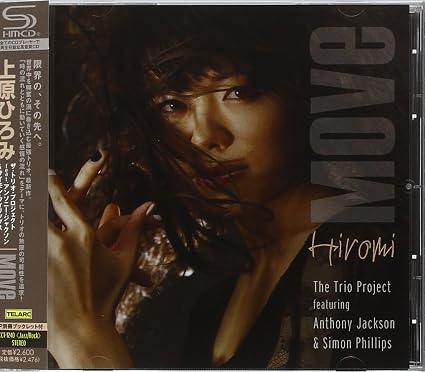
When Hiromi formed the group that became known as the Trio Project, she chose bassist Anthony Jackson and drummer Simon Phillips. On paper, the instrumentation returned her to the most familiar small-group configuration in jazz: piano, bass and drums. In practice, these were not conventional choices.
Jackson had transformed the role of electric bass through decades of work across jazz, fusion, soul and popular music. His six-string contrabass guitar expanded register and harmonic possibilities, but the importance of his playing went far beyond the instrument’s additional strings. Jackson possessed an extraordinary sense of architecture. A bass line could function simultaneously as foundation, counterpoint and compositional voice.
Phillips brought another history. His career encompassed rock, fusion and technically demanding ensemble music, with a drum sound capable of enormous power but also precise internal organization. He had worked in contexts ranging from Jeff Beck and Toto to numerous jazz-rock projects, developing the ability to make complicated rhythmic structures feel physically decisive.
Hiromi did not recruit them to create a neutral rhythm section.
She wrote for who they were.
The first album of the collaboration, Voice, released in 2011, therefore marks more than another change of personnel. It represents a refinement of the ensemble philosophy already visible on Spiral and Sonicbloom. The trio is treated as three strongly differentiated musical identities whose interaction determines the composition.
Jackson’s electric bass can occupy spaces usually unavailable to a traditional acoustic-bass role. Phillips can move from explosive force to detailed rhythmic commentary. Hiromi can use acoustic piano and keyboards without having to supply every harmonic or rhythmic layer herself.
The result is spacious despite the players’ enormous technical resources.
That paradox matters. Three virtuosos do not automatically create good ensemble music. In fact, the danger is often the opposite: too many musicians capable of commanding attention can produce a permanent struggle for the foreground. Voice works when the players recognize that virtuosity includes the decision not to occupy every available space.
Three Musicians, Three Functions — Constantly Changing
The Trio Project became one of the clearest expressions of Hiromi’s belief that ensemble roles should remain unstable. Jackson can begin as foundation and become a melodic partner. Phillips can establish a groove and then reorganize its internal accents. Hiromi can dominate the texture with a piano passage before reducing her role to leave the bass or drums exposed.
This flexibility gives the compositions a sense of narrative that would be diminished if the players maintained fixed responsibilities. A written theme can function almost like the opening proposition in a conversation. Once established, each musician can reinterpret its implications.
Hiromi’s writing became increasingly tailored to these personalities. That distinguishes the Trio Project from a leader hiring exceptional sidemen to perform an existing repertoire. The musicians affected what could be composed in the first place.
Anthony Jackson’s presence is particularly significant. Hiromi had already worked with him on her debut, but the Trio Project allowed the relationship to develop at a much deeper level. His ability to maintain clarity through complicated harmonic and rhythmic movement gave her enormous compositional freedom. She could write densely without having to simplify the bass function merely to keep the music intelligible.
Phillips offered a comparable freedom in rhythm. Odd meters and shifting subdivisions could retain momentum because his playing communicated structure physically. The audience did not have to solve the rhythm to experience its force.
This may be the most important difference between technical complexity and musical complexity. Technical complexity asks whether something is difficult to perform. Musical complexity asks whether several meanings can coexist.
The Trio Project was capable of both.
Move, Alive and the Expansion of the Idea
The collaboration continued through Move in 2012 and Alive in 2014, allowing Hiromi to write with increasingly detailed knowledge of Jackson and Phillips. The advantage of a stable ensemble is not merely familiarity. Over time, musicians develop a shared memory. A gesture no longer needs to be explained because the others understand where it might lead. Compositions can assume a level of responsiveness that would be risky with players encountering the material for the first time.
Onstage, this became especially powerful.
Hiromi’s concerts had always possessed physical intensity, but the Trio Project could generate scale disproportionate to its size. Phillips brought orchestral weight to the drums; Jackson’s instrument covered an unusually broad register; Hiromi moved between acoustic and electric keyboards. Yet the most compelling passages were often those in which the group suddenly reduced that scale. After sustained density, a sparse melodic exchange could feel enormous.
Contrast remained the organizing principle.
By Alive, the Trio Project no longer sounded like an experiment in assembling famous virtuosos. It sounded like a band.
That distinction is essential. Technique attracts attention to individuals; ensemble identity makes the listener hear relationships. Hiromi’s compositions increasingly relied on those relationships, and the musicians’ personalities had become inseparable from the repertoire.
The group would eventually produce another major statement, Spark, but its trajectory could not continue indefinitely. Anthony Jackson’s health increasingly limited his ability to perform, and the Trio Project chapter would close without being replaced by an immediate equivalent.
For Hiromi, that transition created another period of reconsideration.
The pianist who had moved from trio to Sonicbloom, from solo performance to the Trio Project, would again have to decide what remained when a successful musical architecture could no longer simply continue.
The answer would involve returning to the piano alone, writing for strings, entering the world of Japanese animation and eventually building an entirely new electric ensemble.
Once again, Hiromi’s career would advance not by protecting a successful formula, but by allowing the formula to end.
After the Trio, Another Beginning
Spark and the End of a Chapter
By the time Hiromi, Anthony Jackson and Simon Phillips recorded Spark, the Trio Project had developed something that cannot be manufactured simply by assembling extraordinary musicians. The group had memory. Years of performing together had created an accumulated understanding of how each player might react when a composition changed direction, how far a rhythmic idea could be stretched before it needed reinforcement, and how quickly the music could move from dense activity into open space without losing coherence. Spark, released in 2016, captured that maturity while also becoming the final studio statement of the trio.
The album extends principles already established on Voice, Move and Alive: written structures become environments for interaction, instrumental roles remain flexible, and technical complexity is expected to generate physical momentum rather than admiration for its own sake. Hiromi could write with Jackson’s six-string contrabass guitar and Phillips’s particular rhythmic authority already present in her imagination. This is one of the great advantages of a long-term ensemble. Composition no longer begins with abstract categories such as piano, bass and drums. It begins with specific human beings.
Jackson’s subsequent health problems made continued touring increasingly difficult, and the Trio Project eventually ceased to function as Hiromi’s primary ensemble. The end was significant because the group had become one of the strongest vehicles for her music. Yet her career had already demonstrated that stability rarely lasted indefinitely. The trio with Tony Grey and Martin Valihora had led to Sonicbloom; Sonicbloom had been followed by solo piano and other collaborations; the Trio Project had then created another language. Losing that particular configuration did not require Hiromi to find musicians who could imitate it.
It required another beginning.
That distinction has shaped much of her career. Hiromi’s development is less a straight line toward increasing complexity than a series of resets. She builds an ensemble, learns its possibilities, writes increasingly specifically for it and then, when circumstances change, asks what the next musical environment makes possible.
After Spark, the answer initially involved removing the ensemble again.
Spectrum: Returning to One Piano
Released in 2019, the year of Hiromi’s fortieth birthday, Spectrum returned her to solo piano. A solo album after the Trio Project could easily have been framed as retreat — the pianist withdrawing from the scale and force of the previous group. Instead, it demonstrated how misleading the opposition between solo and ensemble could be in her music.
Hiromi has always treated the piano as several instruments at once.
The left hand can establish a bass function while the right develops independent melodic material; inner voices can create rhythmic counterpoint; repeated figures can behave almost like percussion. None of this is unique to Hiromi — the history of piano playing is built partly on the instrument’s capacity to imply multiple voices — but her rhythmic imagination makes the illusion especially vivid. At times, Spectrum seems to contain the memory of an absent band.
The title itself suggests range rather than a single aesthetic. The program moves through original compositions and material associated with other musical histories, including a substantial treatment of George Gershwin’s “Rhapsody in Blue.” Hiromi does not approach such repertoire by attempting to neutralize her personality. Nor does she simply turn familiar music into a technical showcase. She searches for points where its rhythmic, melodic and dramatic possibilities can interact with her own language.
Solo piano also makes another aspect of her musicianship unavoidable: pacing. With no drummer to create propulsion and no bassist to establish the floor beneath the harmony, Hiromi has to generate and release tension herself. A sudden pause carries more weight. A repeated note can reorganize the listener’s perception of time. An acceleration has to feel structurally necessary because no other musician is there to justify it through interaction.
Once again, virtuosity becomes most useful when the listener stops thinking about it.
When the Concert World Stopped
The trajectory following Spectrum was interrupted by circumstances no musician could have anticipated. The COVID-19 pandemic shut concert halls, suspended international touring and separated performers from the collaborative routines around which their professional lives had been organized. For Hiromi, whose music depended so strongly on interaction and live energy, the interruption posed a particularly direct problem.
Her response was not to attempt a remote imitation of the Trio Project.
Instead, she began imagining music around piano and string quartet.
The resulting Silver Lining Suite, released in 2021, represents one of the most revealing changes in her compositional development. Strings had appeared in various contexts around her work before, but writing a substantial project around piano and quartet required another kind of thinking. A string quartet is not simply an orchestral pad that can be placed behind a pianist. Four bowed instruments can sustain, articulate, counterpoint and alter color with enormous independence. If treated seriously, they become characters.
Hiromi wrote the suite with that independence in mind.
The project demonstrates how constraint can produce expansion. The pandemic removed the normal touring environment, but the absence of that environment forced her to reconsider ensemble scale. Instead of recreating the explosive rhythmic architecture of Jackson and Phillips, she worked with musicians capable of extending the piano’s harmonic and melodic world in another direction.
The result is not “Hiromi with strings” in the decorative sense. The quartet participates in the composition.
Silver Lining Suite and the Composer Behind the Pianist
Hiromi’s public image has always made it easy for the pianist to overshadow the composer. A live video can circulate because viewers are astonished by what her hands are doing long before they ask who wrote the piece. Silver Lining Suite makes that imbalance harder to maintain.
Writing for strings requires decisions that cannot be solved through pianistic instinct alone. Register, bowing character, sustained harmony, counterpoint and ensemble balance all have to be imagined beyond the keyboard. The piano remains central, but its relationship with the surrounding voices changes.
This reveals a continuity with Arthur Verocai’s story in an unexpected way: orchestration is not valuable because more instruments make music sound larger. It matters because additional voices create additional relationships. Hiromi’s challenge is to determine which ideas belong to the piano and which become more expressive when distributed across strings.
The album also demonstrates that her rhythmic personality does not disappear when drums are absent. Pulse can be implied through articulation, repeated figures and the interaction of short and sustained gestures. Movement can emerge from harmonic rhythm rather than percussion.
The title, born from a period of global uncertainty, risks inviting a simple narrative of darkness transformed into hope. The music is more interesting than that. Hiromi does not attempt to provide an uncomplicated emotional resolution to the pandemic. Instead, she uses an altered musical environment to explore what can be created when the normal conditions of creation disappear.
The important development is not optimism as a slogan.
It is adaptation as practice.
Blue Giant: Entering Someone Else’s Story
Another major shift arrived through Blue Giant, the animated film adaptation of Shinichi Ishizuka’s manga about a young saxophonist pursuing jazz with obsessive determination. Hiromi composed the music for the film and also performed the piano parts associated with the character Yukinori Sawabe. The project placed her inside a creative situation fundamentally different from making an album under her own name.
Film music has to serve time that the composer does not control.
A scene has a duration. Characters possess emotional trajectories established by narrative and image. Music may need to intensify something visible, contradict it, prepare an event or disappear entirely. A composer accustomed to determining the complete architecture of a piece must negotiate another hierarchy.
For Hiromi, Blue Giant also required engagement with a fictional jazz ensemble whose music needed to sound convincing as jazz while serving dramatic storytelling. The challenge was particularly interesting because the film addresses ideas central to her own career: ambition, practice, improvisation, ensemble communication and the desire to reach listeners through performance.
Yet the characters could not simply become disguised versions of Hiromi.
The music had to belong to their world.
The soundtrack brought Hiromi into collaboration with saxophonist Tomoaki Baba and drummer Shun Ishiwaka, and its success introduced her work to listeners who might never have encountered Another Mind, Sonicbloom or the Trio Project. This is another example of how her career has expanded not by abandoning jazz but by placing jazz musicianship inside different cultural formats.
Anime was not a novelty added to make the music fashionable. It was a compositional assignment requiring Hiromi to think narratively in a different medium.
Sonicwonder and the Return of Electricity
After solo piano, strings and film, Hiromi returned to a full electric ensemble with Sonicwonder. The group brought together Hiromi on piano and keyboards, Hadrien Feraud on bass, Gene Coye on drums and Adam O’Farrill on trumpet. The instrumentation immediately distinguished the ensemble from both Sonicbloom and the Trio Project. There was no guitar and no attempt to recreate Anthony Jackson and Simon Phillips. Trumpet introduced another melodic voice, while the rhythm section belonged to a younger generation with different histories.
The 2023 album Sonicwonderland established the group’s identity through music that retained Hiromi’s rhythmic complexity while allowing electronic keyboards and ensemble color to move back toward the foreground. The title suggested play, and the performances often carried precisely that quality. Complexity did not have to sound severe. A difficult rhythmic passage could possess humor, bounce or the logic of a game.
O’Farrill was especially important because trumpet changed the balance of Hiromi’s writing. Unlike guitar, which can participate heavily in harmonic texture, trumpet naturally creates a more exposed melodic line. Hiromi could write counterpoint between piano and horn, allow the trumpet to carry material above dense keyboard harmony or create conversations in which neither instrument permanently occupied the lead.
Feraud brought an exceptionally fluid electric-bass vocabulary, capable of rapid melodic movement as well as foundation. Coye’s drumming supplied both power and flexibility. Once again, Hiromi chose musicians whose personalities made simple replacement impossible.
Sonicwonder therefore continued the most consistent principle in her ensemble history: never rebuild the last band.
Write for the next one.
Out There and the Value of Continuation
Sonicwonder continued beyond its first recording, allowing the ensemble to develop through touring and further music rather than functioning as a temporary studio concept. This matters because Hiromi’s strongest bands have always deepened through repeated performance. Compositions may begin on paper, but the musicians gradually discover how much freedom exists inside them.
The process recalls the evolution from Voice through Spark, although the musical personalities are entirely different. Hiromi again has an ensemble capable of navigating written complexity while responding spontaneously. The distinction between composition and improvisation becomes less useful because one continually changes the listener’s understanding of the other.
A tightly organized passage can make the following improvisation feel more open. An improvised event can alter how a returning theme is perceived. The written score provides memory; improvisation introduces the possibility that memory will not return unchanged.
This relationship has been central to jazz for generations. Hiromi’s contribution lies in the particular intensity with which she combines it with compositional structures drawn from a wider listening history.
She is neither escaping jazz nor proving that jazz can absorb other genres.
Jazz has always absorbed other music.
Hiromi Inside a Larger History
The old tendency to describe Hiromi as someone who “redefined the boundaries of modern jazz” creates an unnecessarily heroic narrative. No single pianist owns those boundaries, and they were porous long before she began recording. Jelly Roll Morton understood musical mixture at the beginning of jazz history. Duke Ellington composed beyond conventional categories. Lennie Tristano brought another kind of structural discipline to improvisation. Cecil Taylor transformed the physical and formal possibilities of the piano. Herbie Hancock moved between acoustic improvisation, funk and electronic music. Chick Corea built careers in several musical worlds simultaneously. Keith Jarrett crossed classical performance and improvisation. Musicians associated with fusion had already placed jazz beside rock, electronics and complex composition decades before Another Mind.
Hiromi belongs within this history rather than outside it.
What makes her distinctive is not that she invented stylistic openness. It is the specific language she constructed from it: unusually physical piano technique, rhythmic structures that can become playful rather than academic, a strong melodic instinct, an attraction to musicians with powerful individual identities and a willingness to change ensemble architecture whenever the music requires another solution.
Her Japanese background is part of that identity without explaining it completely. Her classical education matters without making her a classical pianist playing jazz. Berklee matters without making her an American jazz product. Chick Corea and Ahmad Jamal matter without turning her into a descendant who can be understood simply through influences.
The language emerges from the intersections.
Why the Speed Still Matters
Correcting the emphasis on virtuosity does not require pretending that Hiromi’s speed is irrelevant. It matters enormously. Physical command allows her to imagine musical events that would be impossible without it. Some compositions depend on rapid articulation, independence between the hands, sudden register changes and rhythmic precision at tempos that create genuine technical danger.
The problem begins only when speed becomes explanation.
Technique can tell us how a musician performs an idea. It cannot tell us why the idea exists.
Hiromi’s career becomes much richer once the question changes from “How can she play that fast?” to “Why does this composition need to move this way?” Sometimes the answer is excitement. Sometimes humor. Sometimes a gradual accumulation of tension. Sometimes a rhythmic pattern has to become almost overwhelming before a sudden empty space can have its full effect.
Speed is therefore part of her dramatic vocabulary.
So is silence.
The Music Behind the Performance
One reason Hiromi became particularly visible in the internet era is that her performances translate extraordinarily well to video. Even without understanding the music, a viewer can recognize physical difficulty and energy. Her expressions, movements and interaction with the instrument create immediate visual drama. A short clip can communicate virtuosity in seconds.
But the same visibility can distort the work.
A composition designed to develop across ten minutes may be represented online by its fastest thirty seconds. A concert built around contrast can circulate through a single climax. The patient architecture disappears while the spectacular moment survives.
Listening to the albums in sequence corrects that distortion.
Another Mind reveals a young composer already thinking beyond instrumental display. Brain and Spiral deepen her relationship with structure. Sonicbloom expands color and electric force. Place to Be removes the band. The Trio Project demonstrates what happens when composition is written around three specific virtuosos. Spectrum returns to the solitary instrument. Silver Lining Suite redistributes the musical architecture through strings. Blue Giant forces composition to serve narrative. Sonicwonder creates another ensemble language.
The career is not a collection of increasingly difficult piano performances.
It is a history of changing musical problems.
Virtuosity Without Borders
Hiromi does not need to be described as the pianist who destroyed categories, reinvented jazz or proved that genre no longer matters. Such claims make a fascinating career sound smaller by forcing it into a familiar mythology of revolution.
Her actual achievement is more durable.
For more than two decades, she has maintained a recognizable musical identity while repeatedly changing the conditions around it. Remove the electric guitar and she remains Hiromi. Remove the rhythm section and she remains Hiromi. Add strings and the language adapts. Place the music inside an animated film and the compositional instincts survive while serving another narrative. Build a new quartet around trumpet, electric bass and drums and the identity changes again without disappearing.
That is a more meaningful form of originality than novelty for its own sake.
The pianist who emerged with Another Mind in 2003 already possessed formidable technique. If technique alone had been the point, the story could have ended there. Instead, every subsequent phase has asked what that technique can serve: another composition, another musician, another ensemble, another story, another way of organizing time.
Hiromi’s hands remain astonishing because they allow her to move almost anywhere she imagines.
Her music matters because she keeps imagining somewhere else to go.