The Pontiac Dynamic and the Birth of the Rolling Wave
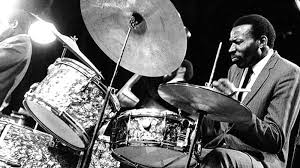
To grasp the absolute, earth-shaking shockwave that Elvin Jones brought to modern music, you have to picture the youngest of ten children growing up in Pontiac, Michigan, surrounded by an elite musical brotherhood that included his brothers Thad (the legendary trumpeter) and Hank (the master pianist). Moving to New York in the mid-1950s, Elvin quickly polarized the city with a style that shattered traditional jazz drumming conventions. Instead of a polite, linear timekeeper, Elvin approached the drum kit as a complex, rolling wave of rhythm. He pioneered an unprecedented level of four-limb independence, decoupling the ride cymbal from the bass drum and snare. This allowed him to superimpose polyrhythms—often playing in triplets over a standard 4/4 meter—creating an elastic, fluid ocean of sound that shifted the entire gravity of the rhythm section.
The Coltrane Crucible: Shaking the Gates of Heaven
In 1960, Elvin’s destiny was permanently sealed when he joined the John Coltrane Classic Quartet alongside McCoy Tyner and Jimmy Garrison. For the high-art connoisseur exploring the absolute pinnacles of The Jazz Compass, this line-up represents the holy grail of spiritual avant-garde jazz. On masterworks like A Love Supreme (1965) and Crescent (1964), the musical dialogue between Coltrane’s soaring sax and Elvin’s volcanic drums became legendary. Elvin didn’t just back Coltrane up; he engaged in a continuous, high-voltage boxing match with him. He drove his massive, heavy-K Zildjian cymbals with a ferocious energy, dropping explosive bass drum “bombs” and complex snare chatter that provided the dense, swirling harmonic canvas Coltrane required to take his historic modal safaris into the stratosphere.
The Machine Gun Grace and the Eternal Latitude
True to the borderless, forward-thinking spirit of Jazz Latitude, Elvin Jones’s artistic geography expanded beautifully into his post-Coltrane career, proving that his rhythmic philosophy was timeless. Leaving the quartet in 1966 as the music pushed into unstructured free jazz, Elvin founded his own powerhouse ensemble, The Elvin Jones Jazz Machine. For nearly four decades, he toured the globe as a revered tribal elder of the drums, mentoring brilliant young talents and recording landmark albums for Blue Note and Enja Records. On stage, he was a mesmerizing sight—sweat-drenched, teeth-bared, playing with a raw, physical intensity that looked like manual labor but sounded like pure, mathematical grace. When Elvin finally put down his sticks in 2004, he left behind an untouched coordinate on our musical map: a permanent monument built on the absolute courage to turn a drum kit into a living, breathing, and deeply sacred heart.