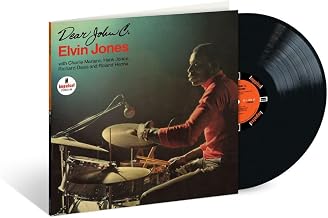
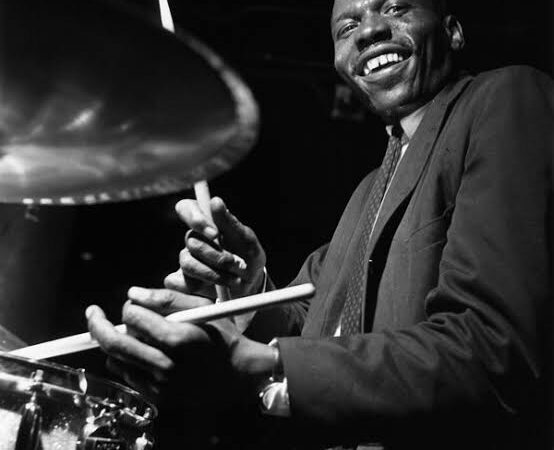
Elvin Jones: The Drummer Who Turned Rhythm Into a Force of Nature
There are drummers who keep time, drummers who decorate it, and drummers who make time itself feel unstable. Elvin Jones belonged to the last category. When he entered John Coltrane’s quartet at the beginning of the 1960s, the drums ceased to function merely as the foundation beneath the soloist. Jones created an enormous field of rhythmic activity around the music: cymbals surged, tom-toms rolled beneath phrases, accents appeared where conventional swing logic did not necessarily predict them, and yet the pulse rarely disappeared. The effect could be overwhelming, but it was never random. Behind the apparent turbulence was one of the most sophisticated rhythmic imaginations in modern jazz, a drummer capable of making several layers of motion coexist while preserving a deep, almost physical sense of forward movement.
His years with Coltrane would make him immortal. From My Favorite Things and Impressions through Crescent and A Love Supreme, Jones became part of one of the defining ensembles in jazz history alongside pianist McCoy Tyner and bassist Jimmy Garrison. Yet treating him simply as “Coltrane’s drummer” misses more than half the story. Before joining the quartet, Jones had already developed through Detroit’s remarkable jazz environment and played with musicians including Bud Powell, J.J. Johnson, Miles Davis and Sonny Rollins. After leaving Coltrane, he spent nearly four decades leading groups of his own, recording prolifically and turning the Elvin Jones Jazz Machine into both a working ensemble and a place where younger musicians could encounter his conception of rhythm directly.
Elvin Jones did not invent polyrhythm in jazz, nor did he abandon swing in pursuit of abstraction. His revolution was subtler and ultimately more influential: he demonstrated that a drummer could make swing multidirectional. The pulse could remain strong while the surface around it expanded. A measure could feel grounded and suspended at the same time. The drummer could support the soloist while also becoming an equal participant in the improvisation.
That idea changed jazz drumming permanently.
Pontiac and the Jones Family
Elvin Ray Jones was born on September 9, 1927, in Pontiac, Michigan, the youngest of ten children in one of the most remarkable musical families in American jazz. His older brothers included pianist Hank Jones and trumpeter, composer and arranger Thad Jones, both of whom would build major careers of their own. Hank became one of the most admired pianists of his generation, celebrated for an elegant touch and extraordinary adaptability; Thad developed into an important trumpeter and composer before becoming internationally known through the Thad Jones/Mel Lewis Orchestra.
Elvin would sound almost nothing like either of them.
That contrast is important. The Jones brothers shared an environment in which music was taken seriously, but they developed radically individual identities. Hank’s piano playing could embody refinement and balance. Thad’s writing combined orchestral intelligence with hard-swinging modern jazz. Elvin’s drums seemed capable of turning the entire bandstand into a moving body.
Their father worked for General Motors and was also a Baptist deacon, and the Jones household existed within a community where church, family and music intersected. Elvin began becoming serious about drums while still young. Unlike the romantic image of the completely instinctive percussionist who somehow emerged fully formed, his development involved intense listening to the drummers who had established the instrument’s evolving role in jazz.
Chick Webb mattered.
Jo Jones mattered.
Buddy Rich mattered.
Then came the bebop generation: Kenny Clarke, Max Roach and Art Blakey.
Elvin listened to all of them, but he would eventually sound like none of them.
Learning From the Drummers Who Changed Time
The history of jazz drumming before Elvin Jones was already a history of transformation. Swing-era masters had expanded the drum set’s expressive possibilities, while Jo Jones helped shift the sensation of the primary pulse away from heavy bass-drum emphasis toward the hi-hat and cymbals. Bebop drummers such as Kenny Clarke and Max Roach pushed the transformation further. The ride cymbal became a principal carrier of swing, while bass drum and snare could create independent accents around the pulse rather than simply state every beat.
This liberated the drummer.
It also created the conditions from which Elvin could eventually develop his own language.
Jones absorbed the modern conception of the drum set as several interacting voices rather than one mechanism producing a repetitive pattern. But where bebop drumming often emphasized clarity, sharp punctuation and the ability to negotiate rapid harmonic movement, Elvin increasingly developed a more rolling sense of time. His limbs could suggest different subdivisions simultaneously. The cymbal might define a broad arc while snare, bass drum and tom-toms produced secondary currents beneath it.
The result would later be called polyrhythmic, and correctly so, but the word can make his playing sound more academic than it felt.
Elvin’s rhythm was physical.
You did not need to calculate it to understand its force.
Detroit: The Real School
After military service in the late 1940s, Jones returned to Michigan and entered the extraordinary jazz environment developing around Detroit. The city produced or nurtured an astonishing concentration of musicians during the period: Tommy Flanagan, Barry Harris, Kenny Burrell, Yusef Lateef, Pepper Adams, Donald Byrd and the Jones brothers were part of a much larger ecosystem in which bebop and hard bop could be learned through constant professional interaction.
Detroit became Elvin’s real conservatory.
The importance of this environment lies not simply in the number of famous names associated with it but in the standards musicians imposed on one another. Rhythm sections had to function at professional level. Players had to know repertoire, respond immediately to unfamiliar situations and develop enough individuality to survive alongside musicians who were themselves rapidly evolving.
Jones worked with local and visiting artists, gradually becoming known as a drummer whose conception was unusual but whose swing was undeniable.
This combination mattered.
Innovation without functional musicianship rarely sustains a career.
Elvin could make music feel dangerous without making the band feel insecure.
The Sound Before New York
Some of the characteristics later associated with Jones were already emerging during these formative years. His sense of rhythm did not depend on keeping every component of the drum set obediently aligned with the same subdivision. He could hear the measure as a larger space containing several simultaneous possibilities.
That conception helps explain the sensation of circular motion in his mature playing.
Traditional descriptions of rhythm often imagine time as a straight line: beat one leads to beat two, then three, then four, and the measure begins again. Elvin could make the same four beats feel more like a rotating structure. Cymbal patterns curved over the bar line. Tom-tom figures suggested movement beneath the formal meter. Accents could push against the expected hierarchy of beats.
Yet somewhere inside the apparent storm, swing remained.
This became one of his defining paradoxes.
The freer he sounded, the stronger the underlying pulse could feel.
New York, 1955
Jones moved to New York in 1955, entering a jazz scene operating at a ferocious level of competition. Bebop had already transformed the music, hard bop was consolidating its own identity, and musicians who would define the next decade were beginning to push beyond both.
New York tested whether an individual vocabulary could function outside the environment that had nurtured it.
Elvin’s could.
He worked with Teddy Charles and Bud Powell and soon appeared in increasingly important settings. His playing attracted attention because it combined modern vocabulary with a rhythmic weight difficult to mistake for anyone else.
Jones was not interested in producing a neat background.
He reacted.
A horn phrase could provoke a snare accent. A harmonic shift could trigger movement across the tom-toms. The ride cymbal could intensify without requiring the tempo itself to change.
This made him especially valuable to improvisers who wanted a drummer to participate rather than merely accompany.
Soon he would encounter several of the most demanding soloists in jazz.
Bud Powell and the Bebop Test
Playing with Bud Powell represented a significant challenge for any drummer. Powell’s piano language condensed much of bebop’s harmonic and rhythmic revolution into an extraordinarily intense approach to the instrument. His right-hand lines could move with horn-like velocity while the rhythm section needed to maintain clarity underneath rapid changes.
For Jones, environments like this sharpened the relationship between freedom and responsibility.
The drummer could not simply impose his own rhythmic universe on every performance.
He had to listen.
This is a point sometimes lost when Elvin’s later Coltrane performances are described primarily through words such as volcanic, explosive or thunderous. He possessed enormous power, but power without responsiveness would have made him unusable to musicians of this level.
Jones learned how to preserve his identity while adapting to different musical personalities.
That versatility would become increasingly visible.
J.J. Johnson and Precision
His work with trombonist J.J. Johnson offered another context. Johnson was one of the musicians who had demonstrated that the trombone could negotiate bebop’s technical demands with the fluency associated with trumpet and saxophone. His groups required precision, articulation and structural awareness.
Elvin could provide all three without surrendering his own rhythmic character.
Experiences like these are essential to understanding the drummer who later joined Coltrane. Jones did not arrive in that quartet as an untamed force whom Coltrane somehow discovered and liberated. He arrived after years of professional situations that had taught him how to make his increasingly personal conception function inside demanding ensembles.
The vocabulary was expanding.
So was the discipline.
Sonny Rollins at the Village Vanguard
One of the most revealing pre-Coltrane documents of Elvin Jones is his work with Sonny Rollins at the Village Vanguard in 1957. Rollins was exploring the possibilities of the piano-less trio, a format that removed much of the conventional harmonic scaffolding from the rhythm section and placed enormous responsibility on bass and drums.
For a drummer like Jones, this was ideal territory.
Without piano constantly defining the harmony, the rhythmic space became wider. Rollins could stretch phrases, manipulate motifs and move through the form with extraordinary freedom. The drummer had to understand not merely where the beat was but where the soloist was going.
Elvin responded conversationally.
The performance environment anticipated something crucial about his future work with Coltrane: Jones was at his best with improvisers who did not want the rhythm section to remain fixed beneath them.
He wanted dialogue.
So did they.
Miles Davis and the Art of Restraint
Jones also recorded with Miles Davis, another encounter that reveals the breadth of his musicianship. Miles built much of his art around space, tone and the ability to make a relatively small number of notes carry enormous dramatic weight.
A drummer incapable of restraint could destroy that balance.
Elvin’s reputation for intensity should therefore never be confused with an inability to control dynamics.
His power worked because it could be shaped.
The same drummer who could fill the air with rolling tom-toms understood that silence and reduced density had musical value. His later performances with Coltrane would often depend on precisely this capacity: intensity could accumulate because it did not have to begin at maximum level.
Jones was learning to control scale.
A Different Kind of Swing
By the end of the 1950s, Elvin Jones had developed a rhythmic conception that fit imperfectly inside conventional categories.
He was clearly a swing drummer.
He was clearly a bebop drummer.
He could function in hard bop.
Yet his approach pointed toward something less easily defined.
Instead of treating the drummer’s primary responsibility as maintaining a stable rhythmic floor while occasionally commenting on the soloist, Elvin increasingly treated the entire measure as an improvisational environment. Time remained present, but it could be surrounded by conflicting accents, triplet-based motion and overlapping phrases.
This did not make the music less grounded.
It made the ground move.
The distinction would prove decisive when John Coltrane began searching for a rhythm section capable of following his rapidly expanding musical ideas.
John Coltrane Was Changing Too
Coltrane entered the new decade at a critical point in his own development. His years with Miles Davis and Thelonious Monk had helped transform him from a gifted tenor saxophonist into one of the central figures of modern jazz. By the late 1950s, the dense harmonic movement associated with his so-called “sheets of sound” period was giving way to an increasing fascination with modal structures, extended improvisation and the possibilities created when harmony became less restrictive.
Giant Steps demonstrated how far Coltrane could push harmonic movement.
“My Favorite Things” would reveal what happened when he moved in another direction.
For this new music, the rhythm section could not merely execute predetermined functions.
Coltrane needed musicians capable of expanding with him.
McCoy Tyner brought a powerful, spacious piano conception built partly around fourths, pentatonic shapes and ringing harmonic structures. Elvin Jones brought a rhythmic field broad enough to support Coltrane without enclosing him.
The chemistry was immediate.
Joining Coltrane
Jones became a regular member of Coltrane’s group in 1960. What emerged over the following years would eventually be recognized as the Classic Quartet: John Coltrane on tenor and soprano saxophones, McCoy Tyner on piano, Jimmy Garrison on bass and Elvin Jones on drums.
Garrison would become the stable bassist after earlier personnel changes, completing the quartet’s defining configuration.
Each member occupied a distinct musical role, but the greatness of the group came from how those roles interacted.
Tyner could create broad harmonic landscapes.
Garrison provided an extraordinarily strong center.
Elvin turned pulse into motion.
Coltrane moved through all of it.
The quartet did not sound like a soloist accompanied by three musicians.
It sounded like a system.
“My Favorite Things”
The transformation of “My Favorite Things,” the Rodgers and Hammerstein song from The Sound of Music, provides an early demonstration of what Coltrane’s developing approach could achieve.
Instead of treating the tune simply as a Broadway standard, Coltrane used its modal possibilities as the basis for extended improvisation on soprano saxophone. The relative harmonic openness changed the responsibilities of the rhythm section. When chord changes cease to dictate every moment of an improvisation, rhythm, texture and intensity become even more important structural forces.
This was perfect for Jones.
He did not need a dense harmonic progression to generate movement.
He could build drama through rhythm itself.
The repeated modal areas gave his drumming room to expand beneath Coltrane’s increasingly long lines. Cymbal patterns could establish continuity while the rest of the kit produced waves of activity around them.
The music could remain on one harmonic area and still feel as though it were traveling enormous distances.
The Coltrane-Jones Relationship
What made the relationship between Coltrane and Jones so extraordinary was not simply that both musicians played with intensity.
Their intensities were compatible.
Coltrane could sustain an improvisation far beyond conventional lengths, developing small melodic ideas through repetition, expansion and increasing emotional pressure. A passive drummer might have made such performances feel static. A drummer concerned only with displaying his own complexity might have made them incoherent.
Jones did neither.
He could recognize where Coltrane’s phrase was moving and create rhythmic pressure around it. When the saxophonist intensified, the drums could rise with him. When Coltrane repeated a figure, Elvin could change the rhythmic environment underneath it, making the same melodic material feel different without requiring the soloist to abandon it.
Their interaction created the sensation of ascent.
The music seemed capable of climbing without reaching a ceiling.
Four Musicians, One Architecture
Once Jimmy Garrison became the quartet’s regular bassist, the balance became extraordinary. Garrison’s grounded pulse gave Jones freedom to create turbulence without destabilizing the ensemble. Tyner’s left hand and powerful chordal approach added another rhythmic layer, while his right hand could answer Coltrane with lines of remarkable clarity.
The quartet therefore contained both stability and instability at the same time.
Garrison anchored.
Tyner opened harmonic space.
Jones rotated around the pulse.
Coltrane searched.
This is why isolating Elvin’s drumming from the quartet can be misleading. His innovations were personal, but their full meaning emerged through interaction. The rolling patterns that might sound excessive in another setting became logical when responding to Coltrane. The density of the drums was balanced by Garrison’s centered bass. Tyner could place monumental chords inside the rhythmic field without needing to compete with it.
Each musician made the others more radical.
The Beginning of a New Rhythmic Era
By the early 1960s, Elvin Jones had found the environment in which his rhythmic imagination could expand at full scale.
He had traveled a long distance from Pontiac: through the musical example of his family, the Detroit jazz community, military service, bebop, Bud Powell, J.J. Johnson, Sonny Rollins, Miles Davis and the competitive world of New York jazz. None of those experiences was merely preparation to become somebody else’s sideman. They had given Jones the ability to enter Coltrane’s music with a fully developed identity.
The timing was extraordinary.
Coltrane was searching for greater freedom.
Jones had learned how to make freedom swing.
Together with McCoy Tyner and Jimmy Garrison, they were about to transform the jazz quartet into something capable of enormous emotional, rhythmic and spiritual intensity.
The next few years would produce Impressions, Live at Birdland, Crescent and, ultimately, A Love Supreme.
By then, no serious listener could mistake Elvin Jones for a drummer who simply kept the beat.
He had begun to redefine what the beat could contain.
Buy Amazon
Inside the Classic Quartet: How Elvin Jones Expanded the Meaning of Swing
By the time the John Coltrane Quartet reached its mature form with McCoy Tyner, Jimmy Garrison and Elvin Jones, the group had become something more complex than an exceptional saxophonist supported by an exceptional rhythm section. Each musician was altering the behavior of the others. Coltrane’s increasingly extended improvisations required a rhythmic environment capable of sustaining intensity without becoming repetitive; Tyner’s broad, resonant piano voicings opened harmonic spaces that did not need to be filled continuously; Garrison’s bass supplied a center strong enough to remain perceptible even when everything above it became turbulent. Jones occupied the space between stability and freedom. He could state swing without imprisoning the music inside a conventional ride-cymbal pattern, and he could generate enormous rhythmic density without dissolving the pulse. This balance became one of the defining sounds of the quartet and one of the reasons its recordings remain so influential. The music often feels as though several rhythmic realities are happening simultaneously, yet the listener is rarely abandoned inside them.
The word most commonly associated with Jones’s mature style is polyrhythm, but the term can become misleading if it suggests an intellectual exercise imposed on the music. Elvin’s playing was certainly capable of organizing contrasting subdivisions and accents across the meter, but the result was intensely physical. His rhythms rolled rather than merely intersected. Triplets could circulate between cymbals, snare, tom-toms and bass drum; accents could imply another layer of meter while the fundamental swing remained intact. What sounded complex on paper could feel almost elemental in performance. Jones’s great achievement was not simply learning to play several rhythmic ideas at once. It was making those ideas breathe as a single musical organism.
Jimmy Garrison and the Center of Gravity
The arrival of Jimmy Garrison as the quartet’s regular bassist was essential to this development. Garrison did not compete with Jones’s rhythmic density. He gave it something to move around. His walking lines could be extraordinarily firm, establishing a center that remained audible even when Elvin began creating overlapping waves of activity across the kit. This relationship made the quartet’s freedom possible because rhythmic complexity did not require everyone to become equally complex at the same moment.
Garrison’s strength was not rigidity. He listened as deeply as the others and could alter articulation, direction and density according to the music. But his ability to maintain a powerful underlying trajectory allowed Jones to treat the measure as a multidimensional space. Elvin could lean against the pulse, surround it with triplets or push accents across bar lines because Garrison continued to communicate where the music was going.
The partnership became particularly important during extended improvisations. Coltrane could play for long stretches, Tyner could intensify through repeated harmonic shapes, and Jones could expand toward near-orchestral density. Garrison prevented the music from losing its center.
The bass was the ground.
Elvin made the ground move.
The Ride Cymbal as a Current
Listen closely to Jones’s cymbal work and the familiar metaphor of a drummer “keeping time” begins to feel inadequate. The ride cymbal certainly communicates pulse, but it also creates continuity. Instead of sounding like a sequence of identical markers, the pattern can feel like a current passing through the performance.
Jones’s relationship with the triplet was fundamental to this sensation. Swing already contains an unequal subdivision of the beat, but Elvin could magnify that internal movement until it spread across the entire drum set. The triplet was not merely part of the ride pattern; it became a way of organizing motion.
A tom-tom figure might reinforce one portion of the subdivision while snare accents suggested another. The bass drum could enter selectively rather than functioning as a constant heavy foundation. Meanwhile, the cymbal maintained enough continuity for the listener to feel the larger pulse.
The effect was simultaneously loose and controlled.
Elvin could sound as if he were falling through the measure while always landing exactly where the music needed him.
Impressions: Freedom Inside a Framework
Coltrane’s “Impressions” provided an ideal setting for this conception. Built around relatively limited modal areas rather than rapid harmonic changes, the composition allowed improvisation to develop through melody, rhythm and intensity over extended spans.
For Jones, harmonic openness meant rhythmic opportunity.
He could reshape the environment underneath Coltrane without requiring a new chord every few beats. If the saxophonist repeated a melodic fragment, Elvin could change its emotional meaning by altering the density or direction of the drums. A phrase surrounded by sparse cymbal movement might initially feel reflective; the same phrase against rolling tom-toms and snare accents could suddenly sound urgent.
This was one of the quartet’s fundamental discoveries.
Development did not have to depend entirely on harmony.
Intensity itself could become form.
The musicians could remain inside a relatively stable modal structure while continually changing the experience of that structure.
Coltrane’s Long Solos Needed Elvin
Extended improvisation creates a practical problem: how does a group sustain attention once the familiar proportions of a three- or four-minute performance disappear?
Coltrane’s answer involved thematic development, harmonic exploration, changes of register, repetition and increasing emotional pressure. Jones supplied another essential element: rhythmic renewal.
Instead of providing the same accompaniment beneath each stage of a solo, he could continually reorganize the surface. This meant that Coltrane could remain with an idea longer because the environment surrounding it continued to evolve.
The drummer was effectively helping compose the solo’s large-scale shape.
When Coltrane intensified, Jones might answer with greater cymbal force and denser movement around the toms. When the saxophonist reduced the line to a repeated figure, Elvin could make repetition feel ritualistic rather than static. When Coltrane left space, the drums could briefly enter that space without automatically filling every opening.
The relationship was conversational, but it could also feel ceremonial.
That quality would become crucial on A Love Supreme.
Live at Birdland: The Quartet in Motion
The recordings associated with Live at Birdland capture the quartet at a point when its internal communication had become extraordinary. The album combines live performances recorded at Birdland with studio material, but across the program the essential character of the group is unmistakable: this was an ensemble whose power came from collective response rather than from predetermined intensity.
“Afro Blue” offers a particularly vivid example. Mongo Santamaría’s composition already carries a distinctive rhythmic identity, and Coltrane’s interpretation expands it into a vehicle for sustained improvisation. Jones does not flatten the piece into conventional swing. He emphasizes its layered rhythmic possibilities, creating movement that feels circular and propulsive at once.
The drums are active almost continuously, yet activity does not mean clutter.
Jones understands hierarchy.
Some gestures push the music forward.
Others color it.
Others answer Coltrane.
The ability to distinguish these functions while performing at high intensity is one reason his playing remains so difficult to imitate convincingly. Copying the surface density without understanding its internal priorities produces noise.
Elvin’s density had direction.
McCoy Tyner and Rhythmic Architecture
The relationship between Jones and McCoy Tyner was equally important. Tyner’s piano style could be massive without becoming harmonically congested. His use of open intervals and powerful chordal structures created broad areas of sound that left room for both Coltrane and the drums.
Rhythmically, Tyner was formidable.
His left hand could reinforce the music with extraordinary authority, while repeated right-hand patterns could create another layer of propulsion. When Tyner and Jones intensified together, the quartet sometimes seemed to contain far more than four musicians.
Yet they rarely duplicated one another.
Tyner supplied vertical weight through chords.
Jones supplied rotational motion.
Garrison maintained horizontal direction.
Coltrane moved through all three dimensions.
This balance explains why the Classic Quartet could reach enormous volume and density while preserving remarkable clarity of purpose. Each musician had an identifiable function, but none was confined to it.
Crescent: Power Through Restraint
The 1964 album Crescent reveals another side of the quartet and another reason Jones should never be reduced to the stereotype of the explosive drummer. Much of the album is introspective, patient and emotionally concentrated.
Elvin responds accordingly.
His playing can remain active without overwhelming the atmosphere. Cymbal color becomes important. Dynamics matter. The drums can suggest pressure without immediately releasing it.
This is mature ensemble playing.
A drummer capable of extraordinary volume understands that power is most effective when contrast gives it meaning.
The title composition unfolds with a solemn quality, and Jones helps maintain that emotional gravity without turning the performance into a rhythmic showcase. His presence is unmistakable, but he serves the shape of the music.
This capacity for restraint makes the later eruptions more powerful.
Elvin’s intensity was not a permanent setting.
It was a dramatic resource.
“The Drum Thing”
Crescent also contains one of the clearest demonstrations of the relationship between Garrison and Jones: “The Drum Thing.” The performance gives the bassist substantial space before Jones becomes increasingly central, effectively revealing the rhythmic foundation of the quartet without the usual front-line activity.
What emerges is not a conventional drum solo inserted into a composition.
It feels closer to an exploration of rhythm as structure.
Garrison establishes a repeating bass figure, and Jones gradually builds around it. The drums do not need harmonic complexity because the drama comes from accumulation, subdivision, timbral contrast and movement.
This is Elvin’s conception exposed.
He can construct narrative without melody in the traditional sense.
Different drums become different registers.
Cymbals create atmosphere.
Accents become punctuation.
Repetition becomes expectation.
The performance demonstrates why Coltrane trusted Jones with such freedom. Elvin did not require a horn solo to give his playing direction.
He could create form himself.
December 1964
On December 9, 1964, Coltrane, Tyner, Garrison and Jones entered Rudy Van Gelder’s studio in Englewood Cliffs, New Jersey, and recorded the principal material for A Love Supreme. Additional material was recorded the following day, but the canonical quartet performance emerged primarily from that December 9 session.
The resulting suite—“Acknowledgement,” “Resolution,” “Pursuance” and “Psalm”—became one of the defining works of Coltrane’s career and one of the most celebrated recordings in jazz.
For Jones, it represents something equally important.
Everything he had developed—swing, polyrhythm, dynamic control, interaction, orchestral use of the drum set and the ability to sustain extended form—could now serve music explicitly conceived as a spiritual statement.
The drums are not decoration around that statement.
They are part of its language.
“Acknowledgement”: The Pulse Becomes Ritual
“Acknowledgement” begins with a brief opening gesture before Garrison establishes the famous four-note bass motif that becomes the movement’s central organizing idea. Coltrane enters, Tyner supplies spacious harmony, and Jones begins building the rhythmic environment.
The performance demonstrates the quartet’s economy.
Nobody needs to state everything.
Garrison’s motif provides identity. Coltrane explores it melodically. Tyner gives the music harmonic breadth. Jones surrounds the structure with motion.
As the movement develops, the repeated “A Love Supreme” vocal phrase transforms the motif into something approaching mantra.
Elvin’s drumming supports this ritual quality without becoming mechanically repetitive. The pulse remains alive because the details continue changing.
Repetition becomes intensification.
This is one of the great lessons of the quartet.
To repeat is not necessarily to remain still.
“Resolution”: Forward Motion
“Resolution” demands another character. Coltrane’s lines become more forceful, and the quartet moves with greater conventional forward momentum while retaining the elasticity established elsewhere.
Jones’s ride cymbal becomes central to the sensation of propulsion, but the rest of the kit constantly comments around it. His accents do not simply emphasize obvious structural points. They create secondary shapes inside the performance.
This makes the rhythm feel larger than the meter.
A listener can follow the basic pulse without consciously understanding every internal layer.
That accessibility is important.
Elvin’s complexity was never dependent on the audience recognizing a mathematical design.
The body understands before analysis begins.
“Pursuance”: Elvin Steps Forward
“Pursuance” gives Jones one of his most prominent moments in the suite, opening with a drum solo before the ensemble enters.
The solo is an ideal demonstration of his ability to organize apparently turbulent material into a coherent trajectory. He moves around the kit with tremendous force, but the performance is not merely a catalogue of technique. Rhythmic ideas recur, expand and transform. Density changes. Registers shift.
Then the group arrives.
The transition shows how inseparable Elvin’s solo language was from his ensemble language. The solo does not exist outside the composition as entertainment between musical events.
It prepares the next event.
When the quartet enters, the energy Jones has accumulated becomes collective.
“Psalm”: Listening to a Prayer
The final movement, “Psalm,” presents a very different challenge. Coltrane’s saxophone line corresponds closely to the rhythm and phrasing of a written devotional poem, effectively turning the instrument into a wordless recitation.
The rhythm section therefore needs sensitivity more than spectacle.
Jones responds with color, punctuation and controlled movement.
His contribution demonstrates the full range of his musicianship. The drummer who could produce one of the most overwhelming rhythmic forces in jazz understood when the music required reverence rather than assault.
The distinction is central to A Love Supreme.
Spiritual intensity does not mean continuous loudness.
The suite moves through declaration, determination, pursuit and prayer.
Elvin changes with it.
Why A Love Supreme Matters to Jones’s Legacy
A Love Supreme is understandably identified first with John Coltrane. It was his conception, his spiritual declaration and his composition.
But the work’s power depends on the quartet’s collective identity.
Imagine “Acknowledgement” without Garrison’s bass.
Imagine the harmonic space without Tyner.
Imagine the suite without Elvin’s rhythmic motion.
It becomes another piece of music.
Jones’s contribution is particularly important because rhythm helps connect the suite’s spiritual intention with its physical impact. The music can feel devotional and bodily at the same time. The listener hears aspiration but also feels pulse.
Elvin connects those dimensions.
His drums make transcendence move.
The Quartet Approaches the Edge
After A Love Supreme, Coltrane continued moving toward increasingly open forms of improvisation. His music became more turbulent, harmony became less restrictive, and musicians associated with the emerging avant-garde entered his orbit.
For Jones, this evolution created both opportunity and tension.
He was adventurous, but his freedom remained deeply connected to pulse and swing. Coltrane increasingly wanted rhythmic environments in which several drummers or percussionists could create dense, collective fields of sound.
The distinction was subtle but significant.
Elvin had spent years expanding meter from inside.
Coltrane was beginning to imagine music in which meter itself could become secondary.
The Classic Quartet had not stopped evolving.
Its members were simply beginning to evolve in different directions.
Ascension and a Changing Language
Coltrane’s 1965 recording Ascension represented a dramatic expansion of ensemble scale and improvisational density. The music incorporated a larger group and embraced an approach strongly associated with the emerging free-jazz movement.
Jones could operate powerfully inside this environment, but the direction suggested that Coltrane’s needs were changing.
The saxophonist was increasingly interested in multiple layers of percussion and rhythmic energy that did not depend on the kind of singular drummer-bassist relationship Jones and Garrison had perfected.
This did not make Elvin conservative.
That interpretation would be far too simple.
Jones had already helped revolutionize jazz rhythm.
But every revolutionary language has its own internal logic, and Elvin’s remained rooted in the tension between freedom and a deeply felt pulse.
Rashied Ali and the End of an Era
The arrival of drummer Rashied Ali in Coltrane’s musical world intensified the transition. Ali represented another approach to rhythmic freedom, one less dependent on conventional swing and more compatible with the increasingly open structures Coltrane was exploring.
For a period, Coltrane experimented with multiple drummers.
Jones ultimately left the group in 1966.
McCoy Tyner had also departed as the Classic Quartet dissolved.
The departures are sometimes framed as a conflict between musicians who could not understand Coltrane’s new direction and a leader racing toward the future. Reality was more nuanced. Tyner and Jones were themselves major innovators. They had helped create the very conditions from which Coltrane could move further.
But musical relationships have limits.
The quartet’s language had reached an extraordinary level of completeness.
Coltrane wanted another language.
What Elvin Took With Him
Leaving Coltrane could easily have become the defining rupture of Jones’s career. Instead, it revealed how complete his musical identity had become.
He did not need Coltrane to sound like Elvin Jones.
The years in the quartet had expanded his vocabulary, endurance and understanding of large-scale improvisational form, but the rhythmic conception belonged to him.
Now he could place it inside his own groups.
This would become the central story of the next stage of his life.
Elvin Jones was approaching forty when the Coltrane association ended. For many musicians, leaving one of the most celebrated groups in jazz might have initiated a gradual decline into historical significance.
For Jones, it initiated nearly four more decades of music.
Beyond the Classic Quartet
The temptation to end Elvin Jones’s story with A Love Supreme is understandable because the album occupies such an enormous place in jazz history. But doing so would turn him into a supporting character in someone else’s biography.
The Classic Quartet established his international reputation.
It did not exhaust his imagination.
Jones had learned how to make rhythm expansive without losing its physical center. He had helped sustain some of the longest and most intense improvisations of the era. He had demonstrated that a drummer could interact with a soloist almost continuously without overwhelming the music. He had developed a way of treating cymbals, drums and pulse as overlapping layers rather than a single accompaniment pattern.
Those ideas would now enter his own recordings.
The drummer who had helped John Coltrane search for a new musical language was ready to become a bandleader.
And the next chapter would demonstrate that the rhythmic revolution did not end when the Classic Quartet did.
Buy Amazon
After Coltrane: How Elvin Jones Built a Rhythmic Legacy of His Own
Leaving John Coltrane did not free Elvin Jones from someone else’s shadow overnight. The association was simply too important. The Classic Quartet had produced some of the most consequential music of the 1960s, and Jones’s drumming had become inseparable from its identity. For the rest of his life, audiences would ask about Coltrane, musicians would study A Love Supreme, and critics would describe new recordings in relation to the enormous rhythmic force heard during those years. Yet Jones did something essential after leaving the group in 1966: he kept moving. Rather than spend the following decades reproducing the sound that had made him famous, he became a leader, assembled new ensembles, worked extensively for Blue Note, developed the Jazz Machine and created opportunities for younger musicians to experience his rhythmic conception from inside a working band. His post-Coltrane career ultimately demonstrated that the revolution listeners had heard behind the saxophonist belonged to the drummer himself.
There was continuity, certainly. Jones did not suddenly abandon the triplet-based movement, rolling tom-toms, expansive cymbal work and multidirectional swing that had defined his mature language. But the context changed. As a leader, he could decide how much harmonic space the music should contain, what kinds of horn combinations best interacted with his drums, how compositions could frame rhythmic exploration and how younger players might respond to an ensemble whose drummer was not merely supporting them from behind. The result was a body of work that extended from late-1960s post-bop through increasingly open forms, modal composition, hard-driving ensemble jazz and decades of live performance. The music did not erase Coltrane. It proved that Elvin Jones had an artistic world beyond him.
Becoming the Leader
The transition from sideman to leader was particularly significant for a drummer. Jazz history contained important drummer-bandleaders before Jones—Art Blakey being the most obvious contemporary example—but the role still required a musician to think beyond the drum set. A leader chooses repertoire, musicians and direction. The question is no longer simply what to play during a composition but what kind of band should exist in the first place.
Jones was well prepared for that responsibility. Years beside Coltrane had given him experience with music that could move between written structure and extended improvisation without losing coherence. His earlier work with Sonny Rollins, Miles Davis, J.J. Johnson and others had exposed him to contrasting approaches to ensemble organization. He understood that musicians needed both freedom and identity.
His groups therefore did not function as excuses for long drum solos.
The drums were central because Elvin was central.
But the band still had to be a band.
Blue Note and a New Chapter
Jones’s relationship with Blue Note became crucial during the late 1960s and early 1970s. The label was itself changing. The hard-bop language associated with its classic period remained important, but jazz was absorbing modal music, avant-garde ideas, rock, funk and broader forms of experimentation.
Elvin fit naturally into this transitional environment because his playing already resisted narrow classification.
He could swing ferociously.
He could play inside modal structures.
He could operate in compositions with considerable harmonic sophistication.
And he could create enough rhythmic instability to interact with musicians moving toward freer approaches.
Albums from this period reveal a leader interested in ensemble character rather than nostalgia for the Classic Quartet. Jones surrounded himself with strong improvisers and allowed the drums to interact with them as an equal voice.
The Coltrane years had ended.
The search had not.
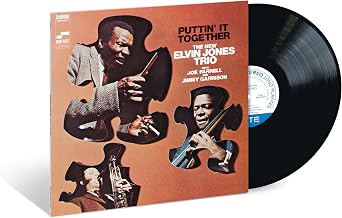
Puttin’ It Together
Recorded in 1968, Puttin’ It Together provided one of the clearest early statements of Jones as a leader. The trio with saxophonist Joe Farrell and bassist Jimmy Garrison immediately carried historical resonance because Garrison had been the bassist of the Classic Quartet.
But the absence of piano changed the environment.
Without a chordal instrument continuously defining harmony, Farrell had greater melodic freedom, while Garrison and Jones could create an unusually open rhythmic foundation. The trio format recalled some of the freedom Jones had experienced with Sonny Rollins more than a decade earlier, but Elvin was now a substantially different drummer.
His years with Coltrane had expanded his sense of scale.
The drums could occupy enormous space without requiring a large ensemble.
Farrell proved an ideal partner because he could move between forceful modern-jazz lines and more exploratory playing. Garrison supplied the familiar stability underneath them.
The album’s title was appropriate.
Elvin was putting together a language of leadership.
The Ultimate
The following project, The Ultimate, again featured Joe Farrell and Jimmy Garrison and reinforced the strength of the trio format. What becomes increasingly apparent across these recordings is that Jones did not need dense instrumentation to create orchestral sensation.
His drum set could imply multiple layers simultaneously.
The cymbals created one field.
Toms created another.
Snare and bass drum supplied accents, interruptions and responses.
Garrison occupied the center.
Farrell moved through the resulting space.
This arrangement also prevented Elvin’s rhythmic complexity from being buried beneath excessive orchestration. The listener could hear the relationship between bass and drums with unusual clarity.
It was the same fundamental relationship that had helped make Coltrane’s quartet possible, now exposed inside Jones’s own musical framework.
Poly-Currents: The Title Says Something Important
The title Poly-Currents could almost serve as a description of Elvin Jones’s rhythmic imagination. Recorded around the turn of the decade with an expanded ensemble, the project moved beyond the compact trio and placed his drumming inside a broader palette of horns and percussion.
The significance was not simply that more instruments created more sound.
Jones was interested in layers.
That idea had always been present in his drumming. Different limbs could suggest different rhythmic currents while remaining connected to an underlying pulse. An expanded ensemble allowed a related principle to operate at the level of arrangement.
The music could contain simultaneous motion without collapsing into disorder.
This is one reason Jones remained relevant as jazz moved beyond the stylistic boundaries of hard bop. His fundamental conception was already based on plurality.
He did not need rhythm to behave in only one way at a time.
The Difference Between Elvin and Art Blakey
Comparisons between Jones and Art Blakey are inevitable because both became enormously influential drummer-bandleaders associated with hard-driving modern jazz. But their rhythmic personalities were strikingly different.
Blakey could create explosive propulsion through emphatic press rolls, powerful backbeats, cymbal crashes and a deep relationship with the blues and hard bop. His Jazz Messengers became one of jazz’s great institutions for developing young musicians.
Jones’s rhythmic world was more circular.
Where Blakey could make a band feel as though it were being pushed forward from behind, Elvin often made it feel as though it were being surrounded by rhythm. His triplet vocabulary and layered accents produced motion that could seem to rotate around the soloist.
Neither approach was superior.
Their differences demonstrate how personal jazz drumming had become.
A listener could identify the drummer through conception, not merely technique.
The Drum Set as an Orchestra
Jones often spoke and played as though the drum set were one integrated instrument rather than a collection of separate components. His performances make the idea audible.
The tom-toms were especially important.
Many drummers used them primarily for fills or transitional effects. Elvin integrated them into the ongoing rhythmic fabric. A tom pattern could begin beneath a saxophone phrase and develop without announcing itself as a formal “fill.” The drums participated continuously in the music’s texture.
His cymbal sound was equally fundamental. The ride cymbal could carry enormous energy without becoming mechanically repetitive, while crashes and other cymbal colors expanded the sense of space around the kit.
This orchestral approach influenced generations of drummers because it suggested that accompaniment did not need to be divided neatly into timekeeping and decoration.
Everything could be time.
Everything could be color.
Power Without Heaviness
Another misconception about Jones comes from descriptions of his enormous physical presence behind the kit. He was unquestionably powerful, but volume alone cannot explain his sound.
His playing could be remarkably light.
The sense of force often came from motion rather than sheer impact. A sequence of carefully placed triplets across the kit could create tremendous momentum without every stroke being loud. Cymbal phrasing could expand the music even at moderate dynamics.
This is why musicians attempting to imitate Elvin by simply playing harder usually miss the point.
His power had internal structure.
Dynamics mattered.
Touch mattered.
Balance mattered.
Most importantly, listening mattered.
Elvin could create a storm because he knew exactly what the rest of the band was doing inside it.
The Jazz Machine
Over time, the name Elvin Jones Jazz Machine became closely associated with his working bands. The concept provided continuity without requiring fixed personnel. Musicians could enter Jones’s rhythmic world, develop inside it and eventually move elsewhere.
In this respect, the Jazz Machine shared something with Blakey’s Jazz Messengers: both became environments in which younger musicians could learn through direct experience with a master drummer.
But Elvin’s classroom had no desks.
The lesson happened on the bandstand.
A saxophonist playing with Jones had to learn how to remain centered while the rhythmic surface shifted continuously. The drummer might answer a phrase immediately, intensify unexpectedly or create movement across the bar line. A musician who depended on accompaniment remaining predictable could become uncomfortable.
Those who learned to hear through the motion gained something invaluable.
They learned that time could be stable without being static.
Joe Farrell and the Importance of Strong Horn Voices
Joe Farrell was one of the musicians who demonstrated how effectively a strong horn player could function beside Jones. His versatility across saxophones and flute gave Elvin multiple textures without requiring a large front line.
Farrell’s presence also illustrates an important principle in Jones’s bands.
Elvin needed musicians with enough identity not to disappear beside him.
A timid soloist could easily be overwhelmed by the sheer amount of rhythmic information coming from the drums. Strong improvisers treated that information as fuel.
This had been true of Coltrane.
It remained true under Jones’s leadership.
Elvin did not reduce his personality to make a soloist comfortable.
He invited the soloist to enter the conversation.
Dave Liebman and Later Generations
Saxophonist Dave Liebman was among the notable musicians who worked with Jones during the 1970s. By then, Liebman belonged to a generation that had grown up hearing the innovations of Coltrane and the 1960s rather than encountering them as new developments.
This created an intriguing reversal.
Jones had once been the drummer helping a revolutionary saxophonist push jazz forward. Now younger saxophonists approached Elvin already knowing the language he had helped create.
But playing with the source was different from studying recordings.
A record does not react when the soloist changes direction.
Elvin did.
The educational power of his later groups therefore came partly from immediacy. Younger musicians could experience the rhythmic conception as a living, changing force rather than a historical style.
Pat LaBarbera and the Long-Term Band
Tenor saxophonist Pat LaBarbera became one of Jones’s important long-term collaborators, particularly through the Jazz Machine years. His presence helped give the later bands continuity while demonstrating that Elvin valued sustained musical relationships.
This matters because the mythology surrounding great improvisers often emphasizes spontaneous encounters at the expense of long-term ensemble development.
Jones understood the value of familiarity.
When musicians know one another deeply, freedom becomes less dangerous. A drummer can take greater rhythmic risks because the saxophonist understands his tendencies. The bassist can alter the pulse without creating confusion. Arrangements can remain open because collective memory provides structure.
This was one of the great lessons of the Coltrane quartet.
Elvin carried it into his own bands.
The Influence on Rock Drummers
Jones’s impact did not remain confined to jazz. As rock drumming became more sophisticated during the late 1960s and 1970s, musicians increasingly listened to jazz drummers for ways to expand beyond straightforward timekeeping.
John Bonham is frequently discussed in relation to Jones because of the enormous physical presence, triplet vocabulary and use of the full drum set as a unified instrument heard in Led Zeppelin. Their musical contexts were obviously different, and influence should not be reduced to a claim that one drummer simply copied another. What matters is that Elvin demonstrated possibilities that could travel.
Mitch Mitchell, best known for his work with Jimi Hendrix, represented another clear connection between jazz-derived drumming and rock. His playing incorporated a degree of rhythmic independence and conversational response unusual in mainstream rock rhythm sections of the period.
The borders between genres were becoming porous.
Elvin’s ideas crossed them.
Ginger Baker and the Famous Argument
The relationship between Elvin Jones and the mythology surrounding rock drummers also produced one of the more frequently repeated anecdotes in percussion culture: Jones’s famously harsh assessment of Ginger Baker’s playing.
The anecdote is entertaining, but it can distract from the larger point.
By the late 1960s, rock drummers were increasingly being discussed using standards and vocabulary derived partly from jazz. The very fact that Elvin’s opinion mattered reflected his authority.
Jones represented a benchmark not because he played louder or faster than everyone else but because his rhythmic conception had depth accumulated through decades of jazz evolution.
The conversation between jazz and rock drumming was therefore asymmetrical but important.
Rock could borrow elements of jazz vocabulary.
Elvin remained rooted in the improvisational culture that had generated them.
Jack DeJohnette, Tony Williams and the Next Jazz Generation
Within jazz, Jones’s influence became even more profound. The generation that included Tony Williams and Jack DeJohnette inherited a drum set whose role had already been radically expanded.
Tony Williams developed a language very different from Elvin’s, with extraordinary clarity, explosive dynamics and an ability to fracture conventional expectations of time. Jack DeJohnette would develop another highly personal approach, combining elasticity, color and enormous stylistic range.
Neither should be described as an Elvin imitator.
That would misunderstand influence.
Elvin’s contribution was to enlarge the field of what a drummer could legitimately do. Once that field existed, later musicians could choose different paths through it.
This is how major innovations propagate.
The descendants do not need to sound like the ancestor.
They inherit freedom.
Elvin and the Meaning of Swing
As jazz diversified through fusion, free improvisation, neo-bop and other movements, Jones remained deeply connected to swing. But his swing had never been conservative.
He demonstrated that tradition and experimentation were not opposites.
The pulse could remain present while almost everything around it changed.
This principle helps explain his longevity. Musicians from different generations could recognize something foundational in his playing even when their own musical languages differed substantially.
Elvin did not need to chase every stylistic trend.
His conception was broad enough to interact with change.
The rhythm remained rooted.
The surface remained alive.
A Late-Career Master
Jones continued leading and performing through the 1980s and 1990s and into the early years of the twenty-first century. By then he had become one of jazz’s elder masters, but his performances could still carry the unmistakable physical momentum that had defined him decades earlier.
Age naturally altered the body.
It did not erase the conception.
This distinction is particularly important for drummers because their instrument demands considerable physical coordination and stamina. A mature drummer cannot rely indefinitely on youthful force.
Jones did not need to.
The essence of his playing was never muscular power alone. It was placement, subdivision, interaction and the ability to organize movement.
Those qualities survived.
Passing the Music Directly
The Jazz Machine became increasingly important as a vehicle for this late-career transmission. Young musicians were not merely playing “Elvin Jones music.” They were learning what happened when Elvin himself responded to them.
That experience could not be fully notated.
How hard would the cymbal arrive behind a phrase?
When would the tom-toms begin to roll?
Would a repeated saxophone figure make the drums intensify or become quieter?
How would Elvin interpret a slight rhythmic displacement from the bassist?
These were decisions made in real time.
The real lesson was therefore not a collection of patterns.
It was attention.
Jones listened intensely.
His apparent turbulence was built from response.
Recognition
By the time Jones received major institutional recognition late in life, his place in jazz history was already secure. In 2003, the National Endowment for the Arts named him an NEA Jazz Master, placing formal recognition behind what musicians had understood for decades.
Such honors matter because they preserve historical visibility, but Elvin’s real monument existed in the playing of other drummers.
Every time a drummer treated the ride cymbal as a flowing layer rather than a metronome, every time tom-toms became part of continuous accompaniment rather than merely a fill, every time several subdivisions circulated around a stable pulse, some part of the rhythmic territory Jones had helped open remained present.
Influence had become vocabulary.
May 2004
Elvin Jones died on May 18, 2004, at the age of seventy-six.
The loss ended a career that had stretched from Detroit’s postwar jazz community through bebop, hard bop, modal jazz, Coltrane’s spiritual and avant-garde explorations, Blue Note leadership and decades of work with the Jazz Machine.
Few drummers had traveled through so many transformations without losing an identifiable voice.
That continuity is remarkable.
Place Jones behind Bud Powell and he remained Elvin.
Place him behind Sonny Rollins and he remained Elvin.
Place him beside Coltrane during A Love Supreme and the identity became monumental.
Put him at the front of his own group decades later and the rhythmic signature remained.
Context changed.
The voice survived.
More Than Coltrane’s Drummer
Elvin Jones will always be connected to John Coltrane, and there is no reason to resist that connection. Their partnership produced some of the greatest music either man ever made.
The mistake is stopping there.
Jones had a history before Coltrane and a substantial career afterward. Detroit shaped him. Bebop tested him. Rollins demonstrated how effectively he could function in open trio environments. Coltrane gave his rhythmic conception an extraordinary arena in which to expand. Blue Note allowed him to develop as a leader. The Jazz Machine turned experience into transmission.
Taken together, those chapters reveal a complete musician.
Not merely a legendary sideman.
Not merely a powerful drummer.
A bandleader and musical thinker.
Why the Polyrhythm Still Swings
The technical descriptions surrounding Jones can become complicated: overlapping subdivisions, triplet organization, metric displacement, limb independence, cross-rhythms and layered accents.
All of those ideas help explain aspects of his playing.
None explains why it feels so good.
That is the final mystery of Elvin Jones.
The complexity never fully separates itself from swing.
A listener who understands nothing about polyrhythm can still feel the music moving. The body does not need to identify which limb is articulating which subdivision.
It hears direction.
That ability to reconcile sophistication with physical immediacy may be Jones’s greatest achievement.
He made complexity groove.
Rhythm as Conversation
Jones also permanently challenged the hierarchy of the jazz rhythm section. The drummer did not have to remain underneath the soloist.
He could stand beside the soloist musically without competing for attention.
That distinction requires enormous sensitivity.
Conversation does not mean speaking constantly. It means knowing when a response matters.
Jones could answer a phrase.
He could contradict it.
He could intensify it.
He could leave it alone.
He could create an entirely different rhythmic layer beneath it and allow the tension between the two ideas to generate energy.
The drums became an improvising voice.
Once musicians heard that possibility, there was no going back.
The Force of Nature Was Listening
Descriptions of Elvin Jones often reach for natural imagery.
Thunder.
Waves.
Volcanoes.
Storms.
The metaphors make sense because his drumming can produce the sensation of encountering something physically larger than a conventional beat.
But nature metaphors have a limitation.
A storm does not listen.
Elvin Jones did.
That is the essential difference.
His enormous rhythmic force was guided by attention to the musicians around him. The rolling tom-toms, cymbal surges and displaced accents were not uncontrolled phenomena. They were responses produced by a musician with an exceptional ability to hear relationships inside time.
The apparent chaos was organized through listening.
The Beat Could Contain More
Elvin Jones’s revolution can ultimately be expressed through one simple idea: he expanded how much information the jazz pulse could contain without ceasing to feel like a pulse.
Before him, generations of drummers had already transformed the instrument. Jones inherited the swing tradition, absorbed bebop and learned from musicians including Jo Jones, Kenny Clarke, Max Roach and Art Blakey. He did not erase that history.
He stretched it.
With John Coltrane, McCoy Tyner and Jimmy Garrison, the expansion reached extraordinary proportions. Impressions, Live at Birdland, Crescent and A Love Supreme demonstrated that rhythm could become one of the primary structural forces in extended improvisation. After Coltrane, Jones proved that those ideas belonged to a musical identity capable of surviving outside the Classic Quartet.
Decades of musicians followed.
Elvin Jones and the Freedom Inside Time
The deepest lesson of Elvin Jones is therefore not about how to play a particular triplet figure or reproduce a famous drum solo.
It is about freedom.
Not freedom from time.
Freedom inside it.
Jones did not need to destroy the pulse to escape predictability. He discovered that a strong pulse could support enormous internal complexity. Different rhythmic ideas could coexist. Accents could challenge the bar line. The drums could converse with the soloist. Intensity could rise to extraordinary levels while the listener continued to feel the underlying movement.
That discovery became one of the foundations of modern jazz drumming.
From Pontiac to Detroit, from New York clubs to Sonny Rollins, from the Classic Quartet to A Love Supreme, from Blue Note to the Jazz Machine, Elvin Jones spent a lifetime demonstrating that rhythm was not the cage around improvisation.
Rhythm was another form of improvisation.
The beat was not something he stood upon.
It was something he could enter, rotate, stretch, illuminate and send back toward the other musicians in a different shape.
That is why recordings made more than half a century ago can still feel so alive.
Elvin Jones never merely counted time.
He made time breathe.
Buy Amazon