

A Bass Sound That Seemed to Come From Somewhere Else
There are musicians whose importance can be recognized within a few notes, before a composition has revealed its structure or an improvisation has gathered momentum. Eberhard Weber belongs to that category. His bass sound—sustained, resonant, unusually lyrical and often surrounded by spacious reverberation—became one of the most recognizable instrumental voices associated with European jazz and with the early identity of ECM Records. Yet reducing Weber to “the ECM sound” misses what made him distinctive. The atmosphere followed from a deeper rethinking of what a bassist could do.
Weber did not approach the bass simply as the lowest voice in a conventional jazz rhythm section. He treated it as melody, counterpoint, texture and eventually an almost orchestral instrument. His customized five-string electric upright bass became central to that identity from the mid-1970s onward, allowing him to develop a sustained, singing register that separated his playing from much of the acoustic jazz-bass tradition. ECM’s own biography identifies the instrument as his principal choice from 1974 and traces the distinctive sound through his work as leader and collaborator.
But Weber’s originality was not produced by equipment alone. It emerged from his background, his compositional instincts and a musical environment in which European musicians were increasingly asking whether jazz made on the continent needed to reproduce American models in order to be legitimate.
Weber’s answer was not a manifesto.
It was a sound.
Stuttgart Before ECM
Born in Stuttgart in 1940, Weber grew up as the son of a music teacher and received classical training. ECM identifies that background as an important influence on his later approach to composition and musical structure.
This matters because Weber’s mature music often behaves differently from jazz organized primarily around a sequence of solos. His compositions can feel architectural. Long melodic lines emerge slowly. Repetition establishes atmosphere. Sections can develop through changes in texture rather than through rapid harmonic movement. The bass does not merely connect chords beneath other musicians; it can determine the emotional contour of the entire piece.
That sensibility developed gradually.
Weber worked extensively in German jazz before becoming an ECM bandleader, including important associations with pianist Wolfgang Dauner. By the time The Colours of Chloë established him internationally, he was already an experienced musician rather than an unknown bassist suddenly discovering a personal language.
The distinction is important.
The famous ECM period did not create Eberhard Weber.
It gave an already developing voice an unusually compatible environment.
The Bass Problem
To understand Weber’s achievement, it helps to consider the traditional responsibilities of the jazz bassist.
In much acoustic jazz, the bassist provides harmonic information and rhythmic momentum simultaneously. Walking bass can connect chord changes while working closely with drums to create forward motion. Even when the instrument solos, listeners often understand that moment as a temporary departure from its principal supporting function.
Weber increasingly questioned that hierarchy.
What if the bass could sustain long notes rather than constantly articulate quarter-note motion?
What if it could state the principal melody?
What if its tone occupied the foreground for an entire composition?
What if electronics allowed one bassist to create layers that approached the density of an ensemble?
These questions did not require rejecting rhythm.
They required redefining the relationship between rhythm and space.
Weber’s music frequently feels as though it has more room around every note. The effect is not emptiness. Space becomes an active compositional element.
An Instrument Built Around an Idea
Weber’s customized electric upright bass became inseparable from this approach. It was not simply an electric substitute for double bass. The instrument allowed him to develop a voice with a different relationship to sustain, register and amplification.
The resulting tone could be immediately recognizable.
A note might begin with a clear attack and then remain in the air, allowing Weber to shape the phrase after the initial pluck. Higher-register passages could take on an almost vocal quality. Lower notes retained weight without forcing him into the conventional rhythmic function expected of acoustic bass.
ECM later described the possibilities of Weber’s five-string electric upright as expanding toward an almost orchestral scale.
That description helps explain why discussions of Weber based only on bass technique are insufficient.
The instrument was part of his compositional vocabulary.
Europe Was Looking for Its Own Voice
Weber’s emergence also belongs to a broader moment in European jazz.
By the late 1960s and early 1970s, generations of European musicians had developed extraordinary fluency in American jazz traditions. Bebop, hard bop, modal jazz and free jazz had all produced serious communities outside the United States.
But another question was becoming increasingly urgent:
Did European jazz have to sound American?
There was no single answer.
Some musicians remained deeply connected to American jazz vocabulary. Others incorporated European classical music, folk traditions, free improvisation, electronic sound, minimalism or forms of composition that placed less emphasis on swing.
The danger is to turn this into a simplistic independence story in which Europe finally “escaped” American jazz.
That would erase the source.
Jazz is an African American art form, and European jazz developed through profound engagement with that history. Weber’s music did not become meaningful by pretending that connection did not exist.
What changed was the range of possibilities musicians felt entitled to pursue.
Manfred Eicher and the ECM Context
The founding of ECM Records by Manfred Eicher in Munich in 1969 provided an important institutional setting for this transformation.
ECM would become associated with spacious recording, careful production, distinctive visual design and musicians whose work often sat between jazz improvisation, chamber music, folk influence and contemporary composition.
Yet it is easy to reverse the relationship and imagine that ECM imposed one uniform aesthetic on everyone who recorded for the label.
Weber complicates that interpretation.
His music helped define what listeners later recognized as an ECM aesthetic.
The relationship was reciprocal.
Eicher found musicians whose ideas suited the possibilities he was developing as a producer. Those musicians, in turn, gave the label its identity.
Few were more important to that process than Weber.
The Colours of Chloë
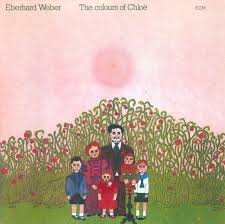
Recorded in December 1973 at Tonstudio Bauer in Ludwigsburg and originally released in 1974, The Colours of Chloë became Weber’s ECM debut as a leader. The personnel already reveals how far the project stood from the conventional image of a bass-led jazz quartet: Weber played bass, cello and ocarina; Rainer Brüninghaus contributed piano and synthesizer; Ack van Rooyen played flugelhorn; Peter Giger and Ralf-R. Hübner handled percussion and drums; and cellists from Stuttgart’s Südfunk Symphony Orchestra expanded the instrumental palette.
The album contained only four pieces:
“More Colours”
“The Colours of Chloë”
“An Evening with Vincent Van Ritz”
“No Motion Picture”
The limited track count is revealing.
This was music interested in extended development.
The compositions needed room.
Not Quite Jazz, Not Quite Chamber Music
Trying to categorize The Colours of Chloë immediately creates problems.
There is improvisation.
There are elements of jazz-rock.
There is chamber-like writing.
There are synthesizers.
There are orchestral colors.
There is repetition that can approach minimalism.
There are sections built around atmosphere rather than a conventional head-solos-head jazz form.
Weber himself later described the original project as containing several strands—reflective European or chamber-oriented writing, jazz-rock and a pictorial relationship with minimalism—that would subsequently be developed by his Colours group.
This description is much more useful than simply calling the album “European jazz.”
It tells us what the musicians were actually doing.
The Bass Leaves the Corner
The title composition demonstrates why Weber’s role deserves special attention.
Bass-led albums existed long before 1974, of course. Charles Mingus had already established one of the most important compositional legacies in jazz. Scott LaFaro had helped transform interactive bass playing. Numerous bassists had expanded the instrument’s technical possibilities.
Weber’s difference lay elsewhere.
He was developing a sound world in which the bass could become the central melodic color without needing to behave like a conventional horn soloist.
That is crucial.
He did not simply make the bass louder and play more notes.
He changed its narrative function.
The sustained quality of his tone could connect sections. Bass melodies could hover over textures rather than push continuously through harmonic changes. The instrument could act almost like the voice of the composition.
Rainer Brüninghaus: The Essential Partner
One of the problems with telling Weber’s story exclusively through the bassist is that Rainer Brüninghaus becomes too easy to overlook.
Brüninghaus’s keyboards were fundamental to Weber’s developing language. Piano and synthesizer could provide harmony without forcing the music into traditional comping patterns. Long textures could surround Weber’s bass. Repeated figures could establish motion without a conventional walking pulse.
The partnership continued well beyond The Colours of Chloë.
Brüninghaus became a member of Weber’s Colours ensemble and later joined him in the Jan Garbarek Group. ECM’s account of Colours specifically emphasizes how important the keyboardist was to the band’s development.
Again, the lesson is collaborative.
A distinctive bandleader needs musicians who understand the world being constructed.
“No Motion Picture”
The extended “No Motion Picture” is particularly revealing because its length allows several of Weber’s interests to coexist.
The piece can move through contrasting textures without behaving like a sequence of unrelated episodes. Rhythm enters and recedes. Repetition can create tension. Electric and acoustic colors interact. Weber’s bass becomes part of a larger architecture rather than simply the foundation beneath it.
The title itself is suggestive.
Much of Weber’s music has been described in visual or cinematic terms because it can seem to evoke landscapes.
But “cinematic” can become another empty adjective if it merely means spacious and beautiful.
The stronger point is structural.
Weber composes in ways that allow the listener to experience changes of scene.
Texture can function almost like location.
The Album That Changed Weber’s Career
The Colours of Chloë received significant recognition, including the Deutscher Schallplattenpreis in 1975.
Its success also established Weber as an important figure within the rapidly developing ECM catalog.
But we should resist the temptation to make the album responsible for everything that followed.
It did not single-handedly create European chamber jazz.
It did not invent atmospheric jazz.
It did not sever European musicians from American influence.
What it did was demonstrate that Weber had arrived at a highly personal synthesis.
That is enough.
And other musicians noticed.
American Musicians Were Listening Too
One of the most interesting complications in the narrative of an “independent European jazz language” is that American musicians became deeply interested in Weber.
During his first decade with ECM, he worked with Gary Burton, including on Ring and Passengers, and with Ralph Towner in the Solstice group. He also appeared on Pat Metheny’s Watercolors in 1977.
This is important historically.
The musical exchange did not run only from America toward Europe.
By the 1970s, European musicians were contributing sounds and compositional ideas that American players actively sought out.
Weber’s career sits directly inside that two-way exchange.
Ralph Towner and Solstice
The connection with guitarist Ralph Towner was particularly significant.
Towner’s music shared several concerns with Weber: acoustic and electric texture, European classical influence, open forms and a relationship with jazz that did not depend entirely on swing.
The Solstice project brought Weber together with Towner, Norwegian saxophonist Jan Garbarek and drummer Jon Christensen.
Those names would become increasingly important.
Christensen, in particular, represented another way of thinking about rhythm. Rather than simply marking a predictable pulse, his drumming could create shifting layers of accents and motion.
That rhythmic flexibility was ideal for Weber.
It allowed the bass to float without causing the music to lose direction.
The Birth of Colours
After The Colours of Chloë, Weber transformed some of its ideas into a working band.
The ensemble was called Colours.
Its first major recorded statement was Yellow Fields, recorded in September 1975 and released in 1976. The quartet consisted of Weber, Charlie Mariano, Rainer Brüninghaus and Jon Christensen.
This was an extraordinary combination of musical personalities.
Mariano had extensive experience in American jazz, including work with Charles Mingus, but his instrumental range extended beyond conventional saxophone vocabulary. In Colours he used soprano saxophone as well as Indian shenai and nagaswaram.
Brüninghaus supplied keyboards.
Christensen brought the rhythmic flexibility that had already connected with Weber through the Towner project.
And Weber’s bass sat at the center.
Why Charlie Mariano Mattered
Mariano was especially important because his presence prevents Colours from being reduced to a stereotype of restrained European jazz.
His playing could be intensely expressive.
The Indian instruments added timbres that moved the music beyond a simple jazz/classical synthesis.
Weber was deliberately interested in sound combinations that could escape familiar jazz associations. ECM’s notes on Yellow Fields record his preference during this period for Mariano’s soprano and Indian reeds over the alto saxophone more strongly associated with conventional jazz vocabulary.
That decision tells us something important.
Weber was not searching for “European jazz” as a geographic brand.
He was searching for a particular sonic identity.
Yellow Fields
Yellow Fields contains four compositions:
“Touch”
“Sand-Glass”
“Yellow Fields”
“Left Lane”
All were written by Weber. The album was recorded at Tonstudio Bauer in Ludwigsburg, the studio that would become central to many ECM recordings.
Compared with The Colours of Chloë, the ensemble is smaller and more clearly identifiable as a working group.
Yet the music does not become conventional.
The reduced instrumentation creates another kind of freedom.
Each player occupies more space.
Mariano’s soprano can rise above the ensemble.
Brüninghaus can establish broad harmonic environments.
Christensen can create motion without constantly defining bar lines.
Weber can move between foundation and foreground.
Teamwork Before Virtuosity
Weber’s own description of the group’s priorities is especially revealing. Discussing Yellow Fields, he emphasized his interest in teamwork and total sound rather than individual display.
That principle explains much of his career.
Weber was an extraordinary instrumentalist, but his leader albums rarely feel constructed primarily to demonstrate bass virtuosity.
The composition comes first.
The ensemble comes next.
Technique serves both.
This separates him from one of the most persistent clichés surrounding instrumental innovation: that redefining an instrument means playing faster, higher or more dramatically than everyone else.
Weber’s innovation was often about integration.
The bass became more prominent precisely because he understood how to place it inside a total sound.
Weber and Jaco Pastorius
The comparison with Jaco Pastorius is inevitable because both musicians expanded the expressive possibilities of electric bass during roughly the same era.
But comparison should not become competition.
Their musical objectives were different.
Pastorius transformed the fretless electric bass through extraordinary articulation, harmonics, rhythmic precision and a vocabulary deeply connected to jazz, funk and R&B.
Weber’s customized upright instrument led him toward another territory: long sustain, orchestral resonance, melodic spaciousness and an integration with chamber-like composition.
ECM’s retrospective on Colours notes that Yellow Fields was recorded before Pastorius’s first solo album appeared, while also emphasizing how distinctive Weber’s bass language already was.
The useful conclusion is not that one anticipated or surpassed the other.
It is that the 1970s produced multiple radical answers to the question of what an electric bassist could become.
A Band With Its Own Grammar
Colours continued developing through Silent Feet in 1977 and Little Movements in 1980. After Christensen’s departure, John Marshall, known for his work with Soft Machine, entered the group, bringing another rhythmic perspective shaped partly by the territory between jazz and progressive rock. ECM’s later Colours collection documents these three albums as the core recorded history of the ensemble.
By then, Weber had established something much more durable than an unusual bass tone.
He had developed a grammar.
Long-form composition.
Melodic bass.
Open harmonic fields.
Rhythm that could move across bar lines rather than constantly reinforce them.
European chamber influences without abandoning improvisation.
Electronic and acoustic colors existing together.
Musicians chosen for their ability to contribute to a collective sound.
These characteristics would follow Weber even outside his own band.
The Road Toward Jan Garbarek
One relationship would become particularly important.
Weber had already worked alongside Jan Garbarek in Ralph Towner’s Solstice. From 1978 onward, according to ECM’s biography, his work with Garbarek became a priority. Weber eventually toured internationally through multiple versions of the Jan Garbarek Group and appeared on numerous recordings with the Norwegian saxophonist.
The partnership makes musical sense.
Garbarek also understood the power of space.
His saxophone could sustain a melodic line across an open landscape rather than filling every moment.
Weber’s bass could do the same.
Two instruments often expected to perform specific jazz functions had become voices capable of shaping atmosphere.
Their interaction would occupy a major part of Weber’s next chapter.
But something else was also happening.
By the end of the 1970s, Eberhard Weber was no longer simply a German bassist with an unusual instrument.
Through his own albums, Colours, ECM and collaborations with musicians on both sides of the Atlantic, he had become part of a much larger redefinition of what European improvised music could sound like.
The next stage would take that language through Jan Garbarek, Pat Metheny, Gary Burton, The Following Morning, Fluid Rustle, solo performance and the increasingly orchestral possibilities of a single bass.
Buy Amazon
From Colours to a Wider Musical Network
By the end of the 1970s, Eberhard Weber had established a musical language strong enough to remain recognizable in very different settings. That achievement matters because a distinctive instrumental sound can easily become restrictive. Once listeners recognize a musician immediately, there is a temptation to repeat the circumstances that produced that recognition. Weber instead moved between his own compositions, the Colours ensemble and collaborations in which someone else’s musical priorities came first.
This period also demonstrates why his career cannot be reduced to the stereotype of solitary, atmospheric ECM music. Weber worked with musicians whose approaches differed substantially: Jan Garbarek, Pat Metheny, Gary Burton, Ralph Towner and others. His bass had to function differently in each environment.
The sound remained identifiable.
The function changed.
That flexibility became one of Weber’s most important strengths.
Jan Garbarek and the Architecture of Space
Weber’s long association with Jan Garbarek became one of the defining collaborations of his career. The connection had already been established through Ralph Towner’s Solstice, but from the late 1970s Weber became a recurring presence in Garbarek’s groups and recordings.
The compatibility between them is easy to hear but difficult to explain without falling into the clichés surrounding ECM.
Both musicians understood space.
That does not simply mean they played fewer notes.
Space in their music has structure.
Garbarek could project a saxophone line across a relatively open harmonic environment and allow the final note of a phrase to remain active after he stopped playing. Weber’s sustained bass could respond without filling the silence. The rhythm section could create direction without converting every moment into conventional swing.
The result gave each instrument unusual independence.
Neither musician needed constant activity to establish presence.
Photo with Blue Sky, White Cloud, Wires, Windows and a Red Roof
One of the important documents of the partnership is Garbarek’s Photo with Blue Sky, White Cloud, Wires, Windows and a Red Roof, recorded in 1978. The ensemble brought together Garbarek, Bill Connors, John Taylor, Jon Christensen and Weber.
Even the title suggests the visual dimension frequently associated with this music. But again, “cinematic” or “landscape-like” should not become substitutes for analysis.
The important point is how the ensemble creates scale.
A relatively small group can sound expansive because the instruments are not constantly competing for the same space. Guitar, piano, saxophone and bass each have distinct registers and roles. Christensen can create motion around them rather than merely underneath them.
Weber’s bass becomes a connective voice.
Sometimes it provides foundation.
Sometimes it behaves melodically.
Often it does both within the same piece.
A European Sound Without a Border
The Garbarek-Weber partnership also complicates the idea of a national jazz identity.
Garbarek was Norwegian.
Weber was German.
Christensen was Norwegian.
John Taylor was British.
Other musicians in these networks came from the United States and elsewhere.
What emerged was not “German jazz” or “Norwegian jazz” in any simple sense.
ECM facilitated a trans-European and transatlantic musical network.
This is a more accurate way to understand the label’s importance than treating “the ECM sound” as a single production formula.
The musicians shared certain interests but retained individual voices.
Weber was unmistakably Weber.
Garbarek was unmistakably Garbarek.
The creative achievement occurred in the space where those identities overlapped.
Pat Metheny and Watercolors
Weber’s appearance on Pat Metheny’s Watercolors, recorded in 1977, places him inside another important strand of ECM’s development. The album featured Metheny with pianist Lyle Mays, drummer Danny Gottlieb and Weber.
The combination is historically fascinating because Metheny and Mays were themselves developing a compositional language that would soon reach a much wider audience through the Pat Metheny Group.
Weber’s presence works naturally in this environment.
Metheny’s compositions could combine strong melody with open harmonic space. Mays was capable of creating broad keyboard textures without crowding the arrangement. Weber’s sustained bass sound could therefore become part of the music’s color rather than merely supplying low-frequency support.
Again, the exchange between European and American musicians becomes visible.
This was not Europe trying to escape American jazz.
It was musicians on both sides of the Atlantic discovering that they could build something together that did not require returning to conventional jazz structures.
Gary Burton: Another Context for Weber
Weber’s work with vibraphonist Gary Burton provides another example of his adaptability. Burton had long been interested in expanding jazz instrumentation and repertoire, and his ECM recordings brought him into contact with musicians whose backgrounds crossed jazz, rock and contemporary composition.
Weber appeared on Burton projects including Ring and Passengers.
The vibraphone creates a particularly interesting relationship with Weber’s bass because both instruments can produce sustained resonance, though by completely different physical means.
This changes the bassist’s responsibilities again.
Rather than functioning against a dense piano-centered harmonic environment, Weber can occupy a more transparent field where resonance itself becomes part of the arrangement.
His sound was distinctive enough to remain recognizable.
His musicianship was flexible enough not to make every collaboration sound like an Eberhard Weber album.
That balance is difficult.
The Following Morning
Weber’s 1976 album The Following Morning pushed his compositional thinking into an even more unusual territory. The recording centered on Weber and Rainer Brüninghaus while incorporating orchestral forces, including members of the Oslo Philharmonic.
The album is important because it demonstrates that Weber’s interest in orchestral scale did not depend on making his music louder or denser.
The orchestra could become an extension of atmosphere.
Strings and other instrumental colors enlarged the harmonic field around the bass and piano.
This is very different from the traditional “jazz musician with strings” model in which an orchestra provides lush accompaniment behind a featured soloist.
Weber was interested in integration.
The composed material and improvisational voices had to inhabit the same architecture.
Composition Before Category
Albums such as The Following Morning make arguments about whether Weber’s music was “really jazz” increasingly unproductive.
There is improvisation.
There is jazz lineage.
There is contemporary composition.
There is orchestration.
There are electronic possibilities.
There is European classical influence.
The useful question is not which category owns the music.
It is how Weber organizes those resources.
His compositions often rely on strong melodic identities. Harmony can remain open enough for those melodies to breathe. Rhythm may appear episodically rather than continuously. Instrumental color can carry structural significance.
This is why Weber should be considered not only as an innovative bassist but as a composer whose principal instrument happened to be unusually distinctive.
Fluid Rustle: Voices Enter the Landscape
Recorded in 1979, Fluid Rustle expanded Weber’s palette in another direction. The project brought together Gary Burton, Bill Frisell, Rainer Brüninghaus and vocalists Norma Winstone and Bonnie Herman, with Weber again controlling a highly unusual ensemble configuration.
The instrumentation itself tells us something about his compositional imagination.
Vibraphone.
Guitar.
Keyboards.
Bass.
Voices.
This is not a standard jazz lineup.
Weber used the human voice primarily as instrumental texture rather than conventional song delivery. That decision allowed the vocals to become another color inside the ensemble.
The effect fits his broader musical priorities.
A voice does not necessarily have to tell a story through lyrics.
It can alter the emotional temperature of a composition simply through sound.
Bill Frisell Before the Familiar Bill Frisell
The presence of Bill Frisell is particularly interesting in retrospect.
Frisell would later become one of the most distinctive guitarists in modern jazz, developing a language that could connect jazz improvisation with Americana, country, folk, rock, electronics and ambient texture.
On Fluid Rustle, he was still early in his ECM-associated career.
Yet his guitar was already well suited to Weber’s music because Frisell understood how sound itself could function compositionally.
A guitar note could be transformed through sustain and effects.
It did not have to behave as a conventional chordal accompaniment.
This placed Frisell naturally beside Weber.
Both musicians were interested in what happens after a note is played.
Decay, sustain and space mattered.
The Studio as Part of Weber’s Instrument
This brings us to an important aspect of Weber’s music: recording was not merely documentation.
His tone depended partly on amplification and processing. Reverb could extend the perceived space around the instrument. Later, looping and overdubbing would allow Weber to layer bass lines until a single performer could suggest multiple instrumental voices.
This does not mean studio technology created his musical identity.
A distinctive effect cannot compensate for weak phrasing.
Weber’s melodic imagination remained the essential element.
Technology expanded what that imagination could organize.
The distinction is important because the old JazzLatitude style sometimes treated equipment and sonic measurements as though they explained musical quality.
They do not.
The interesting question is not which frequency Weber’s bass reaches.
It is what Weber does with the sound once he has it.
The Bass as an Ensemble of One
As Weber developed his use of electronics, the possibility of solo performance became increasingly significant.
Bass is a difficult instrument to sustain alone for extended periods because its traditional functions are relational. We often understand bass by hearing what it does against drums, harmony or melody.
Weber could challenge that expectation because his instrument already occupied several roles.
A repeated lower-register figure could establish foundation.
Another layer could create harmony.
A higher-register line could function melodically.
Electronic looping allowed these identities to coexist.
The result was not simply a technical demonstration.
It was an extension of the compositional thinking already present in his ensemble work.
Weber could construct an architecture and then move inside it.
Pendulum
This approach became particularly visible on Pendulum, released in 1993. The album consists of solo bass performances recorded live in different European locations, with Weber using electronic devices to create layered textures.
The concept sounds technologically complex.
The listening experience does not need to be.
At its strongest, Pendulum feels like a continuation of Weber’s lifelong interest in transforming the bass from a supporting instrument into an environment.
The loops provide context.
The live bass provides movement.
The musician becomes both ensemble and soloist.
That distinction between predetermined structure and spontaneous response is central to the album’s appeal.
Why Weber Never Needed to Sound Like a Bass Virtuoso
Many celebrated bassists are immediately associated with technical feats.
Fast articulation.
Extended solos.
Harmonics.
Slapping.
Complex chordal playing.
Weber possessed substantial technique, but the public identity of his music developed differently.
A listener may recognize him from one sustained note.
That is an extraordinary achievement.
Tone becomes vocabulary.
But even “tone” can be misunderstood if treated as a purely physical property.
Weber’s sound is recognizable because of what he chooses to do with it.
His phrasing.
His patience.
His use of register.
His melodic intervals.
His willingness to let notes decay.
His relationship with silence.
The equipment makes those decisions audible.
It does not make them for him.
The 1980s: Continuity Without Stagnation
After Colours ended, Weber continued developing his leader recordings while remaining active in Garbarek’s ensembles and other collaborations.
Albums such as Later That Evening, Chorus and Orchestra demonstrated that the compositional principles established in the 1970s could continue evolving without simply reproducing The Colours of Chloë.
This is an important point in assessing long careers.
An artist does not need to reinvent their musical identity with every album.
Sometimes development occurs through refinement.
Weber’s melodic language remained recognizable.
His interest in space remained.
His bass sound remained.
But ensemble configurations, electronics and compositional scale could change around those constants.
Identity became a foundation rather than a prison.
Later That Evening
Later That Evening, recorded in 1982, assembled another remarkable group: Weber with Bill Frisell, Lyle Mays, Michael DiPasqua and Paul McCandless.
Again, the personnel crosses categories.
Frisell brought his developing guitar language.
Mays was already central to the Pat Metheny Group’s expansive harmonic and textural approach.
McCandless, associated with Oregon, brought woodwind colors that extended well beyond conventional saxophone vocabulary.
Weber’s compositions could accommodate these musicians because they were not built around rigid instrumental roles.
Each player could become part of the overall color.
This is one reason Weber attracted such distinctive collaborators.
His music gave them room to remain themselves.
The Jan Garbarek Group Becomes a Long-Term Home
While Weber’s own albums continued, the Jan Garbarek Group became one of his most important long-term musical homes.
The collaboration extended across many years and numerous recordings, with Brüninghaus also becoming part of Garbarek’s group.
For Weber, this offered something different from leadership.
A musician with a highly distinctive voice has to know when not to impose it.
Inside Garbarek’s music, Weber could contribute his characteristic sustain and melodic sensibility while serving someone else’s compositions.
The relationship lasted because their musical priorities remained compatible without becoming identical.
This is the mark of a durable collaboration.
Not agreement about everything.
Enough shared language to make differences productive.
Weber and Garbarek on Stage
Live performance made the relationship particularly effective.
Garbarek’s saxophone could carry enormous emotional intensity while Weber’s bass established another melodic layer beneath or around it. Brüninghaus’s keyboards supplied harmonic space, and the drummer could create motion without forcing the music into conventional swing.
The resulting sound became strongly associated with a certain strand of European jazz.
But calling it merely “atmospheric” understates what the musicians were doing.
The music could be forceful.
Rhythm could become urgent.
Garbarek’s tone could be penetrating rather than gentle.
Weber’s bass could drive rather than float.
Space does not mean softness.
It means that intensity has somewhere to go.
Kate Bush: An Unexpected Connection
One of Weber’s most fascinating relationships outside jazz was with Kate Bush.
He contributed bass to several of her recordings, including material associated with albums such as The Dreaming, Hounds of Love and The Sensual World.
At first this may seem like an unusual detour.
It actually makes considerable sense.
Bush’s studio work treated arrangement, texture and timbre as fundamental compositional elements. Songs could contain unconventional instrumental combinations, layered vocals and carefully designed sonic environments.
Weber’s bass was perfect for this kind of thinking.
He did not simply provide a generic low end.
His tone could become a character inside the arrangement.
This collaboration also demonstrates how far his influence extended beyond the boundaries of jazz.
A Sound Recognizable Outside Its Original Context
The Kate Bush recordings reveal something important about instrumental identity.
When Weber appears in another artist’s music, his sound can remain recognizable without making the recording feel borrowed from an ECM album.
This is a rare quality.
Some musicians are identifiable because they repeat a signature gesture.
Weber was identifiable because he had developed a way of shaping sound.
That could survive changes in genre.
Jazz.
Art pop.
European improvisation.
Orchestral composition.
The context changed.
The voice remained.
The Risk of the “ECM Sound” Label
By this stage, Weber was so closely associated with ECM that the label itself can become a shortcut in discussions of his music.
Spacious.
Reverberant.
European.
Cold.
Beautiful.
Atmospheric.
These adjectives appear repeatedly in writing about ECM artists.
They are sometimes useful.
They can also become meaningless.
Weber’s work deserves more precision.
His music was spacious because his compositions were designed to use space.
His bass sustained because he developed an instrumental and electronic approach capable of sustaining.
His ensembles sounded distinctive because he selected musicians whose timbres could coexist without crowding one another.
Production amplified these qualities.
It did not invent them.
Manfred Eicher’s Real Contribution
This does not diminish Manfred Eicher.
A producer’s most important skill is not necessarily imposing a recognizable sound.
It can be recognizing what a musician is trying to achieve and constructing conditions in which that intention becomes audible.
Eicher and Weber had a relationship that extended across decades.
The consistency of Weber’s ECM catalog reflects a productive alignment between composer, performer, producer and label.
The result helped shape the public understanding of European jazz.
But again, causality runs both ways.
ECM gave Weber an environment.
Weber helped give ECM an identity.
A European Jazz Identity—Plural, Not Singular
Weber is often described as one of the musicians who helped establish a specifically European approach to jazz.
That is reasonable as long as the word European remains plural.
There was no single European jazz identity.
Garbarek did not sound like Weber.
Weber did not sound like Keith Jarrett’s European Quartet.
Terje Rypdal did not sound like Ralph Towner.
British improvisation developed differently from Scandinavian jazz.
German scenes contained their own contradictions.
Italian, Polish, French and Dutch musicians followed other paths.
What ECM demonstrated was not that Europe had discovered one alternative to American jazz.
It demonstrated that musicians could stop searching for one.
When the Career Suddenly Changed
For decades Weber had maintained an unusually active musical life: leader albums, collaborations, international touring and his long association with Garbarek.
Then, in April 2007, everything changed.
While on tour with the Jan Garbarek Group, Weber suffered a stroke. ECM’s biographical material records the event as the point that brought his active playing career to an abrupt end. (ecmrecords.com)
For a musician whose identity was inseparable from a highly personal physical relationship with an equally personal instrument, the consequences were profound.
The story could have ended there.
Instead, Weber eventually found another way to make music.
And the solution came from an unexpected source:
his own past performances.
Recorded bass solos from earlier concerts would become material for new composition.
The bassist who had spent decades transforming his instrument into an orchestra would now transform his archive into an instrument.
When Performance Was No Longer Possible
The stroke Eberhard Weber suffered in April 2007 created a rupture unlike any stylistic transition in his career. For decades, his musical identity had depended on an extraordinarily personal relationship between body, instrument and sound. The customized electric upright bass was not simply equipment he happened to prefer. Its sustain, register and response had become extensions of his compositional thinking. When the stroke prevented him from continuing to perform as before, the problem was therefore larger than losing access to an instrument.
A musical language built over decades had suddenly lost its normal means of expression.
Weber had been active until that point with the Jan Garbarek Group, alongside maintaining his own compositional identity. ECM’s biography records the 2007 stroke as effectively ending his performing career.
Yet Weber’s recorded history remained.
Thousands of notes had survived in concert tapes and archives. What initially belonged to completed performances could potentially become something else.
The solution was entirely consistent with Weber’s career: instead of attempting to recreate what had been lost, he changed the definition of the instrument again.
The Archive Becomes an Instrument
During concerts with Jan Garbarek, Weber had often performed solo passages. Garbarek had preserved recordings of many of those performances.
Years later, these recordings offered Weber material he could manipulate and reorganize.
The idea was conceptually fascinating.
A bass phrase played spontaneously during a concert had originally existed within one particular moment. Once extracted from that context, it could become compositional material.
Fragments could be selected.
Layers could be combined.
Sequences could be reorganized.
A performance from the past could participate in a composition made in the present.
This was not simply archival restoration.
Weber was effectively sampling himself.
Résumé
The result became Résumé, released by ECM in 2012. The album was constructed around solo bass recordings taken from performances Weber had given with the Jan Garbarek Group between 1990 and 2007. Weber reworked those recordings, adding keyboards and bringing in Garbarek for soprano saxophone on selected pieces. ECM describes the project as a transformation of live solo recordings into new compositions.
The title could hardly have been more appropriate.
Résumé suggests a summary.
A retrospective.
A document of what came before.
But the album does not function simply as a greatest-hits reconstruction.
Weber treated his own history as raw material.
The past became editable.
Composing With a Former Self
There is something unusually moving about this process without needing to romanticize Weber’s medical circumstances.
The bassist constructing Résumé was listening to performances created by a physically different version of himself.
Those earlier performances contained spontaneous decisions.
A phrase extended unexpectedly.
A rhythmic figure appeared.
A melodic interval suggested another direction.
Years later, Weber could hear those decisions from the outside.
The improviser had become source material for the composer.
This creates an unusual relationship between improvisation and memory.
Jazz normally celebrates the unrepeatable present.
A solo exists because a musician responds to a particular moment.
Résumé reverses that logic.
The moment has passed.
The recording remains.
And the recording can generate another moment.
Technology Without Technological Spectacle
Weber’s use of electronics had always been most effective when technology disappeared behind musical purpose.
The same principle applies here.
It would be easy to present Résumé primarily as a technical achievement: digital editing allows a musician unable to perform to construct new music from archival recordings.
That description is accurate but incomplete.
The technology is not the artistic argument.
Selection is.
Weber had to decide which fragments remained musically alive.
He had to determine how one recorded performance could relate to another.
He had to construct pacing, texture and continuity from material that had not originally been played for this purpose.
These are compositional decisions.
The computer enabled them.
It did not make them.
Jan Garbarek Returns
Garbarek’s participation gave the project another layer of continuity.
The original bass material had been recorded during concerts associated with the Jan Garbarek Group. Years later, Garbarek added soprano saxophone to selected tracks.
The relationship therefore crossed time.
Weber’s earlier bass interacted with Garbarek’s later saxophone.
The musicians were no longer responding to one another simultaneously.
Yet the musical compatibility established over decades remained audible.
That is one of the most remarkable aspects of Résumé.
A long collaboration had become strong enough to survive the loss of simultaneity.
The Meaning of a Musical Voice
Weber’s late work also raises a broader question:
Where does an instrumentalist’s musical identity actually reside?
In the hands?
The instrument?
The tone?
The compositions?
The decisions?
The recorded history?
Weber’s career suggests that the answer is distributed across all of them.
His physical technique had been essential to producing the original performances. His customized bass shaped their tone. But once those performances existed as recordings, Weber could continue making artistic decisions about them even when he could no longer produce new bass performances in the same way.
The voice survived because the voice had never been merely a physical sound.
It was a way of organizing music.
Encore
The process continued with Encore, released in 2015. Like Résumé, it drew upon Weber’s archived solo performances, but this time the project also involved Ack van Rooyen, the flugelhorn player who had appeared decades earlier on The Colours of Chloë. ECM’s documentation describes Encore as a continuation of the approach established by Résumé, using bass solos recorded during Garbarek concerts as the foundation for new pieces.
Van Rooyen’s presence created another historical circle.
He had participated near the beginning of Weber’s ECM story.
Now he appeared near its final stage.
The connection was not presented as nostalgia.
It worked because his flugelhorn could inhabit the open spaces around Weber’s reconstructed bass environments naturally.
Again, Weber chose sound before symbolism.
The symbolism followed.
A Career That Loops Back on Itself
There is an elegant symmetry across Weber’s ECM career.
On The Colours of Chloë, he had begun exploring how bass, electronics, keyboards, percussion and orchestral color could create a musical environment larger than the expected role of the instrument.
On Pendulum, looping allowed him to become an ensemble of one.
On Résumé and Encore, recorded performances themselves became layers.
The technology changed.
The underlying idea remained remarkably consistent.
How much musical space can one bass voice generate?
Weber spent decades answering that question in different ways.
Stuttgart, 2015
In January 2015, Weber’s career was celebrated through concerts in Stuttgart marking his 75th birthday. The event brought together musicians associated with different periods of his work, including Jan Garbarek, Gary Burton, Pat Metheny, Paul McCandless and others, with arrangements and direction involving Michael Gibbs.
For a musician no longer able to participate as he once had, the celebration inevitably had a retrospective dimension.
But the strongest way to understand such an event is not as a ceremonial conclusion.
It demonstrates the network Weber had created.
American and European musicians.
Jazz improvisers.
Composers.
Players associated with ECM and beyond it.
Several generations.
The bass was absent from its former physical role.
Its consequences were everywhere.
Pat Metheny and the Depth of Weber’s Influence
Pat Metheny provides an especially useful example of Weber’s reach.
Their connection went back to Watercolors, but Weber’s influence extended beyond the fact that they had recorded together. Metheny’s own work frequently explored long melodic development, spacious harmonic environments and compositions in which instrumental texture was inseparable from structure.
This does not mean those characteristics came from Weber alone.
Metheny had numerous influences and developed a language entirely his own.
But their compatibility helps explain why Weber could move so naturally into Watercolors and why Metheny remained connected to Weber’s musical world decades later.
Influence is often most meaningful when it does not produce imitation.
Gary Burton and Ralph Towner
The same applies to Gary Burton and Ralph Towner.
Neither sounds like Weber.
That is precisely the point.
Weber’s significance is not measured by the number of bassists who reproduced his tone. His career participated in a larger transformation in which jazz musicians became increasingly comfortable treating instrumentation, composition and studio sound as open questions.
Burton had already challenged conventional jazz instrumentation through vibraphone-centered ensembles.
Towner brought classical guitar, twelve-string guitar and compositional influences into improvisational music.
Weber’s bass belonged naturally beside them because all three approached instruments as sources of possibilities rather than fixed roles.
What Weber Changed for Bassists
For bass players, Weber’s legacy is more specific.
He demonstrated that the instrument could establish a complete melodic identity without abandoning its structural power.
That distinction matters.
A bassist does not become a melodic musician merely by taking longer solos.
Weber showed another route.
Tone itself could establish identity.
Register could create narrative.
Sustain could replace continuous articulation.
Electronic processing could expand the instrument without disguising it.
A bass line could function as a composition’s principal emotional voice.
And silence could be part of the phrase.
These possibilities were not exclusive to Weber, but he developed them into one of the most coherent individual languages in modern bass playing.
Weber and Jaco: Two Different Revolutions
Returning to the comparison with Jaco Pastorius makes the diversity of 1970s bass innovation clearer.
Pastorius made the fretless electric bass astonishingly articulate. His playing could be rhythmically explosive, harmonically sophisticated and technically spectacular. Through Weather Report, Joni Mitchell and his own recordings, he changed expectations surrounding the electric bass.
Weber moved in almost the opposite sonic direction.
Vertical rather than guitar-shaped.
Sustained rather than sharply articulated.
Often spacious rather than densely rhythmic.
Connected to European chamber sensibilities rather than primarily funk.
Interested in orchestral layering and electronics as extensions of melodic space.
Neither represents the “correct” evolution of the bass.
Together they demonstrate how radically the instrument’s possibilities expanded during the decade.
The Bass After Weber
Weber’s influence is sometimes difficult to measure because copying him too closely immediately reveals the source.
That is the paradox of highly individual sounds.
A musician influenced by Paul Chambers can absorb elements of walking-bass language without sounding like an imitation.
Reproducing Weber’s sustained electric-upright tone, spacious phrasing and processing can make the resemblance obvious almost immediately.
His deeper influence therefore lies in permission.
The bassist does not have to accept the inherited job description.
The instrument can be redesigned.
The amplification can be redesigned.
The ensemble can be redesigned.
The composition can be written around what the bass uniquely does.
That principle travels further than any particular tone.
ECM Without the Mythology
Weber’s career is also useful for understanding ECM without reducing the label to a collection of adjectives.
The familiar mythology emphasizes Nordic landscapes, reverberation, silence, minimalist cover design and pristine recording.
Some of that imagery reflects real aspects of the label.
But Weber’s discography reveals something more substantial.
ECM provided continuity.
A musician could develop an idea across decades rather than being forced to reinvent a commercially convenient identity with every release.
The label could accommodate The Colours of Chloë, Colours, orchestral projects, solo bass electronics, Garbarek collaborations and the archival reconstruction of Résumé.
That continuity matters more than reverb.
Manfred Eicher and Long-Term Listening
Weber’s relationship with Manfred Eicher is particularly significant because it demonstrates what can happen when a producer follows an artist’s development over a long period.
A producer encountering Weber for one album might have emphasized the novelty of the electric upright bass.
Over decades, novelty becomes irrelevant.
The question changes from “What is unusual about this sound?” to “Where can this language go next?”
That long-term perspective helped make Weber’s ECM catalog unusually coherent without making it uniform.
The albums belong together.
They are not interchangeable.
The Problem With Calling Weber “Cold”
One recurring stereotype surrounding European ECM music is emotional coldness.
Weber’s music demonstrates why the description is often inadequate.
Restraint is not absence of feeling.
Space is not detachment.
A long sustained bass melody can carry considerable emotional weight precisely because it is not surrounded by constant activity.
Weber’s compositions often avoid overt theatrical gestures.
That does not make them emotionally neutral.
Their intensity operates through accumulation.
A repeated figure.
A harmonic field.
A bass line emerging slowly.
A saxophone entering after space has been established.
Emotion can come from expectation rather than excess.
Beyond “European Versus American”
The same caution applies to narratives that define Weber primarily through opposition to American jazz.
There are obvious differences between his music and much of the American tradition.
But Weber worked extensively with American musicians.
Gary Burton.
Pat Metheny.
Ralph Towner.
Bill Frisell.
Charlie Mariano.
His music also remained inseparable from jazz, an African American art form whose history made Weber’s own experimentation possible.
The more interesting development was not a European rejection of America.
It was the emergence of a musical network confident enough to allow influence to travel in several directions.
Europe could receive.
Europe could transform.
Europe could contribute back.
Listening to The Colours of Chloë Today
More than half a century after its recording, The Colours of Chloë remains the most logical starting point for listeners new to Weber.
Not because everything he later accomplished is already contained within it.
It is not.
But the album introduces several essential ideas simultaneously.
The bass as melody.
Composition built around texture.
Electronic and acoustic instruments sharing the same environment.
Orchestral color integrated into improvisational music.
Rainer Brüninghaus as a crucial partner.
And Weber’s refusal to organize his music according to a familiar jazz hierarchy.
From there, the paths multiply.
Where to Go Next
Yellow Fields is the next essential stop if the goal is to understand Weber as a bandleader. Colours turns some of the expansive possibilities of Chloë into the language of a working ensemble.
The Following Morning reveals the orchestral composer.
Fluid Rustle demonstrates his unusual approach to instrumentation and voice.
Later That Evening shows how effectively his compositions could accommodate musicians such as Bill Frisell and Lyle Mays.
Pendulum exposes the solo architecture of his bass language.
The Jan Garbarek recordings demonstrate Weber as collaborator rather than leader.
Finally, Résumé and Encore transform the archive into composition.
There is no single album that explains him completely.
That is one reason the career remains interesting.
Why Eberhard Weber Still Matters
Weber’s importance does not require claiming that he “invented” European jazz or permanently transformed every bassist who followed him.
His achievement is more specific and more convincing.
He created a musical identity so coherent that the sound of his instrument, the structure of his compositions and the musicians he chose became parts of the same aesthetic.
The customized bass mattered.
But the instrument alone explains nothing.
ECM mattered.
But production alone explains nothing.
European jazz culture mattered.
But geography alone explains nothing.
The distinctive result emerged from the interaction among all of them.
The Infinite Echo
The old title of this JazzLatitude article described Weber as “the infinite echo of the fluid electric double bass.”
The language was exaggerated, but buried inside it was an idea worth preserving.
Echo was genuinely important to Weber.
Not merely as an electronic effect.
His career repeatedly involved sound continuing beyond its expected duration.
A bass note sustaining after the attack.
A loop returning to meet another phrase.
A musical relationship continuing across decades.
A solo preserved on tape becoming a new composition years later.
A musician unable to perform turning earlier performances into future music.
In that sense, Weber’s late work makes the metaphor unusually appropriate.
The note does not disappear when the musician stops playing it.
Something remains.
Final Thoughts: A Voice Larger Than the Instrument
Eberhard Weber began as a bassist working inside the rich postwar German jazz environment. By the time he recorded The Colours of Chloë, he had developed a musical language that could no longer be explained simply through the traditional responsibilities of his instrument.
The bass became melodic.
Then architectural.
Then orchestral.
With Colours, Weber created an ensemble capable of balancing improvisation, jazz-rock, chamber-like writing and rhythmic freedom without forcing those elements into a single category. With Jan Garbarek, he became part of one of the most enduring musical relationships associated with ECM. With Ralph Towner, Gary Burton, Pat Metheny, Bill Frisell, Lyle Mays and others, he demonstrated that the emerging European language was never culturally sealed. The conversation crossed the Atlantic repeatedly.
His experiments with electronics allowed one bass to suggest an ensemble. His work outside jazz, including recordings with Kate Bush, demonstrated how recognizable his voice remained even when the context changed completely.
Then the stroke of 2007 removed the possibility of continuing normally.
Weber’s response was extraordinary because it was so consistent with everything that had preceded it.
He listened backward.
Old concert solos became new material.
The archive became an instrument.
Résumé and Encore allowed the musical voice to continue even when the physical relationship with the bass had changed irreversibly.
That may ultimately be the most useful way to understand Eberhard Weber’s contribution.
He did not redefine the bass by proving that it could do everything another instrument could do.
He discovered what his bass could do that no other voice sounded quite capable of doing.
Then he built compositions around that discovery.
The result became part of the vocabulary of ECM, part of the development of European jazz and part of a much larger history in which musicians gradually stopped accepting inherited definitions of what their instruments were supposed to be.
Weber’s tone is immediately recognizable.
But tone alone is not legacy.
The deeper legacy is the freedom behind it:
the idea that an instrumental role is only a starting point.