
The Chronicle of an Era: The Iron Curtain and the Polyphonic Playground
By the arrival of 1959, the American cultural landscape was locked in a strange, paradoxical dance. On one hand, the Cold War was operating at a chilling, high-stakes equilibrium, forcing the U.S. State Department to weaponize culture by sending jazz musicians behind the Iron Curtain as “goodwill ambassadors.” On the other hand, the domestic music market was fracturing. Rock and roll was capturing the teenage subconscious, and jazz was split between the sweaty, hard-driving blues of New York bop and the polite, detached intellectualism of West Coast Cool. The standard 4/4 time signature—the steady “one-two-three-four” heartbeat that had driven everything from early New Orleans street parades to the height of the Swing Era—had become a comfortable, predictable prison.
It was against this backdrop of global diplomacy and rhythmic stagnation that the Dave Brubeck Quartet entered Columbia’s 30th Street Studio in New York for three historic sessions between June and August 1959. Brubeck did not come to record another safe collection of Broadway show tunes. Inspired by the traditional folk street musicians he had encountered during a State Department tour of Turkey, Iran, and India the previous year, he came to blow up the rhythmic foundations of Western popular music. Time Out was engineered as a radical, calculated experiment: an album where every single track was written in a complex, asymmetrical time signature that the jazz academy insisted was impossible to swing. Instead of alienating the public, it did the unthinkable—it became the first jazz album in history to sell a million copies, proving that the human heart could dance to the most complex equations of time.
The Biography & The Construction of a Myth: The Academic Farmer and the Lyrical Shadow
Dave Brubeck was an unlikely revolutionary. Born in Concord, California, in 1920, he grew up on a cattle ranch, working alongside his father while learning classical piano from his mother. His musical mind was shaped by the immense, complex structures of European modernism; he studied composition under the legendary French avant-garde master Darius Milhaud, who explicitly encouraged Brubeck to blend the formal polyphonic, contrapuntal frameworks of classical music with the native rhythms of American jazz. Brubeck’s style was heavy, percussive, and intensely architectural—he treated the piano not as a delicate horn line, but as an entire orchestra, stacking massive, polytonal block chords that locked horns with the rhythm section.
But Brubeck’s academic density found its perfect, saving grace in his artistic alter-ego: the brilliant alto saxophonist Paul Desmond. Born Paul Breitenfeld in San Francisco, Desmond was the absolute epitome of West Coast Cool. While the rest of the world was trying to mimic the aggressive, lightning-fast fury of Charlie Parker, Desmond consciously chose a completely different path. He famously stated that he wanted his saxophone to sound “like a dry martini,” developing a breathy, pristine, and entirely vibrato-less tone that soared effortlessly into the upper registers of the horn. Desmond was a melodic genius of the highest order, an introverted romantic whose floating, lyrical phrases provided the essential velvet cushion to Brubeck’s heavy, mathematical piano architecture.
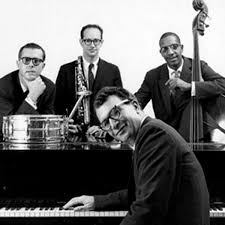
To navigate the treacherous rhythmic terrains Brubeck wanted to explore, the quartet required a rhythm section of absolute, unyielding genius. They found it in the deep, earth-anchoring double bass of Eugene Wright—a veteran of the hard-swinging big bands who kept the group’s feet firmly on the ground—and the extraordinary, polyrhythmic mind of drummer Joe Morello. Morello was a technical marvel, a visually impaired prodigy capable of executing independent, blindingly fast rhythms with each hand, maintaining a loose, effortless swing over the most bizarre, asymmetrical time signatures. Together, these four men formed a smooth, corporate-looking unit that hid a fiercely radical interior.

The Anatomy of the Vinyl: A Sensorial Walk Through an Asymmetrical Masterpiece
To place the needle onto the grooves of Time Out is to step directly into a beautiful, mid-century modern architectural playground. The album detonates its opening manifesto with “Blue Rondo à la Turk”, a track written in a dizzying 9/8 time signature. Instead of breaking the nine beats into the traditional classical pattern of 3+3+3, Brubeck groups them as 2+2+2+3, mimicking the frantic, driving pulse of the Turkish street musicians he had memorized in Istanbul. The horns state the theme with a sharp, aggressive precision that feels like a high-speed train navigating a series of tight mountain switches. Then, without warning, the track downshifts into a deep, greasy, and traditional 4/4 blues groove, letting Brubeck and Desmond trade solos that bridges the ancient gap between the Bosporus and the streets of Chicago.
The undisputed crown jewel of the record arrives with “Take Five”, a track composed entirely by Paul Desmond in the unprecedented time signature of 5/4. Originally designed merely as a vehicle to showcase a drum solo for Joe Morello, the track became a monumental piece of global pop culture. It opens with Morello’s iconic, snapping drum rhythm, followed immediately by Brubeck’s hypnotic, repeating two-chord piano vamp that anchors the floating five-beat meter. When Desmond enters with that historic, smoky saxophone melody, the 5/4 time signature completely dissolves into pure, effortless silk. The emotional climax of the track belongs entirely to Morello; his extended drum solo is a masterclass in independent coordination, shifting accents across the bar lines with a subtle, driving power that leaves the listener completely breathless.
Side B opens with the elegant, dancing grace of “Three to Get Ready”. The track begins as a polite, traditional 3/4 waltz before systematically alternating between two bars of 3/4 and two bars of a driving 4/4 time signature. It is a brilliant, playful trick that mimics a dancer constantly changing their steps mid-phrase, demonstrating the quartet’s absolute comfort within shifting structural dimensions. The melody is light, joyful, and deeply hummable, masking the complex mathematical gymnastics operating just beneath the surface.
The record continues its rhythmic tour with “Kathy’s Waltz”, a tender tribute to Brubeck’s daughter that starts as a sweet drawing-room ballad before sliding into a complex layer of polyrhythms, where the piano plays in a fast 4/4 time while the drums maintain a steady 3/4 waltz underneath. The album closes with “Pick Up Sticks”, a driving blues groove locked inside a solid 6/4 framework, where Eugene Wright’s massive, walking bassline proves permanently that any number of beats can be forced to swing if played with absolute, unyielding soul.
The Legacy and Modern Coordinates: The Eternal Echo of the Mathematical Blueprint
The historical and commercial resonance of Time Out is entirely monumental. Released in the late autumn of 1959, the album shattered all corporate expectations, rising to the top of the Billboard pop charts and spawning “Take Five” as a genuine hit single that dominated global radio stations. It completely redefined the commercial potential of modern jazz, proving that the music could remain deeply experimental, highly intellectual, and structurally radical while simultaneously capturing the hearts of millions of casual listeners worldwide.
The ripples of this geometric revolution permanently altered the DNA of modern instrumental music. The progressive rock movement of the 1970s—including icons like Emerson, Lake & Palmer, Yes, and King Crimson—studied Brubeck’s asymmetrical structures to build their own sprawling, multi-meter epics; avant-garde classical composers and modern minimalist movements drew heavy inspiration from its repetitive, mantric vamps; and generations of contemporary jazz composers, mathematical hip-hop beatmakers, and electronic producers continuously return to Time Out to sample its crystalline textures, its perfectly separated stereo mix, and its unmatched rhythmic weight. Dave Brubeck, Paul Desmond, Eugene Wright, and Joe Morello carved a sharp, elegant, and permanent golden coordinate on the map of Jazz Latitude: an immortal, mid-century lighthouse that reminds us that when technical genius pairs with melodic grace, even the most complex equations can be made to swing for eternity.