When Jazz Began Looking Toward the Infinite
There are musicians who change the language of jazz, and there are others who change the reason for making it. Alice Coltrane belongs unmistakably to the second group. Throughout her remarkable career as a pianist, harpist, composer, bandleader and spiritual teacher, she transformed jazz from a vehicle of artistic expression into a pathway toward transcendence. Her music did not seek merely to entertain or even to innovate. It invited listeners into states of contemplation where improvisation became prayer, harmony became meditation and silence itself suggested the possibility of the sacred.
Today, Alice Coltrane is widely recognized as one of the central figures in the evolution of spiritual jazz, yet that recognition arrived remarkably late. For decades, discussions of her work often began by identifying her as the wife of John Coltrane, one of the greatest saxophonists in history. While their artistic partnership remains one of jazz’s most extraordinary relationships, such framing obscured an equally important truth. Following John’s death in 1967, Alice did not merely preserve his musical legacy. She expanded it into territories that neither he nor any other jazz musician had previously imagined.
Her recordings from the late 1960s and 1970s remain astonishing.
They combine modal improvisation with Indian devotional music.
African rhythmic traditions.
Western classical orchestration.
The shimmering resonance of the harp.
The ecstatic searching of free jazz.
And an unwavering belief that music could become a genuine spiritual practice.
Few artists have united such diverse traditions with comparable coherence.
Even fewer have influenced so many generations while remaining impossible to categorize.
Understanding Alice Coltrane therefore means exploring one of the most profound transformations in the history of modern music.
Detroit: A City of Musical Possibilities
Alice McLeod was born on August 27, 1937, in Detroit, Michigan, a city whose extraordinary musical life shaped countless future innovators.
Long before Motown became internationally famous, Detroit already nurtured vibrant communities of gospel, blues, classical music and jazz.
Church music surrounded her childhood.
The piano became both companion and teacher.
Formal classical study developed technical discipline.
Improvisation emerged naturally alongside it.
Unlike musicians forced to choose between sacred and secular traditions, Alice experienced them as complementary worlds.
Gospel introduced emotional directness.
Classical music revealed architectural beauty.
Jazz offered freedom.
These influences would remain inseparable throughout her life.
The Piano as Prayer
Even before spiritual philosophy became the defining theme of her mature work, Alice Coltrane approached the piano differently from many of her contemporaries.
She admired remarkable stylists such as Bud Powell, Thelonious Monk and McCoy Tyner.
Yet virtuosity alone never interested her.
Instead, she listened for emotional resonance.
Harmony became atmosphere.
Rhythm became breathing.
Improvisation unfolded with extraordinary patience.
This deeply reflective approach distinguished her from the beginning.
Years later, when audiences encountered her celebrated harp recordings, they often described them as completely unprecedented.
In reality, the seeds of that spacious musical language had already been present in her piano playing for many years.
Meeting John Coltrane
Few artistic partnerships have altered jazz history as profoundly as the meeting between Alice McLeod and John Coltrane.
They met in the early 1960s while both were active within the rapidly evolving American jazz scene.
Their connection extended far beyond personal affection.
They shared relentless musical curiosity.
Deep spiritual interests.
An openness toward philosophical exploration.
Following the departure of McCoy Tyner from John Coltrane’s quartet, Alice gradually assumed the piano chair.
The transition represented one of the most challenging roles in modern jazz.
Tyner had fundamentally shaped the quartet’s harmonic identity.
Yet Alice understood that replacing him through imitation would prove impossible.
Instead, she brought her own musical voice.
The ensemble’s final recordings entered increasingly spiritual territory.
Dense harmonies.
Collective improvisation.
Expanding forms.
The music pointed toward horizons that neither artist would fully reach together.
JazzLatitude Insight
Alice Coltrane never viewed improvisation as self-expression alone. For her, music became a way of listening—to other musicians, to silence, to spiritual traditions and, ultimately, to something beyond the individual self.
Loss and Transformation
On July 17, 1967, John Coltrane died from liver cancer at only forty years of age.
His death shocked the musical world.
For Alice, it represented an unimaginable personal loss.
Widowed with four children.
Confronted by enormous emotional and artistic challenges.
Many observers assumed her career would become permanently defined by grief.
Instead, something extraordinary occurred.
She transformed mourning into creation.
The albums she recorded during the following years remain among the boldest statements in the entire history of jazz.
Rather than retreating from experimentation, she embraced it more completely than ever before.
Her music ceased asking how jazz could evolve.
It began asking why music exists at all.
A New Instrument, A New Language
One of Alice Coltrane’s most revolutionary decisions involved an instrument rarely associated with modern jazz.
The harp.
Although the instrument had appeared occasionally within earlier jazz history, no major improviser had integrated it so completely into an original artistic vision.
Alice heard possibilities others overlooked.
Its shimmering resonance suggested celestial space.
Its sustained harmonics complemented modal improvisation beautifully.
Its timbre connected naturally with Indian devotional music and Western sacred traditions alike.
She did not simply add the harp to jazz.
She changed the emotional vocabulary of the music itself.
Toward a Universal Music
By the end of the 1960s, Alice Coltrane had become something entirely unprecedented.
Not merely a remarkable pianist.
Not merely John Coltrane’s artistic companion.
She had emerged as one of the boldest composers of her generation.
The music she was about to create would permanently redefine spiritual jazz.
Its influence continues expanding more than half a century later.
Buy Amazon
Building a New Spiritual Language
If Alice Coltrane’s earliest recordings revealed extraordinary sensitivity, the albums she created after John Coltrane’s death established an entirely new musical philosophy. Rather than attempting to preserve her husband’s legacy through imitation, she chose the far more courageous path of continuing the spiritual search that had animated both of their lives. The result was not an extension of John’s music but the emergence of a unique artistic universe in which jazz, Hindu devotional traditions, modal improvisation, orchestral textures and contemplative silence became inseparable.
Listening to these recordings today remains a startling experience.
They seem untouched by fashion.
Untouched by commercial expectation.
Untouched even by conventional ideas about genre.
Instead, they create the impression of entering a sacred space where every sound exists for a reason beyond entertainment.
Few bodies of work in modern jazz possess such extraordinary coherence.
Ptah, the El Daoud
Released in 1970, Ptah, the El Daoud marked the beginning of Alice Coltrane’s most celebrated creative period.
The album united two towering saxophonists—Pharoah Sanders and Joe Henderson—with bassist Ron Carter and drummer Ben Riley, creating an ensemble capable of extraordinary emotional depth.
Rather than emphasizing harmonic complexity for its own sake, Alice built spacious musical environments in which every performer could explore freely.
The title itself reflected her expanding spiritual interests.
“Ptah” refers to the ancient Egyptian creator deity.
“El Daoud” has been interpreted as “the beloved.”
Together they suggest creation, reverence and transcendence—concepts that resonate throughout the music.
The performances possess remarkable balance.
Freedom never dissolves into chaos.
Meditation never becomes passivity.
Every improvisation feels directed toward something beyond itself.
JazzLatitude Insight
Alice Coltrane did not abandon jazz when she embraced spirituality. She revealed that jazz had always possessed spiritual possibilities waiting to be explored more deeply.
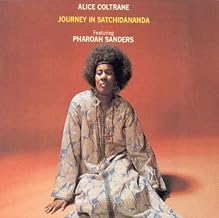
Journey in Satchidananda
If one album defines Alice Coltrane’s artistic vision, it is undoubtedly Journey in Satchidananda (1971).
Few recordings in jazz history have exercised such lasting influence while sounding so unlike anything else produced during their era.
The title honors Swami Satchidananda, the Indian spiritual teacher who profoundly influenced Alice’s philosophical life.
Musically, the album unfolds with extraordinary serenity.
Instead of conventional harmonic movement, it relies upon sustained modal centers.
The hypnotic bass of Cecil McBee anchors each piece.
Pharoah Sanders contributes soaring soprano saxophone lines that seem to float above earthly gravity.
Alice alternates between piano and harp, creating luminous textures that remain among the most recognizable sounds in all of spiritual jazz.
The opening title track has become iconic.
Its gentle pulse.
Its meditative pacing.
Its timeless atmosphere.
More than fifty years later, it continues inspiring jazz musicians, electronic producers, ambient composers and listeners seeking music that encourages reflection rather than distraction.
The Harp Reimagined
Although Alice Coltrane never abandoned the piano, the harp gradually became one of her defining artistic voices.
Her approach differed profoundly from the instrument’s traditional orchestral role.
Rather than using it primarily for decorative effect, she treated it as an improvisational instrument capable of remarkable harmonic freedom.
The harp’s resonance transformed ensemble interaction.
Instead of dense chordal accompaniment, shimmering harmonic fields emerged.
Improvisation acquired new colors.
Time itself seemed to slow.
Many later musicians would explore similar ideas.
Few have equaled the natural elegance with which Alice integrated the instrument into jazz.
Today, it is almost impossible to discuss the modern jazz harp without beginning with her.
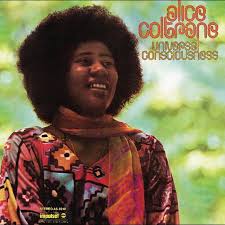
Universal Consciousness
Released later in 1971, Universal Consciousness expanded Alice Coltrane’s vision even further.
Here she incorporated orchestral writing into her already distinctive fusion of jazz and Eastern philosophy.
Strings entered the conversation.
Large-scale compositional forms became increasingly important.
Improvisation remained central, yet the music acquired almost symphonic breadth.
Some listeners initially struggled with the album’s ambition.
Others immediately recognized its originality.
Looking back, Universal Consciousness appears remarkably prophetic.
It anticipated later developments in contemporary classical music, ambient composition and spiritually inspired improvisation by several decades.
Beyond Musical Categories
One reason Alice Coltrane’s work continues attracting new audiences is that it consistently escapes traditional classification.
Certainly it belongs to jazz.
Yet it also speaks naturally to listeners interested in:
Indian classical music.
Sacred music.
Minimalism.
Ambient composition.
Modern classical orchestration.
Meditative practice.
Experimental improvisation.
Rather than borrowing superficially from these traditions, Alice discovered deep philosophical connections among them.
Her music never feels eclectic.
It feels unified.
Every influence serves the same spiritual purpose.
Pharoah Sanders: A Shared Journey
No collaborator proved more central to Alice Coltrane’s mature work than Pharoah Sanders.
Together they created some of the defining recordings of spiritual jazz.
Sanders’ passionate, searching saxophone found perfect balance beside Alice’s luminous harmonic landscapes.
Where his improvisations often reached ecstatic intensity, her accompaniment offered grounding.
Where her music invited contemplation, his horn introduced urgent emotional testimony.
Neither musician dominated.
Both deepened the other’s artistic vision.
Their partnership remains one of the most profound collaborations in modern jazz history.
Music as Devotional Practice
As Alice Coltrane’s spiritual life deepened, the distinction between artistic activity and religious practice gradually disappeared.
Performance became meditation.
Composition became prayer.
Improvisation became disciplined listening.
These ideas would eventually lead her beyond the traditional jazz world toward a broader life devoted to spiritual teaching.
Yet even before those later developments, her recordings already suggested this transformation.
They invite participation rather than observation.
The listener does not merely hear the music.
One enters it.
Essential Albums
For listeners discovering Alice Coltrane for the first time, these recordings provide the clearest introduction to one of the most visionary artistic journeys in modern music.
- A Monastic Trio (1968) — Alice’s first album as a leader after John Coltrane’s passing, revealing the emergence of her independent musical voice.
- Ptah, the El Daoud (1970) — A masterpiece of spiritual jazz featuring Pharoah Sanders and Joe Henderson.
- Journey in Satchidananda (1971) — One of the greatest albums in jazz history and the defining statement of Alice Coltrane’s artistic philosophy.
- Universal Consciousness (1971) — A bold synthesis of orchestral composition, spirituality and improvisation.
- World Galaxy (1972) — A magnificent exploration of strings, harp and transcendental jazz.
- Transfiguration (1978) — A powerful live recording demonstrating the extraordinary depth of Alice’s mature ensemble.
Together, these recordings document one of the most remarkable artistic evolutions ever captured in jazz.
Buy Amazon
A Legacy That Continues to Expand
The influence of Alice Coltrane has grown in a way that few musicians in jazz history have experienced. During her lifetime, she was respected by fellow artists but often misunderstood by critics who struggled to categorize music that ignored conventional stylistic boundaries. Was it jazz? Sacred music? Indian devotional practice? Contemporary classical composition? Avant-garde improvisation? The answer, of course, was all of these—and something beyond them. Only in the decades following her most visionary recordings did listeners fully recognize that Alice Coltrane had not stepped outside jazz. She had expanded its spiritual horizon.
Today, her music occupies an extraordinary position within contemporary culture.
Jazz musicians study her harmonic language.
Classical composers admire her orchestral imagination.
Electronic artists sample her recordings.
Meditation practitioners embrace her music as a companion to contemplation.
Young listeners discovering spiritual jazz often begin not with recordings from the 1960s but with Alice herself.
Her work continues finding new audiences because it addresses questions that remain timeless.
How can music become a path toward inner transformation?
Can improvisation reveal something beyond technical mastery?
What happens when listening itself becomes a spiritual practice?
These questions define Alice Coltrane’s enduring legacy.
Sai Anantam Ashram
During the late 1970s and early 1980s, Alice Coltrane’s spiritual journey entered a new phase.
After years of study with Swami Satchidananda, she became increasingly devoted to Hindu philosophy and devotional practice.
Eventually she founded the Sai Anantam Ashram in California, where she adopted the spiritual name Turiyasangitananda.
For some observers, this appeared to mark a departure from jazz.
In reality, it represented the natural continuation of ideas already present throughout her music.
The distinction between art and spiritual life disappeared.
Music accompanied meditation.
Devotional singing became daily practice.
Teaching complemented performance.
Rather than abandoning creativity, Alice expanded its purpose.
JazzLatitude Insight
Alice Coltrane never treated spirituality as an ornament added to music. She reversed the relationship. Music became one expression of a much larger spiritual search—a search that continues inviting listeners to hear with greater attention and compassion.
Rediscovery by a New Generation
Beginning in the late 1990s and accelerating throughout the twenty-first century, Alice Coltrane experienced one of the most remarkable artistic rediscoveries in modern music.
Reissued albums reached younger audiences.
Vinyl collectors sought original pressings.
Streaming introduced her work to listeners who had never encountered spiritual jazz.
Critics reassessed her importance.
Scholars recognized her role not merely as a pioneering woman in jazz but as one of the music’s most original composers and philosophical thinkers.
This renewed attention coincided with broader changes in contemporary jazz itself.
Many younger musicians were once again searching for transcendence rather than virtuosity alone.
Alice Coltrane suddenly sounded not historical.
But prophetic.
The New Spiritual Jazz Movement
Few artists have influenced contemporary spiritual jazz more profoundly than Alice Coltrane.
The expansive compositions of Kamasi Washington carry unmistakable echoes of her orchestral vision.
Matthew Halsall explores similarly contemplative atmospheres through spacious modal writing.
Groups such as Mammal Hands combine meditation, minimalism and improvisation in ways that reflect Alice’s aesthetic philosophy.
Producers including Floating Points have openly celebrated her recordings, introducing them to electronic music audiences.
Visionary artists like Carlos Niño continue extending conversations that Alice began decades earlier.
Even musicians who sound nothing like Alice often acknowledge her deeper influence.
She demonstrated that sincerity and spiritual purpose could coexist with fearless musical experimentation.
Beyond the Piano
Although Alice Coltrane is often introduced as a pianist, limiting her legacy to any single instrument misses the extraordinary breadth of her achievement.
She transformed the role of the harp in modern improvisation.
Expanded orchestral writing within jazz.
Integrated Indian devotional concepts without superficial exoticism.
Created modal structures unlike those of any contemporary composer.
Most importantly, she changed the emotional expectations surrounding jazz performance.
Her music invited contemplation rather than competition.
Listening rather than display.
Communion rather than spectacle.
These qualities remain surprisingly rare.
They also explain why her recordings continue sounding timeless.
Essential Collaborations and Artistic Connections
Alice Coltrane’s extraordinary artistic vision developed through profound collaborations that continue shaping the history of modern jazz.
Among the most significant are:
- John Coltrane — Their partnership remains one of the most influential artistic relationships in jazz history. Together they explored increasingly expansive forms of modal improvisation and spiritual expression, while Alice later carried many of those ideas into entirely new musical territory.
- Pharoah Sanders — Their recordings, particularly Journey in Satchidananda and Ptah, the El Daoud, stand among the defining achievements of spiritual jazz, balancing ecstatic improvisation with meditative stillness.
- Joe Henderson — His lyrical tenor saxophone provided an ideal counterpoint to Alice’s spacious harmonic language on some of her most celebrated sessions.
- Swami Satchidananda — Although not a musician, his philosophical influence fundamentally shaped Alice’s mature artistic vision, inspiring the spiritual concepts that permeate her most important recordings.
- The contemporary spiritual jazz movement — Artists such as Kamasi Washington, Matthew Halsall, Carlos Niño, Mammal Hands and Floating Points continue drawing inspiration from Alice Coltrane’s integration of spirituality, improvisation and expansive musical form.
Together, these relationships reveal an artist whose influence extends far beyond jazz into philosophy, contemporary composition and global musical culture.
Technical Profile
Born:
- August 27, 1937
Died:
- January 12, 2007
Birthplace:
- Detroit, Michigan, USA
Primary Instruments:
- Piano
- Harp
- Organ
Professional Roles:
- Pianist
- Harpist
- Composer
- Bandleader
- Spiritual Teacher
Primary Styles:
- Spiritual Jazz
- Modal Jazz
- Avant-Garde Jazz
- Post-Bop
- Contemporary Classical
- Devotional Music
Musical Characteristics:
- Deep modal harmony
- Extraordinary use of the harp
- Indian devotional influences
- Spacious orchestral writing
- Meditative improvisation
- Spiritual and philosophical depth
Essential Albums:
- A Monastic Trio (1968)
- Ptah, the El Daoud (1970)
- Journey in Satchidananda (1971)
- Universal Consciousness (1971)
- World Galaxy (1972)
- Transfiguration (1978)
Five Lesser-Known Facts About Alice Coltrane
1. She revolutionized the role of the harp in jazz.
Although the instrument had appeared occasionally in earlier jazz history, Alice Coltrane became the first artist to establish it as a central voice within a complete improvisational language.
2. She founded her own spiritual community.
The Sai Anantam Ashram became the center of her devotional life, where music, meditation and teaching existed as inseparable practices.
3. She composed orchestral works unlike anything else in jazz.
Albums such as Universal Consciousness and World Galaxy expanded jazz through large-scale arrangements that blended classical, Indian and improvisational traditions.
4. Her influence has grown dramatically since her death.
Many of today’s leading jazz musicians cite Alice Coltrane as one of the most important artistic inspirations of the twenty-first-century spiritual jazz revival.
5. She transformed grief into artistic creation.
Rather than allowing John Coltrane’s passing to define her career, Alice created one of the most original and visionary bodies of work in modern music.
Frequently Asked Questions
Who was Alice Coltrane?
Alice Coltrane was an American pianist, harpist, composer and spiritual teacher whose groundbreaking work helped establish spiritual jazz as one of the most profound movements in modern music.
Why is Alice Coltrane important?
She expanded jazz by integrating modal improvisation, Indian philosophy, orchestral composition and the harp into a deeply personal musical language that continues influencing musicians across genres.
What is Alice Coltrane’s greatest album?
Many critics regard Journey in Satchidananda as her masterpiece and one of the greatest spiritual jazz albums ever recorded, although Ptah, the El Daoud, Universal Consciousness and World Galaxy are equally essential to understanding her artistic evolution.
Did Alice Coltrane only play piano?
No. She became one of the most influential harpists in jazz history and also performed extensively on organ, creating a remarkably distinctive instrumental palette.
Which artists are similar to Alice Coltrane?
Listeners who appreciate Alice Coltrane often explore John Coltrane, Pharoah Sanders, Charles Lloyd, Don Cherry, Yusef Lateef, Matthew Halsall, Kamasi Washington, Carlos Niño, Sun Ra and Floating Points, all of whom explore different relationships between improvisation, spirituality and transcendence.
JazzLatitude Rating
| Category | Rating |
|---|---|
| Piano Performance | ★★★★★ |
| Harp Innovation | ★★★★★ |
| Compositional Originality | ★★★★★ |
| Spiritual Vision | ★★★★★ |
| Historical Importance | ★★★★★ |
| Influence on Modern Jazz | ★★★★★ |
| Replay Value | ★★★★★ |
| Timelessness | ★★★★★ |
| JazzLatitude Essential | ★★★★★ |
Final Thoughts
Alice Coltrane occupies a place in jazz history that extends beyond innovation, virtuosity or even influence. She transformed the purpose of improvisation itself. While many great musicians expanded jazz through harmonic complexity, rhythmic invention or technical brilliance, Alice explored another possibility altogether: that music could become a path toward spiritual awakening. Her recordings invite listeners not simply to admire artistic achievement but to experience attention, stillness and transcendence through sound.
That vision emerged from an extraordinary synthesis of traditions. Gospel, modal jazz, Indian devotional philosophy, Western classical composition and the expressive freedom of the avant-garde all coexist naturally within her work. Yet these elements never feel like intellectual experiments or stylistic fusions. They are united by a profound sincerity that gives her music an almost timeless quality. Whether listening to the luminous serenity of Journey in Satchidananda, the orchestral grandeur of Universal Consciousness or the meditative beauty of World Galaxy, one encounters an artist whose deepest commitment was not to genre but to truth.
Her influence continues to grow because contemporary musicians increasingly seek the same balance between technical mastery and emotional depth that Alice embodied so completely. The resurgence of spiritual jazz in the twenty-first century—from Kamasi Washington and Matthew Halsall to Carlos Niño and beyond—would be difficult to imagine without the path she created. Her work also resonates far outside jazz, inspiring composers, ambient musicians, electronic artists and listeners searching for music that nourishes reflection rather than distraction.
Perhaps that is Alice Coltrane’s greatest legacy. She demonstrated that jazz could become more than a conversation among musicians. It could become a conversation between the listener and something immeasurably larger than the self. In doing so, she expanded not only the vocabulary of modern jazz but its spiritual horizon.
For anyone seeking to understand the deepest possibilities of improvisation, Alice Coltrane is far more than one of the greatest pianists or harpists in jazz history.
She is one of the music’s most visionary philosophers—and one of its most enduring sources of light.