
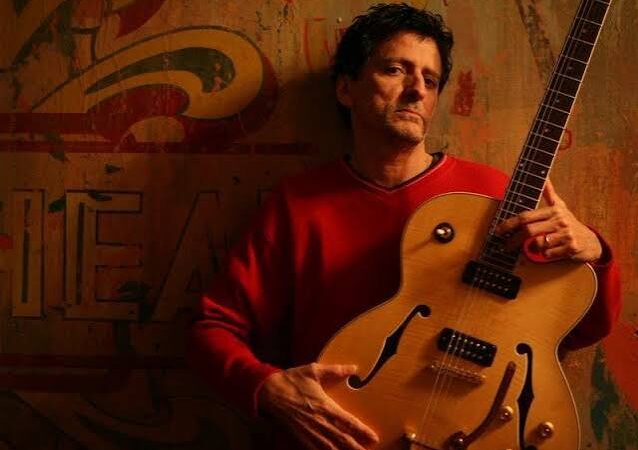
If you were sitting in a sun-drenched apartment in Ipanema during the mid-1980s, the voice of Vinícius Cantuária would have reached you through the warm, compressed waves of commercial FM radio. He was, by all accounts, a certified pop-MPB superstar. His mega-hits like “Só Você” and “Lua e Estrela” were etched into the collective romantic consciousness of a whole generation of Brazilians. He had fame, radio rotation, and the comfortable security of a major-label career in Rio de Janeiro. Yet, a master cultural chronicler like Nelson Motta would immediately tell you that the truest artists are those who possess a dangerous, beautiful restlessness—a creative hunger that refuses to let them sit comfortably on a throne of past triumphs. In 1994, Cantuária packed his bags, took his acoustic guitar, and boarded a flight to New York City. He wasn’t looking to export a postcard version of Brazil; he went to lose himself in the dark, smoky, and fiercely intellectual laboratory of the Downtown jazz vanguard.
What followed over the next three decades remains one of the most radical, fascinating, and deeply sophisticated chameleonic transformations in the entire history of modern music. Upon arriving in Manhattan, Cantuária completely stripped away the bright, polished production values of his pop past. He looked at the historical monument of Bossa Nova not as a museum piece to be preserved in amber, but as a living, breathing blueprint for a radical new kind of minimalist jazz. He realized that the quiet, revolutionary pulse of João Gilberto’s guitar style shared a deep, cellular DNA with the cool, brooding restraint of Miles Davis and Chet Baker. By blending the organic warmth of Rio with the cold, rain-slicked concrete textures of the New York avant-garde, Cantuária pioneered what critics would come to call Neo-Bossa Nova. It is a genre where silence is treated as an active instrument, and where the space between the musical notes carries far more emotional weight than the notes themselves.
When Cantuária unleashed his international debut masterpiece, Sol na Cara, in 1996, audiophiles and jazz purists worldwide sat up in absolute astonishment. This was an album that threw down a brutal, unprecedented challenge to high-end audio playback systems. On the surface, the tracking feels incredibly light and airy, but beneath that deceptive simplicity lies a hyper-transparent soundstage that requires flawless transient response. On reference-grade vinyl editions of his work, Cantuária’s nylon-string acoustic guitar enters right in the dead center of the room. A nylon-string guitar does not possess the sharp, metallic bite of a steel-string instrument; it relies on a soft, woody, and intensely organic pluck that operates squarely between 300 Hz and 1 kHz. If your loudspeakers suffer from a mid-bass suck-out or cabinet coloration, his guitar will sound thin and disembodied. A truly linear system will reveal the physical weight of the instrument, capturing the literal wood of the guitar body and the fleshy contact of his fingertips against the strings.
As you navigate deeper into his towering discography—moving through his landmark albums for the prestigious Verve label like Tucumã (1999) and Vinicius (2001)—the spatial geometry of his recordings expands into a breathtaking masterclass of three-dimensional imaging. To bring his dark, impressionistic visions to life, Cantuária surrounded himself with the absolute elite of the modern jazz vanguard: Brad Mehldau, Marc Johnson, Joey Baron, Ryuichi Sakamoto, and Arto Lindsay. On tracks featuring the legendary Joey Baron on drums, the micro-percussive details provide a ruthless evaluation of your system’s high-frequency resolution. Baron doesn’t just keep time; he paints with sound, utilizing tiny shakers, bells, and delicate rimshots that float like ghosts in the upper registers. On a lesser audio setup, these micro-dynamics will blur together, sounding like generic background tape hiss. But on a high-fidelity system with exceptional phase linearity, these micro-transients pop out with a startling, holographic clarity against a pitch-black, silent background.
Buy Amazon

The absolute pinnacle of Cantuária’s cross-cultural jazz dialogue arrived in 2011 with the release of Lágrimas Mexicanas, a stunning collaborative duo album alongside the visionary guitarist Bill Frisell. This record stands as a monumental test disc for evaluating high-end system coherence and amplifier decay control. The entire session is structured as an intimate, telepathic conversation between two masters of stringed architecture. On one side, you have Cantuária’s grounding, rhythmic nylon-string pulse; on the other, Frisell’s iconic, looping electric guitar lines that swell, reverse, and drift through the soundstage like a warm mist. The technical hurdle here is to keep these two distinctly different guitar timbres perfectly separated yet emotionally bound together. If your playback chain introduces any high-frequency intermodulation distortion, Frisell’s tube-amplified overtones will bleed into Cantuária’s acoustic body, collapsing the beautiful, cinematic depth of the soundstage and flattening a three-dimensional masterpiece into a flat wall of noise.
And then, of course, there is the voice. Cantuária’s vocal delivery is a direct inheritance from the João Gilberto school of absolute containment—a style where singing is reduced to a breathy, confidential whisper spoken directly into your ear. This style puts an immense amount of pressure on your system’s lower-midrange performance, specifically in the critical frequency band between 100 Hz and 250 Hz. When listening to his acclaimed 2015 record, Vinicius Canta Antonio Carlos Jobim, a linear playback chain must render his voice without introducing a single hint of artificial chestiness or boominess. If your room acoustics are poorly treated or your woofers are sluggish, his whispered poetry will lose its transparent focus, becoming muddy and overblown. But on a properly dialed-in audio system, the realism is uncanny; you can hear the precise movement of his lips, the subtle catch of his breath, and the profound, late-night melancholy that anchors his interpretations of Jobim’s classic songbook.
Even as we look at his recent experimental frontiers, such as the electric, avant-jazz explorations of Psychedelic Rio (2024), Cantuária continues to prove that his music is a continuous, unbroken line stretching between the beaches of Guanabara Bay and the experimental lofts of Brooklyn. He has shown the world that Bossa Nova doesn’t need to be loud, fast, or virtuosic to be revolutionary; it only needs to be honest. To sit down in the sweet spot of your listening room, dim the house lights, and let his discography wash over you is to witness a masterclass in musical deconstruction. A true romantic like Nelson Motta would surely tell you that the jazz career of Vinícius Cantuária is the ultimate soundtrack for a sophisticated, late-night urban solitude—a piece of pure bohemian luxury best enjoyed with a glass of cachaça on ice and an open soul. It is a vital body of work that doesn’t merely entertain, but actively challenges our high-end audio systems to reveal their absolute truest capacities for texture, space, and emotional realism.