
Joe Harriott, John Mayer and the Birth of Indo-Jazz
When Joe Harriott and John Mayer came together in London during the mid-1960s, neither musician needed to be introduced to a new musical world. Harriott had already spent years testing the limits of modern jazz, while Mayer had been living between Indian and European musical traditions since long before the phrase “Indo-jazz” became useful. Their meeting did not produce a simple collision between East and West, nor was it a sudden discovery that Indian music and jazz might share common ground. What emerged instead was a carefully constructed collaboration between musicians whose backgrounds had already made cultural borders unusually porous. On Indo-Jazz Suite, recorded in 1966, a jazz quintet and a group of Indian musicians were asked not merely to alternate styles but to occupy the same compositions, responding to structures drawn from different musical systems. The result could sound tense, elegant, unresolved and exhilarating, sometimes within the same piece. That tension is precisely what makes the record historically important.
Harriott had arrived in Britain from Jamaica in 1951, part of a generation of Caribbean musicians who would become essential to postwar British jazz. Born in Kingston in 1928 and trained at the Alpha Boys School, he entered a London scene that could provide professional opportunities while still carrying assumptions about where musical authority belonged. Harriott initially established himself through the language of bebop, working with figures including Tony Kinsey and Ronnie Scott, but his ambitions soon extended beyond being an accomplished interpreter of an established American vocabulary. By the end of the 1950s and beginning of the next decade, recordings such as Southern Horizons, Free Form and Abstract showed a musician searching for ways to loosen conventional relationships among harmony, rhythm and improvisation. His experiments developed independently enough that attempts to describe him simply as Britain’s answer to Ornette Coleman have always obscured more than they explain. Harriott retained a strong relationship with bebop phrasing even as his groups pursued freer collective interaction, and the sharpness of his alto sound gave his music a character distinctly his own.
That background matters when approaching Indo-Jazz Suite. Harriott was not a conventional jazz soloist temporarily placed over an exotic accompaniment. He had already spent years reconsidering how musicians could interact without relying on familiar harmonic sequences. Indian music presented a different set of questions, but the idea of improvisation within structures that did not behave like standard jazz harmony was hardly alien to him. What changed was the framework. Instead of developing a system primarily within his own jazz ensemble, Harriott would now have to negotiate compositions whose melodic and rhythmic logic had been shaped by John Mayer, a musician with an entirely different biography.
John Mayer Between Calcutta and London
Mayer was born in Calcutta in 1930 to an Anglo-Indian father and Tamil mother. His musical education crossed traditions from an early stage, and after studies in India he moved to Britain in 1952 on a scholarship to the Royal Academy of Music. There he studied composition with Mátyás Seiber while continuing to think seriously about the relationship between Indian and Western musical languages. His professional life made that dual perspective even more pronounced. Mayer worked as a violinist with the London Philharmonic Orchestra and later the Royal Philharmonic Orchestra, placing him inside the institutional world of British classical music, while his own compositions increasingly explored materials associated with Indian music.
The distinction is crucial because Mayer’s later work with Harriott was not an opportunistic response to the growing Western fascination with Indian culture in the 1960s. He had been exploring such questions for years. The broader decade certainly created a receptive environment: Ravi Shankar was becoming increasingly visible in Europe and the United States, Indian instruments were entering Western popular recordings, and musicians across jazz, classical music and rock were becoming interested in rhythmic cycles, drones and modal approaches. But Mayer’s project came from sustained compositional experience rather than fashion. He was interested in what happened when musicians trained in different systems were given enough structural information to communicate without forcing one tradition to impersonate the other.
Producer Denis Preston became important to turning that interest into a recording project. Mayer’s work attracted Preston’s attention, and through him the idea eventually reached Atlantic Records co-founder Ahmet Ertegun. The concept that developed was deceptively simple: place a group of musicians associated with Indian music alongside a jazz quintet led by Harriott and have Mayer compose material capable of giving both sides meaningful roles. It was called a double quintet, although the precise instrumentation did not fit a perfectly symmetrical five-against-five arrangement. What mattered was the principle: two musical bodies occupying one compositional space.
This was a fundamentally different proposition from adding a sitar to a jazz arrangement for color. Mayer had to create a practical language in which the musicians could understand where they were, when they could improvise and how their different approaches to melody and rhythm could coexist. The challenge was not to erase the differences. It was to make those differences productive.
Building the Double Quintet
The ensemble assembled for Indo-Jazz Suite brought together musicians with substantial experience. Harriott played alto saxophone, joined on the jazz side by trumpeter and flugelhorn player Eddie Blair, pianist Pat Smythe, bassist Rick Laird and drummer Alan Ganley. Mayer played violin and harpsichord, while Diwan Motihar played sitar, Chandrahas Paigankar tambura and Keshav Sathe tabla; Chris Taylor contributed flute. The instrumentation immediately created possibilities that were unavailable to a conventional jazz group. The tambura could establish a continuous tonal field while the tabla articulated rhythmic patterns of a different character from Ganley’s drum kit. Sitar, violin, flute and Harriott’s alto could approach melodic material from contrasting directions, while piano and bass had to find places within music that did not always depend on the harmonic movement they would normally be expected to define.
Mayer’s compositions became the negotiating table. Rather than asking one ensemble simply to accompany the other, he built sections in which the balance of musical authority could change. Jazz improvisation remained essential, but it operated alongside melodic frameworks and rhythmic ideas associated with Indian classical practice. The musicians therefore had to listen across habits. A drummer accustomed to propelling a jazz ensemble could not treat the tabla as another percussion instrument performing the same function. A pianist could not assume that chord changes would organize every passage. Conversely, the jazz players brought attack, phrasing and spontaneous interaction that prevented the written structures from becoming a demonstration of musical systems placed side by side.
This is one reason the term “fusion,” though unavoidable, can be misleading. It suggests that two established substances are combined until their boundaries disappear. Indo-Jazz Suite often does the opposite. The listener can hear the boundaries. The excitement comes from musicians approaching them, crossing them and occasionally resisting them. There are moments when the two traditions seem completely integrated and others when the seams remain audible. Later Indo-jazz projects would sometimes achieve a more fluid synthesis, but judging Mayer and Harriott only by that standard misses what was adventurous about their first large statement. They were making the negotiation itself part of the music.
London as a Meeting Place
The project also belongs to a particular moment in British cultural history. London in the 1950s and 1960s was being transformed by migration from the Caribbean, South Asia and other parts of the former British Empire. Those changes were not harmonious or free of racism; the city’s musical culture developed amid the contradictions of post-imperial Britain. Yet musicians were encountering one another in clubs, studios, orchestras and informal networks in ways that complicated the neat categories used by the record industry. A Jamaican-born alto saxophonist and a Calcutta-born composer could meet in London and create music that was neither an American jazz imitation nor an ornamental version of Indian classical music.
Harriott’s presence is particularly significant in this context. Discussions of British jazz history have sometimes placed Caribbean musicians at the margins of a story centered on white British players, even though musicians from Jamaica and elsewhere were integral to the scene. Harriott’s career makes that marginalization difficult to sustain. He was not merely participating in British jazz; he was pursuing some of its most ambitious ideas. His earlier free-form work and his subsequent collaboration with Mayer demonstrate two different aspects of the same refusal to treat jazz as a closed language.
Mayer similarly complicates the idea that musical exchange between India and Britain began when Western popular culture became fascinated with the sitar. He possessed firsthand knowledge of Indian traditions and formal training within European classical institutions. His compositions were therefore shaped by a question more demanding than how to make Indian music sound accessible to Western listeners. He wanted to know whether different systems of organization could retain their identities while contributing to a shared musical argument.
That ambition distinguishes Indo-Jazz Suite from many later recordings that used “Eastern” sounds primarily as atmosphere. Its Indian instrumentation is not decorative scenery. The rhythmic and melodic materials affect the compositions at a structural level, which meant that the jazz musicians had to adjust the way they heard and responded to the music. Harriott, with his experience in freer forms of ensemble improvisation, was unusually well equipped for that task.
The Suite Takes Shape
The four pieces that made up the album — “Overture,” “Contrasts,” “Raga Megha” and “Raga Gaud-Saranga” — were all composed by Mayer. Their titles reveal the record’s architecture before a note is heard. The first two establish the project and its opposing forces; the latter two make the relationship with raga explicit. Yet the album is not a lesson in Indian classical music. Mayer was composing for this particular mixed ensemble, adapting ideas to a context in which Harriott and his colleagues needed room to function as jazz improvisers.
That distinction protects the record from another common misunderstanding. Indo-Jazz Suite should not be treated as evidence that jazz musicians had somehow mastered Indian classical traditions after a few rehearsals, nor should Mayer’s writing be mistaken for an attempt to reproduce a traditional Indian performance with Western instruments. The album creates its own hybrid framework. The Indian musicians bring knowledge and instrumental practices that cannot be reduced to jazz terminology; the jazz players contribute a tradition of improvisational interaction that likewise remains identifiable. Mayer’s achievement was to construct enough common ground for a conversation to happen.
The sessions produced something that sounded genuinely unusual in 1966. Contemporary listeners were confronted with long pieces in which tabla and drum kit, sitar and alto saxophone, violin and piano could coexist without settling into the familiar patterns of either a jazz combo or an Indian classical ensemble. A contemporary Jazz Journal review recognized both the complexity of the material and the success of the experiment, evidence that the record was not merely rediscovered decades later and retroactively declared important. It attracted serious attention at the time because listeners could hear that Harriott and Mayer were attempting something difficult.
What they had not yet done was solve every problem raised by the experiment. That would have made the music less interesting. The rhythmic systems did not always merge effortlessly, the transition between written material and improvisation could remain exposed, and the ensemble’s two musical centers sometimes sounded like partners still learning how to speak to one another. But Indo-Jazz Suite turned those difficulties into creative material. Instead of presenting cultural fusion as effortless harmony, it documented musicians discovering where genuine exchange could occur.
That process becomes clearest when the four compositions are examined individually. Beneath the historical reputation of Indo-Jazz Suite lies a record full of specific decisions about rhythm, melody, instrumentation and improvisation. It is there — not in later claims that Harriott and Mayer somehow invented every form of jazz that engaged with Indian music — that the album’s real originality can be heard.
Buy Amazon
Inside Indo-Jazz Suite
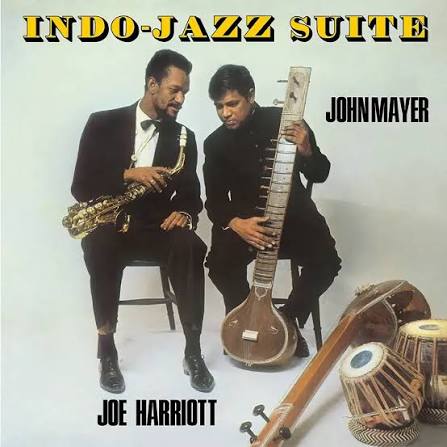
The historical importance of Indo-Jazz Suite can make it tempting to hear the album primarily as an idea: Indian music meets modern jazz in London in the mid-1960s. But the record becomes more revealing when that label is temporarily set aside and attention turns to the four compositions themselves. John Mayer did not simply establish an Indian rhythmic background and invite Joe Harriott’s quintet to improvise over it. Each piece negotiates the relationship differently, changing the balance between written material and improvisation, between jazz rhythm and tabla, and between instruments accustomed to very different ways of organizing musical time. Across roughly thirty-five minutes, “Overture,” “Contrasts,” “Raga Megha” and “Raga Gaud-Saranga” form a sequence in which the musicians gradually seem less like representatives of separate traditions and more like members of a single, unconventional ensemble.
To understand what Mayer was attempting, only a few concepts need to be kept in view. A raga is not simply a scale in the Western sense, even though early descriptions of Indo-jazz often reduced it to one. It provides a melodic framework with characteristic relationships, movements and expressive possibilities. Tala, similarly, is more than a beat or time signature: it organizes rhythm through recurring cycles whose internal accents and divisions can be considerably different from the assumptions of a jazz rhythm section. The tambura contributes another essential element, sustaining a drone that establishes a tonal center without performing chord progressions. For musicians such as Harriott, Pat Smythe, Rick Laird and Alan Ganley, this meant entering music in which improvisation remained fundamental but many of the landmarks normally provided by jazz harmony were either altered or absent. Mayer’s solution was not to demand that they become Indian classical musicians. Instead, he composed structures that allowed their existing improvisational personalities to operate within unfamiliar surroundings.
“Overture”: Establishing the Common Ground
“Overture” is appropriately the most composed introduction to Mayer’s argument. Unlike the three pieces that follow, it is not presented as a raga, and its five-beat metre immediately prevents the jazz musicians from settling into an ordinary swing pattern. The unusual pulse is important, but the piece does not function as a rhythmic puzzle designed to demonstrate technical sophistication. It establishes from the beginning that neither half of the ensemble will be able to dictate the music entirely on its own terms. Mayer’s written material organizes the group closely, introducing instrumental colors and rhythmic relationships that will become progressively more flexible as the suite develops.
The result is a useful entry point because the listener can hear the double ensemble before the distinctions between its components begin to loosen. Tabla and drum kit occupy different rhythmic spaces rather than simply doubling one another, while the sustained tonal environment created by the Indian instruments changes the way the Western instruments are perceived. Harriott’s alto does not suddenly lose the angular articulation and rhythmic urgency that had characterized his earlier jazz work. If anything, those qualities become more noticeable because they are being heard against a different background. His phrases cut through the ensemble rather than dissolving into it, demonstrating one of the central strengths of the project: integration does not require every musician to adopt the same accent.
The tightly organized nature of “Overture” also reveals Mayer’s role more clearly than the broad label of “fusion” sometimes does. He was not merely supplying themes. He was constructing a method by which musicians with different musical vocabularies could arrive at shared points of reference. The five-beat framework gives everyone the same architecture while leaving the instrumental identities intact. Instead of beginning with the most radical possible confrontation between jazz and Indian classical practice, Mayer begins by creating order. Only after that common ground has been established does the suite start to open.
“Contrasts”: Difference as the Subject
If “Overture” establishes the ensemble, “Contrasts” makes its differences more explicit. The title is almost a statement of method. Mayer was not pretending that the traditions represented in the room could be merged without friction, and the piece allows contrasts in timbre, rhythmic conception and improvisational language to become part of its character. The jazz musicians can move with a familiar sense of attack and forward momentum, while sitar, tabla and tambura introduce another relationship to melodic development and time. The interest lies not in deciding which side dominates but in hearing how the composition continually redirects attention from one musical logic to another.
Pat Smythe is particularly important to this negotiation. A contemporary Jazz Journal review observed that among the jazz soloists he adapted most readily to the Indian setting, while Harriott retained more of his established language. That contrast is revealing rather than problematic. Smythe’s piano can reduce the harmonic density associated with conventional jazz accompaniment and respond to the modal environment with considerable sensitivity. Harriott, meanwhile, remains recognizably Harriott. His alto lines bring the rhythmic bite of bebop and the freedom he had developed during the preceding years. The music benefits from the fact that he does not attempt to imitate the sitar or manufacture an artificially “Eastern” saxophone vocabulary.
This is where Indo-Jazz Suite becomes more convincing than many cross-cultural recordings built around surface resemblance. Mayer did not need Harriott to sound Indian. He needed Harriott to listen. Those are different demands. The alto saxophonist’s personality remains strong enough that moments of contact with Diwan Motihar’s sitar feel like encounters rather than stylistic disguise. Motihar follows a melodic conception grounded in another tradition; Harriott answers with phrases shaped by jazz. When their lines occupy the same tonal field, similarities can emerge without the differences being erased.
“Contrasts” therefore captures something fundamental about the entire project. The album’s achievement is not perfect synthesis. It is coordinated coexistence. At certain moments the ensemble sounds unified; at others the underlying musical systems remain clearly audible. Mayer allows both conditions to exist. Rather than hiding the seams, he composes with them.
“Raga Megha”: Improvisation Without Chord Changes
With “Raga Megha,” the album moves deeper into territory where Western functional harmony becomes less useful as the principal map. The tambura’s drone assumes greater psychological importance because the listener’s sense of direction comes increasingly from melodic movement, rhythmic cycles and changes in instrumental density rather than from a progression of chords. For a jazz listener accustomed to hearing improvisation in relation to harmonic movement, the effect can initially seem static. In practice, however, the absence of conventional chord changes creates another kind of mobility. Small melodic decisions become more exposed, rhythmic placement carries greater weight, and the relationship between soloist and accompaniment changes.
This is also where the combination of tabla and drum kit becomes one of the album’s most distinctive resources. Keshav Sathe and Alan Ganley do not simply produce a larger percussion section. Their instruments come from different performance practices, and Mayer’s writing makes that difference audible. Ganley can supply propulsion associated with jazz drumming while Sathe articulates the cyclical rhythmic structure with another vocabulary of accents and gestures. At their best, the two approaches create a rhythmic field that neither musician could have produced alone.
Harriott responds to this environment without abandoning the characteristics that made his earlier playing compelling. His improvisation does not suddenly become serene or meditative simply because the piece carries the name of a raga. There is urgency in his phrasing, and the tension between that urgency and the more continuous tonal environment surrounding him gives the performance much of its energy. The important development is not that Harriott becomes an Indian musician; it is that his familiar language begins behaving differently because the musical conditions around it have changed.
That distinction also helps remove Indo-Jazz Suite from the vague category of “spiritual” East-West experiments into which recordings involving sitar and tabla are sometimes placed retrospectively. Mayer and Harriott were working with concrete compositional problems. How could improvisers orient themselves without standard chord sequences? How could tabla and drum kit share rhythmic responsibility? How could a drone coexist with piano and bass? How much material needed to be written before musicians from different backgrounds could improvise meaningfully together? The answers are heard through performance rather than announced as philosophy.
“Raga Gaud-Saranga”: Toward a Shared Ensemble Language
By “Raga Gaud-Saranga,” the final piece, the unusual instrumentation no longer needs introduction. The listener has learned how to hear the group, and the musicians themselves appear increasingly comfortable moving through Mayer’s hybrid architecture. That does not mean the differences have disappeared. Sitar still sounds like sitar, Harriott’s alto remains rooted in his jazz identity, and the rhythmic roles of Sathe and Ganley remain distinct. What changes is the sense of negotiation. Elements that seemed deliberately juxtaposed earlier in the album now feel capable of participating in a longer shared conversation.
The composition also demonstrates why describing the project as merely “jazz with Indian instruments” is inadequate. Remove the Indian musicians and the structure itself changes. The drone is not an atmospheric layer placed behind an otherwise complete jazz performance, and tabla is not percussion decoration. The melodic and rhythmic organization depends upon these elements. At the same time, removing Harriott’s group would produce something equally different, because Mayer has created spaces that depend on the phrasing, interaction and improvisational instincts of jazz musicians. The double quintet works precisely because neither side is optional.
This mutual dependence may be the most consequential achievement of Indo-Jazz Suite. Cross-cultural projects can easily become hierarchical, with one tradition providing the underlying structure while another contributes recognizable color. Mayer’s compositions do not entirely escape the difficulties inherent in bringing complex traditions together, but they make a serious attempt to distribute musical responsibility. The jazz players are not simply soloists visiting an Indian setting, and the Indian musicians are not a decorative rhythm section attached to a jazz album.
The contemporary response suggests that listeners recognized this distinction. Writing in Jazz Journal in 1966, Michael Shera emphasized the unusual richness created by placing Indian rhythmic instruments behind jazz soloists and called the recording an unqualified success. His reaction matters because it prevents us from constructing the familiar story of a forgotten masterpiece that nobody understood until decades later. Indo-Jazz Suite was unusual, but its ambitions were audible to listeners at the time. It generated enough interest for Harriott and Mayer to continue the collaboration rather than treating the session as a one-off experiment.
Beyond the First Suite
The limitations of the record are part of that story as well. Some transitions can sound more designed than spontaneous, and there are moments when the listener remains conscious of two musical systems being coordinated rather than hearing a completely natural ensemble language. But expecting seamless integration imposes a later standard on musicians who were actively discovering what this combination could do. Indo-Jazz Suite is compelling partly because the process remains exposed. The musicians are not pretending that centuries of distinct musical practice can be reconciled by adding a sitar to a jazz group. They are searching for workable points of contact.
And those points of contact would soon multiply. Harriott and Mayer did not stop with the four pieces recorded for Indo-Jazz Suite. The Double Quintet became a continuing project, performing publicly and returning to the studio with music that pushed the collaboration further. Pieces such as “Partita,” “Multani,” “Gana,” “Acka Raga” and “Subject” would show how quickly the ensemble’s language could evolve once the initial problem of communication had been confronted. The relationship between written composition and improvisation became increasingly flexible, while the group itself demonstrated that Indo-jazz could function as more than the concept behind a single album.
That continuation is essential to understanding the first suite. Indo-Jazz Suite was not important because it provided a finished blueprint that later musicians simply followed. It was important because it established a working ensemble in which experimentation could continue. The questions raised in 1966 did not disappear at the end of “Raga Gaud-Saranga.” They became the foundation for the next stage of Harriott and Mayer’s collaboration — and for a body of music whose significance reaches far beyond the convenient story of jazz simply “meeting” India.
Indo-Jazz Fusions and the Legacy of Harriott and Mayer
The most important evidence that Indo-Jazz Suite was more than an isolated experiment came after the record itself. Joe Harriott and John Mayer continued working together, taking the Double Quintet into performances and developing music in which the relationship between the jazz and Indian musicians became increasingly confident. By the time Indo-Jazz Fusions appeared in 1967, the collaboration had moved beyond the need to announce its premise every time the musicians played. The ensemble was becoming a functioning band. That distinction matters because the history of cross-cultural jazz is filled with projects assembled for a recording session, built around an attractive concept and then dissolved before the musicians could discover what sustained interaction might produce. Harriott and Mayer were able to continue the conversation. The second stage of their partnership shows what happened after the novelty of putting alto saxophone, sitar, tabla, violin, piano, bass and drums in the same room had begun to wear off.
Contemporary reporting captured that change. In 1967, the Double Quintet was described not simply as a recording project but as a group making frequent public appearances, particularly at universities, under the name Indo-Jazz Fusions. Its personnel could change, as working jazz groups inevitably did, but the essential design remained: Harriott’s jazz musicians interacted with Mayer and the Indian instrumentalists, with flute helping to connect the ensemble’s contrasting colors. What had initially required careful explanation was becoming a repertory that could survive outside the studio. That development is one of the strongest arguments for taking the collaboration seriously. Mayer’s compositions were not merely clever demonstrations of compatibility between two musical traditions. They could be performed, expanded and revisited in front of audiences.
From the Suite to Indo-Jazz Fusions
The five pieces on Indo-Jazz Fusions — “Partita,” “Multani,” “Gana,” “Acka Raga” and “Subject” — reveal a project becoming less preoccupied with proving that integration is possible. The longest pieces, “Partita” and “Multani,” provide enough space for the ensemble to move between written structures and improvisation without constantly emphasizing the border between them. Shorter compositions such as “Gana” and “Acka Raga” show another side of Mayer’s writing: concise, memorable and rhythmically distinctive, capable of communicating the character of the group without requiring an extended suite.
“Partita,” which occupies a substantial portion of the album, is especially revealing. Its title invokes a European compositional tradition rather than announcing an Indian form, yet the music belongs to neither category exclusively. Mayer had become increasingly comfortable treating his sources as working materials rather than cultural labels. Instead of asking the listener to identify which element belongs to which tradition, the composition creates a larger structure in which those distinctions can continually change in importance. The jazz players have space to improvise, but the music never becomes simply a sequence of solos over an exotic rhythm section. The written architecture continues to shape the performance.
Harriott’s role within this architecture is central precisely because he remains so recognizable. His alto saxophone brings a cutting, vocal intensity that refuses to disappear into Mayer’s arrangements. The partnership would have been less interesting if Harriott had softened his personality to fit an imagined idea of Indian serenity. His playing could be restless, forceful and rhythmically disruptive. Those qualities created productive friction against sustained drones and cyclical rhythmic structures. Mayer did not eliminate that friction; increasingly, he learned how to compose around it.
“Multani” provides another extended environment in which the ensemble can explore that relationship. As on the first album, the use of raga-derived material should not encourage the assumption that the jazz musicians are performing Indian classical music. The Double Quintet occupies a third space created specifically for these players. Mayer draws from Indian melodic and rhythmic principles while providing structures in which jazz improvisers can respond according to their own musical experience. The distinction may sound subtle, but it is fundamental. The value of the project lies not in demonstrating that Harriott could become an Indian musician. It lies in hearing what happened when his existing language was placed inside conditions that changed its possibilities.
“Acka Raga” and a Music That Traveled
The shorter “Acka Raga” became one of the most durable pieces associated with the project. Its compactness demonstrates that Indo-jazz did not have to depend upon long-form experimentation. Mayer could compress the ensemble’s character into a few minutes, using rhythmic and melodic identities that remained immediately recognizable. The piece later reached an audience beyond specialist jazz listeners through its association with British television, an unusual afterlife for music originating in such an experimental collaboration.
That accessibility should not be mistaken for compromise. One of Mayer’s strengths was his ability to move between complex compositional thinking and material that could be grasped quickly. He had experience in classical orchestras, composition, jazz and Indian music, and his career increasingly crossed institutional boundaries that normally kept those activities separate. The Double Quintet allowed those experiences to converge in a particularly visible form.
For Harriott, however, the collaboration existed alongside a more difficult professional reality. His importance as an innovator did not translate into lasting commercial security. He continued to play more conventional jazz as well as experimental music, and recordings from the period make clear that his engagement with free form and Indo-jazz never erased his command of bebop and standards. This is another reason the simplified image of Harriott as a relentless avant-gardist is misleading. He could move among different approaches, sometimes because of artistic interest and sometimes because working musicians had to accept the opportunities available to them.
His career after the breakthrough of the early 1960s became increasingly difficult. The British jazz economy was changing, audiences were shifting, and experimental achievement did not guarantee steady employment. Harriott continued performing, but maintaining his own groups became harder. When he died in Southampton in January 1973, only forty-four years old, the gap between the originality of his work and the recognition he had received had become painfully apparent.
What Harriott and Mayer Actually Changed
It is tempting at this point to construct a heroic lineage. Harriott and Mayer worked with Indian music before Indo-jazz became common; therefore, the argument goes, later encounters between jazz and Indian traditions must descend from them. That is precisely the kind of history their achievement does not need.
John Coltrane’s engagement with Indian thought and musical concepts developed through different routes. Don Cherry’s increasingly international musical language had its own network of encounters. When John McLaughlin formed Shakti in the 1970s with musicians including L. Shankar and Zakir Hussain, the musical circumstances, personnel and depth of engagement with Indian classical performance were substantially different. Later artists working between jazz and South Asian traditions would likewise arrive through their own histories. Similarity does not prove direct descent.
The more defensible claim is also more interesting. Harriott and Mayer demonstrated unusually early that a sustained ensemble could be organized around musicians trained in different improvisational systems without making one group merely decorative. They showed that collaboration could occur at the level of composition and rhythmic structure rather than simply instrumentation. And they did so within the specific cultural environment of postwar Britain, where musicians from the Caribbean, South Asia and Britain were creating new relationships partly because migration had placed them within the same musical economy.
Seen this way, the Double Quintet belongs not at the beginning of a neat family tree but within a larger history of musicians questioning the borders used to classify them. Its importance does not depend on whether a later artist owned Indo-Jazz Suite. The recordings matter because they document one sophisticated solution to a problem that musicians around the world would continue to approach differently: how can traditions interact without reducing one another to stylistic signs?
Two Careers, Different Afterlives
Mayer continued pursuing that question long after Harriott’s death. His career expanded through composition, education and later versions of Indo-Jazz Fusions. In the 1990s he revived the concept with younger musicians, demonstrating that he had never regarded the original recordings as a closed historical episode. By then, the terminology surrounding cross-cultural music had changed considerably. “World music” had become an industry category, jazz festivals routinely presented international collaborations, and encounters between South Asian musicians and jazz improvisers no longer seemed as unusual as they had in mid-1960s Britain. Mayer nevertheless returned to the structural questions that had interested him decades earlier.
Harriott’s reputation followed a different path. For years, access to much of his recorded work was inconsistent, and his position in broader histories of jazz remained smaller than the music justified. Subsequent reissues and scholarship gradually made it easier to hear the continuity between his bebop foundations, free-form experiments and work with Mayer. These should not be understood as unrelated phases in which Harriott repeatedly abandoned one identity for another. Across them runs a persistent interest in improvisational freedom, collective interaction and the possibilities that appear when familiar musical rules become negotiable.
That perspective also restores Harriott to a richer account of British jazz. He was Jamaican, and his musical identity cannot be separated from the Caribbean presence that reshaped postwar Britain. At the same time, reducing him to a representative of Caribbean jazz would be equally limiting. He was a modern jazz musician whose work crossed bebop, free improvisation and Indo-jazz because he continually sought new situations in which improvisation could operate.
Mayer’s story resists simple classification in a parallel way. Born in Calcutta, educated in Indian and Western traditions and professionally embedded in British classical music, he could not easily be placed on one side of an East-West divide. The Double Quintet worked because its two leaders were already accustomed to living across categories before they attempted to build music across them.
Hearing Indo-Jazz Suite Again
Nearly six decades later, Indo-Jazz Suite can be heard without the burden of proving that it predicted everything that followed. Its historical position is secure enough that such exaggeration is unnecessary. The record appeared at a moment when Indian music was becoming increasingly visible to Western audiences, but Mayer’s engagement with it predated the fashionable sitar boom, while Harriott brought years of experimentation with the boundaries of jazz improvisation. Their partnership therefore had foundations deeper than novelty.
The album also sounds more human when freed from the language of revolution and prophecy. There are passages of extraordinary coordination and others where the mechanics of the experiment remain audible. Some ideas flow naturally; others reveal musicians negotiating unfamiliar structures in real time. Those imperfections do not diminish the achievement. They tell us what genuine collaboration often sounds like before later generations make its solutions seem obvious.
Indo-Jazz Fusions strengthened that achievement by proving that the conversation could continue. The Double Quintet developed repertory, performed before audiences and refined a musical language whose identity depended upon the participation of musicians from both sides of its original design. What began as Mayer’s compositional problem became a working ensemble.
Joe Harriott and John Mayer therefore deserve a place in jazz history that is both significant and precise. They did not invent every later encounter between jazz and Indian music, nor did they create a universal blueprint for cultural fusion. What they accomplished was more concrete: in 1960s London, they assembled musicians with different traditions of rhythm, melody and improvisation and built compositions in which those differences could become part of the music rather than obstacles to it.
That is the enduring value of Indo-Jazz Suite. It does not offer a fantasy in which musical borders disappear. It records what can happen when musicians learn how to cross them while still carrying their own histories with them.