
After Coltrane, a Different Kind of Freedom
In February 1969, Pharoah Sanders entered RCA Studios in New York to record music that would become one of the defining statements of spiritual jazz. The sessions took place on February 14 and 19, with producer Bob Thiele, the same producer whose work at Impulse! had been closely associated with John Coltrane. The resulting album, Karma, was strikingly concise in its materials but enormous in scale: the original record was dominated by the extended “The Creator Has a Master Plan,” complemented by the shorter “Colors.” Around Sanders stood an unusually rich ensemble that included vocalist and percussionist Leon Thomas, pianist Lonnie Liston Smith, bassist Reggie Workman, French horn player Julius Watkins, flutist James Spaulding, and, depending on the session, musicians including Richard Davis, Ron Carter, Billy Hart, Freddie Waits and Nathaniel Bettis.
Those facts establish the session. They do not explain the record.
To understand Karma, it is necessary to hear it within the uncertainty that followed John Coltrane’s death in 1967. Sanders had been one of the musicians most closely associated with Coltrane’s final period, when the saxophonist’s music moved toward collective improvisation, extreme registers, multiphonics and increasingly explicit spiritual concerns. Sanders participated in recordings including Ascension, Meditations and Expression, and his tenor became one of the most immediately recognizable sounds of Coltrane’s late ensembles. But association with a revolutionary musician creates a difficult problem after that musician disappears. Continuing exactly along the same path risks imitation; retreating from it can sound like denial. Sanders chose neither option. He absorbed the spiritual and improvisational possibilities of Coltrane’s late work, then gradually built a language in which ecstatic free jazz could coexist with chant, percussion, modal repetition and melodies of extraordinary simplicity.
Karma is where that synthesis becomes exceptionally clear.
From Arkansas to the New York Avant-Garde
Sanders had traveled a considerable distance before reaching that point. Born Ferrell Sanders in Little Rock, Arkansas, in 1940, he eventually moved west and became active in the San Francisco Bay Area before arriving in New York during the early 1960s. His first years there were difficult. The avant-garde jazz economy was small, and Sanders experienced periods of severe financial insecurity while attempting to establish himself.
The music, however, was changing quickly.
Ornette Coleman had already challenged conventional harmonic organization. Cecil Taylor was redefining what the piano could do. Albert Ayler was developing an intensely vocal saxophone language built from cries, marches, folk-like melodies and extreme timbral expression. Sun Ra had created an entire musical universe in which composition, improvisation, spirituality, mythology and performance could coexist.
Sanders entered this environment with a tenor sound capable of remarkable transformation. At one moment it could be warm and centered; at another it could fracture into overtones, growls, screams and multiphonics. This range would become crucial because the emotional architecture of Karma depends upon contrast. Ecstasy has meaning partly because tranquility exists beside it.
Coltrane recognized something in Sanders’s playing and invited him into his expanding ensembles. Their relationship changed Sanders’s career, but it also created the historical comparison that would follow him for decades.
Karma helps explain why Sanders ultimately escaped that comparison.
The Impulse! Context
By 1969, Impulse! Records had become inseparable from some of the most adventurous jazz of the decade. Coltrane had been its central figure, but the label also documented music by artists such as Archie Shepp, Albert Ayler and other musicians working beyond conventional hard-bop boundaries.
Sanders was therefore not being asked to make an accessible jazz record in order to justify his place on the label.
The opposite possibility existed.
Impulse! provided an institutional home where large-scale improvisation, unusual instrumentation and extended forms could reach listeners through a major jazz label. Producer Bob Thiele, who had worked extensively with Coltrane, understood that music of this kind could not necessarily be compressed into conventional song structures.
That freedom was essential to Karma.
“The Creator Has a Master Plan” extends for more than half an hour. The original LP divided the performance across the two sides of the record, but conceptually it functions as a long-form journey rather than a conventional sequence of songs. The composition is credited to Sanders, with lyrics by Leon Thomas.
Length alone, however, is not what makes the piece remarkable.
Its structure does.
“The Creator Has a Master Plan”
The opening does not immediately attack the listener with the extreme intensity commonly associated with free jazz. Instead, the music emerges gradually. Flute, horn, piano, bass, percussion and saxophone create an atmosphere that feels spacious and ceremonial. A simple melodic idea begins to establish itself, and the ensemble allows repetition to become part of the composition’s identity.
This is one of the crucial differences between Karma and the stereotype of avant-garde jazz as continuous abstraction.
Sanders understood the power of accessibility inside experimentation.
“The Creator Has a Master Plan” contains passages of tremendous intensity, but its central materials are memorable. Themes return. Vocal phrases provide recognizable landmarks. Percussion creates communal momentum. The music can move far from conventional harmonic organization without completely severing the listener’s connection with its central idea.
The result is not simply free improvisation stretched to thirty minutes.
It is a carefully shaped alternation between theme, repetition, expansion, eruption and return.
That architecture is one reason the performance remains approachable even when Sanders pushes the tenor into extreme territory.
Leon Thomas Changes the Record
It is impossible to understand Karma by treating Leon Thomas as a guest vocalist placed on top of Sanders’s ensemble. His contribution fundamentally changes what the music can be.
Thomas brought an extraordinary vocal presence to the session, combining singing, chant-like delivery, percussion and distinctive vocal techniques. His voice introduces language into an environment that might otherwise remain entirely instrumental.
That matters because words change the listener’s relationship with abstraction.
The central message of “The Creator Has a Master Plan” is direct and affirmative. The piece does not require a listener to decode a complicated philosophical system before entering the music. Thomas’s presence gives the performance a communal dimension: what might have remained an instrumental meditation becomes something closer to a collective declaration.
His percussion is equally important. The rhythmic environment of Karma is broader than the conventional bass-and-drum relationship of a jazz quartet. Multiple layers of percussion help create the sense of ritual and forward movement that became strongly associated with spiritual jazz.
Thomas and Sanders therefore operate less like soloist and featured singer than complementary centers of the composition.
Lonnie Liston Smith and the Harmonic Atmosphere
Another essential contributor is Lonnie Liston Smith, years before his later prominence as leader of the Cosmic Echoes. His piano work helps establish the harmonic space in which Sanders can move.
Smith does not need to fill every moment with harmonic information. Much of the effectiveness comes from allowing relatively open modal environments to persist long enough for texture and rhythm to become structurally important.
This is one of the lessons spiritual jazz drew from the modal developments of the previous decade.
When harmony changes less frequently, other elements become more audible.
Tone matters more.
Rhythm matters more.
Register matters more.
Repetition matters more.
And when Sanders finally moves from a centered tenor sound toward overblowing, split tones and multiphonics, the contrast becomes enormous because the listener understands the environment being disrupted.
The extreme sound has a context.
Reggie Workman and the Weight Beneath the Music
The bass architecture is equally unusual. Reggie Workman, who had himself played with Coltrane earlier in the decade, provides a direct historical connection to that world. On “The Creator Has a Master Plan,” he is joined by Richard Davis, creating a lower register capable of both anchoring the music and adding contrapuntal movement. Discographical records identify both Workman and Davis on the February 14 session, while the February 19 recording of “Colors” uses Workman alongside Ron Carter.
This expanded bass presence contributes to the album’s unusual sense of scale. The ensemble can sound grounded even when the upper voices become increasingly turbulent.
Sanders needs that foundation.
His tenor frequently works through accumulation. A phrase can begin relatively simply, repeat, become more forceful, move upward in register and eventually fracture into a field of overtones. Without sufficient weight beneath him, that process could become disconnected from the ensemble.
On Karma, the ground remains present.
From Beauty to Ecstasy
The most remarkable feature of Sanders’s playing on “The Creator Has a Master Plan” may be the distance he travels without making the beginning and climax sound like unrelated pieces of music.
His tone can initially be surprisingly lyrical.
Then pressure accumulates.
Notes become rougher around the edges. Harmonics appear. The tenor begins producing several layers of sound simultaneously. Rhythmic phrases become increasingly insistent.
Eventually the instrument seems less like a saxophone delivering melodic lines than a physical source of energy.
Yet Sanders repeatedly reconnects with the composition.
This is crucial.
The intensity is not there merely to demonstrate how aggressively a tenor saxophone can be played. The extreme passages acquire meaning because the music has established recognizable melodic and spiritual centers to depart from and return toward.
Freedom therefore operates inside memory.
The listener knows what has been left behind.
And when the central materials return, they sound changed by what has happened between them.
Spiritual Jazz Without the Label
Today Karma is routinely discussed within the category spiritual jazz, but the term can become misleading when applied retrospectively as though it described a single style. The music associated with the label ranges widely: Alice Coltrane does not sound like Pharoah Sanders; Lonnie Liston Smith’s later work does not sound like Albert Ayler; modal composition, free improvisation, gospel, African diasporic percussion, Eastern philosophical references and devotional themes appear in radically different combinations.
What connects much of this music is less a specific sound than an aspiration.
Jazz could become a vehicle for questions larger than musical technique.
Community.
Transcendence.
Peace.
Identity.
Spiritual search.
Karma is one of the clearest examples because these ideas are not merely described by titles or liner notes. They shape the actual organization of the performance. Repetition becomes meditative. Collective percussion creates communal momentum. Thomas’s voice turns spiritual intention into human language. Sanders’s tenor moves between lyricism and ecstatic rupture.
The concept exists inside the sound.
February 14, 1969
The principal performance was recorded on February 14, 1969, at RCA Studios in New York. The documented personnel for “The Creator Has a Master Plan” include Sanders, Leon Thomas, Lonnie Liston Smith, Julius Watkins, James Spaulding, Reggie Workman, Richard Davis, Billy Hart and Nathaniel Bettis. Five days later Sanders returned for the session that produced “Colors,” with a somewhat different ensemble including Ron Carter and Freddie Waits.
That second composition is much shorter, but it should not be treated as an appendix.
“Colors” reveals another side of the same musical vision.
And its presence raises an important question about Karma: how can an album dominated by one enormous composition avoid becoming a one-track statement?
The answer lies in contrast.
“The Creator Has a Master Plan” expands outward.
“Colors” turns inward.
One seeks transcendence through collective accumulation.
The other finds meaning through concentration.
Together they reveal that Sanders’s spiritual language was capable of more than ecstatic intensity.
Buy Amazon
“Colors”: The Quiet Center of Karma
After the vast scale of “The Creator Has a Master Plan,” “Colors” can initially seem almost impossibly small. The first composition dominates Karma not only in duration but in emotional magnitude: voices, percussion, horns, basses and Sanders’s tenor accumulate into an extended cycle of meditation and eruption. “Colors,” recorded during the second RCA Studios session on February 19, 1969, works differently. The personnel changes as well. Sanders remains alongside Leon Thomas, Lonnie Liston Smith, Julius Watkins and Reggie Workman, but Ron Carter appears on bass and Freddie Waits on drums. The official Sanders discography confirms this distinction between the two sessions and the two ensembles.
The contrast is fundamental to the album’s design. “Colors” does not attempt to reproduce the scale of the preceding performance. Instead, it reduces the musical environment until individual gestures acquire greater weight. Thomas’s voice occupies a different emotional space, while Sanders shows that the spiritual dimension of his music did not depend exclusively on screaming tenor climaxes or massive collective improvisation. The quieter performance makes an argument that is easy to miss when Sanders is remembered primarily as one of the great ecstatic saxophonists of the 1960s: intensity and volume were never the same thing in his music.
This quieter side had already appeared elsewhere in his work and would become increasingly important throughout his career. Sanders possessed a tenor tone capable of remarkable tenderness. His most extreme techniques were powerful precisely because they existed beside that warmth. Without contrast, a scream eventually becomes only another sound. Sanders understood how to make the journey toward extremity matter.
The Architecture of “The Creator Has a Master Plan”
That principle becomes clearer when returning to the album’s central composition. “The Creator Has a Master Plan” is often remembered through its ecstatic peaks, but those peaks occupy only one part of a much larger design. The performance gains its power through accumulation.
At the beginning, the ensemble establishes atmosphere before confrontation. Timbres overlap gently. The melodic material is simple enough to be remembered, and the rhythm develops a circular quality rather than pushing toward a conventional destination. This creates something unusual for an extended jazz performance: the listener does not necessarily experience the piece as a sequence of chord changes or solos waiting for resolution. Time itself begins to feel different.
Repetition is essential.
In conventional descriptions of jazz improvisation, repetition can sometimes be treated as the opposite of development. The improviser is expected to generate new material continuously. Sanders demonstrates another possibility. A phrase can acquire new meaning precisely because it returns. Changes in dynamics, instrumentation, register and collective density alter the context around material that remains recognizable.
This approach gives the composition its ritualistic character without requiring us to describe the music vaguely as a “ritual.” We can hear how the effect is constructed. A theme establishes familiarity; voices reinforce it; percussion creates cyclical movement; improvisation moves progressively further from the center; and eventually recognizable material returns.
The journey matters because there was somewhere to leave.
From Melody to Sound
Sanders’s tenor solo is central to this process. His playing demonstrates how an improvisation can move beyond conventional melody without abandoning musical direction. He begins with material that retains a relatively clear relationship to the modal environment. Gradually, however, the distinction between pitch and timbre becomes less stable.
The saxophone starts producing more than notes.
Overblowing introduces additional harmonics. Split tones roughen the sound. Multiphonics allow several frequencies to appear simultaneously. Register becomes dramatic. Repeated figures gather force until the physical act of producing sound becomes part of the expressive content.
These techniques were not invented by Sanders, and he was hardly the only saxophonist of the period exploring them. John Coltrane, Albert Ayler, Archie Shepp and others had already expanded the vocabulary of the instrument dramatically. What distinguishes Sanders is how naturally he could connect extreme timbral exploration with simple melodic and spiritual materials.
The radicalism does not erase the melody.
It transforms the listener’s memory of it.
When Sanders returns from the most turbulent passages, the recognizable musical environment can feel newly illuminated. The theme itself has not necessarily changed. Our relationship with it has.
Leon Thomas and the Human Voice
Leon Thomas is essential to that transformation because his contribution provides a human center within the large ensemble. His vocal presence makes the spiritual intention of the composition explicit without turning the performance into conventional religious music.
Thomas’s role also broadens the definition of what a jazz ensemble can contain. Voice is not simply positioned in front of instrumental accompaniment. Percussion, chant, words and non-standard vocal sounds become integrated into the overall texture. The official album credits appropriately list him for both vocals and percussion, underlining that dual function.
This partnership would not end with Karma. Thomas appears again alongside Sanders and Lonnie Liston Smith on Jewels of Thought, recorded later in 1969, where voice and percussion remain central to the music. Their continuing collaboration shows that the vocal dimension of Karma was not a one-time studio experiment. It had become part of Sanders’s expanding conception of ensemble music.
That development also helps explain why Karma feels different from much of the free jazz with which Sanders is historically associated. Its freedom is not simply instrumental. Sanders was expanding the social and sonic space of the ensemble—adding voices, percussion and communal repetition to the vocabulary of post-Coltrane improvisation.
Lonnie Liston Smith Before the Cosmic Echoes
Hearing Lonnie Liston Smith on Karma is particularly revealing in retrospect. Listeners who know his later work with the Cosmic Echoes may associate him with electric keyboards, atmospheric grooves and the more accessible cosmic jazz of the 1970s. Here, years before that period, the foundations of his approach to space and modal harmony can already be heard.
Smith’s role is not to compete with Sanders for attention. His piano helps create continuity.
This requires considerable discipline. In an ensemble with multiple basses, percussion, French horn, flute, voice and an exceptionally forceful tenor saxophone, adding constant harmonic density would easily overcrowd the music. Smith instead understands the value of leaving the modal center open enough for other timbres to operate.
His contribution is therefore architectural without needing to sound architectural.
The piano provides a harmonic environment rather than a cage.
Sanders can move enormous distances because Smith helps ensure that the listener still senses where home is.
Percussion and the Expansion of Jazz Rhythm
Rhythm is another reason Karma should not be reduced to a saxophone record. The February 14 ensemble included Billy Hart on drums and Nathaniel Bettis on percussion, with Leon Thomas also contributing percussion. Combined with two bassists, this produces a rhythmic environment substantially broader than a conventional quartet.
The significance is not simply that there are more percussion instruments.
The function of rhythm changes.
Instead of drums existing primarily to articulate swing behind a soloist, rhythm becomes an environmental layer shared across the ensemble. Patterns can repeat, overlap and intensify. Pulse remains present, but it is distributed among several musicians.
This was becoming increasingly important within the broader music now described as spiritual jazz. Percussion offered ways of reorganizing ensemble hierarchy. A performance did not have to revolve around a succession of individual solos accompanied by rhythm section. Collective sound could itself become the event.
Sanders would continue exploring expanded percussion and instrumentation after Karma. The official personnel listings for Thembi, for example, show an ensemble containing multiple percussionists and Sanders himself playing bells, balafon, maracas and other instruments in addition to saxophones and flute.
Karma, then, is not an isolated experiment. It captures a vocabulary Sanders was actively developing.
1969 and the Search for Another Language
The year 1969 matters.
Jazz had spent the decade undergoing extraordinary fragmentation and expansion. Hard bop remained alive. Soul jazz had developed a large audience. Miles Davis was moving rapidly toward electric music. Free jazz had challenged assumptions about harmony, meter and ensemble interaction. Coltrane’s final work had pushed improvisation toward increasingly ecstatic and spiritual territory.
At the same time, American culture was experiencing enormous political and social upheaval. The civil rights struggles of the decade, Black cultural nationalism, opposition to the Vietnam War, generational conflict and new interest in religious and philosophical traditions outside mainstream American Christianity all formed part of the environment in which musicians were working.
It would be simplistic to treat Karma as a coded response to every political event of 1969. The record does not function as a newspaper editorial.
But it would be equally misleading to isolate its spiritual language from the historical moment.
For many musicians, questions about musical freedom could not be completely separated from questions about cultural freedom, identity and self-definition. African and diasporic references, non-Western instruments, collective improvisation and spiritual themes offered ways to imagine musical structures outside established commercial and cultural expectations.
Sanders’s music participated in that search.
But Karma remains distinctive because its answer is overwhelmingly affirmative.
Peace Without Passivity
The optimism of “The Creator Has a Master Plan” is easy to underestimate. Experimental art is often associated with alienation, confrontation or difficulty. Sanders certainly knew how to create confrontational music, and his tenor playing could be ferocious.
Yet the emotional destination of Karma is not despair.
It is possibility.
That does not make the music passive. The most intense passages sound almost physically overwhelming. But the aggression of the sound and the emotional purpose of the composition are not identical. Sanders can use distortion, screams and density in pursuit of something affirmative.
This contradiction is one of the reasons the album remains compelling.
Peace does not arrive through avoidance of turbulence.
The music passes through turbulence.
That is very different.
The structure of “The Creator Has a Master Plan” can therefore be heard as a movement between states: serenity, gathering momentum, ecstatic expansion, disorientation and return. Whether a listener interprets those stages spiritually, psychologically or simply musically is ultimately personal. The composition does not require agreement with a specific theology to work.
Its form carries the experience.
Why “Spiritual Jazz” Became Useful—and Limiting
The term spiritual jazz helps modern listeners connect Sanders with figures such as Alice Coltrane, Lonnie Liston Smith and later musicians who drew on modal repetition, devotional themes, expanded percussion and non-Western musical references. As a discovery tool, the category is valuable.
As history, it requires more caution.
The musicians grouped under the label did not constitute a single movement with a manifesto or standardized musical language. Their religious ideas differed. Their compositional methods differed. Their relationships with African, Asian and Middle Eastern musical traditions differed. Even their understanding of jazz tradition could be radically different.
Sanders himself moved through many musical environments over the following decades. The official discography alone shows how extensive that path became, from Tauhid and Karma through Thembi, Black Unity, Journey to the One and ultimately Promises in 2021.
So Karma should not be treated as evidence that Sanders permanently settled into one genre called spiritual jazz.
It is better understood as one extraordinarily successful solution to questions he was asking at the end of the 1960s.
How could freedom retain melody?
How could collective improvisation create community rather than chaos?
How could a jazz performance communicate spiritual aspiration without sacrificing musical complexity?
And how could Sanders move beyond Coltrane while acknowledging everything his years beside Coltrane had made possible?
Coltrane’s Presence—and Sanders’s Independence
John Coltrane inevitably remains part of the story. His late ensembles gave Sanders international visibility, and Coltrane’s own spiritual development helped open space for music in which improvisation and devotional searching could become inseparable.
But hearing Karma primarily as an extension of Coltrane diminishes Sanders.
By 1969, the differences were becoming increasingly clear.
Sanders favored melodic materials capable of functioning almost like communal songs. He integrated voice and percussion differently. His music could alternate between extraordinary saxophone violence and an almost disarming warmth. Rather than constantly moving toward greater abstraction, he often returned to simplicity.
This ability to return is essential.
The melody matters.
The chant matters.
The pulse matters.
The human voice matters.
Sanders had learned from Coltrane that jazz could search for transcendence.
Karma demonstrated that he had developed his own way of searching.
What Comes After Ecstasy?
By the end of Karma, the listener has traveled through an unusual emotional scale. The album contains only two titles, yet it encompasses serenity, lyricism, collective celebration, free improvisation, vocal expression and some of the most physically intense tenor playing of Sanders’s career.
Its apparent simplicity is therefore deceptive.
The central melody of “The Creator Has a Master Plan” may be memorable, but the performance built around it asks difficult questions about repetition, improvisation and collective structure. “Colors” may be brief and restrained, but its quietness changes how we understand the enormous piece beside it.
The two compositions need each other.
And Sanders was not finished.
Later in 1969, he recorded Jewels of Thought with Lonnie Liston Smith and Leon Thomas again in the ensemble, extending the combination of spiritual themes, voice, percussion and long-form improvisation. In the early 1970s, records including Thembi, Black Unity and Wisdom Through Music would continue expanding his palette.
That makes Karma both destination and beginning.
It gathers ideas that had been developing through Sanders’s encounters with free jazz and Coltrane, then provides a foundation from which his own musical universe could expand.
But its historical importance raises one final question.
More than half a century later, after spiritual jazz has been rediscovered by new generations of listeners and musicians, why does Karma still feel so immediate?
Why Karma Still Sounds Alive
More than half a century after its release, Karma occupies an unusual position in jazz history. It belongs unmistakably to the cultural and musical transformations of the late 1960s, yet it has avoided becoming merely a document of that moment. Part of the reason is that Pharoah Sanders built the album around contrasts that remain immediately understandable even when the historical context is unfamiliar: melody and noise, repetition and improvisation, individual expression and collective sound, serenity and eruption. A listener encountering “The Creator Has a Master Plan” for the first time does not need detailed knowledge of free jazz or modal theory to recognize those movements. The music provides its own points of orientation and then repeatedly tests how far it can travel from them.
That accessibility should not be confused with simplicity. Sanders created music capable of communicating on several levels simultaneously. The memorable themes can draw a new listener into the performance, while repeated hearings reveal the interaction among basses, percussion, piano, voice, horns and tenor saxophone. The spiritual message can be taken literally, metaphorically or simply as part of the historical character of the work. And the extreme passages remain challenging because they refuse to reduce the saxophone to conventional melodic beauty. Karma does not require everyone to hear the same meaning in it. Its durability comes partly from leaving enough space for different listeners to enter by different routes.
A Different Model for the Jazz Epic
Long jazz performances existed well before Karma, of course, and extended improvisation was central to many developments of the 1960s. What distinguishes “The Creator Has a Master Plan” is the way Sanders uses duration. The piece is not simply a conventional composition followed by a succession of increasingly long solos. Its length allows the state of the ensemble itself to change.
This is an important distinction.
The opening atmosphere establishes one kind of listening. Repetition gradually alters the perception of time. Thomas’s voice introduces explicit human language. Percussion expands the rhythmic field. Sanders’s tenor progressively moves from relatively centered melodic expression toward sound as physical force. Collective intensity eventually becomes more important than the conventional hierarchy between soloist and accompaniment.
Duration makes these transformations possible.
A three- or five-minute version could preserve the melody but not the experience.
The original LP format created an additional practical peculiarity by dividing the extended composition across the record, reminding us that this apparently boundless music was still being distributed through the physical technology of 1969. The work feels expansive, but it was created within material limits.
Sanders turned those limits into part of the listening journey.
The Influence of Karma
It is difficult to draw a clean line from one album to every later musician associated with spiritual jazz, and claims of direct influence should be made carefully. What can be said with greater confidence is that Karma became one of the most visible examples of a musical possibility that later generations would repeatedly revisit: jazz could be exploratory without abandoning emotional directness.
That idea became especially significant as Sanders’s work was rediscovered beyond the audience that had originally encountered it through Impulse!. Listeners interested in modal jazz, free jazz, ambient music, global improvisational traditions, psychedelic music and later forms of experimental composition could all find different points of connection.
The renewed interest in artists such as Alice Coltrane and Sanders also helped bring the broader spiritual-jazz vocabulary into contemporary conversation. Younger musicians did not necessarily reproduce the exact sound of Karma. More often they absorbed its permission to combine traditions.
That may be the album’s more useful legacy.
Not a formula.
A possibility.
That legacy can also be heard in contemporary artists such as Kamasi Washington, whose large-scale approach to spiritual jazz places similar ideas of repetition, collective intensity and accessibility within a very different Los Angeles context.
From Karma to Black Unity
Sanders’s subsequent recordings make clear that he had no intention of simply remaking Karma. Jewels of Thought, recorded later in 1969, retained Leon Thomas and Lonnie Liston Smith while continuing to explore voice, percussion and long-form improvisation. Thembi expanded the instrumental palette further, while Black Unity pushed collective repetition and ensemble density into another kind of large-scale form. His official discography documents a remarkably active period in which each project reorganized many of the same fundamental questions rather than reproducing a successful template.
This progression is important because canonical albums can distort our understanding of artists. Once one record becomes famous, everything around it risks being treated as preparation or aftermath.
Sanders deserves better.
Karma is a particularly effective entry point, but it is not a complete summary of his work. His career continued for decades, passing through changing ensembles, labels and musical contexts. Hearing what came afterward makes the 1969 album more interesting because it becomes a moment within an evolving practice rather than a frozen definition of “the Pharoah Sanders sound.”
The Long Arc to Promises
The extraordinary length of Sanders’s career became especially visible near its end. In 2021, more than fifty years after Karma, he collaborated with Floating Points and the London Symphony Orchestra on Promises. The project placed Sanders inside a radically different environment: spacious electronic repetition, orchestral texture and patient development rather than the dense collective percussion associated with much of his late-1960s work.
Yet the distance between the two records is not as absolute as it first appears.
Both understand repetition as something more than background.
Both allow gradual change to become structurally important.
Both depend heavily on the emotional significance of tone.
And both recognize the expressive power of space.
The comparison should not be pushed too far—Promises is not Karma rewritten with electronics and strings—but hearing them together reveals remarkable continuity in Sanders’s ability to make a relatively simple musical environment feel spiritually and emotionally expansive.
Sanders was in his eighties when Promises appeared. He died the following year, on September 24, 2022, at the age of 81.
The late acclaim surrounding the collaboration introduced his playing to listeners who had never encountered his Impulse! recordings. For some of them, the journey backward led inevitably to Karma.
Hearing Sanders Beyond the Screams
One of the benefits of that broader perspective is that it corrects an incomplete image of Sanders.
His capacity for overblowing, multiphonics and extreme intensity was extraordinary, but describing him primarily as a screaming free-jazz saxophonist misses much of what made him distinctive. Listen carefully to Karma and the amount of warmth in his playing becomes impossible to ignore.
Sanders could produce a remarkably full, human tenor sound.
The extreme techniques work partly because that center exists.
He understood contrast intuitively: a beautiful tone becomes more vulnerable after abrasion; a simple melody acquires additional significance after abstraction; quietness feels different after collective eruption.
This explains why some of Sanders’s most powerful performances contain moments that are almost disarmingly direct.
He did not treat beauty as the enemy of experimentation.
Nor did he treat experimentation as an obligation to avoid beauty.
The two could strengthen each other.
How to Listen to Karma Today
For a first encounter, Karma is best heard without trying to decode every instrumental event. Follow the broad emotional movement of “The Creator Has a Master Plan.” Notice when the ensemble feels settled, when repetition begins to accumulate energy, when Sanders’s tone becomes more abrasive and when recognizable materials return. The large structure becomes easier to perceive once the listener stops treating every moment as an isolated solo.
On a second hearing, concentrate on Leon Thomas. His vocals and percussion reveal how central the human voice is to the identity of the recording.
Then listen to the rhythm section and low register. The interaction of basses and percussion gives the performance much of its physical foundation.
Another hearing can focus almost exclusively on Sanders’s sound. Instead of asking whether individual passages are “beautiful” or “harsh,” notice how gradually he travels between those conditions.
Finally, listen to “Colors” immediately after the extended work and resist treating it as an encore.
Its restraint completes the album.
Karma becomes richer when approached not as a test of whether the listener can tolerate thirty minutes of avant-garde jazz, but as a carefully organized study of transformation.
Where to Go After Karma
Listeners who respond most strongly to the communal and vocal qualities of Karma should continue with Jewels of Thought. The presence of Leon Thomas and Lonnie Liston Smith creates a natural continuation while the music develops its own identity.
For a deeper exploration of Sanders’s early-1970s sound, Thembi is essential. Its broader instrumental palette and atmosphere show how quickly his conception was evolving.
Black Unity provides a different challenge. Its extended form and rhythmic concentration make it one of the strongest demonstrations of Sanders’s interest in collective ensemble music.
Those interested in his later career should explore Journey to the One, which presents another balance between spiritual expression, melody and improvisation.
And Promises should eventually be heard not simply because it was among Sanders’s final major projects, but because it demonstrates how convincingly his sound could inhabit a musical environment separated from Karma by more than five decades.
The sequence reveals an artist, not a genre.
Returning to John Coltrane
There is also value in returning to Sanders’s recordings with John Coltrane after hearing Karma.
The usual chronology works in the opposite direction: listeners discover Coltrane, encounter Sanders in the late ensembles and then follow Sanders into his solo career.
Reverse the sequence.
Hear Karma first.
Then return to Coltrane’s Meditations, Ascension or other recordings from the period in which Sanders participated.
The experience changes because Sanders no longer sounds merely like a disruptive additional voice entering Coltrane’s universe. Elements of his later identity become easier to recognize. His timbral intensity, register and willingness to push beyond conventional saxophone tone can be heard as part of a language that would soon operate under his own leadership.
This does not diminish Coltrane’s influence.
It restores Sanders’s agency.
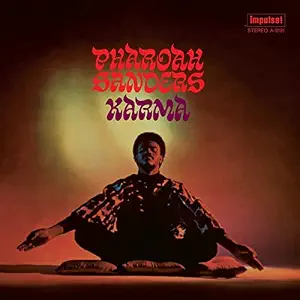
The Album Cover and the Impulse! Identity
Karma also belongs visually to one of the most recognizable periods in jazz record design. The Impulse! identity—famously associated with orange, black and white—helped establish a strong visual continuity across a catalog containing remarkably diverse music.
That consistency mattered.
A listener browsing records could encounter experimental music inside packaging that communicated seriousness and coherence rather than marginality. The label’s presentation helped position adventurous jazz as work deserving the same attention as more commercially familiar recordings.
For Sanders, this institutional context was significant. Karma was radical music, but it was not released as an obscure private document.
It entered the marketplace as an Impulse! album.
That gave the music a route into collections, radio programming, criticism and eventually the historical canon.
The Value of Karma Is in the Music
The previous JazzLatitude article approached Karma through claims about high-frequency transducer stability, tweeter performance, amplifier behavior and audiophile testing.
That framework ultimately distracted from what makes the record worth hearing.
Karma does not need to prove the thermal stability of a loudspeaker.
Its sonic extremes are interesting because they are musical decisions.
When Sanders pushes the tenor into multiple layers of harmonics, the important question is not whether a tweeter survives the passage cleanly. It is why that sound occurs at that moment, what preceded it and what happens when the music returns toward melody.
When the percussion becomes dense, the point is not whether an amplifier maintains control.
The point is how collective rhythm changes our perception of time.
And when Thomas’s voice appears, the meaningful question is not how accurately a system reproduces the midrange.
It is what happens when human language enters an extended instrumental meditation.
This is the distinction between using music to evaluate equipment and listening to equipment in order to experience music.
JazzLatitude should remain on the side of the music.
Why Karma Matters
The historical importance of Karma can therefore be stated without exaggeration.
It captures Pharoah Sanders at the moment when the vocabulary he had developed around the New York avant-garde and John Coltrane became unmistakably his own. It demonstrates that free improvisation could coexist with memorable melody, voice, repetition and spiritual aspiration. It gives Leon Thomas a central role in one of the era’s most distinctive large-ensemble performances. It points toward the expanded percussion, modal environments and collective structures Sanders would continue exploring. And it became one of the recordings through which later listeners learned to recognize the broad territory eventually called spiritual jazz.
None of those claims requires us to call it an immortal monument.
The evidence is on the record.
Final Thoughts: The Journey Back to the Theme
At the beginning of Karma, Sanders offers the listener something remarkably simple.
A musical center.
From there, almost everything becomes possible.
The ensemble expands. Voices enter. Percussion multiplies. Repetition alters the perception of time. Sanders’s tenor moves from warmth toward abrasion, then beyond conventional pitch into harmonics, screams and multiphonics. Individual improvisation gives way to collective density.
The music appears to be moving further and further away.
But it remembers where it began.
That may be the most important characteristic of Karma. Its freedom is meaningful because it retains memory. Sanders can take the music toward the edge of dissolution because melody, pulse and communal voice remain available as points of return.
This balance allowed him to solve one of the hardest problems facing experimental jazz at the end of the 1960s.
How do you move beyond established forms without losing the listener?
Sanders’s answer was not compromise.
It was connection.
Give the listener a melody worth remembering.
Build a community around it.
Travel as far as the music requires.
And then allow the memory of that melody to guide the way back.
More than fifty years later, Karma still invites us to make that journey.
And every time the theme returns, it feels as though we have traveled further than we expected.