
A Late Beginning in Sapporo
Ryo Fukui’s story is often introduced through the fact that he began playing piano at twenty-two, and the detail is remarkable enough to invite exaggeration. It can easily become the foundation for a familiar mythology: the self-taught outsider who ignored conventional training, developed almost miraculously and emerged a few years later with a masterpiece. Fukui’s actual development is more interesting because it was neither miraculous nor detached from the jazz world around him. He came to the piano unusually late, listened intensely, practiced with determination, sought guidance from more experienced musicians and developed through performance. By the time Scenery appeared in 1976, his progress had been unusually rapid, but the album was not the spontaneous achievement of an isolated natural talent. It represented years of concentrated engagement with a musical language that Fukui had consciously chosen as an adult. That distinction matters because it changes how we hear both the pianist and the record that eventually made his name familiar around the world.
Fukui was born on June 1, 1948, in Biratori, Hokkaido, the northern Japanese island that would remain central to his identity. His first serious encounter with an instrument was not the piano but the accordion, which he began playing at eighteen. He did not turn toward piano until around 1970, when he was twenty-two, an age at which many professional jazz pianists had already accumulated more than a decade of formal instruction. Fukui therefore entered the instrument without the childhood technical foundation usually assumed in stories about major pianists. He had to develop basic physical command of the keyboard at the same time that he was attempting to understand harmony, repertoire, improvisation and the rhythmic vocabulary of modern jazz. What followed was not freedom from discipline but an unusually compressed period of discipline. The late beginning created urgency.
Learning Jazz as an Adult
The temptation to romanticize Fukui’s self-taught background can obscure what self-teaching actually demanded. Jazz piano required him to coordinate several forms of knowledge simultaneously. Chords had to become physical shapes under the hands; harmonic movement had to become recognizable by ear; standards had to be learned deeply enough to support improvisation; time and articulation had to develop alongside technique. A pianist who begins as an adult cannot rely on childhood muscle memory accumulated before those problems become intellectually intimidating. Fukui had to confront them consciously.
Listening became one of his principal teachers. The American modern-jazz tradition provided a large part of the language he wanted to understand, particularly the piano-trio vocabulary that had developed through bebop and the 1950s and 1960s. Yet the old Jazz Latitude article goes too far when it confidently constructs a neat lineage from Bill Evans, Red Garland, Tommy Flanagan and Wynton Kelly directly into Fukui’s supposedly distinctive “emotional sincerity.” Influence rarely operates that tidily. What can be heard more securely in his early work is an immersion in mainstream modern jazz: swing, blues vocabulary, bebop phrasing, standards and the interactive possibilities of the piano trio.
Fukui’s development also depended upon contact with working Japanese musicians. Saxophonist Hidehiko Matsumoto became an important figure during his early years, offering encouragement and advice at a time when Fukui remained acutely aware of how much he had to learn. Matsumoto was no minor local mentor. He was one of the established figures of postwar Japanese jazz, and his willingness to take Fukui seriously provided both practical guidance and confirmation that the young pianist’s unusual path was worth pursuing.
This did not eliminate Fukui’s doubts. Accounts of his early development describe periods of frustration in which he felt his progress was insufficient. That is hardly surprising. The gap between hearing a sophisticated jazz pianist and being able to reproduce even a small part of that language can be enormous, particularly for someone who has only recently learned the instrument. Fukui’s achievement came from remaining inside that gap long enough for his playing to change.
Japan’s Jazz Culture Beyond a Single Scene
Fukui’s development took place during an extraordinary period in Japanese jazz. By the beginning of the 1970s, Japan had already built a substantial jazz culture through decades of clubs, record collecting, touring American musicians, local ensembles and an increasingly confident generation of Japanese players. The country’s musicians were no longer simply absorbing an imported style. They were participating in debates about what modern jazz could become, with approaches ranging from hard bop and modal jazz to free improvisation, electric fusion and highly individual forms of composition.
Tokyo naturally occupied an important position within that network, and Fukui did spend time there during his development. This is where the simplistic version of his biography — the provincial pianist who rejected Tokyo and quietly created his art in Sapporo — becomes misleading. Fukui did not develop in complete isolation from Japan’s principal jazz center. His early path involved movement and contact with musicians beyond Hokkaido. What became distinctive was not that he refused the larger Japanese jazz world, but that he ultimately built a durable musical life in Sapporo rather than treating success as something that could exist only in Tokyo.
That decision becomes more meaningful when placed within the geography of Japan. Sapporo is separated from Tokyo by considerable distance, and the recording industry, major media institutions and much of the country’s highest-profile jazz activity were concentrated farther south. Building a career in Hokkaido therefore meant relying heavily on the strength of local performance culture. Clubs, musicians and dedicated listeners mattered because jazz had to function as a living practice rather than merely as a route toward national visibility.
For Fukui, that environment proved productive.
Sapporo and the Education of the Bandstand
Sapporo would become the city most closely associated with Fukui, and the relationship between pianist and place is more important than the old narrative of a solitary genius working outside the mainstream. Jazz develops through communities. A pianist can practice harmony and technique alone, but ensemble time, accompaniment and improvisational judgment are learned through playing with other people. Sapporo gave Fukui the conditions to do exactly that.
The piano trio became his central format. Its apparent simplicity is deceptive. With only piano, bass and drums, every rhythmic and harmonic decision becomes exposed. The pianist must lead without overwhelming the other musicians, accompany the bassist when necessary, react to the drummer and maintain enough awareness of form to allow improvisation to stretch without losing direction. For someone who had begun the instrument late, the trio offered an uncompromising education.
Fukui’s growth therefore happened not only through practice but through repeated negotiation with rhythm sections. Bass and drums forced his time to become more precise. Standards forced him to understand harmonic movement beyond isolated exercises. Improvisation forced technical ideas to become musical decisions. A phrase that works in the practice room may fail when a drummer changes the rhythmic emphasis beneath it; a chord voicing that appears elegant alone may become too dense when a bassist occupies the same register. These are lessons that performance teaches with unusual efficiency.
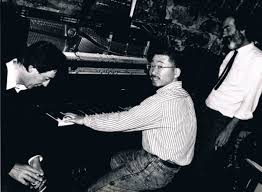
By the middle of the 1970s, Fukui had developed sufficiently to lead his own trio. Bassist Satoshi Denpo and drummer Yoshinori Fukui, Ryo’s brother, became crucial partners in the music that would define his early recorded career. Their presence is important because the later international mythology surrounding Scenery often focuses almost entirely on the pianist. The record is remembered under Fukui’s name, but its musical character depends on three musicians responding to one another.
Denpo provides more than harmonic support. His bass gives Fukui a flexible center around which phrases can expand, while Yoshinori Fukui’s drumming keeps the music moving without forcing the pianist into a rigid rhythmic frame. The trio’s relationship reflects the broader modern-jazz tradition Fukui had been studying, but it also demonstrates how far he had traveled in a remarkably short period. Only a few years after beginning the piano, he was no longer simply learning standards. He was learning how to lead musicians through them.
Tradition Rather Than Reinvention
This is another place where Fukui’s later reputation can distort the historical picture. Listeners discovering Scenery through the internet decades later sometimes encounter the album as an exotic object: a mysterious Japanese LP from the 1970s whose cover, rarity and geographical distance seem to promise an alternative history of jazz. The music itself is far less concerned with exoticism.
Fukui loved the jazz tradition.
He played standards. He valued swing. He worked through familiar harmonic structures and developed improvisations inside forms that American jazz musicians had explored for decades. He did not attempt to make his piano sound conspicuously “Japanese” for international listeners, nor did he build Scenery around avant-garde techniques that would announce a radical break with bebop.
That apparent conservatism is not a weakness. It gives us a clearer way to understand his achievement. Fukui was attempting to enter a mature musical language on his own terms. Because the forms were familiar, the question became what he could do inside them.
A standard such as “Autumn Leaves” carries an enormous recorded history. By the 1970s, countless pianists had played it. Choosing such material means accepting comparison rather than avoiding it. The challenge is not to convince the listener that the composition is new but to make the performance feel alive despite its familiarity.
Fukui’s early career was built around this problem. His identity developed through touch, timing, phrasing and the construction of solos rather than through a radically original compositional system. That helps explain why his music could be overlooked by listeners searching primarily for the most experimental Japanese jazz of the period. Japan in the 1970s produced extraordinarily adventurous free jazz, fusion and large-ensemble music. Fukui’s trio occupied another territory: a committed engagement with modern jazz tradition by musicians thousands of miles from the places where that tradition had first developed.
The Road to Scenery
By 1976, Fukui had been playing piano for only about six years. The number remains astonishing, but it should now mean something different. Those six years were not an empty interval between inspiration and sudden genius. They contained intensive practice, listening, frustration, contact with experienced musicians and the practical education of performance.
The opportunity to record arrived through Trio Records. The session took place in September 1976 at Yamaha Hall in Sapporo, with Fukui at the piano, Satoshi Denpo on bass and Yoshinori Fukui on drums. The location itself is significant. Fukui did not have to leave Hokkaido and transform himself into a Tokyo musician before making his first statement under his own name. The trio could document the music within the environment in which much of it had developed.
The album they created contained only six tracks. Four were established standards: “It Could Happen to You,” “I Want to Talk About You,” “Willow Weep for Me” and “Autumn Leaves.” Two pieces, “Early Summer” and the title track, allowed another side of Fukui’s musical personality to emerge. The balance between standards and original material made the record an unusually clear portrait of where he stood in 1976. He wanted to participate in the jazz tradition, not escape it, while beginning to define how his own compositions could exist within that language.
Nothing about the session suggested that the album would become an international phenomenon four decades later.
There was no global marketing campaign waiting to introduce Ryo Fukui to audiences outside Japan. There was no mythology of Japanese jazz collecting surrounding his name. There were no recommendation algorithms capable of placing the album in front of a teenager listening on another continent.
There was simply a twenty-eight-year-old pianist who had started unusually late, a bassist, a drummer and a set of tunes they knew well enough to make their own.
The album was called Scenery.
Its second life would come much later.
Buy Amazon
Inside Scenery
When Ryo Fukui entered Yamaha Hall in Sapporo in September 1976 to record Scenery, he had been playing piano for only about six years. That fact has become inseparable from the album’s reputation, but it can also interfere with listening. Once we know how late Fukui began, every fluent phrase risks being interpreted as evidence of extraordinary natural talent, as though the record’s value depended upon how quickly he had acquired technique. Scenery offers a more interesting argument. It presents a pianist who had immersed himself deeply enough in modern jazz to understand its vocabulary but who had not yet accumulated decades of habits around it. With bassist Satoshi Denpo and drummer Yoshinori Fukui, his brother, Fukui recorded six pieces that reveal both his attachment to jazz tradition and the qualities beginning to distinguish his own playing. Four are standards with extensive histories; two are original compositions. Nothing about that program announces a revolution. The achievement lies in what the trio does with familiar materials.
The record opens with “It Could Happen to You,” a Jimmy Van Heusen and Johnny Burke song that had long since entered the jazz-standard repertoire. Beginning a debut album with such material is revealing. Fukui does not attempt to establish credibility through obscurity or technical novelty. He chooses a composition whose harmonic movement and melodic shape would already have been familiar to experienced jazz listeners, leaving his interpretation exposed to comparison with countless earlier versions. The trio responds by treating the tune not as a historical artifact but as working material. Fukui’s lines move with clarity through the changes, and his articulation has a directness that distinguishes the performance from more harmonically elusive approaches to piano jazz. Denpo and Yoshinori do not merely accompany him; they establish the rhythmic confidence that allows the pianist to phrase freely without losing the song’s forward movement.
Standards as a Measure of Identity
The standards on Scenery are crucial because they tell us what Fukui valued. “I Want to Talk About You,” written by Billy Eckstine and famously explored by John Coltrane, invites a different kind of pacing from the opening track. Fukui allows the melody to retain its lyrical character before developing the improvisation, demonstrating that his musical personality was not built exclusively around fast lines or hard swing. His relationship with melody is important throughout the album. Even when a solo becomes more active, the phrasing tends to remain connected to clearly shaped ideas rather than dissolving into technical display.
This does not mean Fukui was uninterested in virtuosity. His rapid development required substantial technical command, and Scenery contains moments when the pianist pushes vigorously through the keyboard. But technique functions within the language he had chosen to learn. He was not trying to dismantle the standard or expose its harmonic assumptions. He wanted to swing inside it.
That distinction places Scenery in an interesting position within Japanese jazz of the mid-1970s. The country’s scene contained musicians pursuing free improvisation, large-scale composition, modal experimentation and electric fusion. Against that background, Fukui’s commitment to standards could appear conservative. Yet historical importance does not always belong to the most formally radical music. Fukui’s record documents another dimension of Japanese jazz: musicians engaging deeply with African American jazz traditions while developing individual identities through performance rather than through conspicuous stylistic rupture.
“Willow Weep for Me” makes this especially apparent. Ann Ronell’s composition had already been interpreted by generations of jazz musicians, and its blues-inflected character gives Fukui space to emphasize touch and rhythmic placement. His phrases can sit slightly behind or push through the beat without abandoning the trio’s underlying swing. Denpo provides a bass line that is supportive but mobile, while Yoshinori’s drumming responds to changes in intensity rather than simply maintaining a fixed pattern. The trio format works because the musicians understand that familiarity with a composition can create freedom. Nobody needs to explain the form to the others; they can concentrate on what happens inside it.
“Early Summer”
If the standards reveal Fukui’s relationship with the jazz tradition, “Early Summer” provides one of the clearest glimpses of how he was beginning to write within it. The piece has become one of the most recognizable tracks on Scenery, and its appeal is easy to understand. It possesses an immediate rhythmic energy that distinguishes it from the more relaxed portions of the album, allowing the trio to demonstrate how quickly it can move from controlled swing into something more forceful.
Fukui’s composition does not abandon the language heard elsewhere on the record. Instead, it concentrates it. The theme establishes a strong identity before opening into improvisation, and the performance gives each member of the trio room to affect its momentum. Yoshinori’s role becomes particularly important. His drumming can increase the sense of urgency beneath Fukui without simply following the pianist’s phrases, while Denpo maintains enough harmonic definition to keep the performance centered as the intensity rises.
The piece also challenges the later stereotype of Fukui as primarily a lyrical, introspective pianist. That image has been encouraged partly by the visual and cultural framing surrounding the rediscovery of Scenery: the elegant cover, the rarity of the original LP, the association with Japanese jazz collecting and the tendency of streaming-era listeners to describe older recordings through moods. “Early Summer” is harder to reduce to atmosphere. The trio plays with physical energy. Fukui attacks the keyboard when the music requires it, and the rhythm section responds accordingly.
What remains impressive is not simply speed. The performance has direction. Energy accumulates because the musicians understand when to intensify and when to leave enough space for the next phrase to matter. Fukui’s relatively short experience on the piano becomes almost irrelevant once the trio is fully engaged. We are no longer listening for evidence of how much he had learned in six years. We are listening to a working jazz group.
“Autumn Leaves” and the Problem of Familiarity
No track better demonstrates Fukui’s willingness to accept the burden of jazz history than “Autumn Leaves.” By 1976, Joseph Kosma’s song had become one of the most frequently played standards in jazz. Its harmonic cycle was familiar to students, professionals and audiences alike, and countless major pianists had already recorded it. Choosing the tune offered almost no protection from comparison.
Fukui’s solution is not to disguise the composition.
He allows its harmonic movement to remain clear and uses that clarity as the basis for improvisation. This is significant because later descriptions of Scenery sometimes search for qualities that make the album uniquely Japanese, as though geographic origin must produce an audible national signature. “Autumn Leaves” resists that expectation. Fukui is participating in an international jazz language, playing a European song transformed through decades of African American jazz practice, recorded by a Japanese trio in Sapporo.
That chain of transmission is itself more interesting than forcing a national characteristic onto his phrasing.
The performance also illustrates Fukui’s developing sense of narrative. A convincing solo over familiar changes cannot rely on harmonic surprise alone because listeners already know where the progression is going. Interest has to come from the construction of phrases: their length, rhythmic placement, density and relationship to what came before. Fukui builds rather than merely accumulates. Some lines move fluidly across the changes; others leave more space, allowing Denpo and Yoshinori to become audible as partners.
The trio’s interaction prevents the standard from becoming an exercise. Denpo does not need to compete with Fukui for attention, but his walking lines give the pianist something active to play against. Yoshinori can alter cymbal emphasis and introduce accents that subtly change the feel without disrupting the form. Familiarity becomes an advantage because the musicians can concentrate on conversation.
The Title Track
“Scenery,” Fukui’s own composition, occupies a different emotional space. The title would eventually become inseparable from his identity, but in 1976 it was simply one of two originals placed among standards. Its position on the album allows us to hear what Fukui was beginning to contribute as a composer rather than only as an interpreter.
The piece does not attempt to establish a radically new compositional language. Fukui remains close to the melodic and harmonic world he admired, but the material gives him greater control over the atmosphere and pacing. Without the accumulated interpretive history attached to “Autumn Leaves” or “Willow Weep for Me,” the trio can establish its own expectations from the opening measures.
This is where the album’s title becomes useful without requiring the sentimental language that later surrounded it. “Scenery” suggests observation rather than declaration. The music develops through shifts in perspective: melody, accompaniment, solo, rhythmic response. Fukui does not need to overwhelm the composition with improvisational complexity. The piece benefits from proportion.
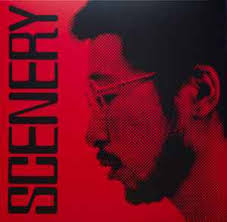
The word would later acquire another meaning as the album traveled far beyond its original context. The cover and title became visual shorthand for a particular imagined world of 1970s Japanese jazz. Listeners encountering the record online could know nothing about Sapporo, Fukui’s late beginning or the Japanese jazz scene and still recognize the image associated with Scenery. But the music itself is less mysterious than that mythology suggests. It is direct, disciplined trio jazz played by musicians who understand the tradition they have entered.
Satoshi Denpo and Yoshinori Fukui
The international rediscovery of Scenery has inevitably concentrated attention on Ryo Fukui, but the album’s identity cannot be separated from Satoshi Denpo and Yoshinori Fukui. Piano-trio recordings are particularly vulnerable to retrospective hero narratives because the leader’s name dominates the cover while the rhythm section becomes supporting information. On Scenery, that approach misses much of what makes the record successful.
Denpo’s bass establishes both harmonic direction and rhythmic elasticity. He can support Fukui directly without becoming passive, and his lines give the pianist a foundation sufficiently secure for rhythmic experimentation. Yoshinori’s drumming provides a similarly important balance. His playing does not attempt to dominate the session, but he responds to the pianist’s changes in intensity and helps shape the architecture of longer improvisations.
The relationship among the three is especially revealing during transitions. A piano solo does not simply end because Fukui has completed a predetermined number of choruses. Changes in density signal movement. The bass can become more prominent, the drums can increase pressure, or the pianist can reduce his activity and create room. These are ordinary tools of accomplished jazz performance, but that ordinariness is precisely the point. Scenery works because the trio has developed enough shared language to use them naturally.
Calling Fukui a “self-taught genius” can inadvertently erase this collective achievement. However unusual his personal development was, jazz did not happen alone at the piano. His growth became meaningful when it entered an ensemble.
Six Tracks, One Clear Statement
At roughly forty minutes, Scenery does not attempt to survey everything Fukui could play. Its six pieces create a remarkably coherent first statement because the repertory is limited and the trio format remains consistent. There are no orchestral additions, elaborate studio concepts or stylistic detours designed to demonstrate versatility. The listener encounters Fukui primarily through the fundamental materials of jazz: melody, harmony, rhythm, improvisation and interaction.
That simplicity would later make the album unusually accessible to new listeners. Someone discovering Japanese jazz through Scenery does not need prior knowledge of the country’s experimental scenes or recording history. The standards provide recognizable structures, while the originals offer enough contrast to establish Fukui’s identity. The record can be approached immediately.
But accessibility should not be confused with simplicity of execution. Playing familiar jazz convincingly is difficult precisely because the vocabulary is so exposed. Fukui could not hide behind unusual instrumentation or an elaborate concept. If the time was weak, the listener would hear it. If the improvisations lacked direction, the standards would reveal it. If the trio failed to interact, the entire record would flatten into accompaniment and solos.
Instead, Scenery sounds assured.
That assurance is perhaps the most remarkable aspect of the album when placed beside Fukui’s biography. Six years after beginning the piano, he had reached a point where his unusual route into the instrument no longer needed to be the central subject. The music could stand without the story.
Before the Myth
Scenery did not immediately become the global phenomenon later accounts can make it seem destined to be. It was a Japanese jazz record released in 1976 into a crowded musical environment, and Fukui continued working rather than becoming an international star. His second album, Mellow Dream, followed soon afterward and extended the trio language established on his debut.
The decades that followed would change both Fukui and the way his first record was understood. He would continue refining his approach, develop an important relationship with pianist and educator Barry Harris, establish the Slowboat jazz club in Sapporo with his wife Yasuko and make further recordings that reveal a musician considerably more mature than the twenty-eight-year-old heard on Scenery.
Yet history would eventually return to the debut.
Long after the original LP had become difficult to find, listeners who had never visited Sapporo — and in many cases had not been born when the album was recorded — began sharing Scenery online. The record entered recommendation algorithms, streaming libraries, record-collector communities and a growing international fascination with Japanese jazz.
Its cover became familiar. “Early Summer” accumulated listeners. Reissues brought the music back to vinyl shops. Fukui’s name began appearing in conversations far beyond the audience that had known his work during his lifetime.
The transformation was extraordinary.
But before Scenery became an internet discovery, a collectible record or a symbol of Japanese jazz, it was something much simpler and more durable:
three musicians in Sapporo, playing jazz together.
Slowboat and the Rediscovery of Ryo Fukui
The story of Ryo Fukui becomes distorted when everything after Scenery is treated as an epilogue. The extraordinary international rediscovery of his 1976 debut has made that album so dominant that it can appear to contain his entire musical identity, leaving the pianist himself frozen at twenty-eight. Fukui’s actual career continued for four decades. He recorded Mellow Dream the following year, deepened his understanding of bebop through an important relationship with Barry Harris, returned to recording after a long interval with My Favorite Tune, made an album in New York, established Slowboat in Sapporo with his wife Yasuko and remained committed to the everyday practice of jazz until the end of his life. Seen across that longer arc, Scenery becomes more interesting rather than less. It captures an unusually accomplished young pianist near the beginning of a process that Fukui never considered finished.
Mellow Dream, recorded and released in 1977, followed quickly enough to function almost as a companion to Scenery. The trio format remained central, and Fukui continued balancing standards with his own material, but the second album provides evidence of a pianist already thinking beyond the circumstances of his debut. Pieces such as the title track and “Horizon” became important parts of his repertoire, while standards including “My Foolish Heart,” “What’s New?” and “My Funny Valentine” reinforced his commitment to the jazz language he had chosen to master. The album did not represent a radical stylistic break, nor did Fukui need one. His development was happening inside the vocabulary: greater control of time, stronger construction of solos and an increasingly confident relationship between blues, bebop and the lyrical side of his playing.
Beyond the First Two Albums
The absence of another leader album for many years can make the period after Mellow Dream look like a disappearance, particularly when Fukui’s career is reconstructed from streaming catalogs. It was nothing of the sort. Recording history and musical life are not the same thing. Fukui continued playing, practicing and developing through performance, particularly in the jazz-club culture that had always been essential to him. For a musician whose education had depended so heavily on the bandstand, the stage remained as important as the studio.
One of the decisive relationships of this later development was with Barry Harris. The Detroit-born pianist represented one of the strongest living connections to the bebop tradition Fukui had admired from the beginning. Harris was not merely an accomplished performer; he was an influential teacher whose understanding of harmony, movement and improvisation was rooted in direct proximity to the language developed by Charlie Parker, Bud Powell, Thelonious Monk and their generation. For Fukui, studying with Harris did not mean abandoning the identity heard on Scenery. It provided a way of examining the foundations of that identity more deeply.
The relationship also complicates the familiar description of Fukui as purely “self-taught.” The term is accurate when describing his unusual entrance into the piano, but it becomes misleading if extended across his entire career. Fukui sought knowledge from musicians. He listened, questioned, studied and continued refining his playing. Harris became a mentor and friend, and the influence can be understood less as imitation than as a strengthening of Fukui’s commitment to bebop as a living musical practice.
This long period of development eventually produced a very different kind of record.
My Favorite Tune
Recorded in Sapporo in June 1994, My Favorite Tune arrived seventeen years after Mellow Dream. It was Fukui’s first and only solo-piano album, removing the bass and drums that had been so important to his early recorded identity. The format exposed how much his playing had changed. A solo pianist must provide his own architecture: bass movement, harmonic rhythm, melody, internal pulse and improvisational development all have to emerge from the same instrument.
The repertory deliberately connects different stages of Fukui’s life. “Scenery” and “Mellow Dream” return, but they no longer belong to the young trio leader who first recorded them in the 1970s. Without rhythm-section support, Fukui has to reconstruct the pieces through touch, register and the relationship between his hands. “Voyage” and “Nord” broaden the original material, while the presence of Barry Harris’s “Nobody’s” makes the mentor’s importance explicit. Sonny Clark’s “My Conception” and Avery Parrish’s “After Hours” further situate Fukui within the tradition he continued to study.
The album is valuable because it prevents a simplistic story of Fukui progressing from youthful imitation toward some radically separate mature style. His later playing remained deeply attached to jazz history. Maturity did not mean escaping bebop. It meant inhabiting it with greater authority.
That same principle would become even clearer when Fukui finally recorded in the city that had shaped so much of the music he loved.
Fukui in New York
Ryo Fukui in New York, released in 1999, placed the pianist inside an American rhythm section associated with the bebop tradition. The symbolic significance is difficult to miss. Fukui had begun learning piano in Hokkaido at twenty-two by immersing himself in jazz largely developed thousands of miles away. Nearly three decades later, he could enter a New York setting not as a curious student but as a mature bandleader.
The album’s repertory again demonstrates his priorities. Standards and bebop compositions remain central, while “Mellow Dream” connects the session directly with his own earlier work. The point was not to prove that a Japanese pianist could sound authentically American. By this stage such a question had little value. Fukui had spent decades making jazz part of his own musical life. New York was another environment in which that language could be tested through interaction.
The session also provides a useful counterweight to the later internet image of Fukui as a mysterious figure from an isolated Japanese scene. His musical world was international. His connection with Harris linked Sapporo to New York, while touring musicians and Japanese jazz networks continually moved music across geographic boundaries. Fukui’s decision to remain strongly identified with Hokkaido did not mean artistic isolation.
In fact, the most important institution of his later life would make Sapporo itself part of that international network.
Slowboat
In 1995, Ryo and Yasuko Fukui opened Slowboat in Sapporo. The club became far more than a business carrying the name of a jazz musician. It provided Fukui with a permanent musical home: a place to perform, listen, practice, meet other musicians and sustain the kind of everyday jazz culture that had shaped his own development.
Slowboat also offers a better way of understanding Fukui’s relationship with Sapporo. The city was not simply a picturesque alternative to Tokyo or an explanation for why he supposedly remained obscure. Fukui actively contributed to its musical infrastructure. By creating a venue, he helped provide the conditions through which jazz could continue as a local practice.
This distinction matters because jazz history is often written around recordings and famous concert halls, while much of the music actually survives through smaller spaces. Clubs allow musicians to develop material repeatedly before audiences. They create relationships between generations. Visiting players meet local musicians; students hear experienced performers at close range; repertoire evolves through repetition. Fukui’s own education had depended on exactly this kind of environment.
At Slowboat, he could now help sustain it for others.
The club became inseparable from his later career. He performed there regularly and welcomed musicians passing through Sapporo. The pianist who had once needed places to test his developing vocabulary had become one of the people maintaining such a place.
A Letter from Slowboat
That relationship eventually entered the recorded catalog. A Letter from Slowboat, recorded at the club in 2015, returned Fukui to the trio format with bassist Takumi Awaya and drummer Ittetsu Takemura. It was his first leader album in sixteen years and would become his final recording under his own name.
The repertory again tells us much about how Fukui understood himself. “Stella by Starlight,” “Speak Low,” “Nobody Knows the Trouble I’ve Seen,” “Chasin’ the Bird” and other pieces connect the album to the standards and bebop vocabulary that had sustained him throughout his career. There is no attempt to create a late-period reinvention designed to make Fukui appear contemporary. He plays the music he has spent decades learning.
Yet the result cannot be reduced to nostalgia. The pianist heard here is separated from the musician on Scenery by almost forty years of performance. The touch is heavier, the pacing more deliberate and the relationship with the material less concerned with demonstrating fluency. Fukui does not need to prove that he belongs inside the tradition. He has lived inside it.
The younger rhythm section makes the album particularly appropriate as a final document. Jazz knowledge is not presented as something preserved intact by one generation. It moves through musicians playing together. Slowboat becomes the physical location where that exchange occurs, and the recording captures a small part of it.
Fukui died on March 15, 2016, at the age of sixty-seven. Yasuko continued the work of Slowboat after his death. The club therefore survived not simply as a memorial but as the continuation of the musical environment they had created together.
The Second Life of Scenery
By the time Fukui died, something unexpected was already happening to his earliest recordings. Scenery, once a comparatively difficult Japanese jazz LP for international listeners to encounter, had begun circulating online. Full-album uploads, recommendation systems, streaming services and online record communities introduced the music to listeners who had no connection with the Japanese jazz audience of the 1970s.
The scale of the rediscovery changed Fukui’s reputation.
For many listeners outside Japan, Scenery became not merely their introduction to Fukui but an entry point into Japanese jazz itself. From there they could discover musicians whose histories were very different: Tsuyoshi Yamamoto, Terumasa Hino, Hiromasa Suzuki, Isao Suzuki, Masabumi Kikuchi and many others. The internet did not uncover a single forgotten Japanese scene; it exposed international listeners to multiple scenes and generations that had previously been difficult to navigate without specialist knowledge.
Fukui was unusually suited to this new environment. Scenery is immediately approachable. Its standards provide familiar structures even for listeners only beginning to explore jazz, while “Early Summer” offers rhythmic excitement capable of making an immediate impression. The album cover is memorable, the trio format is easy to grasp, and the performances reward repeated listening without demanding historical context before they can be enjoyed.
Streaming removed another obstacle: scarcity.
A listener no longer needed to find an original Trio Records LP or even know which specialist shop might import a Japanese reissue. The recording could appear instantly after another album, a recommendation, a playlist or a shared link. Geographic distance collapsed.
Rediscovery Is Not Discovery
The word “rediscovery,” however, requires care.
Fukui was not an unknown amateur whose recordings sat unheard until the internet found them. He had released albums, performed professionally for decades, operated an important jazz club and received recognition in Sapporo. In 2012 he was awarded the Sapporo Culture Encouragement Prize, evidence that his contribution to the city’s cultural life was recognized before the largest wave of international online attention.
What changed was the geography and scale of his audience.
The digital circulation of Scenery allowed listeners across Europe, the Americas and elsewhere to encounter a musician whose reputation had previously been far more concentrated in Japan and among specialist collectors. Reissues followed and reinforced the process. Records that had become scarce objects entered circulation again, while streaming ensured that Fukui’s music could remain accessible regardless of the availability of physical editions.
This phenomenon also reveals something about how jazz history is constructed. For decades, international narratives of the music were shaped partly by what recordings labels exported, what critics covered, what stores stocked and what histories were translated. Digital archives and recommendation systems did not eliminate those filters, but they created new ones. A 1976 Japanese trio album could suddenly compete for attention with canonical American recordings simply because listeners kept sharing and replaying it.
The result can be historically messy. Online enthusiasm sometimes turns musicians into myths, exaggerating obscurity, uniqueness or influence. Fukui has been described as though he were the secret genius of Japanese jazz, when Japan contained numerous pianists with longer careers and substantial contemporary reputations. His achievement does not require diminishing them.
Ryo Fukui Beyond Scenery
The most useful consequence of Fukui’s rediscovery is not the elevation of Scenery into another untouchable masterpiece. It is the opportunity to hear the rest of his career.
Mellow Dream reveals how quickly the language of the debut continued developing. My Favorite Tune exposes Fukui alone at the piano after nearly two additional decades of work. Ryo Fukui in New York places him inside the bebop tradition he had studied for most of his life. A Letter from Slowboat returns us to Sapporo and to the club that became his musical home.
Together, these recordings dismantle the image of the twenty-eight-year-old prodigy frozen on a single LP.
Fukui’s real story is about persistence.
He began unusually late and never treated that late beginning as permission to stop learning. He remained attached to standards when fashion could have encouraged reinvention. He studied with Barry Harris rather than using “self-taught” as a badge of independence. He built a club because jazz required places where musicians could actually play. And he continued performing until near the end of his life.
The international audience arrived on a scale he could hardly have anticipated when he recorded Scenery in Sapporo in 1976.
But the music was already there.
What the internet changed was not Ryo Fukui’s past.
It changed how much of the world could finally hear it.