The Coast That Refused to Be One Sound
For decades, the phrase “West Coast jazz” has carried an unusually powerful visual identity. Mention it and certain images arrive almost automatically: Chet Baker photographed beneath California light, Gerry Mulligan holding his baritone saxophone, Dave Brubeck turning unusual meters into popular music, musicians playing with an apparent ease that seemed worlds away from the crowded clubs and hard-driving bebop associated with New York. The mythology is attractive because it offers an immediate contrast. East Coast jazz becomes intense, urban, muscular; West Coast jazz becomes relaxed, elegant, cerebral. One belongs to midnight Manhattan, the other to afternoons beside the Pacific. The problem is that the music itself has never behaved so neatly.
West Coast jazz was not a single style invented by a small circle of white musicians in Los Angeles. It was a network of overlapping scenes, working musicians, composers, arrangers, improvisers, clubs, record labels, touring bands, Hollywood studios, and experiments that happened to converge in California during a particularly fertile period. Some musicians embraced cool-jazz aesthetics; others played blues, bebop, hard bop, big-band music, chamber-like arrangements, or combinations that resisted any convenient label. Many moved constantly between California and New York. Others arrived from elsewhere and stayed only briefly. The history becomes far more interesting once we stop trying to make everyone fit the same coastal stereotype.
The familiar names still matter. Chet Baker and Dave Brubeck were not imposed on this history by accident. Their enormous visibility helped define how the public imagined jazz from California, while Gerry Mulligan’s Los Angeles quartet became one of the movement’s most influential ensembles. But treating those musicians as the whole story is like describing bebop entirely through Charlie Parker and Dizzy Gillespie. Great figures can define an era while simultaneously hiding how crowded that era actually was.
West Coast jazz becomes richer when we move beyond the postcard.
California Before “West Coast Jazz”
Jazz did not suddenly arrive in California in the 1950s. Los Angeles already possessed a significant African American musical culture, and Central Avenue had developed into an important center of nightlife and jazz activity long before critics began using “West Coast” as a stylistic category. Musicians traveled through the city, settled there, worked in clubs, joined bands, and encountered a musical environment shaped by migration, entertainment industries, and racial segregation.
That history complicates the popular narrative immediately.
If West Coast jazz is imagined only as the cool style of the 1950s, much of the music that made California an important jazz center disappears from view. The blues, swing, bebop, and African American club culture that preceded the cool-jazz boom become a kind of invisible prehistory.
But they were not peripheral.
They were part of the foundation.
California’s attraction for musicians was practical as well as artistic. Los Angeles offered work connected to film, radio, television, recording studios, clubs, touring orchestras, and the broader entertainment business. The same infrastructure that could provide stability also created tensions. Studio work rewarded precision, reading ability, and professional discipline. Jazz valued spontaneity and individual expression. Many musicians lived comfortably in both worlds; others felt the compromises more sharply.
That relationship between craft and freedom would become one of the defining tensions of West Coast jazz.
Gerry Mulligan Arrives With New York in His Luggage
No musician better demonstrates the inadequacy of a simple East-versus-West division than Gerry Mulligan.
Mulligan’s musical formation was deeply connected to New York. During the late 1940s he participated in the extraordinary circle surrounding Miles Davis, Gil Evans, Lee Konitz and others whose experiments eventually became associated with Birth of the Cool. Mulligan wrote or arranged six of the eleven pieces collected on that landmark project, whose expanded instrumental palette and emphasis on arrangement offered alternatives to the conventional small bebop group.
Then he went west.
Mulligan moved to Los Angeles in the early 1950s and found himself in a city where his ideas about arrangement, counterpoint, instrumental texture, and improvisational space could take another form. His subsequent quartet with Chet Baker became a focal point of what critics would call West Coast jazz. Yet even Mulligan resisted some of the mythology that accumulated around the movement. His own recollections emphasize that the contrapuntal ideas associated with the quartet were part of a broader musical conversation rather than some isolated California invention.
This is essential.
One of the most famous “West Coast” sounds was created partly by a musician carrying lessons from New York.
Jazz geography was already porous.
The Pianoless Quartet
The Gerry Mulligan Quartet’s most obvious structural feature was what it lacked.
There was no piano.
In a conventional modern-jazz quartet, the pianist could establish harmony through chords while bass and drums provided rhythmic and structural support. Remove the piano and suddenly the horn players have considerably more room—and considerably more responsibility.
Mulligan and Baker exploited that openness brilliantly.
Baritone saxophone and trumpet could move around each other instead of simply alternating solos. One instrument might suggest a melodic direction while the other answered. Lines could intersect. Harmony could be implied rather than continuously stated. Bass and drums became especially important because the missing piano created an environment in which everyone had to participate more actively in defining the music.
The quartet’s early recorded personnel included Mulligan, Baker, bassist Bob Whitlock, and drummer Chico Hamilton. Pacific Jazz documented the group in Los Angeles in 1952, helping establish both the ensemble and the young label.
The result sounded light without being lightweight.
That distinction has been repeatedly lost.
Because Mulligan and Baker could play with remarkable economy, their music was sometimes treated as a retreat from the intensity of bebop. But fewer notes do not necessarily mean fewer ideas. The quartet’s openness demanded extraordinary listening. Without dense harmonic accompaniment constantly defining the terrain, melodic decisions became more exposed.
Every line mattered.
Every response changed the balance.
Chet Baker Before the Icon
Chet Baker became so visually associated with West Coast cool that it can be difficult to separate the musician from the mythology.
The photographs remain irresistible: Baker young, handsome, apparently detached, embodying an idea of effortless melancholy that later became inseparable from his music. But his emergence was not simply the triumph of image over substance.
Before the Mulligan quartet, Baker had already won a coveted opportunity to perform with Charlie Parker in 1952. Soon afterward, his compatibility with Mulligan became the basis of one of the era’s defining small groups. The Library of Congress describes Baker and Mulligan, together with their quartet colleagues, as pioneers of the style critics came to call West Coast jazz.
Their musical relationship worked because their personalities on the instruments complemented each other.
Mulligan’s baritone could be surprisingly agile and conversational. Baker’s trumpet avoided unnecessary weight. Neither needed to dominate every measure. Together they could create counterpoint that sounded almost casual even when the underlying interaction was sophisticated.
“My Funny Valentine” became one of the enduring documents of that partnership. The quartet’s treatment of the Rodgers and Hart standard eventually entered the Library of Congress National Recording Registry, recognition of its lasting cultural and musical importance.
Yet Baker’s popularity would eventually distort the history around him.
The face became larger than the scene.
The Problem With “Cool”
“Cool jazz” is another useful phrase that becomes misleading when treated too literally.
Cool did not mean emotionless.
It did not mean slow.
It certainly did not mean technically undemanding.
The term described a cluster of tendencies rather than a fixed recipe: lighter articulation, greater interest in arrangement, sometimes softer dynamics, expanded instrumental colors, contrapuntal writing, and a willingness to find intensity outside the aggressive surface associated with some bebop performances.
Even those characteristics were never universal.
The historical connection between Birth of the Cool and later West Coast developments is instructive because the Miles Davis sessions were recorded in New York. The musical ideas that critics later associated with California had already been circulating across the country. Mulligan’s migration helped carry some of those ideas west, where they encountered a different professional and cultural environment.
West Coast jazz was therefore not born because California musicians suddenly decided to play quietly.
It emerged from circulation.
Musicians moved.
Ideas moved.
Records moved.
Arrangements moved.
The coast changed what arrived there, but it did not begin from zero.
Los Angeles as a Laboratory
The Los Angeles scene offered something particularly valuable to musicians interested in composition and arrangement: access to players with exceptional reading skills.
Hollywood’s studios employed instrumentalists capable of navigating demanding written music quickly and accurately. Some of those musicians also played jazz, moving between commercial sessions and more adventurous projects.
That professional ecosystem encouraged a particular kind of experimentation.
A composer could imagine unusual instrumental combinations because musicians capable of realizing them were available. Small jazz groups could incorporate techniques associated with larger ensembles. French horns, tubas, flutes, oboes, and other colors could enter arrangements without automatically turning the music into conventional big-band jazz.
The result was not one sound but an expanded palette.
This is where West Coast jazz begins to look less like a genre and more like a workshop.
Musicians were asking how much composition jazz could absorb without losing improvisational vitality.
How much could be written?
How much should remain open?
Could the transparency of chamber music coexist with swing?
Could bebop vocabulary survive inside more elaborate arrangements?
Could improvisation remain central when orchestration became increasingly important?
Different musicians gave different answers.
That diversity is the real story.
Shorty Rogers and the Arranger’s West Coast
Shorty Rogers became one of the musicians most closely associated with the organized, compositionally sophisticated side of the West Coast movement. A trumpeter, composer, and arranger with big-band experience, he represented the connection between jazz improvisation and the professional arranging culture surrounding Los Angeles.
His importance extends beyond individual solos.
Rogers helped demonstrate that modern jazz on the West Coast could use arrangement as a creative engine rather than merely as background for improvisers. Written passages could establish character, introduce unusual instrumental combinations, or shape the architecture of a performance.
That emphasis contributed to one of the movement’s recurring misunderstandings.
Music with carefully constructed arrangements can appear controlled when compared with the explosive spontaneity of bebop or hard bop. But control is not the opposite of creativity. Duke Ellington had already demonstrated for decades that composition, orchestration, and improvisation could belong to the same artistic system.
West Coast arrangers were pursuing their own versions of that relationship.
The important question was never whether the music was written or improvised.
It was how effectively the two interacted.
Shelly Manne and the Myth of Relaxed Rhythm
Drummer Shelly Manne is another musician whose career destabilizes the stereotype of West Coast jazz as gentle background music.
Manne possessed enormous stylistic range. He could operate inside sophisticated arrangements, swing hard, support small groups, and respond to changing musical contexts with a drummer’s intelligence rather than a fixed regional formula.
His career also demonstrates how deeply jazz and the Los Angeles entertainment industry overlapped. The ability to work across studio environments and improvisational settings was not evidence of artistic compromise by itself. For many musicians, versatility was part of the craft.
This matters because one of the persistent caricatures of West Coast jazz treats its rhythmic character as inherently less forceful than East Coast jazz.
The comparison usually tells us more about marketing than musicians.
West Coast drummers did not stop swinging because they lived near the Pacific.
The rhythm could be lighter in texture without becoming passive. It could support intricate arrangements while retaining forward motion. It could create room for contrapuntal lines without sacrificing momentum.
Again, economy should not be confused with weakness.
Chico Hamilton and Another Direction
Chico Hamilton makes the category even harder to contain.
As the original drummer in Mulligan’s pianoless quartet, he was present at one of the foundational moments of the West Coast story. But his later work would explore ensembles and textures that expanded far beyond the familiar Baker-Mulligan image.
Hamilton’s career reminds us that musicians associated with a movement rarely remain frozen inside the moment that made them famous.
Jazz musicians evolve.
They change personnel.
They encounter new influences.
They reject earlier assumptions.
They sometimes contradict the very categories critics created around them.
This is particularly important for West Coast jazz because the label became visually and commercially powerful very quickly. Once album covers, photographs, liner notes, and magazine profiles established the idea of California cool, listeners could easily begin hearing the music through the image.
Hamilton’s broader career pushes against that simplification.
So does the career of nearly every important musician in the scene.
The Lighthouse and the Geography of a Scene
Jazz history is often organized around recordings, but scenes require physical places.
Clubs allow musicians to meet.
They allow ideas to be tested before audiences.
They create recurring communities in which players hear each other repeatedly rather than encountering one another only during recording sessions.
In Southern California, the Lighthouse in Hermosa Beach became one of the places strongly associated with the development of the West Coast scene. Its importance was not simply symbolic. Venues like the Lighthouse gave musicians space to establish working relationships and helped create an audience for modern jazz outside the traditional centers of the East Coast.
But even here, the temptation to turn geography into destiny should be resisted.
A jazz club near the Pacific Ocean does not automatically produce “Pacific” music.
What matters is who enters the room.
Dave Brubeck and the Northern California Complication
Then there is Dave Brubeck.
Brubeck is routinely included in narratives of West Coast jazz, but his presence immediately complicates the Los Angeles-centered version of the story. His musical development was deeply associated with Northern California, and his career eventually became international in scale.
Brubeck’s fascination with unusual meters, extended forms, composition, and the relationship between jazz and concert traditions shared certain concerns with musicians farther south. Yet his quartet developed an identity unmistakably its own.
Paul Desmond was central to that identity.
Desmond’s alto sound could be light and lyrical, but again the adjective “cool” tells only part of the story. His improvisations were harmonically intelligent, melodically inventive, and often filled with a dry wit that made economy sound effortless.
Brubeck and Desmond became among the most commercially visible jazz musicians associated with California.
Their success helped broaden the audience for modern jazz.
It also helped strengthen the mistaken assumption that West Coast jazz could be summarized by a handful of polished, cerebral stars.
Beyond Baker and Brubeck
That is precisely where the old version of this article lost its way.
It treated West Coast jazz partly as a catalog of recordings to evaluate, attaching “audiophile interest” to music whose significance has nothing to do with its usefulness as a demonstration for speakers or amplifiers. That framework shrank an enormous cultural and musical history into a consumer guide.
The more interesting question is not which West Coast recording produces the most impressive stereo image.
It is why so many different approaches to modern jazz flourished in California at roughly the same time.
Mulligan brought ideas developed partly in New York.
Baker transformed melodic restraint into a personal language.
Rogers explored composition and arrangement.
Manne demonstrated extraordinary rhythmic versatility.
Hamilton kept expanding beyond the boundaries of the style associated with his early fame.
Brubeck and Desmond developed another California modernism altogether.
And we have not yet reached some of the musicians who most dramatically disrupt the conventional story.
Art Pepper.
Bud Shank.
Bob Cooper.
Jimmy Giuffre.
Curtis Counce.
Hampton Hawes.
Dexter Gordon.
Harold Land.
Teddy Edwards.
Wardell Gray.
Their presence forces a larger question.
If musicians playing bebop, hard bop, cool jazz, chamber-like arrangements, blues-rooted improvisation, and intensely swinging small-group music were all working on the West Coast, what exactly was “West Coast jazz”?
Perhaps the answer was never supposed to be a single sound.
Perhaps it was a scene.
And once we hear it that way, the history opens dramatically.
Buy Amazon
The Musicians Who Complicate the Myth
Art Pepper and the Other California Cool
If Chet Baker became the visual symbol of West Coast jazz, Art Pepper offered a far less comfortable version of the same geography. Both musicians were based in California, both became associated with the cool-jazz era, and both possessed instantly recognizable lyrical voices. Yet the emotional worlds they created were profoundly different. Pepper’s alto saxophone could be elegant, but elegance never fully concealed the tension underneath. His playing often carried an urgency that made the conventional opposition between “cool” West Coast jazz and “hot” East Coast jazz difficult to sustain.
Pepper had emerged through the big bands of Stan Kenton before establishing himself as one of the most distinctive alto saxophonists of his generation. His musical language drew from bebop, particularly Charlie Parker, but he gradually developed a voice less dependent on imitation. There was clarity in his articulation and a strong melodic instinct, yet there was also vulnerability, nervous energy, and an increasingly direct emotional quality. By the time of recordings such as Art Pepper Meets the Rhythm Section, the idea that California jazz necessarily represented a restrained alternative to harder East Coast styles becomes almost impossible to defend. The famous 1957 session placed Pepper with Miles Davis’s rhythm section of Red Garland, Paul Chambers, and Philly Joe Jones. Geographically and stylistically, the supposedly separate jazz worlds were already sharing the same room.
That record matters not because it stages some imaginary competition between coasts, but because it demonstrates how artificial the division had become. Pepper did not suddenly cease being a California musician when confronted with an East Coast rhythm section, nor did Garland, Chambers, and Jones need to soften themselves to accommodate him. The musicians found common ground through the language of jazz itself.
West Coast identity could survive contact with New York because it had never been sealed off from New York in the first place.
Hampton Hawes and the Bebop California Forgot
Hampton Hawes complicates the mythology even further.
A Los Angeles native, Hawes developed within the city’s African American musical community and became one of the most compelling pianists to emerge from the West Coast during the postwar period. His music was deeply connected to bebop. Charlie Parker and Bud Powell mattered. Blues mattered. Swing mattered. The polished chamber-like textures popularly associated with West Coast jazz could hardly contain the full force of his playing.
This raises an uncomfortable historical question: why did the image of West Coast jazz become so strongly associated with Baker, Mulligan, Brubeck, Shorty Rogers, and other musicians identified with cool jazz when Los Angeles simultaneously supported musicians whose work did not fit that description?
Part of the answer lies in marketing. Genres are not created solely by musicians. Record labels, critics, photographers, promoters, and magazines help determine which characteristics become representative. California offered a powerful visual language, and cool jazz was unusually compatible with it. Modernist graphic design, relaxed clothing, bright sunlight, beaches, convertibles, and young musicians could be assembled into an attractive cultural package.
Bebop did not disappear.
It simply did not fit the postcard as neatly.
Hawes reminds us that the West Coast contained a harder, bluesier, more rhythmically aggressive modern-jazz tradition throughout the period. His presence should not be treated as an exception to West Coast jazz history. It should force us to redefine what that history includes.
Dexter Gordon Was There Too
Dexter Gordon creates an even larger problem for the simplified narrative.
Born in Los Angeles, Gordon became one of the foundational tenor saxophonists of bebop. His enormous influence on later players, his associations with figures including Charlie Parker and Dizzy Gillespie, and the commanding rhythmic personality of his playing place him at the center of modern jazz history.
Yet he rarely appears in the popular image of “West Coast jazz.”
Why?
Because the category was never purely geographical.
If West Coast jazz literally meant jazz made by important musicians from the West Coast, Gordon would be unavoidable. Instead, the term gradually became attached to a narrower stylistic image. Musicians who sounded insufficiently “cool” could effectively disappear from a history supposedly organized around location.
This contradiction tells us something important about genre formation.
Labels begin as shortcuts.
Then shortcuts begin determining what gets remembered.
Gordon’s Los Angeles roots expose the gap between California jazz and “West Coast jazz” as a marketed style. Once that gap becomes visible, the history must be reconstructed more broadly.
Wardell Gray and the Central Avenue Continuum
Wardell Gray provides another crucial connection.
His tenor battles with Dexter Gordon became part of Los Angeles jazz lore, particularly around Central Avenue. The competitive jam-session culture represented a musical environment quite different from the detached coolness later associated with California. Musicians tested one another, exchanged ideas, extended solos, and developed reputations through direct confrontation on the bandstand.
This was not background history.
It was part of the ecosystem from which later California jazz emerged.
The importance of Central Avenue also reminds us that race cannot be treated as a secondary issue in the story. Los Angeles was segregated. African American musicians navigated discriminatory housing, employment, and entertainment structures even while contributing decisively to the city’s cultural life.
When the commercially dominant image of West Coast jazz later centered heavily on white musicians, an older Black Los Angeles jazz history became easier to overlook.
Recovering that history does not require diminishing Baker, Mulligan, Brubeck, or Rogers.
It requires enlarging the frame.
Jazz history becomes more accurate when inclusion is additive rather than competitive.
Teddy Edwards and the Tenor Tradition
Teddy Edwards similarly belonged to a Los Angeles jazz world that resists the cool-jazz stereotype. A tenor saxophonist with a strong bebop foundation, Edwards developed a robust, swinging language whose relationship to the city’s scene was every bit as legitimate as the more heavily marketed West Coast style.
His presence demonstrates how misleading it is to imagine musicians choosing between two clearly defined camps.
Real scenes are messier.
A musician might play a club date with one group, enter a recording studio with another, work commercially during the week, and participate in a jam session at night. Musicians listened across supposed stylistic boundaries because professional and social networks were more fluid than later genre histories suggest.
The distinction between “cool” and “hard” approaches could be real at the level of particular recordings.
It becomes unreliable when used to divide entire communities.
Harold Land Goes West
Harold Land offers yet another version of the story. Born in Houston and raised in San Diego, he became widely known through his work with Clifford Brown and Max Roach—hardly an ensemble associated with stereotypical West Coast restraint. When Land returned to California, he brought that experience into a local environment already filled with competing approaches to modern jazz.
His career illustrates how migration continually destabilized regional categories.
Musicians did not arrive in California as blank slates waiting to acquire a West Coast sound. They brought histories with them. Touring experience, records, mentors, bandmates, and regional traditions traveled inside their playing.
Land’s tenor retained depth and rhythmic authority while adapting to numerous contexts. His later collaborations, including important work with vibraphonist Bobby Hutcherson, would move well beyond the boundaries of 1950s cool jazz.
Again, California appears less like a genre factory than a meeting place.
Curtis Counce and the Harder Edge
Bassist Curtis Counce and the ensembles associated with him further undermine the idea that serious hard bop belonged primarily to the East Coast.
The Curtis Counce Group created music with muscular rhythm, blues feeling, sophisticated improvisation, and the kind of ensemble cohesion more often associated in popular histories with New York labels such as Blue Note or Prestige. Yet this was California jazz.
The distinction matters because listeners who approach the period through familiar marketing categories may assume that West Coast musicians collectively turned away from blues and hard bop.
They did not.
The Counce group demonstrates that the same coast that produced carefully arranged cool-jazz sessions also supported forceful small-group modern jazz.
Both histories are true.
The mistake is choosing only one.
Bud Shank and the Professional Musician’s Life
Bud Shank occupied another important position in the California ecosystem. His career crossed jazz performance, studio work, arranging contexts, and the broader professional music industry. Like many Los Angeles musicians, he developed the ability to move between artistic and commercial environments without treating them as mutually exclusive worlds.
This versatility has sometimes contributed to a critical bias against West Coast musicians. Studio proficiency can be mistaken for artistic conservatism, as though the ability to read difficult music or perform efficiently for film and television somehow diminished improvisational credibility.
The assumption is peculiar.
Jazz history is filled with musicians whose technical command allowed them to thrive in multiple environments. Professional competence does not determine artistic ambition.
What Los Angeles did provide was an unusually concentrated marketplace for such versatility. A musician might need to perform jazz at night and read demanding studio charts the next morning. That reality shaped technique, discipline, and musical networks.
It also created economic possibilities that differed from those available in many other American jazz centers.
The West Coast story therefore includes not only stylistic innovation but a distinctive ecology of musical labor.
Bob Cooper and the Expanding Instrumental Palette
Bob Cooper, a saxophonist and multi-instrumentalist associated with the West Coast scene, further illustrates how orchestral thinking entered California jazz.
The availability of musicians comfortable with multiple woodwinds encouraged arrangers to think beyond standard small-group instrumentation. Flute, oboe, and other colors could enter jazz arrangements naturally because players capable of handling them were already embedded in the professional community.
This helped create some of the movement’s most distinctive textures.
But once again, texture should not be confused with superficial refinement.
An unusual instrumental combination is meaningful only if the arrangement gives those colors a musical purpose.
The strongest West Coast projects understood this. They used orchestration to expand possibilities for interaction, not merely to decorate familiar material.
Jimmy Giuffre and Jazz at the Edge of Chamber Music
Jimmy Giuffre may be one of the most important musicians for understanding where West Coast experimentation could lead.
A saxophonist, clarinetist, composer, and arranger, Giuffre repeatedly questioned assumptions about what a jazz ensemble needed in order to function. He explored unusual instrumentation, contrapuntal writing, quieter dynamics, folk influences, and forms of improvisation that sometimes moved far from conventional swing.
His music exposes the inadequacy of treating quietness as commercial softness.
Giuffre could make quiet music that was conceptually radical.
Removing drums, changing instrumentation, or reducing volume did not necessarily make jazz less adventurous. Sometimes those choices removed familiar supports and forced musicians into even more exposed forms of interaction.
That distinction would become increasingly important as jazz moved into the 1960s.
Giuffre’s later work anticipated developments in free improvisation and chamber jazz that would resonate far beyond California.
The West Coast could be restrained and experimental at the same time.
Chico Hamilton Moves Beyond the Quartet
Chico Hamilton’s post-Mulligan career followed another route toward expanded instrumentation.
His own groups became known for combinations that could include cello, flute, guitar, and reeds alongside conventional rhythm-section instruments. The presence of cello alone challenged assumptions about what a small jazz ensemble should look like.
The purpose was not novelty for novelty’s sake.
Different instrumentation changes the possibilities of arrangement and improvisation. A cello can occupy spaces between bass and horn. A flute can alter the perceived weight of an ensemble. Guitar can provide harmony without the density of piano.
Hamilton’s groups explored those relationships while maintaining a strong rhythmic identity.
This is precisely why reducing West Coast jazz to “cool” is so inadequate.
The interesting story is not that California musicians played softly.
It is that many of them were reconsidering the architecture of the jazz ensemble.
The Birth of Pacific Jazz
Record labels played a decisive role in turning a local scene into a recognizable movement.
Pacific Jazz, founded in Los Angeles in 1952 by Richard Bock and drummer Roy Harte, became closely identified with the emerging West Coast sound. Its early association with the Gerry Mulligan Quartet gave the label a remarkable starting point, and its catalog would help document numerous musicians connected with California jazz. The Library of Congress’s Pacific Jazz archival holdings describe the label as a significant record of West Coast jazz history and the work of Bock and Harte. (loc.gov)
The importance of a label extends beyond releasing records.
Labels create narratives.
Album covers establish visual identity.
Liner notes explain music to listeners.
Artist rosters encourage audiences to hear connections between musicians.
Advertising reinforces categories.
A scene becomes legible.
Pacific Jazz helped make West Coast jazz something listeners could recognize as a movement rather than merely a collection of unrelated musicians.
That recognition brought opportunities.
It also encouraged simplification.
Contemporary Records and Lester Koenig
Contemporary Records, founded by Lester Koenig in Los Angeles, became another essential institution. Its catalog extended across stylistic boundaries and included musicians who complicate any narrow definition of California jazz.
Art Pepper’s recordings for Contemporary are among the obvious examples, but the label’s broader significance lies in the seriousness with which it documented modern jazz on the West Coast.
Contemporary demonstrated that California jazz could not be reduced to a single commercial package.
The label recorded musicians associated with cool jazz, bebop, hard bop, and other approaches, creating a catalog that now serves as an important historical map of the period.
The records themselves matter because they preserve evidence against the stereotype.
Listen widely enough and the myth begins collapsing on its own.
The Black Musicians the Narrative Left Behind
The deeper we move into this history, the harder it becomes to ignore a fundamental imbalance.
Popular accounts of West Coast jazz have often foregrounded white musicians, while Black musicians working in California during the same period appear in separate categories—bebop, hard bop, Central Avenue jazz—or disappear from the West Coast narrative altogether.
That division distorts the scene.
Hampton Hawes was a West Coast musician.
Dexter Gordon was a West Coast musician.
Teddy Edwards was a West Coast musician.
Curtis Counce was a West Coast musician.
Harold Land was deeply connected to California jazz.
Their music may not conform to the stereotype, but that is an argument against the stereotype, not against their inclusion.
The point is not to retrofit every California musician into “cool jazz.”
It is to distinguish between West Coast jazz as a marketed style and jazz on the West Coast as a living musical culture.
Once we make that distinction, the history becomes far more honest.
Race, Opportunity, and the Studio System
The Los Angeles studio system offered substantial employment, but access to that employment was not equal.
African American musicians faced barriers that affected who received lucrative film, television, and commercial recording work. The professional advantages associated with being a versatile Los Angeles studio musician therefore cannot be discussed without acknowledging the discriminatory structures surrounding that marketplace.
This inequality also shaped historical visibility.
Musicians with access to studio networks could establish financial stability, build industry relationships, and appear across a wide range of commercial projects. Others remained more dependent on club work, touring, or jazz recording.
The resulting career paths could look very different even among musicians of comparable ability.
West Coast jazz history is therefore also a history of American labor and race.
The music cannot be separated completely from the city that produced it.
The East Coast Versus West Coast Story Falls Apart
By this point, the familiar binary has become difficult to sustain.
Art Pepper recorded with Red Garland, Paul Chambers, and Philly Joe Jones.
Harold Land had played with Clifford Brown and Max Roach.
Gerry Mulligan brought New York arranging experience to Los Angeles.
Musicians toured nationally.
Records circulated internationally.
Players moved repeatedly between cities.
There was no musical border patrol at the Rocky Mountains.
The differences between particular scenes were real. New York’s density of clubs, labels, musicians, and jam sessions created a different environment from Los Angeles. California’s studio economy and geographic sprawl created its own professional conditions. Regional networks mattered.
But those differences should be understood as contexts, not opposing musical species.
Jazz was already national and increasingly international.
The coasts were talking constantly.
What the Stereotype Prevents Us From Hearing
The greatest problem with the conventional West Coast narrative is not that it is entirely false.
Baker really did matter.
Mulligan really did develop a distinctive pianoless quartet in Los Angeles.
Brubeck really did become one of California jazz’s most famous figures.
Rogers, Manne, Shank, Cooper, Hamilton, and others really did explore arrangements and instrumental colors associated with the movement.
The problem is what happens when that partial truth becomes the whole story.
We stop hearing Hampton Hawes.
We stop hearing Curtis Counce.
We separate Dexter Gordon from the California environment that helped form him.
We overlook Central Avenue.
We forget how often musicians crossed supposed stylistic boundaries.
And we begin treating a complicated musical community as an aesthetic lifestyle.
West Coast jazz deserves better.
Its history is not interesting because every musician sounded alike.
It is interesting because they didn’t.
A Scene Large Enough for Contradiction
Perhaps the best definition of West Coast jazz is therefore the least restrictive one.
It was a scene large enough to contain contradiction.
It could be arranged and spontaneous.
Cool and fiery.
Black and white.
Commercial and experimental.
Local and transcontinental.
Connected to Hollywood studios and late-night clubs.
Rooted in bebop while searching for alternatives to bebop.
Interested in chamber-like textures while still capable of blues-heavy hard bop.
Those contradictions are not problems that need to be solved.
They are evidence of a living culture.
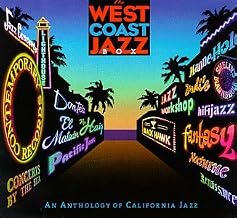
And once we stop asking West Coast jazz to conform to the image created by its most famous album covers, the music becomes much harder to summarize—and much more rewarding to explore.
Buy Amazon
What West Coast Jazz Left Behind
When the Label Became Too Small
By the end of the 1950s, the phrase “West Coast jazz” had become both successful and restrictive. It had helped listeners identify a remarkable concentration of musicians working in California, and it had given record labels and critics a convenient way to describe music that often differed from the dominant images of bebop and hard bop. Yet the more familiar the label became, the less capable it was of describing what musicians were actually doing.
The problem was partly historical. Jazz was changing too quickly. The neat stylistic categories of the early and middle 1950s could not easily contain the developments approaching in the next decade. Miles Davis was moving toward modal improvisation. John Coltrane was expanding the harmonic and expressive possibilities of the saxophone. Ornette Coleman was challenging fundamental assumptions about form, harmony, and collective improvisation. Charles Mingus was building music in which composition, blues, gospel, politics, and controlled disorder could coexist. Thelonious Monk’s once-radical language was becoming increasingly central to modern jazz. Against that background, defining California primarily through coolness and careful arrangement began to feel inadequate.
California musicians were changing too. Some would move toward harder forms of modern jazz. Others would explore freer improvisation, new instrumentation, modal structures, world music, or the emerging possibilities of electric instruments. The studio economy continued to provide work, but jazz itself was entering a period when many of its established assumptions were being questioned.
West Coast jazz did not disappear.
The category simply became less useful than the musicians it had attempted to contain.
Ornette Coleman and the California Nobody Expected
Few musicians demonstrate this better than Ornette Coleman.
Coleman was born in Texas, but an important phase of his development took place in Los Angeles during the 1950s. His presence there is one of the great contradictions in the conventional story of West Coast jazz. While the public image of California modernism emphasized elegance, arrangement, and controlled ensemble textures, Coleman was developing a musical language that would soon provoke some of the most intense debates in jazz.
His ideas challenged conventional relationships among harmony, melody, rhythm, and improvisation. The arrival of The Shape of Jazz to Come in 1959 would make those ideas impossible for the broader jazz world to ignore.
Yet Coleman’s California years remind us that innovation on the West Coast did not move in one direction.
The same regional environment associated with cool jazz also contained one of the musicians who would help detonate the next major argument about jazz freedom.
This does not mean Coleman should simply be relabeled a West Coast jazz musician. That would reproduce the same problem in reverse. His importance is precisely that his presence demonstrates how incomplete regional categories become when treated as aesthetic boundaries.
Los Angeles could contain Shorty Rogers and Ornette Coleman.
That fact should change how we imagine the city.
Eric Dolphy and the Los Angeles Foundation
Eric Dolphy offers another powerful example.
Born and raised in Los Angeles, Dolphy developed within the city’s musical environment before becoming internationally associated with some of the most adventurous jazz of the early 1960s. His later work with Charles Mingus, John Coltrane, and under his own name placed him near the center of the period’s expanding avant-garde.
Dolphy’s multi-instrumentalism—particularly his work on alto saxophone, bass clarinet, and flute—would become one of his signatures. His improvisational language could be angular, lyrical, humorous, abrasive, and startlingly unpredictable.
Again, he does not fit the postcard.
Yet Los Angeles was part of his formation.
This matters because jazz histories often become organized around the places where musicians achieved fame rather than the places where they learned. New York’s central position in the recording industry and jazz press naturally pulled many narratives eastward. A musician who moved there could gradually be detached from the regional environment that had helped shape him.
Restoring Dolphy to the California story does not diminish New York’s importance.
It reveals how much musical traffic moved toward New York from elsewhere.
Charles Mingus and a California Beginning
Charles Mingus further enlarges the picture.
Born in Arizona and raised largely in the Los Angeles area, Mingus developed musically on the West Coast before becoming one of the most important composers and bassists in jazz history. His early experiences included classical study, engagement with jazz, work with prominent musicians, and exposure to the complicated racial environment of Los Angeles.
The mature Mingus would become impossible to classify regionally. His music absorbed Ellington, blues, gospel, bebop, collective improvisation, political anger, composition, and an intensely personal sense of drama.
But his California background matters.
Once Mingus, Dolphy, Coleman, Gordon, Hawes, Edwards, Land, and others enter the picture, the old idea of West Coast jazz as a predominantly cool, polished, white modernism becomes impossible to sustain.
California did not produce one modern jazz tradition.
It produced many.
The Studio Musicians Were Not the Enemy
At the same time, correcting the old narrative should not lead to a new caricature in which studio-oriented musicians become symbols of commercial compromise.
That would be equally misleading.
The professional demands of Los Angeles created musicians with extraordinary versatility. Reading complex arrangements, switching styles rapidly, adapting to conductors and composers, and delivering precise performances under time pressure required serious skill.
Some musicians valued that work because it provided economic stability unavailable through jazz alone. Others genuinely enjoyed moving between different musical environments. Many maintained creative jazz careers alongside commercial sessions.
The tension between art and employment was real, but it was not uniquely Californian.
Jazz musicians everywhere had to make a living.
What distinguished Los Angeles was the scale of the entertainment industry surrounding them.
Hollywood could constrain.
It could also sustain.
The interesting history lies in how individual musicians negotiated that reality.
Jazz and the California Dream
California itself carried cultural meanings that affected how West Coast jazz was marketed.
Postwar America increasingly imagined the state as a landscape of possibility: sunshine, automobiles, suburban expansion, new architecture, leisure, youth, and modern living. Los Angeles in particular became both a real city and a national fantasy.
Jazz could be inserted into that fantasy.
Album design and photography helped present musicians as part of a modern California lifestyle. The association between cool jazz and mid-century modernism was aesthetically powerful because the music’s apparent clarity and restraint could be paired with clean graphic design and images of coastal life.
None of this means the music was inauthentic.
It means that music reaches audiences through visual and commercial frameworks as well as sound.
The problem comes when the framework becomes more memorable than the music.
Chet Baker becomes a face.
California becomes sunshine.
Cool jazz becomes relaxation.
The complicated social and musical environment disappears.
Chet Baker’s Myth and Its Cost
Baker’s later life made the mythology even more powerful.
His youthful beauty deteriorated dramatically. Addiction, legal problems, violence, instability, and physical changes became part of his public image. Photographs from different decades seemed to show two different people, encouraging a tragic narrative almost too compelling for journalists and filmmakers to resist.
The music sometimes became secondary to the story.
That is unfortunate because Baker’s artistic importance does not require romanticizing self-destruction. His phrasing, melodic instincts, trumpet sound, singing, and ability to make familiar material feel unusually intimate remain significant without turning his life into a morality play.
The same principle applies to West Coast jazz generally.
Myth can attract listeners.
But myth should lead back to music, not replace it.
Dave Brubeck and the Collapse of the Regional Category
Dave Brubeck’s career eventually became so large that calling him merely a West Coast jazz musician seemed increasingly inadequate.
The Dave Brubeck Quartet became one of the most recognizable jazz groups in the world. Paul Desmond’s “Take Five,” recorded on Time Out, became an extraordinary popular success. The quartet toured internationally, and Brubeck’s interests expanded through large-scale compositions, sacred music, unusual meters, and encounters with musical traditions beyond the United States.
Yet California remained important to his formation.
Brubeck’s career demonstrates how regional scenes can launch musicians whose later work transcends the categories associated with those scenes.
The same could be said of numerous figures connected to West Coast jazz.
A movement succeeds partly by making itself obsolete.
It gives musicians a place from which to depart.
Gerry Mulligan Refuses to Stay Put
Mulligan likewise refused to remain trapped inside the Los Angeles quartet that had made him famous.
His career expanded through different ensembles, collaborations, larger groups, and encounters with musicians across jazz. The baritone saxophone remained unmistakable, but the context continually changed.
This mobility is essential to understanding him.
If we hear Mulligan only through the pianoless quartet with Baker, we hear a brilliant chapter but not the whole musician.
Jazz careers are rarely linear.
Musicians revisit old ideas, abandon successful formulas, collaborate with unexpected partners, and respond to changes in the culture around them.
The West Coast moment was important to Mulligan because it allowed certain ideas to crystallize.
It did not define the limits of his imagination.
The Reunion With Chet Baker
When Mulligan and Baker reunited years later, the historical meaning of their partnership had changed. They were no longer two young musicians helping define an emerging Los Angeles scene. They had accumulated separate careers, reputations, struggles, and musical experiences.
That later reunion is valuable precisely because it demonstrates how misleading nostalgia can be.
The goal should not be to ask whether older musicians perfectly reproduced the atmosphere of 1952.
They could not.
Time had changed them.
The more interesting question is what remained in their musical relationship after those changes.
Counterpoint remained.
Listening remained.
The contrast between Mulligan’s baritone and Baker’s trumpet remained.
But history had entered the sound.
This is why their 1974 Carnegie Hall reunion deserves to be understood as music rather than as an exercise in audio spectacle. Its significance lies in two musicians returning to a language they had once shared and discovering what that language meant more than twenty years later.
The Influence on Chamber Jazz
One of West Coast jazz’s most durable legacies can be heard in later approaches often described as chamber jazz.
The term is imperfect, but it points toward music that combines improvisation with carefully considered instrumentation, dynamics, composition, and ensemble texture.
The experiments of Mulligan, Giuffre, Hamilton, Rogers, and others helped establish that a jazz group did not need to conform to standard instrumentation to remain recognizably jazz.
Remove the piano.
Add a cello.
Use flute.
Write counterpoint.
Reduce volume.
Allow more silence.
Create arrangements in which individual voices move independently.
These possibilities became part of the broader jazz vocabulary.
Later musicians would pursue them in entirely different contexts, often without identifying themselves with West Coast jazz at all.
That is how influence usually works.
The original label fades.
The ideas survive.
The Influence on European Jazz
Some of those ideas also found receptive audiences in Europe.
European musicians searching for alternatives to American hard bop could hear in cool jazz, chamber-like ensembles, and open arrangements possibilities that did not depend on reproducing the most dominant New York models.
This should not be interpreted as a simple line from California to Europe. European jazz developed through numerous influences, including local folk traditions, classical music, free improvisation, American touring musicians, and independent scenes.
But West Coast experiments formed part of the available vocabulary.
The idea that intensity could emerge from restraint mattered.
The idea that instrumentation could be reconsidered mattered.
The idea that written form and improvisation could interact without one subordinating the other mattered.
Those lessons traveled well.
The Return of West Coast Jazz
Decades later, Los Angeles would again become central to discussions of jazz innovation, though the music looked very different.
The contemporary scene surrounding musicians such as Kamasi Washington and the broader West Coast Get Down emerged from another historical moment, one shaped by hip-hop, spiritual jazz, funk, electronic music, global influences, and new forms of independent production.
It would be a mistake to describe this simply as a revival of 1950s West Coast jazz.
The differences are too large.
But there is continuity in one important sense: Los Angeles remains capable of producing jazz communities whose identity reflects the city’s particular mixture of cultures, industries, neighborhoods, and musical networks.
The lesson of the 1950s therefore survives.
Place matters.
It simply does not determine one sound.
Why the East-versus-West Argument Survives
If the distinction is so unreliable, why has it lasted?
Because binaries are memorable.
East versus West.
Hard versus cool.
Black versus white.
Improvised versus arranged.
Hot versus restrained.
New York versus Los Angeles.
These oppositions create stories that are easy to understand and easy to repeat.
History is rarely so cooperative.
Musicians cross boundaries faster than critics can maintain them. The same player can be lyrical in one session and aggressive in another. A carefully arranged composition can contain explosive improvisation. A musician associated with cool jazz can have deep bebop roots. A California ensemble can include musicians formed elsewhere.
The binary survives because it organizes complexity.
Our job as listeners is to recognize when organization becomes distortion.
Records, Not Demonstration Discs
There is another distortion worth leaving behind.
West Coast jazz has sometimes been discussed through the language of high-end audio because many recordings from labels such as Contemporary and Pacific Jazz are admired for their production. That interest is legitimate for listeners who care about recording history.
But it should remain secondary.
Art Pepper did not enter the studio to test loudspeaker imaging.
Shelly Manne’s cymbals are not historically important because they reveal high-frequency extension.
A Curtis Counce bass line is not a subwoofer exercise.
Chet Baker’s trumpet does not need expensive equipment to become emotionally persuasive.
Reducing these records to “reference recordings” strips away the cultural and musical conditions that made them worth recording in the first place.
Recording quality can enhance our access to a performance.
It cannot explain the performance.
What to Hear Instead
Listen instead to interaction.
Hear how Mulligan and Baker negotiate harmony without piano.
Hear how Art Pepper transforms bebop language into something unmistakably personal.
Hear Hampton Hawes connect Los Angeles to the blues and Bud Powell.
Hear Shelly Manne adjust his drumming to different ensemble architectures.
Hear Chico Hamilton rethink instrumentation.
Hear Jimmy Giuffre explore the border between jazz, composition, and open improvisation.
Hear Curtis Counce demonstrate that hard-swinging modern jazz never belonged exclusively to New York.
Hear the Central Avenue tradition behind the polished images of 1950s California.
Then listen to Brubeck and Desmond and notice how different their solution is from all the others.
The more music we hear, the less useful the stereotype becomes.
That is a sign of progress.
Beyond Chet Baker and Dave Brubeck
The title of this article is not an argument against Baker or Brubeck.
Quite the opposite.
Both deserve their importance.
Baker remains one of the most recognizable trumpet voices of his generation, and his work with Mulligan changed the possibilities of small-group interaction. Brubeck expanded jazz rhythm, composition, and popular reach while Paul Desmond developed one of the great alto voices in the music.
The problem begins only when fame becomes exclusivity.
West Coast jazz also belongs to Gerry Mulligan, Art Pepper, Shelly Manne, Shorty Rogers, Chico Hamilton, Jimmy Giuffre, Bud Shank, Bob Cooper, Hampton Hawes, Curtis Counce, Harold Land, Teddy Edwards, and many others.
Its larger California history reaches Dexter Gordon, Eric Dolphy, Charles Mingus, Ornette Coleman, Wardell Gray, and the Black musical communities that existed before the term “West Coast jazz” became fashionable.
No single aesthetic can contain all of them.
Nor should it.
A Better Way to Understand the West Coast
Perhaps we should think of West Coast jazz not as a genre but as a conversation.
Some musicians argued for economy.
Others argued for fire.
Some trusted arrangement.
Others trusted improvisational freedom.
Some found opportunities in Hollywood.
Others remained rooted in clubs and small-group jazz.
Some carried bebop forward.
Others dismantled assumptions inherited from it.
Sometimes these musicians disagreed aesthetically.
Sometimes they played together anyway.
That is what scenes do.
They create proximity.
Proximity creates exchange.
Exchange creates music that refuses to remain inside the categories invented to describe it.
The Coast Beyond the Postcard
The familiar California image will probably never disappear.
Chet Baker will remain young in those photographs.
Gerry Mulligan’s baritone will remain beside him.
Brubeck will continue turning unexpected meters into memorable compositions.
Pacific sunlight will continue illuminating album covers and histories of cool jazz.
There is nothing wrong with enjoying that image.
We simply should not mistake it for the whole coast.
Behind the postcard was Central Avenue.
There were beboppers and studio musicians, arrangers and experimentalists, Black communities and white musicians, Hollywood sessions and late-night clubs, carefully written scores and improvisations that threatened to dissolve the score altogether.
There were musicians arriving from New York and musicians leaving California for New York.
There were careers that crossed every border critics attempted to establish.
That is the West Coast jazz worth remembering.
Not a softer alternative to “real” jazz happening somewhere else.
Not a collection of immaculate recordings designed to demonstrate expensive audio systems.
Not merely Baker, Brubeck, sunshine, and cool.
It was a restless musical culture whose greatest strength was precisely its inability to remain one thing.
And once the postcard is removed, the coast becomes larger.