
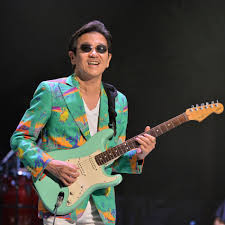
The Tokyo Prodigy and the Seychelles Tropical Revolution
To plot the ultimate coordinate of sonic euphoria and instrumental sunshine on The Jazz Compass, one must steer directly toward the neon-lit coastline of 1970s Tokyo. This is the vibrant universe of Masayoshi Takanaka. After making waves with the avant-garde Sadistic Mika Band, Takanaka unleashed a solo career that permanently altered the landscape of Japanese music. His 1976 debut album, Seychelles, became a seismic cultural milestone. Instead of mimicking the dark, cerebral hard-bop of New York, Takanaka pioneered a breathtakingly fresh genre-blend: he cross-pollinated the technical brilliance of American jazz-fusion with the syncopated grooves of Brazilian bossa nova, reggae, and high-energy funk, effectively inventing the breezy, coastal soundtrack of the City Pop phenomenon.
The Insatiable High and the Surfboard Guitar Mythology
For the high-art connoisseur tracking the golden era of guitar virtuosity, Takanaka’s output in the late 70s and early 80s represents a masterclass in melodic songwriting. Masterpieces like An Insatiable High (1977) and his magnum opus, The Rainbow Goblins (1981), showcase a jaw-dropping technical precision. Armed with his iconic, sky-blue Yamaha SG custom guitar, Takanaka achieved a rare feat in instrumental music: his guitar lines didn’t just provide solos; they sang hooks so infectious they became national pop anthems. His live performances became legendary rituals of pure theatrical joy—famous for stepping onto stadium stages playing a fully functional guitar shaped like a surfboard, proving that high-level jazz improvisation could coexist with absolute, unadulterated fun.
The Eternal Summer Across the Cosmic Latitude
True to the forward-thinking, borderless ethos of Jazz Latitude, Masayoshi Takanaka’s musical geography is a brilliant map of cross-continental bridges and timeless nostalgia. A multi-generational icon whose vinyl records are heavily sought after by contemporary producers and global crate-diggers, he spent six decades proving that instrumental fusion could be deeply sophisticated yet universally accessible. Gismonti gave us the rainforest, and Hancock gave us the cosmos, but Takanaka gifted us the ultimate beach party of the mind. He has left an immovable, sparkling coordinate on our map—a beautiful, sun-drenched monument built on the absolute certainty that six strings can capture the endless joy of a summer that never dies.