Some masterpieces announce themselves immediately.
Others reveal their greatness slowly, rewarding listeners who return again and again.
Crescent belongs firmly to the second category.
Released in 1964, it has long lived in the shadow of A Love Supreme, the monumental spiritual suite that would follow only months later.
Yet many musicians, critics and devoted Coltrane listeners quietly argue that Crescent is every bit as extraordinary.
If A Love Supreme is the triumphant declaration of faith, Crescent is the private prayer that came before it.
It is an album of reflection rather than proclamation.
Questions rather than answers.
Meditation rather than celebration.
Listening to Crescent feels less like attending a concert and more like entering a sacred conversation.
There are no dramatic gestures designed to impress.
No displays of virtuosity for their own sake.
Instead, every note seems carefully weighed.
Every silence carries emotional significance.
Every composition unfolds with remarkable patience.
By 1964, John Coltrane had already transformed modern jazz.
Giant Steps redefined harmonic possibility.
My Favorite Things expanded the language of modal improvisation.
Ballads revealed his lyrical sensitivity.
Now, with Crescent, he turned inward.
The result was one of the most personal albums of his career.
More than sixty years later, its quiet intensity remains profoundly moving.
A New Stage in Coltrane’s Journey
The early 1960s were years of relentless artistic growth for John Coltrane.
Each recording seemed to open another creative door.
Yet Crescent feels fundamentally different from everything that came before.
Rather than exploring external musical ideas, Coltrane began exploring himself.
His compositions became increasingly introspective.
Melodies grew more spacious.
Improvisations became less concerned with technical display and more focused on emotional truth.
This transformation reflected changes taking place in his personal life as well.
Coltrane’s deepening spiritual interests influenced not only his philosophy but also his approach to composition.
Music was becoming something greater than performance.
It was becoming a form of prayer.
That profound shift permeates every moment of Crescent.
The Classic Quartet Reaches Full Maturity
Few ensembles in jazz history have ever achieved the level of unity heard on Crescent.
By this point, the Classic Quartet had developed an almost instinctive understanding of one another.
John Coltrane’s searching melodies.
McCoy Tyner’s majestic harmonic architecture.
Jimmy Garrison’s unwavering foundation.
Elvin Jones’ flowing rhythmic landscapes.
Each musician had grown beyond individual brilliance.
Together, they created something larger than themselves.
Communication no longer depended on visual cues or predetermined arrangements.
Ideas emerged naturally.
The quartet breathed as a single musical organism.
This extraordinary cohesion allowed Coltrane’s increasingly personal compositions to unfold with remarkable freedom while maintaining perfect balance.
Few recordings capture ensemble interaction at such a sophisticated level.
JazzLatitude Insight
Unlike many landmark jazz albums built primarily around standards, Crescent is dominated by original compositions. This gave Coltrane complete freedom to shape every melody, harmonic progression and emotional contour according to his own artistic vision, making the album one of his most personal statements before A Love Supreme.
The Sound of Reflection
One of the first things listeners notice about Crescent is its atmosphere.
The album feels spacious.
Unhurried.
Contemplative.
Even moments of intensity never lose their sense of inner calm.
Coltrane’s tenor saxophone sounds richer than ever.
Tyner’s piano provides luminous harmonic landscapes.
Garrison’s bass anchors every performance with quiet authority.
Jones’ drumming balances tremendous energy with extraordinary sensitivity.
Rather than filling every available space, the quartet embraces silence.
That restraint becomes one of the album’s defining strengths.
Each composition unfolds naturally, allowing emotion to develop gradually instead of demanding immediate attention.
It is music that rewards patience.
The deeper one listens, the more it reveals.
Inside the Music
The Compositions That Prepared the Way for A Love Supreme
One of the defining characteristics of Crescent is that every composition feels purposeful.
There are no filler tracks.
No commercial concessions.
No performances included simply to complete an album.
Each piece explores a different emotional landscape while contributing to a unified artistic vision.
Unlike Ballads, where Coltrane interpreted beloved standards, Crescent presents original works that reveal his rapidly evolving identity as both a composer and a spiritual thinker.
These are not merely songs.
They are meditations.
Each composition asks the listener to slow down, to reflect and to experience music as something deeper than entertainment.
The result is one of the most cohesive albums in Coltrane’s entire catalog.
“Crescent”
The title track immediately establishes the album’s unique atmosphere.
Rather than opening with explosive energy, Coltrane begins with quiet confidence.
The melody unfolds patiently, almost as if it were searching for its own destination.
McCoy Tyner supports the theme with broad, luminous chords that create a sense of openness without sacrificing harmonic richness.
Jimmy Garrison’s bass remains calm and unwavering, providing a subtle gravitational center beneath the music.
Meanwhile, Elvin Jones demonstrates once again why he was one of jazz’s greatest conversational drummers.
His rhythms never simply accompany the melody.
They respond to it.
Encourage it.
Challenge it.
The performance grows naturally from reflection to intensity before returning to quiet contemplation.
It is one of Coltrane’s finest original compositions.
“Wise One”
If the title track represents introspection, “Wise One” embodies serenity.
Many listeners describe it as one of the most beautiful melodies Coltrane ever wrote.
The composition unfolds with remarkable elegance.
Every phrase feels inevitable.
Nothing appears forced.
Coltrane’s tenor saxophone sings rather than declares.
His tone is warm, rounded and deeply expressive.
Tyner’s piano provides delicate harmonic colors that seem to shimmer beneath the melody.
Rather than displaying technical brilliance, every member of the quartet serves the emotional character of the composition.
The result is profoundly moving.
Decades after its release, Wise One remains one of the defining lyrical performances in modern jazz.
“Bessie’s Blues”
Following the contemplative opening pieces, “Bessie’s Blues” introduces a welcome change of mood.
Rooted in the blues tradition, the composition demonstrates that Coltrane never abandoned the music’s deepest foundations, even while exploring increasingly sophisticated harmonic and spiritual ideas.
The quartet performs with joyful confidence.
Elvin Jones’ drumming becomes more playful.
Tyner’s piano swings effortlessly.
Garrison provides a rock-solid groove while subtly enriching the harmonic movement.
Coltrane’s improvisation combines technical brilliance with unmistakable warmth.
The performance reminds listeners that innovation and tradition need not exist in opposition.
For Coltrane, they were complementary forces.
JazzLatitude Insight
Although Crescent is often described as a deeply spiritual album, Coltrane never relied on explicit religious symbolism within its music. Instead, he expressed spirituality through atmosphere, patience, emotional honesty and the profound interaction between the members of the quartet.
“Lonnie’s Lament”
Many devoted Coltrane admirers consider “Lonnie’s Lament” the emotional heart of the album.
Named in honor of saxophonist Lonnie Hillyer, the composition unfolds with extraordinary patience.
Unlike many jazz performances built around rapid thematic development, this piece embraces stillness.
Jimmy Garrison opens with one of the most memorable bass foundations of his career.
His resonant tone establishes an atmosphere of quiet dignity long before Coltrane enters.
When the tenor saxophone finally appears, every phrase feels deeply considered.
Rather than rushing toward dramatic climaxes, Coltrane allows each melodic idea to evolve naturally.
The emotional effect is remarkable.
The music seems less concerned with expressing sorrow than with accepting it.
There is melancholy here.
But also peace.
Many critics regard this performance as one of the quartet’s greatest collective achievements.
“The Drum Thing”
The album concludes with “The Drum Thing,” a composition that highlights another essential voice within the Classic Quartet.
Elvin Jones.
Far more than a conventional drum feature, the performance demonstrates Jones’ extraordinary ability to shape musical architecture through rhythm alone.
His improvisation flows with remarkable freedom while remaining deeply connected to the ensemble.
Tyner, Garrison and Coltrane contribute subtle responses that transform the piece into a true group performance rather than a simple percussion showcase.
The result reinforces one of Crescent‘s central themes.
Every member of the quartet matters.
Each voice contributes equally to the album’s emotional and artistic unity.
Music That Rewards Patience
Unlike albums designed to impress on first listen, Crescent reveals its deepest qualities gradually.
Its melodies linger long after the music ends.
Its silences become increasingly meaningful.
Its emotional architecture grows richer with every return.
This slow unfolding explains why so many musicians consider it one of Coltrane’s greatest achievements.
The album asks nothing from the listener except attention.
Those willing to give it are rewarded with one of the most profound experiences in modern jazz.
Buy Amazon
From Hidden Gem to Essential Masterpiece
When Crescent was released in 1964, it received respectful reviews but did not generate the same immediate cultural impact as some of John Coltrane’s earlier recordings.
Nor did it become the defining statement that A Love Supreme would soon become.
For a time, Crescent occupied an unusual place in Coltrane’s discography.
It was admired.
But not fully understood.
Listeners recognized its beauty.
They sensed its depth.
Yet many failed to appreciate how significant the album truly was.
Only with the passage of time did its importance become unmistakable.
Today, Crescent is widely regarded as one of the greatest artistic achievements of the Classic Quartet and one of the finest examples of spiritual expression in instrumental jazz.
Rather than existing in the shadow of A Love Supreme, it is now understood as the essential bridge that made that masterpiece possible.
The Road to A Love Supreme
It is impossible to hear Crescent without recognizing its connection to what came next.
The album does not yet present the unified spiritual suite that would define A Love Supreme.
Instead, it explores the emotional and musical language from which that suite would emerge.
The patient pacing.
The spacious compositions.
The emphasis on atmosphere.
The profound interaction between the quartet.
The growing sense that music could serve as prayer.
All of these ideas reach extraordinary maturity on Crescent before culminating in Coltrane’s most celebrated work.
Many historians describe the relationship between the two albums as similar to that between a sketchbook and a finished painting.
The comparison is understandable.
Yet it risks undervaluing Crescent.
This album is not a preliminary draft.
It is a complete artistic statement in its own right.
Its quiet confidence simply differs from the triumphant declaration that follows.
The Quartet at Its Peak
By 1964, the Classic Quartet had become one of the most cohesive ensembles in jazz history.
What makes Crescent so remarkable is not merely the brilliance of its individual musicians, but the complete absence of ego within their performances.
John Coltrane never dominates the conversation.
McCoy Tyner supports without overwhelming.
Jimmy Garrison anchors every composition with unwavering authority.
Elvin Jones shapes rhythm with extraordinary imagination while remaining completely responsive to the ensemble.
Listening to the album today, one is struck by how naturally the music flows.
No transitions feel forced.
No solos appear disconnected.
Every performance unfolds organically, as though four musicians were discovering each composition together in real time.
That level of collective intuition is extraordinarily rare.
JazzLatitude Insight
Many musicians regard Crescent as the Classic Quartet’s finest example of collective balance. While A Love Supreme often highlights Coltrane’s spiritual vision, Crescent showcases four equal voices creating a unified musical language in which every instrument shapes the emotional direction of the performance.
Rudy Van Gelder’s Masterpiece Behind the Glass
Part of Crescent‘s enduring appeal lies in the extraordinary sound captured by engineer Rudy Van Gelder.
Recording once again at his legendary Englewood Cliffs studio, Van Gelder created an environment in which every instrument retained remarkable warmth and clarity.
Coltrane’s tenor saxophone possesses both intimacy and power.
Tyner’s piano sounds spacious without losing definition.
Jimmy Garrison’s bass resonates with exceptional depth.
Elvin Jones’ drums retain every subtle nuance, from whisper-soft cymbal work to explosive rhythmic surges.
The recording never feels artificial.
Instead, it creates the illusion that the quartet is performing only a few feet away.
For audiophiles, Crescent remains one of the finest examples of Van Gelder’s legendary engineering.
A Lasting Influence
Although Crescent never achieved the commercial recognition of A Love Supreme, its influence has steadily grown across the decades.
Jazz musicians study its compositions as models of thematic development and emotional pacing.
Saxophonists analyze Coltrane’s mature tone and lyrical phrasing.
Pianists continue to admire McCoy Tyner’s majestic harmonic landscapes.
Bassists learn from Jimmy Garrison’s patient architecture.
Drummers explore Elvin Jones’ remarkable ability to balance freedom with structure.
Beyond jazz, composers of film music, ambient recordings and contemporary classical works have drawn inspiration from the album’s atmosphere and emotional restraint.
Its influence extends far beyond genre.
It speaks to any artist interested in depth rather than spectacle.
An Album That Grows With the Listener
Some records reveal everything during the first listen.
Crescent does the opposite.
Its greatest rewards appear gradually.
With each return, new relationships emerge between melody and harmony.
New rhythmic details become apparent.
New emotional layers reveal themselves.
The album seems to evolve alongside the listener.
Perhaps that is why so many musicians revisit it throughout their lives.
Each stage of experience uncovers something previously unnoticed.
Very few recordings possess that remarkable quality.
Crescent is one of them.
The Enduring Legacy of Crescent
Some albums become famous because they change music overnight.
Others quietly transform the way musicians think for generations.
Crescent belongs to the second category.
It has never enjoyed the widespread recognition of A Love Supreme or the technical mystique of Giant Steps, yet among musicians, critics, and devoted jazz listeners, it occupies an almost sacred place.
Why?
Because Crescent captures John Coltrane at a unique moment in his artistic evolution.
He had already mastered the technical challenges of modern jazz.
He had already expanded the possibilities of harmony and improvisation.
Now, his focus had shifted toward something deeper.
Meaning.
Purpose.
Spiritual reflection.
The result is an album that continues to reward careful listening more than sixty years after its release.
It is not merely a collection of compositions.
It is an invitation to slow down, to reflect, and to experience music as a form of contemplation.
Why Crescent Still Matters
Modern listeners often discover John Coltrane through Blue Train, Giant Steps, or A Love Supreme.
Eventually, many arrive at Crescent.
And for a surprising number of them, it becomes the favorite.
The album offers a rare balance between accessibility and depth.
Its melodies are memorable.
Its improvisations are adventurous without becoming overwhelming.
Its emotional atmosphere is profound without ever feeling sentimental.
Unlike many landmark jazz recordings that demand analytical listening, Crescent speaks directly to the emotions.
Every performance feels honest.
Every composition unfolds with quiet confidence.
The music asks for patience rather than admiration.
That timeless quality explains why musicians continue returning to it throughout their careers.
Each listen reveals another layer.
Another conversation.
Another unanswered question.
Essential Tracks
While every composition contributes to the album’s remarkable unity, several pieces have become defining moments in Coltrane’s catalog.
“Crescent”
The title composition remains one of Coltrane’s greatest original works.
Its spacious melody and gradual emotional development perfectly capture the album’s reflective spirit.
“Wise One”
Perhaps the most lyrical composition Coltrane ever wrote.
Its unforgettable melody showcases the warmth of his tenor saxophone and the remarkable sensitivity of the Classic Quartet.
“Bessie’s Blues”
A joyful reminder that Coltrane never abandoned the blues tradition, even while exploring increasingly spiritual and modal territory.
“Lonnie’s Lament”
One of the emotional high points of the album.
Jimmy Garrison’s bass foundation and Coltrane’s deeply expressive tenor create a performance of extraordinary dignity and quiet sorrow.
“The Drum Thing”
A brilliant showcase for Elvin Jones that also demonstrates the quartet’s remarkable collective interaction.
Rather than functioning as a conventional drum feature, the piece becomes another example of musical conversation at the highest level.
JazzLatitude Insight
Many musicians describe Crescent as the “missing chapter” in John Coltrane’s spiritual journey. Without its introspective compositions and mature ensemble language, it is difficult to imagine A Love Supreme emerging in the form we know today.
Technical Profile
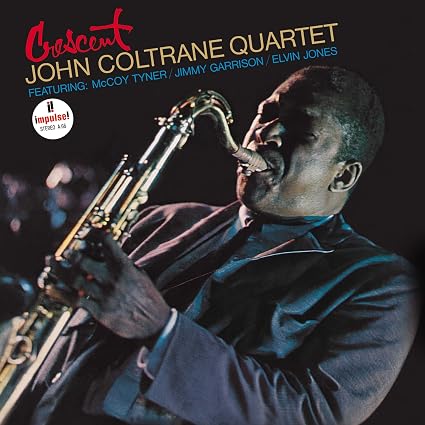
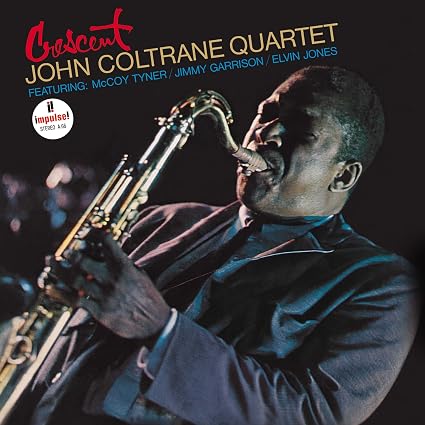
Album: Crescent
Artist: John Coltrane Quartet
Release Year: 1964
Recorded: April 27 and June 1, 1964
Label: Impulse! Records
Producer: Bob Thiele
Recording Engineer: Rudy Van Gelder
Recording Studio: Van Gelder Studio, Englewood Cliffs, New Jersey
Personnel
- John Coltrane — tenor saxophone
- McCoy Tyner — piano
- Jimmy Garrison — double bass
- Elvin Jones — drums
Primary Styles
- Modal Jazz
- Post-Bop
- Spiritual Jazz
- Contemporary Jazz
Five Lesser-Known Facts About Crescent
1. Nearly every composition was written by John Coltrane.
Unlike many earlier jazz albums built around standards, Crescent is dominated by original material, revealing Coltrane’s growing confidence as a composer.
2. It was recorded only months before A Love Supreme.
Many of the musical ideas that reached their fullest expression on A Love Supreme first appeared in a more intimate form on Crescent.
3. “Lonnie’s Lament” is one of Jimmy Garrison’s defining performances.
Although Coltrane’s saxophone naturally draws attention, Garrison’s patient, resonant bass playing provides the emotional foundation that makes the piece so powerful.
4. The album has grown steadily in reputation.
While initially overshadowed by Coltrane’s more famous releases, Crescent is now widely regarded as one of the greatest jazz albums of the 1960s.
5. It remains a favorite among professional musicians.
Many jazz performers cite Crescent as one of the finest examples of ensemble listening, compositional balance and emotional maturity ever recorded.
Frequently Asked Questions
Why is Crescent considered one of John Coltrane’s greatest albums?
Because it combines extraordinary compositions, exceptional ensemble playing and profound emotional depth, serving as the artistic bridge between Coltrane’s modal innovations and the spiritual vision of A Love Supreme.
Is Crescent a good introduction to John Coltrane?
Yes. While slightly more introspective than Ballads, it remains highly accessible and offers an excellent introduction to Coltrane’s mature compositional style.
What style of jazz is featured on Crescent?
The album blends modal jazz, post-bop and spiritual jazz, emphasizing atmosphere, melodic development and collective improvisation.
Who performs on Crescent?
The recording features the complete Classic Quartet: John Coltrane, McCoy Tyner, Jimmy Garrison and Elvin Jones.
Why is Crescent often linked to A Love Supreme?
Because it represents Coltrane’s final major artistic statement before recording A Love Supreme, introducing many of the spiritual, emotional and compositional ideas that would define that landmark suite.
JazzLatitude Rating
| Category | Rating |
|---|---|
| Historical Importance | ★★★★★ |
| Compositional Quality | ★★★★★ |
| Emotional Depth | ★★★★★ |
| Ensemble Interaction | ★★★★★ |
| Recording Quality | ★★★★★ |
| Spiritual Expression | ★★★★★ |
| Influence | ★★★★★ |
| Replay Value | ★★★★★ |
| JazzLatitude Essential | ★★★★★ |
Final Thoughts
Crescent is often described as the quiet masterpiece in John Coltrane’s catalog.
That description is entirely deserved.
It lacks the immediate cultural impact of Giant Steps.
It avoids the monumental structure of A Love Supreme.
It never seeks to overwhelm the listener.
Instead, it achieves something far more enduring.
It earns trust.
Through patient melodies.
Through extraordinary ensemble playing.
Through music that values reflection over spectacle.
Supported by the incomparable artistry of McCoy Tyner, Jimmy Garrison and Elvin Jones, Coltrane created an album that feels timeless not because it follows trends, but because it speaks to universal human experience.
Hope.
Longing.
Faith.
Silence.
Growth.
Few recordings capture these emotions with such honesty.
More than sixty years later, Crescent continues to reveal new dimensions with every listen.
It stands not merely as a prelude to A Love Supreme, but as one of the greatest artistic achievements of the entire jazz canon.
For those willing to listen deeply, Crescent offers one of the richest and most rewarding journeys in all of modern music.
It is an album that never raises its voice.
Yet it continues to be heard around the world.