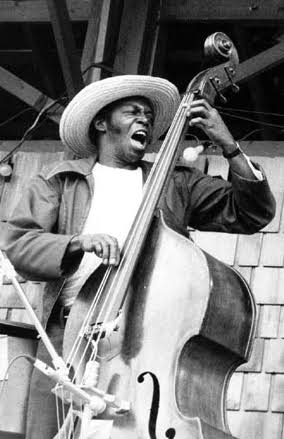
The Bassist Who Held Together One of the Greatest Bands in Jazz History
In every legendary jazz ensemble, there is usually one musician whose importance is easy to overlook.
Not because their contribution is small.
Quite the opposite.
Their artistry becomes so perfectly integrated into the music that listeners often notice it only when it is absent.
For John Coltrane’s Classic Quartet, that musician was Jimmy Garrison.
While Coltrane explored the outer limits of melody, McCoy Tyner expanded the harmonic landscape and Elvin Jones transformed rhythm into a living, breathing force, Garrison provided something equally essential.
Stability.
Patience.
Balance.
He was the quiet center around which everything else revolved.
His bass lines rarely demanded attention.
They didn’t need to.
Instead, they created an unwavering foundation that allowed the rest of the quartet to take extraordinary musical risks without ever losing their sense of direction.
This remarkable ability became one of the defining characteristics of the Classic Quartet.
No matter how adventurous Coltrane’s improvisations became, Garrison remained calm.
No matter how turbulent Elvin Jones’ rhythmic waves grew, Garrison maintained clarity.
No matter how expansive McCoy Tyner’s harmonies sounded, Garrison connected them effortlessly to the pulse beneath.
His playing embodied one of jazz’s most difficult artistic lessons:
Sometimes the greatest strength lies in restraint.
Yet Jimmy Garrison was far more than a dependable accompanist.
He possessed a rich, resonant tone, impeccable timing and an extraordinary understanding of space.
He knew exactly when to reinforce the music and when to step aside.
That wisdom transformed him into one of the most respected bassists of the post-bop era.
Although his years with Coltrane remain the defining chapter of his career, Garrison also collaborated with many of jazz’s greatest innovators and helped shape the evolution of modal and spiritual jazz during one of the music’s most creative periods.
Today, bassists continue to study his recordings—not because they are filled with flashy virtuosity, but because they reveal something far more valuable.
How to make every note matter.
To understand Jimmy Garrison is to understand that great jazz is not built solely on brilliance.
It is built on trust.
And few musicians earned the trust of their fellow artists more completely than Jimmy Garrison.
Growing Up in Philadelphia
James Emery Garrison was born on March 3, 1934, in Miami, Florida, but spent much of his youth in Philadelphia after his family relocated during his childhood.
By the 1940s and 1950s, Philadelphia had become one of America’s great jazz cities.
Its neighborhoods produced an astonishing concentration of talent, including John Coltrane, McCoy Tyner, Lee Morgan, Benny Golson and the Heath brothers.
For a young musician, there could hardly have been a better environment.
Garrison initially experimented with several instruments before discovering the double bass.
The instrument suited his personality perfectly.
Unlike the trumpet or saxophone, the bass rarely occupied the spotlight.
Instead, it served as the bridge between rhythm and harmony.
That role fascinated him.
Rather than seeking attention, Garrison became interested in how music functioned as a whole.
He listened carefully.
Observed constantly.
And developed an unusually mature understanding of ensemble playing long before his professional career began.
Those qualities would later make him indispensable to John Coltrane.
Learning from the Masters
As Garrison entered the professional jazz scene during the 1950s, he encountered a generation of musicians determined to push bebop into new territory.
His early performances quickly attracted attention.
Not because he played aggressively.
But because he possessed extraordinary musical judgment.
He always seemed to know exactly what the music required.
That reliability earned him opportunities with several major figures of modern jazz.
Working alongside adventurous bandleaders exposed him to increasingly sophisticated harmonic ideas and prepared him for the revolutionary musical world he would eventually enter with John Coltrane.
Even at this early stage, fellow musicians admired one characteristic above all others:
Jimmy Garrison never rushed.
His sense of time was almost immovable.
That quiet confidence would soon become the heartbeat of one of the greatest quartets in jazz history.
From Ornette Coleman to John Coltrane
Before Jimmy Garrison became the foundation of John Coltrane’s Classic Quartet, he had already earned the respect of some of the most adventurous musicians in jazz.
The late 1950s and early 1960s were years of extraordinary transformation.
Bebop had matured.
Hard bop dominated many clubs.
Meanwhile, a new generation of artists was beginning to challenge long-held assumptions about harmony, rhythm and improvisation.
Jimmy Garrison found himself at the center of that movement.
His calm musical personality made him uniquely suited to environments where experimentation flourished.
No matter how radical the music became, Garrison never lost his balance.
He listened first.
Played second.
That philosophy would define his entire career.
Working with Ornette Coleman
One of Garrison’s earliest major breakthroughs came through his work with Ornette Coleman.
Coleman’s revolutionary approach to improvisation challenged nearly every convention in modern jazz.
Traditional chord progressions became optional.
Melodies unfolded with unprecedented freedom.
Ensemble interaction mattered more than predetermined structures.
Many musicians found the music intimidating.
Jimmy Garrison embraced it.
His natural sense of pulse and extraordinary listening skills allowed him to navigate this unfamiliar territory with remarkable confidence.
Rather than trying to control the music, he learned how to support spontaneous creativity.
Those experiences proved invaluable.
When he later joined John Coltrane, he already understood how to remain grounded even while the music explored entirely new directions.
The Art of Musical Patience
One of Garrison’s defining characteristics was his refusal to overcrowd the music.
Many bassists understandably feel pressure to demonstrate technical ability.
Jimmy Garrison rarely did.
He trusted simplicity.
A single perfectly placed note often carried more emotional weight than an elaborate passage.
His bass lines breathed.
They left space.
They invited conversation.
This approach perfectly complemented John Coltrane’s increasingly expansive improvisations.
As Coltrane’s solos grew longer and more adventurous, Garrison resisted the temptation to become busier.
Instead, he created stability.
His unwavering pulse gave the rest of the quartet extraordinary freedom.
It became one of the group’s greatest strengths.
Joining the Classic Quartet
In 1961, Jimmy Garrison officially became the bassist for John Coltrane’s evolving quartet.
The chemistry appeared almost immediately.
McCoy Tyner supplied harmonic openness.
Elvin Jones generated flowing rhythmic energy.
Coltrane explored limitless melodic possibilities.
Garrison quietly unified them all.
Unlike many bassists who constantly outlined changing chord progressions, Garrison often relied upon pedal points and repetitive ostinatos that reinforced the modal character of Coltrane’s music.
His playing encouraged patience.
Rather than pushing harmony forward at every moment, he allowed ideas to develop naturally.
This subtle contribution became essential to the quartet’s identity.
Without Garrison’s remarkable steadiness, many of Coltrane’s most ambitious performances would have sounded far less cohesive.
JazzLatitude Insight
Musicians often describe Jimmy Garrison as one of the greatest listeners in jazz history. Rather than reacting to individual notes, he responded to the overall emotional direction of a performance. That broader awareness allowed him to anticipate musical changes almost instinctively.
A Master of the Pedal Point
Perhaps no bassist is more closely associated with the artistic use of the pedal point than Jimmy Garrison.
Holding a single note for extended periods may appear simple.
In reality, it demands extraordinary discipline.
The bassist must maintain impeccable intonation, unwavering time and complete concentration while the surrounding harmony evolves.
Garrison transformed this technique into an expressive art form.
The sustained bass notes created an anchor beneath Coltrane’s modal improvisations.
Listeners always sensed where the musical center remained, even when melodies traveled far from conventional harmonic expectations.
Rather than restricting freedom, the pedal point made greater freedom possible.
It became one of the defining sounds of the Classic Quartet.
My Favorite Things
One of the earliest recordings to showcase Garrison’s remarkable gifts was My Favorite Things.
The famous title track depends heavily upon repetition.
Its hypnotic character emerges not through constant harmonic change but through gradual evolution.
Garrison understood this instinctively.
Instead of introducing unnecessary complexity, he established a deep, unwavering groove that supported the entire performance.
His bass became almost meditative.
Each repeated figure strengthened the music’s sense of continuity.
As Coltrane’s soprano saxophone soared through increasingly adventurous improvisations, Garrison remained perfectly centered.
The result feels almost timeless.
More than sixty years later, the recording continues to sound fresh precisely because every musician trusted simplicity.
The Opening of A Love Supreme
Few moments in jazz history demonstrate Jimmy Garrison’s importance more clearly than the opening of A Love Supreme.
The album begins with one of the most recognizable bass introductions ever recorded.
Before Coltrane enters.
Before Tyner’s harmonies unfold.
Before Elvin Jones expands the rhythmic landscape.
There is Jimmy Garrison.
Alone.
His resonant bass establishes the emotional atmosphere for everything that follows.
The introduction is neither flashy nor technically extravagant.
Its power lies elsewhere.
Confidence.
Patience.
Clarity.
Those opening measures immediately invite listeners into the spiritual journey that defines the entire suite.
It remains one of the greatest bass introductions in recorded jazz.
Holding the Music Together
As Coltrane’s later performances became increasingly expansive, Garrison’s role grew even more important.
Concerts regularly extended beyond thirty minutes.
Improvisations moved far beyond traditional song forms.
Yet audiences rarely felt lost.
Jimmy Garrison quietly maintained orientation.
His bass lines served almost as a compass.
No matter how adventurous the music became, listeners always sensed an underlying order.
That remarkable balance between freedom and structure became one of the defining achievements of the Classic Quartet.
And at its center stood Jimmy Garrison.
Calm.
Focused.
Always listening.
Buy Amazon
Beyond Coltrane: A Life Dedicated to Musical Integrity
When John Coltrane passed away on July 17, 1967, the jazz world lost one of its greatest visionaries.
For Jimmy Garrison, the loss was deeply personal.
For more than six years, the two musicians had shared an artistic partnership built on trust, discipline and a common desire to push jazz beyond its traditional boundaries.
The Classic Quartet had become more than a working band.
It had become a musical family.
With Coltrane gone, an extraordinary chapter of jazz history came to an end.
Yet Jimmy Garrison’s own journey was far from over.
Carrying the Spirit Forward
Unlike many musicians who attempted to recreate the sound of the Classic Quartet, Garrison chose another path.
He never tried to replace John Coltrane.
Nor did he attempt to imitate the music they had created together.
Instead, he carried its values forward.
Honest listening.
Collective improvisation.
Respect for silence.
Patience.
Musical integrity.
These principles guided every project that followed.
Garrison understood something profound.
Great music could never be repeated.
It could only inspire new conversations.
New Collaborations
During the years after Coltrane’s death, Jimmy Garrison continued working with some of the most adventurous musicians in jazz.
He performed and recorded with artists such as:
- Alice Coltrane
- Archie Shepp
- Pharoah Sanders
- Don Cherry
- Elvin Jones
- Dewey Redman
- Old and New Dreams
These collaborations reflected Garrison’s remarkable versatility.
Although closely associated with modal and spiritual jazz, he moved comfortably between post-bop, avant-garde jazz and free improvisation.
No matter the setting, one quality remained constant.
His extraordinary musical judgment.
He always knew when to lead.
When to support.
And when silence expressed more than another note.
JazzLatitude Insight
Jimmy Garrison rarely viewed the bass as a solo instrument. Even during his own improvisations, he remained deeply connected to the ensemble. His philosophy reflected an uncommon humility: the purpose of every note was to strengthen the music, not to draw attention to the player.
The Bass as a Voice
Many bassists focus primarily on rhythm.
Others emphasize harmony.
Jimmy Garrison achieved something far more subtle.
He gave the double bass its own voice.
His sound was immediately recognizable.
Warm.
Resonant.
Centered.
Rather than filling every available space, he allowed notes to resonate fully before introducing the next idea.
This patience created remarkable emotional depth.
His solos often resembled thoughtful conversations rather than technical demonstrations.
Even in moments of complete freedom, listeners sensed purpose.
Every phrase felt inevitable.
Every silence carried meaning.
Old and New Dreams
One of the most significant chapters of Garrison’s later career came through Old and New Dreams, an ensemble formed in the late 1970s by former collaborators of Ornette Coleman.
Alongside Don Cherry, Dewey Redman and Ed Blackwell, Garrison explored a repertoire that honored Coleman’s revolutionary ideas while allowing each musician complete creative freedom.
The group quickly earned critical acclaim.
Their performances balanced lyricism with experimentation, discipline with spontaneity.
For Garrison, the ensemble represented a natural continuation of everything he valued.
Collective listening.
Mutual respect.
Musical exploration without ego.
It became one of the defining groups of the post-Coltrane era.
A Quiet Influence
Unlike many celebrated jazz figures, Jimmy Garrison rarely appeared on magazine covers.
He gave relatively few interviews.
He avoided self-promotion whenever possible.
Yet musicians understood his importance immediately.
Bassists admired his unwavering sense of time.
Drummers trusted his rhythmic consistency.
Pianists appreciated the openness of his harmonic approach.
Saxophonists valued the freedom his playing provided.
His influence spread quietly.
Through performances.
Through recordings.
Through example.
Rather than seeking recognition, Garrison earned respect.
And among musicians, respect has always mattered most.
The Final Years
During the 1980s and early 1990s, Garrison gradually reduced his performance schedule as health problems increased.
Even so, whenever he appeared onstage, audiences immediately recognized the qualities that had defined his entire career.
Calm authority.
Deep musical listening.
Remarkable patience.
He remained devoted to the double bass until the very end.
Jimmy Garrison passed away on April 7, 1996, at the age of sixty-two.
His death marked the loss of one of jazz’s quiet giants.
Although never as publicly celebrated as some of his contemporaries, his influence continued growing.
Each new generation of bassists discovered the elegance of his restraint.
The beauty of his simplicity.
The strength of his unwavering pulse.
More Than a Sideman
History sometimes remembers Jimmy Garrison primarily as John Coltrane’s bassist.
While understandable, that description tells only part of the story.
Garrison helped define one of the most influential rhythm sections in jazz history.
He transformed the artistic possibilities of modal bass playing.
He demonstrated that stability could be every bit as revolutionary as virtuosity.
His greatest achievement was not technical innovation alone.
It was trust.
Every musician who performed beside him knew the music rested upon solid ground.
Few compliments are greater than that.
Buy Amazon
The Enduring Legacy of Jimmy Garrison
In jazz, greatness is not always measured by the number of notes a musician plays.
Sometimes it is measured by the confidence those notes inspire in everyone else on the bandstand.
Jimmy Garrison understood this better than almost anyone.
He never viewed the double bass as an instrument of display.
He saw it as the heart of the ensemble.
Its pulse.
Its center of gravity.
Its quiet source of strength.
That philosophy helped define one of the most influential rhythm sections in the history of jazz.
Today, more than half a century after the Classic Quartet transformed modern music, Garrison’s playing continues to teach an invaluable lesson.
Virtuosity means little without purpose.
Technique means little without listening.
And simplicity, when guided by wisdom, can become extraordinary.
The Jimmy Garrison Sound
Jimmy Garrison possessed one of the most recognizable bass tones of the post-bop era.
Rich.
Warm.
Focused.
Every note carried remarkable clarity.
He avoided excessive ornamentation.
Instead, he trusted the natural resonance of the double bass.
His touch allowed notes to bloom fully before moving to the next phrase.
That patience became one of his defining characteristics.
Unlike bassists who constantly outlined complex harmonic movement, Garrison often relied on pedal points, ostinatos and long sustained tones that created an almost meditative sense of stability.
His playing provided freedom without sacrificing direction.
Within Coltrane’s music, this approach proved indispensable.
The farther the improvisation traveled, the more essential Garrison’s calm musical presence became.
Essential Jimmy Garrison Recordings
Although much of Garrison’s reputation rests on his work with John Coltrane, his contributions across numerous recordings remain essential listening.
My Favorite Things (1961)
The album that introduced the Classic Quartet’s evolving musical language.
Garrison’s hypnotic bass lines form the foundation beneath Coltrane’s groundbreaking soprano saxophone improvisations.
Live at Birdland (1963)
One of the quartet’s finest live documents.
Garrison demonstrates extraordinary control while supporting some of Coltrane’s most inspired performances.
Crescent (1964)
Perhaps the finest example of Garrison’s mature interaction with the Classic Quartet.
Every note reflects patience, balance and profound musical understanding.
A Love Supreme (1965)
A landmark recording in jazz history.
Garrison’s unforgettable opening bass introduction immediately establishes the spiritual atmosphere that defines the entire suite.
Meditations (1966)
A fascinating glimpse into Coltrane’s increasingly adventurous late period.
Garrison’s steady presence helps maintain coherence amid expanding musical freedom.
Old and New Dreams (1979)
A beautiful demonstration of Garrison’s later artistry alongside Don Cherry, Dewey Redman and Ed Blackwell.
The recording reveals his enduring commitment to collective improvisation.
JazzLatitude Insight
Jimmy Garrison proved that the bassist does not need constant movement to create momentum. His greatest strength lay in knowing exactly how much to play—and, just as importantly, how much to leave unsaid.
Technical Profile
Full Name: James Emery Garrison
Born: March 3, 1934
Birthplace: Miami, Florida, USA
Died: April 7, 1996
Primary Instrument: Double Bass
Years Active: 1957–1996
Major Labels: Impulse!, Atlantic, Blue Note, Black Saint
Associated Acts:
- John Coltrane
- McCoy Tyner
- Elvin Jones
- Ornette Coleman
- Alice Coltrane
- Don Cherry
- Archie Shepp
- Old and New Dreams
Primary Styles:
- Modal Jazz
- Post-Bop
- Spiritual Jazz
- Avant-Garde Jazz
Five Lesser-Known Facts About Jimmy Garrison
1. He began on another instrument.
Before dedicating himself to the double bass, Garrison experimented with other instruments. That broader musical perspective helped shape his unusually melodic approach to bass playing.
2. Silence was part of his vocabulary.
Garrison believed that pauses could strengthen the music just as much as notes. His restraint became one of the defining qualities of his artistry.
3. He was equally comfortable with free jazz.
Although many listeners associate him with modal jazz, his earlier work with Ornette Coleman prepared him to navigate some of the most adventurous improvisational settings of the 1960s and beyond.
4. He rarely sought the spotlight.
Despite performing on several of the greatest jazz albums ever recorded, Garrison remained one of the most humble figures in modern jazz, preferring the success of the ensemble over individual recognition.
5. His influence extends far beyond bassists.
Pianists, drummers, saxophonists and composers continue to study his remarkable sense of balance, patience and musical architecture.
Frequently Asked Questions
Why is Jimmy Garrison considered one of the greatest jazz bassists?
Because he redefined the bassist’s role within modal jazz, providing extraordinary stability, musical intelligence and emotional depth while anchoring John Coltrane’s Classic Quartet.
What made Jimmy Garrison’s playing unique?
His warm tone, unwavering sense of time, masterful use of pedal points and remarkable restraint allowed soloists complete freedom without ever sacrificing musical coherence.
What is the best Jimmy Garrison recording for beginners?
A Love Supreme remains the essential introduction, while Crescent offers perhaps the clearest example of his subtle brilliance throughout an entire album.
Did Jimmy Garrison record many albums as a leader?
Unlike many jazz bassists, Garrison devoted most of his career to collaborative projects rather than pursuing an extensive solo discography. His legacy is therefore found primarily in the landmark recordings he helped shape alongside other great artists.
How influential is Jimmy Garrison today?
His influence remains enormous. Modern bassists continue to study his sense of time, his use of space and his ability to create deep musical foundations with remarkable simplicity.
JazzLatitude Rating
| Category | Rating |
|---|---|
| Historical Importance | ★★★★★ |
| Bass Technique | ★★★★★ |
| Ensemble Interaction | ★★★★★ |
| Rhythmic Foundation | ★★★★★ |
| Modal Jazz Contribution | ★★★★★ |
| Musical Restraint | ★★★★★ |
| Discography | ★★★★★ |
| Cultural Impact | ★★★★★ |
| JazzLatitude Essential | ★★★★★ |
Final Thoughts
Jimmy Garrison rarely occupied center stage.
He did not need to.
His greatness was measured not by visibility but by indispensability.
Within John Coltrane’s Classic Quartet, he became the quiet force that allowed extraordinary musical risks to flourish.
His unwavering pulse gave freedom to Coltrane’s searching improvisations.
His deep, resonant tone grounded McCoy Tyner’s expansive harmonies.
His calm authority balanced Elvin Jones’ volcanic rhythmic energy.
Together, they created one of the most influential ensembles in jazz history.
Yet Garrison’s legacy extends beyond a single band.
He demonstrated that the double bass could provide far more than harmonic support.
It could shape the emotional architecture of an entire performance.
It could lead through listening rather than dominance.
It could reveal the immense expressive power of simplicity.
In an art form that often celebrates dazzling virtuosity, Jimmy Garrison reminds us of a deeper truth.
The musicians who make everyone else sound better are often the ones who change music forever.
That is precisely what Jimmy Garrison accomplished.
Quietly.
Gracefully.
And with a depth that continues to resonate through every generation of jazz musicians who understand that true mastery begins with listening.