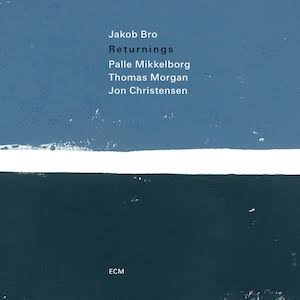

Jakob Bro — Returnings: The Quiet Art of Making Time Disappear

Jakob Bro — Returnings: The Quiet Art of Making Time Disappear

Four Musicians, Eight Pieces and the Space Between the Notes

When Silence Becomes Part of the Composition

There are jazz albums that establish their identity through velocity, harmonic density or the unmistakable force of a soloist taking control of a room. Returnings begins from almost the opposite assumption. The music created by Jakob Bro, Palle Mikkelborg, Thomas Morgan and Jon Christensen does not demand attention through volume or virtuoso display. It draws the listener inward by making every gesture consequential. A guitar chord appears and is allowed to remain in the air. A trumpet phrase arrives without insisting on resolution. The bass can suggest direction with a handful of notes, while the drums frequently refuse to provide the kind of pulse that would tell everyone exactly where the music is supposed to go. Silence is not an interruption between events. It is one of the materials from which the events are made.

Recorded at Oslo’s Rainbow Studio in July 2016 and released by ECM in March 2018, Returnings brought together four musicians from different generations whose histories already intersected in revealing ways. Bro had established an especially close musical relationship with bassist Thomas Morgan, while drummer Jon Christensen connected the guitarist to an older lineage of European improvisation. Trumpeter and flugelhornist Palle Mikkelborg added another dimension: a musician whose career extended across decades of Scandinavian jazz and whose lyrical, spacious conception made him unusually compatible with Bro’s compositions. Producer Manfred Eicher, whose work with ECM had helped define an entire approach to recorded improvised music, placed these voices inside a context where restraint did not mean absence of drama.

The result is frequently described as atmospheric, meditative or cinematic. All of those words contain some truth, but they can also make Returnings seem more passive than it is. Beneath its quiet surface lies constant negotiation. The musicians are listening intensely, deciding when to enter, when to withdraw, when to support an idea and when to destabilize it. What sounds like stillness is actually activity at a reduced scale.

That is the paradox at the heart of the album.

Returnings moves slowly, but it is never standing still.

Jakob Bro and the Refusal of the Guitar Hero

Bro’s path toward this music is significant because the guitar is an instrument burdened with expectations. Born in Denmark in 1978, he began on trumpet before turning to guitar after encountering Jimi Hendrix. His subsequent studies took him through Denmark’s Royal Academy of Music, Berklee in Boston and the New School in New York, but some of his most consequential education occurred outside the classroom. Before becoming an ECM leader, Bro worked with musicians including Paul Motian and Tomasz Stańko, appearing with Motian’s ensemble on Garden of Eden and with Stańko’s quintet on Dark Eyes.

Those associations matter because both leaders possessed highly individual relationships with space. Motian had spent decades dismantling assumptions about what jazz drums were required to do. Time could be implied rather than declared; texture could replace conventional accompaniment. Stańko similarly understood that a melodic line did not have to fill every available space in order to establish authority. His trumpet could seem more powerful because of what surrounded it.

Bro absorbed lessons from these environments without simply reproducing either musician.

His guitar language increasingly developed around patience. Effects and looping could expand the instrument’s presence, but technology was never the real subject. The essential quality was compositional: Bro understood how a small phrase might continue affecting the ensemble after he had stopped playing it.

This is a very different conception from the guitar hero tradition. Bro does not need to dominate Returnings simply because his name appears on the cover. In fact, one of the album’s defining qualities is how frequently leadership becomes difficult to identify.

The music belongs to whoever has the most meaningful idea at that particular moment.

The Meaning of “Returnings”

The album’s title is unusually precise. Returnings is filled with music coming back in altered forms: musicians reunited, compositions revisited, personal memories resurfacing and ideas from earlier stages of Bro’s career re-entering the present.

“Oktober,” which opens the album, had already appeared on Bro’s Gefion. “Lyskaster” also returns from that earlier recording. Jon Christensen, who played on Gefion, comes back into Bro’s immediate musical world after Joey Baron had occupied the drum chair on Streams. Palle Mikkelborg and Christensen themselves carry decades of shared European jazz history. Even individual compositions contain forms of recurrence: “Hamsun” reappears within the title track in another key, turning memory into part of the album’s structure.

Return, however, does not mean restoration.

Bro is not trying to recover a previous version of the music.

The point is transformation.

A composition changes because different musicians enter it. A melody heard years earlier acquires another emotional meaning. Relationships evolve. Memory itself becomes improvisational.

This gives the album a subtle conceptual coherence. Its pieces do not merely follow one another as separate performances. They seem to remember each other.

“Oktober”: Beginning With Something Already Known

Opening an album called Returnings with a previously recorded composition is more than a clever structural choice. “Oktober” immediately establishes the record’s central question: what happens when musicians return to familiar material without attempting to reproduce what happened before?

Manfred Eicher suggested revisiting the piece, and the new setting changes its emotional dimensions. Mikkelborg’s presence gives the melody another voice, while Christensen and Morgan refuse to reduce the composition to a fixed rhythmic architecture. Bro does not present the tune as an object that the quartet must preserve. It becomes a space through which the musicians move.

This is one of the most useful ways to understand Bro as a composer.

His compositions often establish conditions rather than dictate outcomes.

The melody matters enormously, but it does not necessarily determine every subsequent event. A tune can operate like a landscape: recognizable enough to give orientation, open enough for the musicians to choose different routes through it.

Thomas Morgan is essential to this process. Bro has spoken of Morgan’s remarkable ability to respond simultaneously to several musicians, supporting melody while engaging the improvised directions emerging around him. That quality is especially valuable in a group where the drums may deliberately avoid the expected rhythmic emphasis. Morgan does not merely anchor the ensemble. He connects its moving parts.

The distinction is important.

An anchor holds things in place.

Morgan allows them to move together.

Thomas Morgan and the Art of Listening

Morgan’s playing across Returnings demonstrates why minimal music requires enormous concentration. In a dense arrangement, individual decisions can disappear inside the collective sound. Here, almost every note remains exposed.

His role is rarely reducible to conventional bass accompaniment. Sometimes he clarifies Bro’s melody; elsewhere he responds to Christensen’s rhythmic suggestions or creates a counterline beneath Mikkelborg. The bass moves between structural and conversational functions so naturally that the distinction begins to disappear.

Bro described Morgan as a socially skilled musician, and the phrase captures something fundamental about improvisation. Great ensemble playing is not simply the simultaneous display of four individual talents. It involves understanding how one’s own decisions change the possibilities available to everyone else.

Morgan excels at that negotiation.

He can strengthen an idea without trapping it.

He can suggest direction without forcing arrival.

This quality had already made him a natural partner for Bro, and Returnings demonstrates how differently that partnership behaves when Christensen rather than Joey Baron occupies the drum chair. The identity of a trio or quartet is not determined by replacing one instrumental function with another equivalent player. Each musician changes the social structure of the ensemble.

With Christensen present, time itself becomes less predictable.

Morgan responds accordingly.

Jon Christensen and the Freedom Not to Keep Time

By the time Returnings was recorded, Jon Christensen had spent decades redefining the role of drums in European jazz. His work with musicians such as Jan Garbarek, Keith Jarrett, Terje Rypdal and many others had demonstrated that a drummer could create extraordinary momentum without relying on continuous conventional timekeeping.

On Returnings, this freedom becomes central to the quartet’s character.

Christensen frequently avoids the obvious rhythmic response. When another musician intensifies, he does not necessarily intensify in parallel. When a phrase seems to invite a clear accent, he may move elsewhere. Bro himself identified this quality as one of the things he found compelling: Mikkelborg might play a strong line while Christensen heads in another direction.

The effect is not disconnection.

It is independence.

Four musicians can remain part of the same composition without making identical decisions about its emotional trajectory.

This creates the floating sensation often associated with the album, but “floating” should not be mistaken for vagueness. Christensen’s playing requires acute awareness. He knows where the center is precisely because he is capable of moving around it without losing the ensemble.

The pulse remains possible even when it is not explicitly stated.

That possibility keeps the music alive.

Palle Mikkelborg: A Voice Bro Had Known Since Childhood

Mikkelborg enters Returnings carrying another kind of history. Bro had admired him since childhood, when Bro himself was still playing trumpet. Both musicians later lived in Copenhagen and crossed paths repeatedly, eventually discussing possible collaborations before deciding to concentrate on improvised music. Concerts with this quartet configuration in 2014 convinced Bro that the combination had further potential, and the relationship developed toward the recording session.

Mikkelborg is particularly important because his presence does not function as that of a featured celebrity placed in front of an established trio. His trumpet and flugelhorn become part of the album’s internal grammar.

The affinity with Bro is immediately understandable.

Both musicians value sustained melody.

Both understand the emotional force of restraint.

Both can make a single note feel larger by allowing space around it.

Yet their sounds remain distinct. Bro’s guitar can create halos around a phrase through repetition and effects, while Mikkelborg’s horn gives the music a human breath and physical vulnerability. When the two voices move together, they do not simply double one another. Their differences create depth.

The relationship also introduces another historical dimension. Mikkelborg had famously composed and produced Aura for Miles Davis, and the title composition of Returnings itself contains an indirect connection to that compositional thinking. Bro recalled that Mikkelborg developed material from letters associated with ECM and Manfred Eicher, in a manner related to techniques he had used when constructing Aura.

Past and present overlap again.

Another returning.

“Strands”: Music Without a Rush Toward Resolution

The second piece, “Strands,” illustrates the quartet’s ability to create tension without conventional dramatic architecture. Bro’s compositions often resist the expectation that every phrase must point toward a climax. Instead, the musicians establish a field of possibilities and allow small changes to alter its emotional character.

Mikkelborg’s horn is particularly effective in this environment. His phrases can appear almost detached from clock time, but Morgan and Christensen ensure that the music never loses internal motion. Bro surrounds the ensemble with guitar textures that can suggest both foreground and background, making it difficult at times to determine whether he is accompanying the trumpet or reshaping the space around it.

This ambiguity is one of Returnings’ strengths.

Traditional instrumental hierarchy becomes less useful.

There is no permanent foreground.

A sound emerges, becomes important and then recedes.

Another voice assumes weight.

The music continually redistributes attention.

Four Generations of Experience in One Room

Although the musicians come from different generations and national backgrounds, Returnings does not present their differences as a confrontation between old and new. Christensen and Mikkelborg are not there to represent European jazz history while Bro and Morgan represent its contemporary continuation.

The relationships are more fluid than that.

The younger musicians had already learned from traditions the older musicians helped establish, but Christensen and Mikkelborg remain improvisers rather than monuments. They respond in real time, capable of disrupting expectations as readily as anyone else.

This is crucial to the album’s vitality.

Jazz history becomes dangerous when musicians are reduced to symbols of their eras.

Returnings refuses that reduction.

Everyone in the room is present tense.

Quiet Music Is Not Passive Music

The album’s restraint can make it tempting to describe it primarily through images of landscapes, water, mist or Nordic stillness. Such metaphors have followed ECM recordings for decades, sometimes usefully and sometimes to the point of cliché.

Returnings deserves a more precise listening.

Its quietness is active.

Every musician is making decisions about density, duration and interruption. The absence of a note can alter the meaning of the next one. A rhythmic gesture from Christensen can redirect Morgan. Mikkelborg can introduce a phrase that changes the emotional color of Bro’s harmony.

Nothing needs to become loud for the stakes to increase.

This is not background music.

It is music that asks the listener to adjust the scale of attention.

Once that adjustment occurs, the album begins to reveal how much is happening inside what initially seemed like emptiness.

And as Returnings moves deeper into pieces such as “Song for Nicolai,” “View,” “Lyskaster” and “Hamsun,” that apparent emptiness becomes increasingly populated by memory: absent friends, fathers, literary influences, earlier recordings and musicians whose ideas continue to circulate long after the original moment has passed.

The silence is not empty at all.

It is carrying history.

Buy Amazon

jakob cd

Memory, Loss and the Music That Comes Back Changed

“Song for Nicolai”: When Restraint Becomes Grief

The third piece on Returnings, “Song for Nicolai,” changes the emotional meaning of everything that precedes it. Dedicated to Danish bassist Nicolai Munch-Hansen, who had died in 2017 at only thirty-nine, the composition turns the album’s spaciousness toward remembrance. Nothing about the performance requires the listener to know its dedication in order to feel its weight, but the knowledge changes how that weight is understood. The pauses no longer seem merely aesthetic. The reluctance to fill the musical space begins to suggest absence itself.

Bro does not construct an elaborate memorial. That would contradict the musical language of the album. Instead, the quartet allows the composition to unfold with extraordinary patience, and Palle Mikkelborg becomes particularly important. His horn does not announce grief theatrically. It carries it through fragility. Notes emerge carefully, as though each one has to justify breaking the silence around it.

Bro responds in the same spirit. His guitar does not surround Mikkelborg with decorative harmony or push the performance toward an obvious climax. He creates an environment in which the trumpet can exist. Thomas Morgan provides the connective tissue beneath them, while Jon Christensen avoids converting mourning into a predictable slow pulse.

The emotional force comes from refusal.

The quartet refuses to exaggerate.

That restraint gives “Song for Nicolai” unusual dignity. Music written after a death can easily become burdened by the expectation that it must communicate profound emotion. Bro avoids that problem by allowing the musicians to behave as they do elsewhere on the album: listening, waiting and making small decisions collectively.

The grief enters through the same language they were already speaking.

That makes it more convincing.

Memory Without Sentimentality

One of the central achievements of Returnings is its ability to address memory without becoming nostalgic. The album repeatedly looks backward, but it never suggests that the past was a perfect place that should somehow be recovered.

This distinction is fundamental.

Nostalgia attempts to restore.

Memory transforms.

When Bro returns to an earlier composition, the purpose is not to recreate its previous recording. When he remembers a musician, he does not attempt to reconstruct that person through sound. The past becomes material for a new present.

Jazz is particularly suited to this understanding of memory because improvisation makes exact restoration impossible. A musician can return to the same melody, the same musicians and even the same room, but the performance will still be different. Time has intervened. Everyone has changed.

Returnings makes that inevitability its subject.

The music comes back.

But it never comes back unchanged.

“View”: The Leader Disappears

The fourth track, “View,” belongs to Palle Mikkelborg, and its placement near the center of the album reinforces the collaborative character Bro wanted from the session. Rather than presenting himself as composer and guitarist surrounded by carefully selected interpreters, Bro allows another musician’s composition to become one of the record’s most expansive statements.

The performance begins with Morgan and Christensen.

That decision immediately destabilizes the expected hierarchy. On an album led by a guitarist and featuring a celebrated trumpeter, the longest track initially belongs to bass and drums. Bro and Mikkelborg introduce the theme only later, after the rhythm section has already established the piece’s internal world.

It is a revealing choice.

Morgan and Christensen do not behave like musicians waiting for the “real” melodic material to arrive. Their dialogue is the composition in motion. The eventual entrance of guitar and trumpet does not replace what came before. It adds another layer to something that already possesses direction.

Bro has described Returnings as so collaborative that any of its four musicians might reasonably be considered the leader.

“View” demonstrates what he means.

Leadership becomes temporary.

It moves around the quartet according to who currently has something worth saying.

Four Independent Voices

The idea of independence is essential to the album. In many ensemble settings, cohesion is achieved by agreement: musicians emphasize the same accents, build toward the same climax and respond to intensity with corresponding intensity.

Returnings frequently achieves cohesion through something closer to negotiated disagreement.

Christensen is central to this process. Bro admired the drummer’s tendency not to provide the stressed rhythmic response another player might expect. Mikkelborg can increase the force of a phrase while Christensen chooses another direction entirely. Morgan may simultaneously acknowledge both.

The musicians remain connected without becoming synchronized emotionally.

That is a sophisticated form of ensemble playing.

It requires confidence because nobody can depend on the others to validate every gesture immediately. A phrase can be left unanswered. A rhythmic idea can disappear. A melodic statement may encounter silence rather than accompaniment.

But silence itself becomes a response.

The quartet trusts the music enough not to explain every decision.

Jon Christensen and Paul Motian: Different Roads to Freedom

The freedom Christensen brings to Returnings inevitably invites comparison with Paul Motian, especially because both Bro and Morgan had worked with Motian and because his influence is explicitly present in the album.

The comparison is useful as long as it does not collapse two highly individual drummers into a single style of abstract timekeeping.

Motian possessed one of the most recognizable approaches to drums in modern jazz. Decades after his early work with Bill Evans and Scott LaFaro, he continued stripping away assumptions about accompaniment. A cymbal stroke might function more as punctuation than pulse. A drum could interrupt a phrase rather than reinforce it. Time existed, but Motian refused to behave as though the drummer alone was responsible for proving its existence.

Christensen arrived at freedom through his own history. His decades within European jazz, particularly the ECM world surrounding musicians such as Jan Garbarek and Keith Jarrett, developed another vocabulary in which rhythmic momentum could be powerful without becoming metrically obvious.

Bro had experienced both musicians directly.

That matters.

He did not encounter their ideas as historical concepts. He had stood on bandstands with them and felt how their decisions altered his own playing.

On Returnings, the memory of Motian and the presence of Christensen therefore create an extraordinary dialogue without requiring imitation.

One drummer is absent.

The other is fully present.

Both affect the music.

“Lyskaster”: A Melody for Bro’s Father

“Lyskaster” carries another layer of personal memory. Bro had recorded the composition previously on Gefion, where its melody was treated with even greater spaciousness. On Returnings, its return acquires a new meaning through Mikkelborg.

The piece is dedicated to Bro’s father.

His father had also been a trumpet player and admired Mikkelborg’s sound. That biographical detail transforms the new arrangement into something quietly profound. When Bro and Mikkelborg play the melody together, the trumpet is not merely another instrumental color chosen for an ECM quartet.

It carries association.

The sound itself contains memory.

There is no need for the musicians to dramatize that fact. Indeed, doing so would diminish it. The significance lies precisely in how naturally the personal history enters the performance.

A son writes music connected to his father.

Years later, he revisits it with a trumpeter his father admired.

The melody returns differently because life has changed around it.

Once again, the album title becomes literal.

What a Returning Really Means

By this point, Returnings has established several kinds of recurrence.

Compositions return from previous recordings.

Musical partnerships resume.

Christensen returns to Bro’s group.

Mikkelborg reconnects with Christensen.

Memories of Bro’s father enter “Lyskaster.”

Nicolai Munch-Hansen is remembered through “Song for Nicolai.”

Paul Motian remains present in the thinking surrounding “Hamsun.”

The album’s architecture is therefore built not simply around eight tracks but around overlapping timelines.

This is why the title is plural.

There is no single return.

Every musician brings something back.

“Hamsun”: Literature, Motian and an Older Composition

“Hamsun” may be the clearest example of the album’s layers of memory occupying the same piece. Bro dedicated the composition to Norwegian writer Knut Hamsun, whose books he began reading partly because Paul Motian had spoken about the author while the two musicians toured together.

The path is characteristic of artistic influence.

A drummer talks to a guitarist about a novelist.

The guitarist reads the novelist.

The experience eventually becomes part of a composition.

Years later, that composition enters another recording with a different drummer.

Influence travels through conversation as easily as through recordings.

Bro had originally written “Hamsun” with Kenny Wheeler in mind, adding yet another absent figure to the composition’s history. On Returnings, however, it initially appears in the intimate setting of guitar and bass.

Bro and Morgan do not need drums or trumpet to establish the piece’s atmosphere. Their long partnership gives the duet a conversational ease that makes the written melody feel almost inseparable from improvisation.

Then something remarkable happens later.

The theme returns.

A Melody Inside Another Composition

Material from “Hamsun” reappears in a different key within the title track.

This may be the album’s most elegant structural expression of its central idea.

A return is not a repetition.

The melody is recognizable, but its context has changed. What belonged to one composition enters another. Memory crosses the boundary between tracks.

The listener who recognizes the transformation experiences the album differently. Individual pieces stop feeling entirely self-contained. They become connected chambers inside a larger structure.

Bro does not announce this relationship dramatically.

It simply happens.

That subtlety is important because Returnings never behaves like a concept album trying to prove the cleverness of its concept. Its internal connections emerge from musical practice rather than theoretical design.

Themes return because musicians remember them.

People return because relationships continue.

Ideas return because they were never completely finished.

Knut Hamsun and the Complications of Artistic Memory

The reference to Knut Hamsun also introduces a more uncomfortable form of historical memory. Hamsun remains one of Norway’s most influential literary figures, particularly through novels such as Hunger and Mysteries, but his political history—including his notorious support for Nazi Germany—makes his legacy profoundly complicated.

Bro’s composition does not attempt to solve that contradiction, nor does instrumental music provide an obvious mechanism for doing so.

But the title reminds us that artistic memory is rarely clean.

The people and works that shape musicians do not always arrive without historical baggage. Influence can survive alongside moral discomfort. Admiration for a work does not necessarily resolve judgment of its creator.

That complexity belongs naturally within an album concerned with returning.

When we return to the past, we do not always find what we remembered.

Sometimes history has changed the meaning of the memory.

Thomas Morgan as the Album’s Invisible Architecture

Across these pieces, Morgan increasingly appears as the musician who makes the quartet’s freedom sustainable. His bass rarely calls attention to itself through conventional soloistic display, yet removing his role from the ensemble would change its entire architecture.

He listens horizontally.

Rather than relating only to Bro as leader or Christensen as rhythmic partner, Morgan appears aware of several conversations simultaneously. He can connect trumpet and guitar, respond to drums and still preserve the harmonic implications of the composition.

This makes him particularly suited to Bro’s music.

Bro leaves spaces.

Morgan understands that those spaces do not automatically need filling.

The ability not to play is often discussed romantically in jazz, but meaningful restraint requires as much judgment as activity. Silence only becomes powerful when the musician could have played something useful and deliberately chooses not to.

Morgan possesses that judgment.

So does the entire quartet.

ECM and the Aesthetics of Attention

It would be impossible to discuss Returnings without acknowledging its place within ECM, but the label’s identity can also become a critical shortcut. Describing a record as “ECM-like” sometimes substitutes atmosphere for analysis: spacious, Nordic, reflective, beautiful.

Returnings deserves better.

Its relationship with ECM is meaningful not because it conforms to a stereotype but because Manfred Eicher recognized the value of the musicians’ particular approach to time and ensemble balance. He even suggested the return of “Oktober,” helping strengthen the album’s underlying structure of recurrence.

The production does not create the quartet’s restraint.

It gives that restraint room to remain intact.

That distinction matters.

The silence belongs to the musicians before it belongs to the recording.

Memory as an Active Force

By the end of “Hamsun,” Returnings has revealed itself as something more emotionally complicated than the serene album its surface might suggest.

Death is present.

Family is present.

Former collaborators are present.

Literature is present.

Earlier recordings are present.

Decades of European jazz history are present through Mikkelborg and Christensen.

But none of these memories freeze the music.

They activate it.

That may be the album’s deepest idea.

The past does not sit behind the musicians like an archive.

It enters the improvisation.

Every returning becomes another opportunity to discover that what once existed cannot be recovered exactly—and that the difference between then and now is where new music begins.

The quartet does not play as though it wants time to stop.

It plays as though it understands that time never does.

Part III — The Music Returns, but Nothing Returns Unchanged

“Returnings”: The Album Finds Its Center

By the time the title track arrives, the logic of Returnings has already been established through several different forms of recurrence. Earlier compositions have reappeared in new settings. Personal memories have entered the music through dedications. Paul Motian remains present through conversations remembered by Jakob Bro, while Jon Christensen transforms the rhythmic environment through his physical presence. Palle Mikkelborg brings decades of Scandinavian jazz history into a quartet led by a guitarist who first admired him as a child. Thomas Morgan connects these timelines with a bass language built less around assertion than extraordinary responsiveness.

“Returnings” gathers those ideas without turning them into an obvious summary.

Credited jointly to Bro and Mikkelborg, the piece demonstrates how thoroughly the album has moved beyond the conventional distinction between composer, leader and sideman. Mikkelborg’s contribution to its melodic construction connects with a method he had used decades earlier when composing Aura for Miles Davis, deriving musical material from letters and names. Bro then develops that material within a musical world very different from the large-scale conception of Aura.

The connection is not a quotation.

It is another return.

A compositional idea developed in one period of Mikkelborg’s life enters another musician’s album decades later and acquires a completely different function. Jazz history appears not as a sequence of sealed eras but as a reservoir of procedures, relationships and memories that can re-enter the present whenever musicians find new uses for them.

This is precisely what Returnings has been doing from its opening notes.

Palle Mikkelborg and the Long Shadow of Aura

Mikkelborg’s relationship with Miles Davis occupies a singular place in European jazz history. After Davis received the Léonie Sonning Music Prize in Denmark in 1984, Mikkelborg composed Aura around him, creating a large-scale work that combined orchestration, electronic color and improvisation. Recorded in 1985 and released several years later, it became one of the most distinctive projects associated with Davis’s late career.

But Mikkelborg’s importance cannot be reduced to having worked with Miles Davis.

What matters on Returnings is how little he needs that history to establish authority.

There is no attempt to transform the quartet into a monument to his past. His trumpet and flugelhorn exist entirely inside Bro’s musical environment. The long melodic lines, controlled dynamics and remarkable patience fit so naturally that the generational difference between the musicians becomes almost irrelevant.

This is one of Bro’s achievements as a leader.

He does not invite history into the room so that it can be admired.

He invites musicians.

Mikkelborg responds by remaining an improviser in the present tense.

When Generations Stop Mattering

Jazz often organizes its history around generations. Musicians become representatives of particular movements, decades or scenes, and collaborations across age groups are consequently described as meetings between traditions.

Returnings makes that framework feel unnecessarily rigid.

Mikkelborg and Christensen carry histories extending deep into European jazz, while Bro and Morgan belong to later generations. Yet the music does not divide naturally into older musicians providing wisdom and younger musicians providing contemporary relevance.

Everyone listens.

Everyone adapts.

Everyone takes risks.

Christensen may be the elder statesman in chronological terms, but his rhythmic decisions can be the least predictable events in the performance. Morgan, younger than the other players, often becomes the stabilizing presence. Bro is the nominal leader yet repeatedly leaves the center. Mikkelborg possesses one of the most recognizable biographies in Scandinavian jazz but never uses reputation as musical weight.

The quartet works because status disappears when the improvisation begins.

Only attention remains.

Jon Christensen and a European Conception of Time

Christensen’s presence gives Returnings a particularly deep connection to the history of ECM and modern European jazz. Across decades of recordings with Keith Jarrett, Jan Garbarek, Terje Rypdal and many others, he helped establish a rhythmic vocabulary in which propulsion could exist without conventional swing patterns dominating the music.

This was not the abandonment of rhythm.

It was an expansion of what rhythm could do.

Christensen could imply a pulse, disrupt it, circle around it and suddenly make it unmistakable again. Cymbals became sources of movement rather than merely timekeeping devices. Drum sounds could function as independent events within the ensemble.

That conception fits Bro’s music exceptionally well because Bro similarly avoids telling the listener too much.

Both musicians trust implication.

When Christensen refuses an obvious accent, Bro does not need to compensate. When the drummer creates an unexpected burst of activity, the guitarist can allow it to pass without converting it into a collective climax.

The ensemble breathes because nobody is required to follow every gesture.

Freedom here does not mean everybody playing independently.

It means everybody remaining connected without becoming obedient.

“Youth”: Ending With an Open Door

The final composition, “Youth,” gives the album an appropriately ambiguous conclusion. After a record filled with remembrance, loss and musical histories returning in altered forms, the title points in the opposite temporal direction.

Youth suggests beginning.

Possibility.

Something not yet completed.

The placement matters. Returnings could easily have ended by reinforcing its retrospective dimension, leaving the listener with a final sense of memory. Instead, Bro closes with a word associated with what comes before experience rather than after it.

The gesture prevents the album from becoming an elegy.

Memory is important, but memory is not the destination.

The past feeds the next beginning.

This idea has always been central to jazz, even when discussions of tradition obscure it. Musicians learn languages developed by people who came before them, but the purpose is not perfect reproduction. A tradition survives only if somebody changes it.

Youth therefore becomes an ideal final statement for an album about return.

What comes back must eventually move forward.

Bro After Returnings

Within Jakob Bro’s ECM discography, Returnings occupies an especially revealing position. His earlier leader recordings for the label had already established his partnership with Thomas Morgan and demonstrated his preference for spacious compositions in which improvisational relationships mattered more than displays of instrumental dominance. The addition of Mikkelborg and the return of Christensen expanded that conception without destroying its intimacy.

What Returnings makes particularly clear is that Bro’s minimalism is not simply a matter of playing fewer notes.

It is an ensemble philosophy.

The compositions create enough identity to orient the musicians while leaving enough uncertainty for the performances to remain genuinely open. The guitarist does not fill space simply because he can. The bassist does not continuously define harmony. The drummer does not continuously declare meter. The trumpeter does not treat melody as an obligation to remain in the foreground.

Everyone accepts partial responsibility.

That distribution of responsibility is what allows the music to feel so spacious.

Beyond the Myth of “Nordic Jazz”

Bro’s nationality, the presence of Mikkelborg and Christensen, the Oslo recording location and the ECM label make Returnings easy to place beneath the broad heading of Nordic jazz.

The term can be useful.

It can also become a stereotype.

Descriptions of Scandinavian jazz often reach quickly for landscapes: fjords, snow, darkness, open skies, frozen lakes and northern light. Those images may provide evocative metaphors, but repeated too often they risk suggesting that musicians from Denmark or Norway naturally produce spacious music because they live near dramatic scenery.

Returnings has more concrete explanations.

Bro learned directly from Paul Motian and Tomasz Stańko.

Christensen spent decades developing an unconventional approach to rhythm.

Mikkelborg cultivated an extraordinarily patient melodic language across a long career.

Morgan became one of the most responsive bassists of his generation.

Manfred Eicher brought decades of experience producing improvised music.

The album sounds the way it does because of musicians and their histories.

Geography provides context.

It does not compose the music.

Silence Is Not a Sound Effect

The same precision is necessary when discussing silence.

Silence has become so closely associated with ECM’s critical mythology that it can sound almost like a production technique: record musicians in a reverberant room, leave enough empty space and the famous ECM atmosphere will appear.

Returnings demonstrates why that interpretation is inadequate.

Silence begins with musical decisions.

Bro chooses not to extend a phrase.

Morgan waits.

Christensen allows an expected beat to pass without emphasis.

Mikkelborg delays his entrance.

Those decisions create space before microphones capture it.

The studio can preserve the relationships among sounds, and a producer can encourage the musicians not to overcrowd them, but recording technology cannot manufacture meaningful restraint from musicians who do not possess it.

Silence matters on Returnings because the quartet knows what could have been played instead.

Absence has meaning only because presence was possible.

Why the Old Audiophile Reading Misses the Album

Recordings with wide dynamic contrasts and exposed instrumental textures often attract discussions centered on playback systems. In the case of Returnings, that kind of language can become particularly seductive because the music contains so much space. One can easily begin describing frequency ranges, stereo imaging, transient behavior, noise floors, cartridge performance, amplifier control or the ability of loudspeakers to reproduce the smallest details.

But none of those categories explains the album.

They describe what equipment does with a recording.

They do not describe what four musicians did together.

The quietness of Returnings is not valuable because it reveals electronic noise in a playback chain. It is valuable because the musicians use low density to alter the listener’s perception of time.

Christensen’s cymbals are not important because they test tweeter extension.

They are important because his placement of a single cymbal sound can change the rhythmic meaning of the phrase surrounding it.

Morgan’s bass is not a demonstration of low-frequency control.

It is the connective tissue of an ensemble whose members frequently refuse obvious structural roles.

Mikkelborg’s horn does not exist to reveal soundstage depth.

It carries melody, memory and breath.

And Bro’s guitar is not a diagnostic signal.

It is the compositional voice around which these relationships become possible.

Once those distinctions are restored, the album becomes far more interesting.

The Human Meaning of Detail

There is, however, a reason listeners become fascinated by the small details of Returnings.

The details matter.

The mistake is assuming that their significance is technical.

A breath before a trumpet entrance matters because it changes anticipation. A bass note allowed to decay matters because Morgan has chosen not to replace it immediately. A cymbal appearing unexpectedly matters because Christensen has reorganized the listener’s sense of pulse.

These are human details.

Their meaning comes from decisions.

That is why close listening remains essential even after the audiophile vocabulary is removed. In fact, the music demands more careful listening once equipment stops being the subject.

The question changes from “Can my system reproduce this?” to something much richer:

“Why did the musician choose to do this now?”

That question leads into the music rather than away from it.

The Last Recording With Jon Christensen

The historical weight of Returnings increased after its release. Jon Christensen died in February 2020, ending one of the most consequential careers in European jazz drumming.

For Bro, the relationship was personal as well as historical.

The drummer who had helped shape Gefion and returned for Returnings became another figure whose presence would subsequently exist through memory and recordings.

That fact gives the album title an unintended additional resonance.

Christensen can return now only through what was preserved.

But the music itself resists turning him into an elegiac figure. On Returnings, he remains unpredictable, alert and alive to every possibility in the room.

That is the more valuable memorial.

Not reverence.

Interaction.

An Album About What Remains

By its conclusion, Returnings has accumulated an extraordinary network of absences and presences.

Bro’s father.

Nicolai Munch-Hansen.

Paul Motian.

The memory of earlier compositions.

Mikkelborg’s long history.

Christensen’s decades inside European jazz.

Thomas Morgan’s continuing partnership with Bro.

Pieces heard before and heard differently now.

Yet the album never becomes overwhelmed by its own past.

That is because memory is treated as a creative force rather than a museum.

Nothing is preserved untouched.

Everything re-enters the present and changes.

The Quiet Art of Making Time Disappear

The title Returnings ultimately describes something fundamental about improvisation.

A musician plays a melody.

It disappears.

Another musician remembers part of it and answers.

The first idea returns differently.

A composition is recorded.

Years pass.

The musicians play it again.

It returns differently.

A person influences another musician.

The person dies.

The influence continues.

It returns differently.

This cycle occurs throughout jazz, but Bro makes it unusually visible because his music leaves enough space for us to notice the transformation.

That is the real meaning of the album’s quietness.

The quartet slows our attention until recurrence becomes audible.

Past and present stop behaving like separate territories. Bro, Mikkelborg, Morgan and Christensen inhabit both simultaneously, carrying memories into improvisations that can exist only once.

The music disappears as soon as it is played.

But something remains.

And eventually, in another phrase, another composition, another musician or another generation, it returns.

Never exactly as it was.

That is why it remains alive.