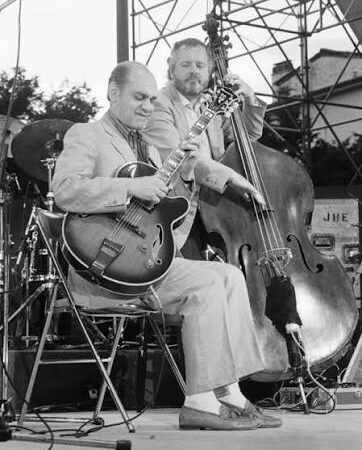
If you were to spend a rainy autumn evening in the late 1970s wandering through the cobblestone streets of Copenhagen, eventually seeking refuge inside a warm, dimly lit jazz club, you would be stepping into the epicenter of European acoustic sophistication. While the American jazz scene of that era was deeply entangled in the high-voltage electricity of jazz-rock fusion, synthesizers, and jazz-funk grooves, Europe remained a proud, sanctuary fortress for the pure, unadulterated acoustic instrument. A master cultural chronicler like Nelson Motta would instantly tell you that the most mesmerizing musical encounters do not require a wall of amplifiers, a bank of keyboards, or a thunderous rock drum kit. Sometimes, all that is needed to create absolute, spine-tingling artistic history is an acoustic archtop guitar, a beautifully carved wooden contrabaixo, and two absolute masters who possess a level of technical command that borders on the supernatural. In the chilly winter of 1978, the legendary American jazz guitarist Joe Pass met the titanic Danish double-bass virtuoso Niels-Henning Ørsted Pedersen—universally known as NHOP—in a small recording studio. Under the elegant, uncompromising supervision of producer Norman Granz for his iconic Pablo Records label, they recorded Chops. It remains, to this day, an unparalleled, gravity-defying masterpiece of acoustic dialogue.
Buy Amazon
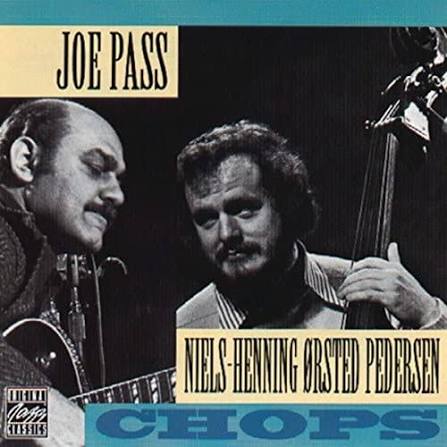
What Pass and NHOP achieved on Chops is a dazzling, hyper-sophisticated exhibition of musical telepathy that completely rewired the concept of a jazz duo. For decades, the double bass was relegated to a polite, rhythm-keeping role in the background, providing a steady walking line while the guitar or horn took center stage. But NHOP was a force of nature—a man who played the massive contrabaixo with the speed, fluidity, and lyrical melodic brilliance of a horn player. When his unmatched European precision collided with Joe Pass’s legendary, chordally rich, and flawlessly swinging American guitar style, the result was a magnificent explosion of acoustic architecture. It is a music defined by its breathtaking, high-speed velocity, yet anchored by a profound, aristocratic sense of taste and restraint. For high-fidelity audio collectors and serious enthusiasts, Chops has long been a legendary, fiercely demanding test disc. When the specialized audiophile label Analogue Productions selected this historical acoustic document for a premium AAA reissue, mastering it completely all-analog from the original master tapes and pressing it onto dead-silent 180-gram virgin vinyl, they handed the high-end community the ultimate reference tool for evaluating system transient response, woofer damping control, and soundstage focus.
The primary, most ruthless technical challenge that Chops throws down at the feet of your audio playback chain is the absolute, blistering speed of NHOP’s double bass plucks. On the dazzling opening track, a hyper-tempo interpretation of “Have You Met Miss Jones?”, NHOP unleashes a wave of sixteenth-note runs that move across the fingerboard with an astonishing, fluid velocity. This recording layout operates squarely in the critical lower-midrange and bass registers between 40 Hz and 200 Hz, presenting a notorious death trap for sluggish or poorly damped audio systems. If your power amplifier lacks a high damping factor to immediately stop your speaker’s woofer cones from vibrating between notes, or if your listening room suffers from standing waves, NHOP’s legendary fingerwork will instantly degenerate into an amorphous, boomy hum. A truly linear high-fidelity chain will articulate the crisp, physical snap of the string snapping against the wooden fingerboard, immediately followed by the hollow, deep woody resonance of the instrument’s large body, preserving the distinct pitch and separation of every single note in his lightning-fast runs.
As you allow the heavy vinyl to rotate and the stylus journeys deeper into the brilliant arrangement of “Oleo”, the precise spatial geometry of the studio opens up into an incredibly focused, intimate masterclass of stereo imaging. The mix is remarkably clean and symmetric: Joe Pass’s hollow-body acoustic archtop guitar is mixed predominantly into the left-center channel, while NHOP’s double bass commands the right-center channel. There are no drums or pianos to hide behind; the two instruments stand completely exposed in a deep, holographic space. This stark presentation requires an exceptional level of channel separation and low intermodulation distortion from your phono cartridge. If your cartridge’s azimuth is even slightly misaligned, Pass’s complex chord extensions will bleed across the soundstage into NHOP’s acoustic space, flattening a gorgeous, three-dimensional conversation into a flat, lifeless two-dimensional wall of sound. On a properly dialed-in audio system, the realism is uncanny—you can hear the exact physical height of the two instruments and the literal air moving between them.
Furthermore, this uncompressed AAA analog master puts a tremendous amount of stress on your system’s mid-bass transparency. On slow, deeply emotional tracks like the hauntingly beautiful reading of “Come Rain or Come Shine”, NHOP switches tactics, utilizing a bowing technique (arco) that coaxes a deep, growling, and intensely resonant texture from his contrabaixo. This bowed bass registration demands an audio system with absolute lower-midrange purity. Any structural cabinet coloration or room boominess will turn his emotional, singing bass tone into an overblown, muddy roar. A pristine high-end system with flat frequency response will capture the fine, microscopic friction of the horsehair bow dragging across the thick, tensioned strings, allowing the listener to perceive the emotional weight and the subtle, late-night melancholy that anchors his European interpretation of the great American songbook.
Meanwhile, the jaw-dropping guitar work of Joe Pass provides a rigorous, non-stop workout for your system’s transient rise time and upper-midrange harmonic resolution. On his jaw-dropping solo performance of “Mood Indigo”, Pass demonstrates his absolute mastery of chord-melody playing, simultaneously walking a bass line, strumming mid-range chords, and playing a fluid melody line on his acoustic Gibson archtop. The technical hurdle here is the management of these overlapping harmonic layers. The guitar strings are plucked with a pick that creates a sharp, immediate transient spike, followed by a warm, woody acoustic decay. Your system’s midrange drivers must possess extraordinary speed and minimal energy storage to prevent the sharp attack of the guitar pick from sounding thin, hard, or plasticky. On this Analogue Productions pressing, provided your playback chain has immaculate phase linearity, the guitar note blooms into the room with an organic warmth that feels completely detached from the physical boundaries of your speaker enclosures.
To truly appreciate the mastery of this reissue, your audio setup must also be capable of rendering low-level micro-dynamics with absolute fidelity. Throughout the record, as Pass and NHOP trade lightning-fast solos on tunes like “Yardbird Suite”, you can hear the faint, intimate sounds of the musicians breathing, the subtle slide of fingers across the guitar frets, and the mechanical vibration of the double bass strings vibrating against the wood. On a standard, mass-market audio setup, these low-level acoustic details are completely lost, swallowed up by system noise or modern digital compression. On this magnificent AAA pressing, however, provided your electronics have a vanishingly low noise floor, these human elements float gracefully within the mix, transforming a studio recording into a living, breathing performance taking place right before your eyes.
The true triumph of this legendary Norman Granz production is its sheer, unadulterated purity. In an era when studio engineers were becoming obsessed with multi-track overdubbing, artificial echo chambers, and complex mixing consoles, Granz chose to keep things beautifully simple. He set up two top-tier microphones, sat the two masters down facing each other, and hit record. On tracks like “A Child Is Born”, when NHOP plays a gentle, floating melody in the upper register of his bass and Pass responds with a sequence of delicate, whispered chords, you are hearing the pure acoustic truth of two instruments interacting in real-time. If your audio system introduces any time-alignment errors across its frequency bands, this delicate, telepathic balance will be completely destroyed, stripping the performance of its immense, poetic emotional impact.
To sit down in the sweet spot of your listening environment, dim the house lights, and absorb Chops from its initial, swinging salvo to its final, fading acoustic chord is to witness a masterclass in musical sophistication and acoustic engineering. It is an intense, deeply rewarding, and endlessly fascinating auditory journey. A legendary bohemian romantic like Nelson Motta would undoubtedly tell you that this record is the ultimate expression of sophisticated, late-night artistic luxury—a piece of pure, uncompromising musical gold best enjoyed in absolute stillness with a pour of old, rich tawny port, while the city outside goes to sleep and the mind drifts away on the breathtaking, woven lines of these two acoustic giants. The Analogue Productions team has executed a monumental archival service, treating NHOP and Joe Pass’s timeless acoustic duel with the absolute, unyielding reverence it commands. It is an indispensable, foundational cornerstone that will continuously challenge your audio system to achieve its absolute peak of speed, spatial clarity, and emotional truth.