

There are some musicians who use their instruments to slice through the air like a knife, and then there is Ben Webster. Known affectionately as “The Frog,” this towering titan of the swing era possessed a tenor saxophone sound that defied the very laws of physics. It was a dual personality: on up-tempo numbers, his horn roared with a ferocious, gravelly bite; but on ballads, he transformed into something entirely ethereal. He would back off the mic and unleash his signature “breath blow”—a technique where the literal sound of rushing air, the vibration of the cane reed, and the warm sigh of a human soul became more prominent than the musical note itself. In March 1964, just before he packed his bags to move permanently to Europe, Webster stepped into Rudy Van Gelder’s studio to lay down See You at the Fair for the progressive Impulse! label. It would stand as his final American recording session, a sublime valedictory address backed by an incredibly supple, tasteful rhythm section: Hank Jones on piano, Richard Davis on double bass, and Osie Johnson at the drum kit.
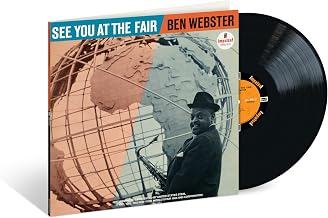
The session they committed to tape is a stunning exercise in pure, unhurried sonic intimacy—a record that feels less like a studio date and more like an autumn sunset slowly fading over a quiet harbor. For generations of high-end audio enthusiasts, reproducing the fragile, low-level micro-dynamics of Webster’s breath without losing it in a sea of tape hiss or masking it behind a thick wall of system distortion has been an incredibly difficult task. The ultimate validation arrived when Chad Kassem selected this rare gem for the premium Acoustic Sounds Series. Mastered meticulously all-analog (AAA) from the original master tapes by Ryan K. Smith at Sterling Sound and pressed onto dead-silent 180-gram vinyl at Quality Record Pressings (QRP), this reissue is a breathtaking, revelatory experience. It stands today as an absolute, top-tier reference disc for testing a high-fidelity system’s transparency, low-level signal resolution, and tweeter decay accuracy.
Buy Amazon
The foundational, uncompromising gauntlet that See You at the Fair lays down before your audio chain is the absolute purity of its midband transparency. Take the heartbreakingly beautiful rendition of “The Single Petal of a Rose”. On this track, Webster’s saxophone enters with a physical, spooky realism that places him squarely in the center of your listening room. The frequency balance here is an incredibly delicate test for any loudspeaker. If your system suffers from a slight midrange dip or cross-over misalignment between 1 kHz and 4 kHz, the literal textures of his performance will vanish. Ryan K. Smith’s brilliant, unmanipulated mastering allows you to hear the mechanical clicking of the saxophone keys, the wet vibration of the reed against the mouthpiece, and the immense column of air vibrating the brass body cavity. A truly linear system will not just play the notes; it will recreate the physical presence of a giant standing six feet away from you, pouring his final American memories into a Neumann U47 microphone.
As the needle effortlessly glides into the playful, swinging rhythm of the title track, “See You at the Fair”, the soundstage expands into a masterclass of 1960s spatial geometry. Here, Hank Jones’ pristine piano chords occupy a distinct, beautifully defined space in the left-center channel. Every single touch on the keys must be rendered with an immediate, lightning-fast transient leading edge, followed by a long, harmonically rich decay that reflects naturally off the studio’s cedar wood panels. The real audiophile torture test on this track is the separation of these piano overtones from the work of bassist Richard Davis. Davis plays with an incredibly nimble, articulate style, pulling deep, tuneful notes from his double bass that anchor the entire room. If your system’s amplifier lacks a high damping factor to control your woofers, Davis’s lower register—operating between 40 Hz and 90 Hz—will turn into a boomy, undefined mass of sound, instantly smothering the delicate, sparkling piano notes and collapsing the three-dimensional depth of the stage.
Meanwhile, the micro-dynamics of the high frequencies on this QRP pressing provide a ruthless evaluation of your system’s low-level resolution. Osie Johnson’s drum work on this session is a lesson in masterly restraint. He spends much of the album utilizing brushes, creating a faint, rhythmic whisper across the surface of his snare drum. On a lesser audio setup, this brushwork will completely blur, sounding like a generic tape hiss artifact or random background noise. But on this reference-grade vinyl, provided your system’s tweeters have a fast rise time and exceptional phase linearity, you can actually distinguish the individual metal strands of the brushes scraping against the textured drumhead. This delicate high-frequency layer floats perfectly over a black, utterly silent background, free from the distracting pre-echo or non-fill distortions that plague lesser pressings.
To sit down in the sweet spot, turn up the volume, and absorb See You at the Fair from its opening groove to the final, haunting decay of side B is to understand why the analog medium remains the ultimate portal to musical truth. This isn’t about clinical, sterile digits; it is about the physical preservation of human emotion frozen into a physical groove. A legendary chronicler like Nelson Motta would undoubtedly tell you that this record is a bittersweet, deeply personal farewell letter—a piece of pure, sophisticated bohemian luxury that demands a glass of single-malt scotch, a dark room, and a mind ready to drift away on a cloud of velvet sound. Acoustic Sounds and Ryan K. Smith have delivered an absolute archival masterpiece, treating Ben Webster’s immense legacy with the uncompromising reverence it commands. It is an indispensable cornerstone that will continuously challenge your high-fidelity audio system to reveal its deepest, truest capacities for emotional and spatial realism.