
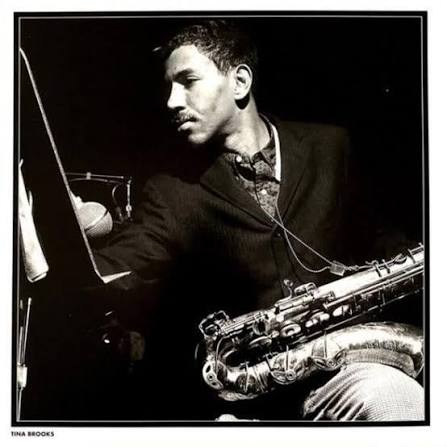
There is a particular category of jazz artist whose legacy feels less like a traditional career and more like a beautiful, heartbreaking ghost story haunting the catalog of Blue Note Records. In March 1961, an incredibly gifted tenor saxophonist named Harold “Tina” Brooks walked through the doors of Rudy Van Gelder’s studio in Englewood Cliffs to record The Waiting Game. Brooks was a musician of extraordinary depth—a player who didn’t just blow notes, but poured his entire, fragile soul into the horn, teetering beautifully between an infectious, deep-fried blues swing and a melancholic, searching lyricism. For this session, he assembled an absolute powerhouse lineup: Johnny Coles on trumpet, Kenny Drew on piano, Sam Jones on double bass, and the fierce Philly Joe Jones behind the drum kit. They recorded an absolute masterpiece of hard-bop literature, a session teeming with raw emotional honesty and intricate, compositionally brilliant arrangements.
Yet, in one of those devastating twists of fate that defined his tragic life, Alfred Lion decided to shelve the master tapes. The record was completely buried, left to sit in a dark, silent metal vault for over three decades before ever seeing the light of day. When Joe Harley and Kevin Gray marked this unissued gem for the premium Blue Note Tone Poet Series, they didn’t just unearth a fascinating historical artifact; they restored the vital, missing chapter of a jazz genius. Cut entirely all-analog (AAA) directly from the original master tapes at Cohearent Audio and pressed onto heavy, pristine 180-gram virgin vinyl at RTI, this reissue is an absolute revelation. It stands today as an essential reference disc for evaluating a high-end sound system’s ability to recreate the authentic “room sound” of Englewood Cliffs, its transient micro-dynamics, and the complex separation of overlapping horn lines.
Buy Amazon

The foundational challenge that The Waiting Game throws down at the feet of your playback chain is its stark, unflinching preservation of Van Gelder’s iconic studio acoustics. On the swinging opening track, “Talkin’ About”, the horns state the theme in a tight, punchy unison before Brooks steps out for the first solo. Brooks’ tenor saxophone enters with a holographic, upfront physical presence right in the center of the room. His tone is instantly recognizable: it is throaty, dense, and packed with a smoky, vocal-like texture rich in lower-midrange frequencies. If your loudspeakers suffer from cabinet coloration or an uneven frequency response between 200 Hz and 600 Hz, Brooks’ horn will sound lean, dry, and stripped of its visceral, chest-thumping authority. A truly linear audio system will reveal the physical weight of his horn, capturing the literal column of air moving through the brass bell and reflecting off the cedar wood walls of the studio.
As the needle glides into the deeply soulful, driving track “The Waiting Game”, the soundstage opens up into a masterclass of mid-century spatial geometry. Here, Johnny Coles’ trumpet occupies a beautifully distinct space just to the right of center. Coles was famous for his warm, lyrical tone and his usage of a Harmon mute, which creates a highly piercing, metallic high-frequency signature. Your system’s tweeters must possess incredible speed and phase linearity to render Coles’ solo without pushing into an aggressive, fatiguing glare. At the exact same time, Kenny Drew’s piano lays down rich, percussive chords in the left channel. Every hammer strike on the strings must be delivered with a clean, lightning-fast transient response, followed by a long, organic decay that gently dissolves into the dead-silent backgrounds of the RTI vinyl. If your playback chain lacks resolution, the trumpet’s sharp overtones will bleed across the stereo field, blurring the piano’s midrange and collapsing the three-dimensional depth of the room.
Meanwhile, the low frequencies on this Tone Poet edition provide a brutal, real-world test for your system’s bass control and amplifier damping factor. Sam Jones’ double bass is captured with its full, woody body resonance, walking the bassline with an infectious, driving authority. Right alongside him, the legendary Philly Joe Jones delivers a clinic in explosive, hard-bop drumming. Philly Joe was famous for his fiercely loud, crackling rimshots and his aggressive, driving ride cymbal work. On this all-analog pressing, Kevin Gray does not compress these sudden, massive peaks of energy. When Philly Joe drops a heavy accent on the snare or steps on his bass drum, the macro-dynamic jump requires your amplifier to deliver instantaneous current to your woofers. If your power supply is sluggish or your woofers are slow, the drums and bass will blur into a boomy, overwhelming mass of sound, completely burying the delicate percussive nuance of the ride cymbal floating in the right channel.
To sit down in the sweet spot, turn up the volume, and absorb The Waiting Game from start to finish is to experience the true magic of high-fidelity analog playback. It isn’t about clinical, digital analysis; it is about capturing the living, breathing soul of a human being frozen in time onto a physical piece of wax. A master chronicler like Nelson Motta would surely tell you that this record is a beautiful, late-night love letter to a forgotten era—a piece of pure, sophisticated bohemian luxury best enjoyed in a dimly lit room with a pour of old rye whiskey while the rest of the world sleeps. The Blue Note Tone Poet team has delivered a magnificent archival triumph, treating Tina Brooks’ tragic legacy with the absolute, uncompromising reverence it commands. It is an indispensable cornerstone that will continuously challenge your audio system to achieve its absolute highest potential of transparency, speed, and musical truth.