The Chronicle of an Era: The Late-Fifties Hi-Fi Golden Wave and Norman Granz’s Sonic Vanguard
By the arrival of 1957, the recording of classic American popular song had entered its absolute high-fidelity golden age. The development of advanced magnetic tape multi-tracking and the widespread implementation of specialized vacuum-tube studio gear allowed engineers to capture acoustic instruments with unparalleled physical realism and tonal warmth. At the absolute center of this technical revolution was producer Norman Granz, the visionary founder of Verve Records. Granz operated under a simple but uncompromising audiophile philosophy: strip away the unnecessary commercial pop orchestrations, gather the greatest improvisers in the world in a comfortable, open-room studio setting, and let the pure, uncompressed acoustic interactions between jazz masters dictate the shape of the soundstage.
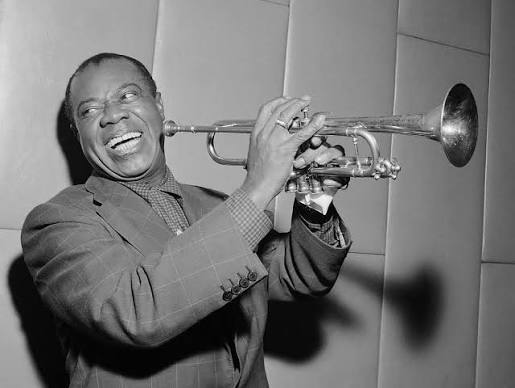
It was precisely within this climate of high-definition analog documentarianism, on October 14, 1957, that Louis Armstrong stepped into Capitol Studios in Hollywood. Having already fundamentally invented the foundational language of jazz phrasing and solo improvisation three decades prior, “Satchmo” was often relegated by mainstream media to the status of a commercial pop entertainer. Granz sought to dismantle this superficial view. By pairing Armstrong directly with the most precise, hard-driving, and harmonically sophisticated rhythm engine of the era—the Oscar Peterson Trio—Verve engineered an extraordinary, historic creative threshold. The resulting session did not just document timeless standards; it delivered an untouchable, reference-grade audiophile monument for mid-range vocal texture, organic acoustic bass weight, and pristine brass transients.
The Biography & The Concept of the Masterwork: Pop Majesty and the Telepathic Canadian Machine
The artistic trajectory of Louis Armstrong (1901–1971) stands as the literal spine of all twentieth-century Western popular music. Emerging from the brutal street bands of New Orleans to establish the primacy of the individual solo over collective ragtime improvisation, Armstrong possessed an innate, sub-atomic mastery of swing feel. By 1957, his trumpet chops had naturally moved past the volcanic, high-register acrobatics of his youth, settling into a mature, profoundly lyrical, and deeply selective approach to melody. His voice had evolved into a gravelly, deeply textured chest-instrument—a singular physical force capable of swinging a lyric with absolute authority while revealing immense, vulnerable human warmth beneath its rough exterior.
The core conceptual architecture of Louis Armstrong Meets Oscar Peterson represents a deliberate, beautifully executed study in structural contrast and mutual respect.
Rather than matching Armstrong with his usual New Orleans-style traditional jazz horn sections, Granz surrounded him exclusively with Oscar Peterson’s modern powerhouse.
Featuring Peterson on grand piano, the legendary Herb Ellis on hollow-body electric guitar, Ray Brown on upright acoustic bass, and the subtle, impeccably tasteful Louis Bellson on drums, the ensemble operated like a Swiss watch. Peterson, widely known as a sprawling, lightning-fast technical virtuoso, consciously dialed back his dense harmonic attack, providing instead a lean, swinging velvet carpet of blues-inflected chords. This forced a sublime musical conversation: Armstrong delivers a minimalist, deeply touching vocal or trumpet line, Peterson answers with an elegantly swinging filigree, and Ray Brown’s bass pulses below like a steady, warm human heartbeat.
The Anatomy of the Soundstage: A Sensorial Excursion Through Gravelly Chest Resonance, Wooden Bass Plucks, and Warm Brass Mutes
Buy Amazon
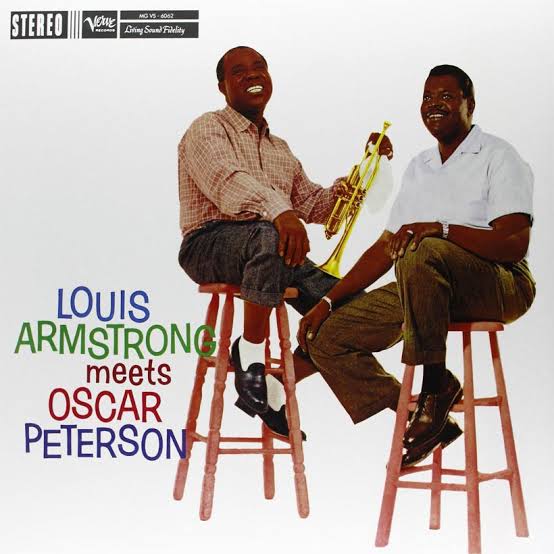
To experience an original 1957 Verve deep-groove monaural pressing—or a masterfully executed modern AAA audiophile vinyl reissue cut via an all-analog signal chain directly from the original magnetic master tapes—is to bear witness to a stunning masterclass in three-dimensional acoustic presence. The studio tracking, using top-tier large-diaphragm tube condenser microphones, captures the band arranged in a tight, natural semi-circle that completely detaches from the physical boundaries of your speakers. Side A opens with the immortal interpretation of “What’s New?”. The track materializes from a deep, velvety tape silence with Ray Brown’s acoustic bass positioning itself dead center, its low-frequency plucks carrying an immense, woody density where you can physically feel the heavy string vibrating against the wooden fingerboard.
The physical realism of Armstrong’s vocal projection is astonishing; the moment he sings the opening question, his unique, highly textured throat resonance is captured with uncompressed, grain-by-grain fidelity.
You can hear the subtle moisture on the microphone, the deep, rumbling chest air, and the precise, conversational timing of his lip movements.
As the record transitions into the jauntily swinging groove of “Sweet Lorraine”, the instrument separation and acoustic layout reach reference-grade clarity. Herb Ellis’s clean, hollow-body jazz guitar sits beautifully in the left-center spatial horizon, its warm, amplified tube tone blending seamlessly with the acoustic room ambiance.
When Armstrong lifts his golden trumpet to deliver a solo, the instrument cuts through the center of the soundstage with a round, warm, and blindingly authentic brass bite that is entirely free of modern digital glare or high-frequency harshness.
The mix preserves the natural, brief acoustic decay of the Hollywood studio space, allowing the natural ring of Peterson’s grand piano keys to bloom and fade organically, providing a visceral lesson in how analog engineering can capture the absolute pinnacle of sophisticated musical joy.
The Legacy and Modern Coordinates: The Unbending Blueprint for Sophisticated Simplicity
The historical, critical, and archival trajectory of Louis Armstrong Meets Oscar Peterson stands today as an untouchable, universally canonized milestone that rests at the very apex of the vocal jazz idiom. The album provided definitive, historical proof that Armstrong’s genius was entirely timeless—showing that he could step out of his traditional Dixieland environments and effortlessly command the sophisticated harmonic terrain of the modern cool-era standard. It remains a definitive monument of artistic restraint, proving that absolute emotional authority and minimalist melodic phrasing carry far more weight than complex harmonic clutter.
Today, the modern coordinates of Jazz Latitude look directly back to this 1957 Hollywood document as the essential, foundational textbook for the art of relaxed swing feel and small-group vocal accompaniment. From contemporary singers who strive to balance pop accessibility with deep improvisational credibility to the high-end audiophiles who use the demanding, hyper-textured mid-range of Armstrong’s voice and the deep, organic low-frequency extension of Ray Brown’s acoustic bass to tune the tonal balance and soundstage depth of premium tube amplifiers, everyone operates directly within the trade routes mapped out by Satchmo and Oscar. Louis Armstrong carved a permanent, brilliantly glowing coordinate of gold, wood, and pure human swing on our map: an eternal vanguard outpost that stands as an immortal monument to the infinite triumph of the generous musical soul.